Duck Creek Technologies: Products, Platform, and Guidewire Comparison
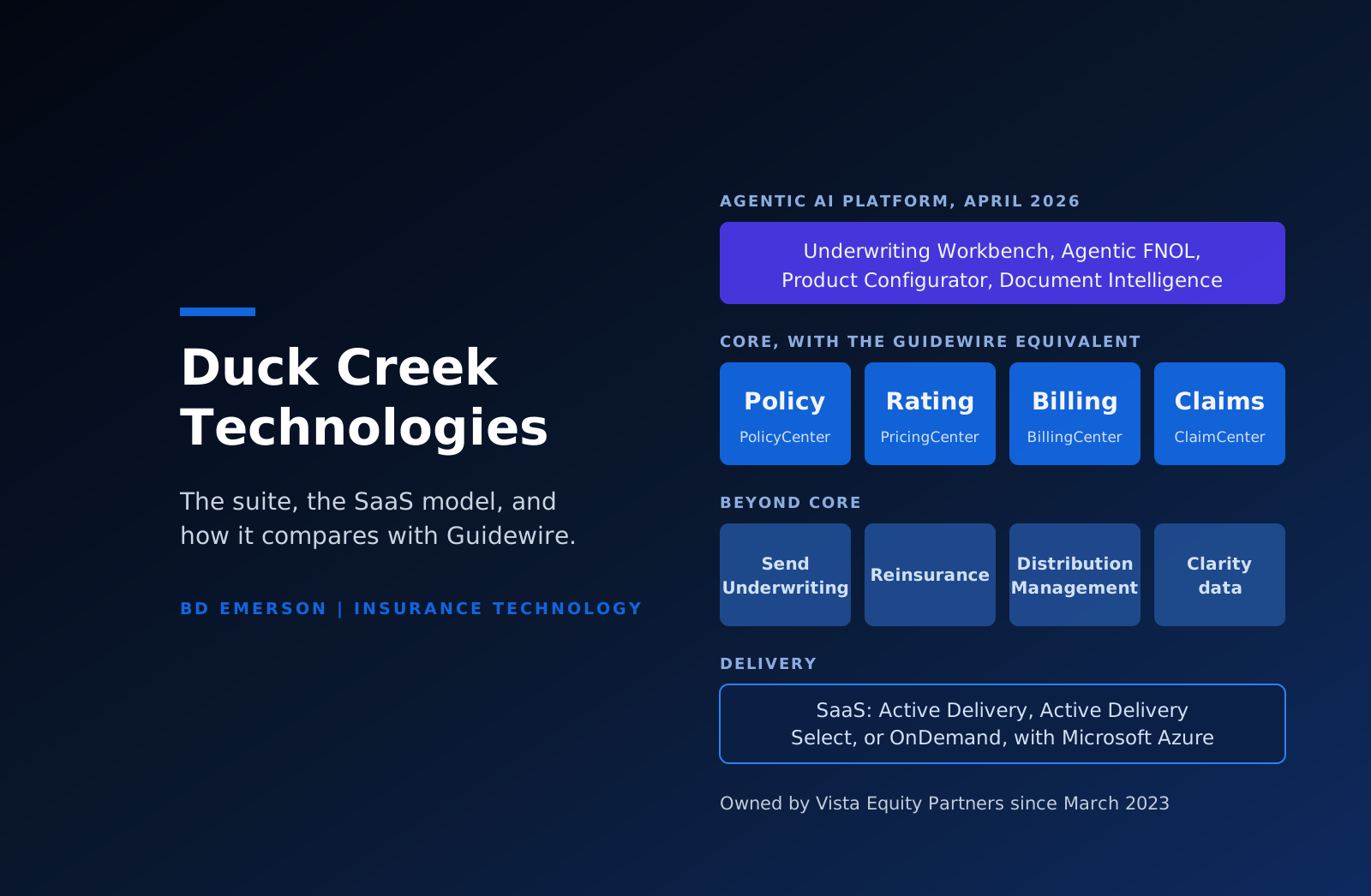
Duck Creek Technologies is a privately held software company that sells core systems to property and casualty (P&C) and general insurers: Duck Creek Policy for policy administration, Duck Creek Rating, Duck Creek Billing, and Duck Creek Claims, plus reinsurance, distribution management, payments, data, and agentic AI products around that core. Vista Equity Partners has owned Duck Creek since March 30, 2023, and Duck Creek delivers its products as software as a service (SaaS) through Duck Creek OnDemand, which it runs with Microsoft Azure. In April 2026, Duck Creek reported more than 370 customers and more than $150 billion of premium flowing through its platform each year.
We wrote this guide for carriers that have Duck Creek on a shortlist or run it today. We do not implement or resell Duck Creek, Guidewire, or any other core suite. Our insurance team includes people who helped lead a Guidewire implementation practice of thousands of professionals at a Big Four firm, and we help carriers compare suites with a custom agentic core on five-year numbers. Our guide to what Guidewire is covers the other half of that comparison.
Duck Creek Technologies at a glance
Duck Creek began in 2000 in Bolivar, Missouri, and today runs from Boston. The facts below change over time, so each carries a date.
| Item | Fact (as of October 2026) | Source |
|---|---|---|
| Founded | 2000, in Bolivar, Missouri | Accenture, July 2011 |
| Owner | Vista Equity Partners, since March 30, 2023 | Vista, March 2023 |
| Chief executive | Hardeep Gulati, named October 14, 2025 | Duck Creek, October 2025 |
| Customers | More than 370, including 33 of the top 50 North American insurers | Duck Creek, April 2026 |
| Fiscal 2026 (ended August 31, 2026) | Annual recurring revenue up 15 percent; net revenue retention of 111 percent | Duck Creek, September 2026 |
| Analyst position | A Leader in Gartner's 2026 Magic Quadrant for SaaS P&C core platforms in North America, for the eighth consecutive year | Duck Creek, September 2026 |
Duck Creek history: Accenture, the IPO, and Vista
Duck Creek has changed ownership four times since 2011. Accenture announced on July 14, 2011, that it would acquire Duck Creek, which then served more than 60 clients in North America and the United Kingdom, and it completed the purchase on August 23, 2011, adding about 370 Duck Creek employees. Accenture then merged Duck Creek with one of its in-house software businesses, the Boston Globe reported. Duck Creek began selling SaaS core systems in 2013 and signed its first SaaS customer in 2014, according to its fiscal 2020 Form 10-K.
On April 18, 2016, Accenture and Apax Partners announced a joint venture in which Apax-advised funds would take 60 percent of Duck Creek and Accenture would keep 40 percent, and Duck Creek dates its return to independence to August 2016. Duck Creek priced its initial public offering of 15 million shares at $27.00 on August 13, 2020, and its stock began trading on the Nasdaq Global Select Market under the symbol DCT the next day.
Vista Equity Partners agreed on January 9, 2023, to buy Duck Creek for $19.00 a share in cash, a deal valued at about $2.6 billion and a 46 percent premium to the January 6 closing price, and it completed the take-private on March 30, 2023. Mike Jackowski, chief executive since 2011, became vice chair in October 2025, when Hardeep Gulati, formerly chief executive of PowerSchool, took over. Duck Creek then launched its Agentic AI Platform on April 28, 2026, and on July 3, 2026, it acquired Send, a London underwriting software company founded in 2017.
Duck Creek products: what each module does
Duck Creek sells its products individually or as a full suite. The table lists the platform as Duck Creek's website and filings describe it in October 2026.
| Product | What it does | Public detail |
|---|---|---|
| Duck Creek Policy | Policy administration from quote to issuance, endorsement, renewal, cancellation, and rewrite | More than 140 products in production and 2,000+ APIs and extension points |
| Duck Creek Rating | Rate and pricing management controlled by the business | 45 days to go-live with predefined commercial products, per Duck Creek |
| Duck Creek Billing | Billing, invoicing, payments, collections, and commissions | Fiscal 2022 10-K |
| Duck Creek Claims | Claims from first notice of loss (FNOL) through assignment, reserves, payments, subrogation, fraud indicators, and closure | More than 30 million claims processed on OnDemand |
| Send Underwriting | Underwriting orchestration for commercial, specialty, and complex risks, from intake through post-bind work | Acquired July 2026 and still sold standalone |
| Duck Creek Reinsurance | Treaty, facultative, ceded, assumed, and retroceded programs in one system, with recoveries calculated from contract terms | QBE and Fortegra named on the product page |
| Distribution Management | Automates sales channel work for agents and brokers, including onboarding and commission plans | Encova went live on the upgraded version in March 2026 |
| Clarity Data Foundation | An insurance data model and governed data platform for reporting, business intelligence, and AI | Multi-entity, multi-currency reporting |
| Portals, payments, and loss control | Policyholder Portal, Producer Portal, Embedded Payments with a payments marketplace, and Loss Control for risk prevention | Grouped as Beyond Core products |
| Industry Content | Prebuilt rules, product designs, rating algorithms, screens, and workflows for lines such as commercial auto | 1,000+ bureau circulars processed a year, per Duck Creek |
| Agentic AI Platform | Model, orchestration, governance, and gateway layers for AI agents, plus agentic applications for underwriting, FNOL, product configuration, and documents | Launched April 28, 2026 |
The platform's AI Gateway supports the Model Context Protocol (MCP) and Agent2Agent (A2A), the standards a carrier's own agents would use to connect. Duck Creek launched Agentic FNOL on September 28, 2026, for early access customers, built with Google Cloud on Gemini models. Our insurance claims management system guide covers the claims side.
How Duck Creek OnDemand and Active Delivery work
Duck Creek runs its products for customers as SaaS. Its press releases still use OnDemand as the name for that service, while its Cloud Delivery page now names three delivery models, one of them OnDemand. Its security page says OnDemand runs with Microsoft's Azure cloud services, maintains an ISO 27001-certified information security management system, and undergoes annual SOC 1 Type II and SOC 2 Type II examinations.
| Model | How Duck Creek describes it | Who it is for, per Duck Creek |
|---|---|---|
| Active Delivery | A standardized cloud operating model with managed infrastructure and continuous updates | Carriers that want speed, simplicity, and out-of-the-box cloud delivery |
| Active Delivery Select | A flexible model for complex, highly extended, or enterprise-scale environments, with governed extensibility and managed services | Large carriers and migrating customers that need more control, isolation, or dedicated infrastructure |
| OnDemand | A transitional cloud landing zone for existing customers moving off on-premises environments | Migrating customers preparing for Active Delivery |
Active Delivery changes how upgrades work. When Duck Creek made Policy with Active Delivery generally available on August 5, 2024, it promised bi-weekly product updates applied automatically, each behind a feature flag that the insurer turns on when ready. The Reinsurance with Active Delivery release of April 8, 2026, describes monthly updates applied in the middle of each month. That release also says the reinsurance product is built on AWS, while Duck Creek's reinsurance product page says its products deploy on Microsoft's Azure cloud. We treat the difference as a contract question: confirm the cloud and region for every module and every AI service before you sign.
How Duck Creek configuration works
Duck Creek keeps configuration separate from platform code. Its fiscal 2022 Form 10-K says "the configuration layer is separated from our solutions and platform code," and it says technical and non-technical users tailor the products with low-code tools. Duck Creek Policy calls its approach Product Factory: business and IT teams model coverages, rules, and rating logic together, configure a product once, and reuse or inherit that definition when they launch the next one.
The configuration artifacts are called manuscripts. Duck Creek's Agentic Product Configurator, launched April 29, 2026, reads underwriting manuals, rating guides, and forms, then produces "implementation-ready manuscript configurations" for Duck Creek Policy, with human review at decision points. Duck Creek reports early results of up to a 50 percent cut in requirement and manuscript effort, and its product page lists the tool in Controlled Availability through Duck Creek Professional Services.
Partner integrations show the toolchain a carrier's developers need. Duck Creek's Content Exchange listing for its Snapsheet claims integration requires Microsoft Visual Studio and SQL to install. Duck Creek University certifies client and partner staff at Proficient and Master levels. In our view, the number of extensions a carrier carries outside the standard model decides a Duck Creek program, because heavy extension moves it from Active Delivery toward Active Delivery Select.
Who uses Duck Creek?
Duck Creek says it serves more than 370 customers, including 33 of the top 50 North American insurers, and Insurance Journal's July 2026 report on the Send deal describes Duck Creek as serving more than half of the top 20 global P&C carriers. Its 2023 closing release names Berkshire Hathaway Specialty Insurance, Hollard Insurance, Northbridge Financial Corporation, and Tokio Marine. The table lists recent customer announcements, plus one fast launch.
| Customer | What Duck Creek announced | Date |
|---|---|---|
| Capricorn Mutual, Australia and New Zealand | Went live on Policy, Rating, Billing, Claims, and Clarity on OnDemand, implemented with Aggne | July 2026 |
| Southern Trust Insurance Company, Georgia | Selected Embedded Payments and Policyholder Portal, adding to the Policy and Billing it runs on OnDemand | June 2026 |
| Encova Insurance | Went live on the upgraded Distribution Management | March 2026 |
| Fortegra | Selected Reinsurance and Clarity | March 2026 |
| Medical Assurance Society, New Zealand | Selected Policy, Rating, Claims, Billing, and Clarity, delivered on OnDemand | February 2026 |
| Millers Mutual Insurance, Pennsylvania | Selected Policy, Billing, Reinsurance, and Clarity on OnDemand | November 2025 |
| Argyle Insurance, Australia | Went live on Policy, Billing, and Rating in under 60 days, delivered by Coforge | May 2023 |
The announcements show two buying patterns: Capricorn Mutual and the Medical Assurance Society bought the full core, while Encova, Fortegra, and Southern Trust each added one or two modules. A carrier on another core that shortlists one module should first ask for a documented integration with its current policy and claims systems.
Duck Creek implementation: partners, timelines, and pricing
Systems integrators and Duck Creek's Professional Services run implementations. Its fiscal 2022 10-K counted 23 systems integrators with more than 6,000 Duck Creek implementation resources. Duck Creek's partner awards for 2024 and 2025 went to integrators including Accenture, Cognizant, Xceedance, LTIMindtree, Hexaware, Next Level Solutions, and Aggne, a Wipro company, and Coforge delivered Argyle's launch.
Public timelines come from Duck Creek and its customers, and they describe the fast end. The Cloud Delivery page says implementations of 3 to 6 months are possible, and Argyle Insurance rolled out its first product through Australian brokers on Policy, Billing, and Rating in under 60 days. Duck Creek's last 10-K gave no typical duration, while Guidewire's fiscal 2026 Form 10-K says implementation and testing of its products "typically lasts six to 24 months or longer." For an established carrier, we plan with the BD Emerson ranges below.
| Scenario | BD Emerson planning range | What moves it within the range |
|---|---|---|
| New carrier or MGA, one line on Duck Creek Industry Content | 3 to 9 months | Fit with bureau content, number of states, and data and payment integrations |
| One module beside an existing core, such as Clarity, Reinsurance, or Distribution Management | 4 to 9 months | Source systems feeding the module and their data quality |
| Policy, billing, and claims for an established carrier, two to four lines | 12 to 24 months | Lines, states, policies and open claims to convert, integrations, and parallel running |
| Enterprise program across many lines or countries on Active Delivery Select | 18 to 36 months | Extensions carried forward, multi-country setup, and organization change |
Duck Creek does not publish prices. Its last 10-K as a public company, for fiscal 2022, said it generally priced SaaS and license arrangements at individually negotiated rates based on the direct written premium (DWP) its solutions manage, "with pre-determined fee adjustments as the customer's DWP increases over the term of the contract." If a contract applied one flat rate to DWP, 8 percent annual premium growth would raise the year-five fee by 47 percent, because 1.08 to the fifth power is 1.47. Tiered rates soften that curve, so the tier table matters more than the year-one price, as our five-year business case for replacing Guidewire shows.
Duck Creek vs Guidewire: product scope and operating model
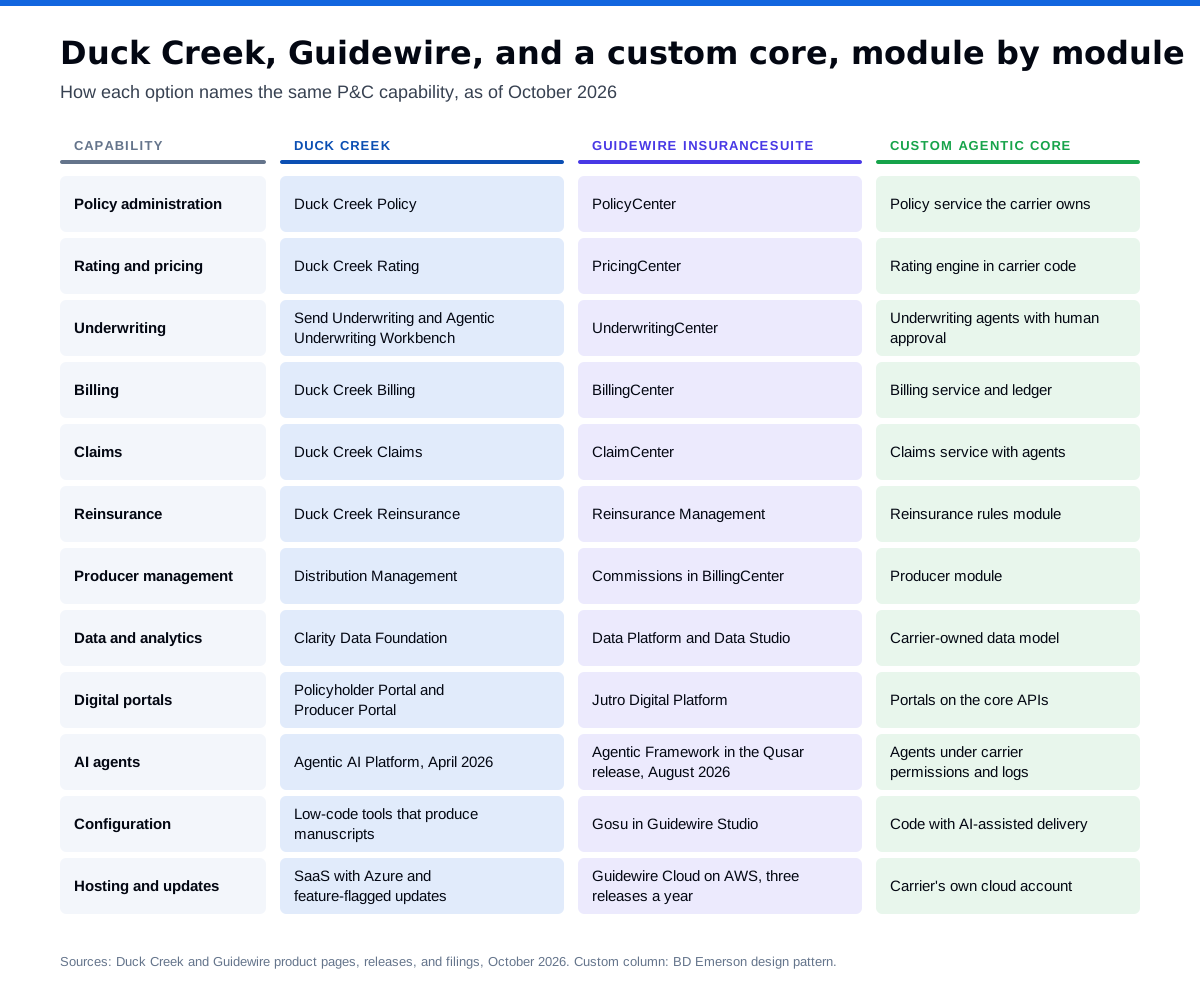
Duck Creek and Guidewire sell the same core and differ in how each suite is packaged, configured, and updated. Our Guidewire alternatives guide compares them on ownership and bureau content. The map below pairs the modules, and the table compares the operating model, both drawn from each vendor's filings and product pages as of October 2026.
| Area | Duck Creek | Guidewire InsuranceSuite |
|---|---|---|
| Product scope | Policy, Rating, Billing, Claims, Send Underwriting, Reinsurance, Distribution Management, Clarity, portals, payments, and loss control | PolicyCenter, PricingCenter, UnderwritingCenter, BillingCenter, and ClaimCenter, plus Reinsurance Management, data and analytics products, and the Jutro Digital Platform |
| Deployment | SaaS on Active Delivery, Active Delivery Select, or OnDemand, with Microsoft Azure | Guidewire Cloud on AWS, plus self-managed InsuranceSuite under term licenses |
| Updates | Bi-weekly (Policy, 2024) or monthly (Reinsurance, 2026), behind feature flags | Three named Guidewire Cloud releases a year |
| Configuration | Low-code tools that produce manuscripts; Visual Studio and SQL for partner integrations | Gosu, a statically typed language on the Java Virtual Machine, in Guidewire Studio |
| AI agents | Agentic AI Platform, April 2026; Agentic FNOL in early access | Agentic Framework in the Qusar release, August 2026; Agentic FNOL in Early Access |
| Claims | Duck Creek Claims, rated a Luminary by Celent in 2026 | ClaimCenter, 270+ customers in 30+ countries, with Canvas and Compare included |
| Partner bench | 23 integrators with 6,000+ resources (fiscal 2022 10-K) | 30,000+ trained partner professionals |
| Customer base | More than 370 customers, including 33 of the top 50 North American insurers (April 2026) | About 550 customers in 44 countries (fiscal 2026 10-K) |
| Pricing basis | Negotiated and based on DWP, with fee steps as DWP grows (fiscal 2022 10-K) | Based on DWP; initial terms generally five years (fiscal 2026 10-K) |
The suites line up module for module, so the choice rarely turns on whether a capability exists. In our view, three operating differences decide it: how often updates reach production, which skills your team and integrator hold, and how each contract prices premium growth, since both companies describe DWP-based fees in their 10-Ks. A move from either suite to the other is a full core replacement, with conversion, parallel running, and retraining.
When Duck Creek fits, and when to look elsewhere
Duck Creek fits carriers that want a full P&C suite run as SaaS, accept a standardized operating model in exchange for continuous updates, and work comfortably in a Microsoft environment. It also fits carriers that want one module, such as Reinsurance or Clarity, and multi-country insurers in the markets Duck Creek supports today, which include North America, the United Kingdom and Ireland, India, Australia, and New Zealand, according to its June 2026 platform announcement.
Look at another suite when your requirements fall outside that footprint, for example when you want life and annuity administration from the same vendor, which Sapiens and Majesco both sell. Look at a custom agentic core when your products are where you compete, premium growth keeps raising a DWP-based fee, and you want AI agents to act on policy, billing, and claims data under permissions and logs your team controls. Recent Andersen Consulting insurance work includes platforms that enabled the launch of two new insurance companies in less than a year each, and our policy administration system practice scopes that option against the suites.
What to ask in a Duck Creek evaluation
These seven questions surface the cost and risk that demos skip.
- Which delivery model, Active Delivery, Active Delivery Select, or OnDemand, will each module run on, and what does moving between models cost?
- Which cloud and region host each module you are buying, including Reinsurance and each agentic application, and which model provider processes your data?
- How long can a feature flag stay off, and what regression testing does Duck Creek run against your configuration before each update?
- What are the DWP tiers and fee adjustments for each year of the term, at today's premium and at plan premium?
- Which of your products and states does Industry Content cover today, and who loads each bureau circular?
- Which integrator will staff the program, how many Master-certified people will it name in the contract, and who maintains your manuscripts after go-live?
- Which agentic applications are generally available, and can your own agents read and write core data through the AI Gateway?
Frequently asked questions
What does Duck Creek Technologies do? Duck Creek Technologies sells core software to P&C and general insurers: Duck Creek Policy for policy administration, Duck Creek Rating, Duck Creek Billing, and Duck Creek Claims, plus reinsurance, distribution management, payments, data, and agentic AI products. In April 2026 it reported more than 370 customers and more than $150 billion of premium on its platform each year.
Who owns Duck Creek Technologies? Vista Equity Partners owns Duck Creek. Vista agreed on January 9, 2023, to buy the company for $19.00 a share in cash, about $2.6 billion, and completed the acquisition on March 30, 2023, when Duck Creek's shares left Nasdaq. Accenture owned Duck Creek from 2011, and Apax-advised funds took a 60 percent stake in 2016.
Is Duck Creek a public company? No. Duck Creek was public from its August 2020 initial public offering on the Nasdaq Global Select Market, under the symbol DCT, until Vista Equity Partners took it private on March 30, 2023. Its fiscal 2022 Form 10-K is the last audited public description of its business and pricing basis.
What is Duck Creek OnDemand? Duck Creek OnDemand is the name Duck Creek uses for its SaaS service, which it runs with Microsoft Azure. Its Cloud Delivery page now lists three models: Active Delivery, with continuous feature-flagged updates; Active Delivery Select, for complex or highly extended environments; and OnDemand, a transitional landing zone for customers moving off on-premises systems.
How long does a Duck Creek implementation take? Duck Creek says 3 to 6 months is possible on its cloud, and Argyle Insurance went live on Policy, Billing, and Rating in under 60 days, both fast, greenfield cases. Our planning range for an established carrier replacing policy, billing, and claims across two to four lines is 12 to 24 months, driven by lines, states, data conversion, and integrations.
How is Duck Creek software priced? Duck Creek does not publish prices. Its fiscal 2022 Form 10-K said it priced SaaS and license arrangements at individually negotiated rates based on the direct written premium its solutions manage, with predetermined fee adjustments as that premium grows. Ask for the fee tiers in writing and model the fee at today's premium and at plan premium.
If Duck Creek is on your shortlist, or your current core contract renews inside three years, our core replacement team will build the five-year comparison of Duck Creek, your current platform, and a custom agentic core, and prototype one of your products on the new core before you commit.

About the author