

Dental Practice Acquisition: The Due Diligence That Protects the Deal
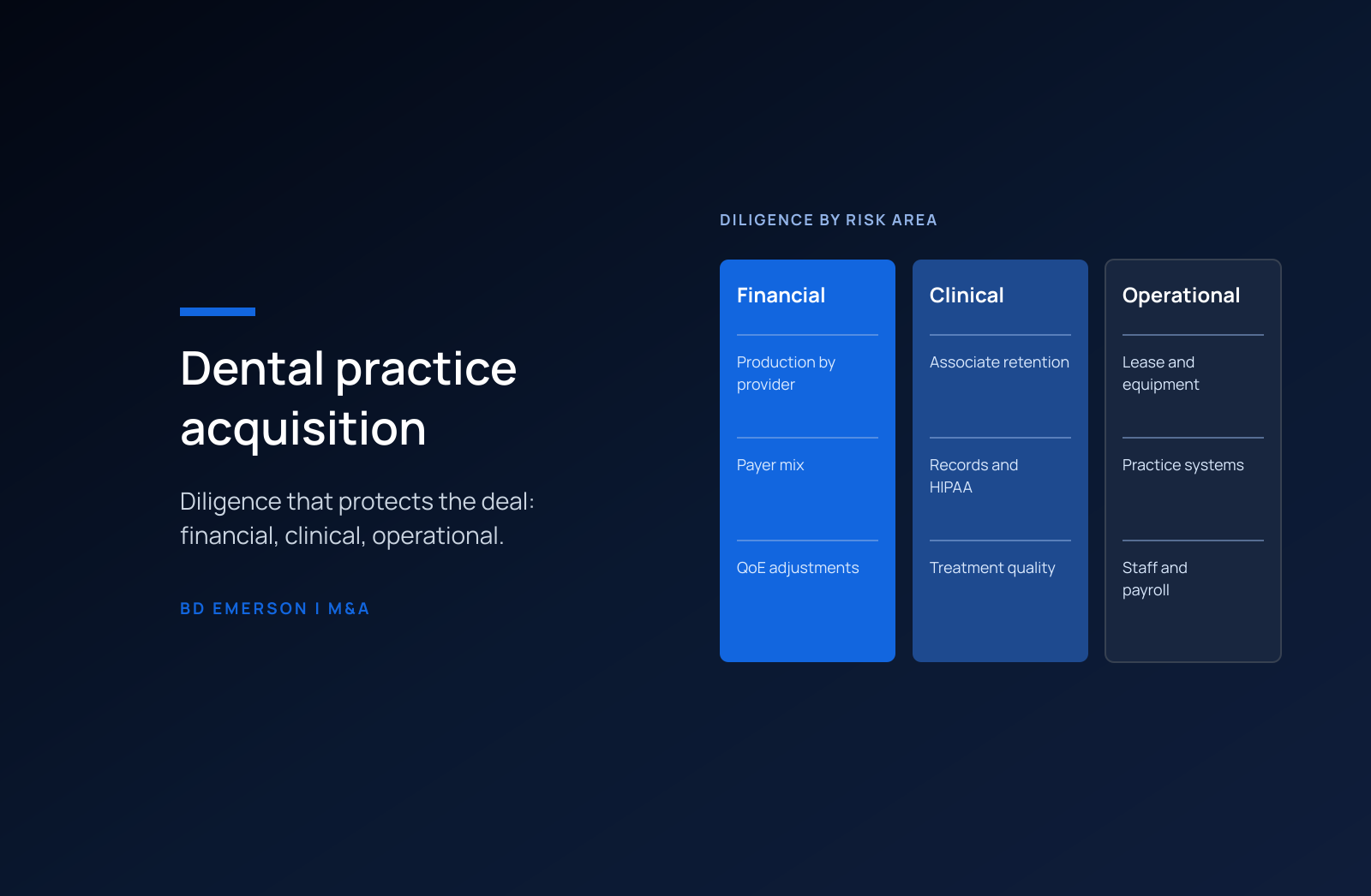
Due diligence for a dental practice acquisition should answer four questions before anyone signs: whether earnings hold up once the owner's compensation and one-time items are normalized, whether production depends on a dentist who may leave, whether payer contracts and patient records transfer cleanly, and whether the lease and equipment support the plan. A dental support organization adding a practice has three more questions to answer: how quickly each dentist can be credentialed with the practice's PPO plans, how the practice management system will be converted, and how associates and hygienists will be kept through the transition. Deals that disappoint usually fail on one of those points, and each one can be tested before closing.
What makes dental practice acquisitions different?
Most dental practices are small, owner-operated businesses in which the selling dentist is also the largest producer. That makes the buyer's central risk a people risk: much of what the buyer pays for is the patient relationships of one or two clinicians, and those relationships do not transfer by contract. The buyer is also often a dental support organization (DSO). According to the ADA Health Policy Institute, more than one in four dentists within ten years of graduating were affiliated with a DSO in 2024, and HPI counts a practice as affiliated when an outside entity manages some or all of its nonclinical functions, such as billing, marketing, and human resources.
Ownership rules shape the structure. Many states limit who may own a dental practice or direct clinical decisions, so DSO transactions typically separate a clinical entity owned by a licensed dentist from a management company that provides nonclinical services under a management services agreement. Diligence has to cover both entities and the agreement that connects them, because that agreement determines where the economics flow and whether the arrangement satisfies the state dental board.
Financial diligence: production, collections, and quality of earnings
Start with production by provider, split between dentists and hygienists, and then reconcile production to collections. A practice that books high production but collects a falling share of it is writing off more each year, often because its PPO fee schedules lag its standard fees or because claims are denied and never reworked. The quality of earnings work then normalizes the owner's pay to what an associate dentist would cost, removes personal expenses run through the practice, and separates one-time items from the recurring base.
| Diligence area | What to request | What should worry a buyer |
|---|---|---|
| Production by provider | Monthly production by dentist and hygienist for at least 24 months | The selling dentist produces most of the revenue and has no transition commitment |
| Collections and adjustments | Collections, write-offs, and adjustments by payer | A collection ratio that falls year over year, or large write-offs concentrated in one plan |
| Payer mix | Revenue by fee-for-service, each PPO, and Medicaid or CHIP | Heavy dependence on one plan whose fee schedule or network status could change |
| Owner compensation | Owner draws, benefits, and personal expenses paid by the practice | Add-backs that cannot be traced to records, or an owner salary below market |
| Accounts receivable | Aging by patient and insurer, plus patient credit balances | Old insurance receivables and credit balances that are refund liabilities the buyer inherits |
| Active patients | Patient counts by last visit date and new patients per month | Active patient counts based on an unstated or very long lookback window |
Define every metric before comparing practices. Sellers and brokers measure active patients over different lookback periods, often 12 to 24 months, and the definition can change the count by a large margin. Ask for the raw visit data and apply your own definition.
Clinical and provider risk
The transition agreement with the selling dentist is the most important document after the purchase agreement. It should state how long the seller will practice after closing, at what schedule, and how patients will be introduced to the incoming dentists. Pair it with a review of associate and hygienist employment agreements, because those people will treat most of the patients once the seller steps back.
Restrictive covenants need state-by-state review. The Federal Trade Commission moved on September 5, 2025 to dismiss its appeals and accept the vacatur of its Non-Compete Clause Rule after a district court held that the agency lacked authority to issue it. Whether a seller's or associate's noncompete holds therefore depends on state law, which treats covenants tied to the sale of a business differently from covenants in employment agreements. Have counsel confirm both before you price the deal on the assumption that patients stay.
A sample chart audit belongs in clinical diligence. Reviewing a set of charts against the codes billed tests documentation quality and spots patterns, such as frequent periodontal scaling claims, that could draw payer audits and recoupment demands after closing.
Patient records, HIPAA, and compliance
Sellers sometimes hesitate to share patient data during diligence. HIPAA addresses this directly: the definition of health care operations in 45 CFR 164.501 includes the sale, transfer, merger, or consolidation of all or part of a covered entity with another covered entity, and due diligence related to that activity. That permits the disclosure, but it does not suspend the minimum necessary standard, so share de-identified or summary data first and full records only when the buyer needs them.
The buyer should also review the seller's HIPAA risk analysis, any past breaches, and the business associate agreements with vendors such as the cloud practice management system, imaging software, and the IT support provider. Small practices are frequent ransomware targets, and a buyer that inherits weak backups or a shared administrator password inherits the incident that follows. In an asset deal, agree in writing who will hold the patient records after closing and how the selling dentist can reach them to meet state retention requirements.
Technology diligence for a dental practice is short but specific. Find out who administers the network and holds the administrator credentials, whether backups are kept offline and restored in a test at least once, whether imaging workstations run operating systems that no longer receive security updates, and whether email and the practice management system require multifactor authentication. Each answer feeds the integration budget, because closing the gaps usually means new hardware, a managed security service, or both, and those costs belong in the model before the price is set.
Lease, equipment, and deal structure
Most single-practice acquisitions are asset purchases, and goodwill is usually the largest asset. Both sides report how the price is allocated: IRS Form 8594 must be filed by the seller and the purchaser of a group of assets that makes up a trade or business when goodwill or going concern value attaches to those assets. Agree on the allocation in the purchase agreement, because it changes taxes for both parties.
The lease can block a deal that works on paper. Confirm that the landlord will consent to assignment, that the remaining term and renewal options cover the buyer's holding period, and that relocation or demolition clauses do not let the landlord move the practice. For equipment, list each operatory's chairs, delivery units, and imaging devices with their age and service history, and build a replacement schedule into the model so the first two years of capital spending are not a surprise.
Integration risks after closing
Credentialing is the integration step buyers underestimate most. If the transaction changes the billing entity or tax identification number, each dentist may need to be credentialed with each PPO under the new entity, and claims filed before approval can be delayed or paid out of network. Start applications as soon as the purchase agreement is signed. As a BD Emerson planning range, allow 60 to 120 days for credentialing to complete, and model the cash impact of the low end and the high end.
The practice management system conversion comes next. Moving to the DSO's standard system means converting patient ledgers, treatment plans, periodontal charts, insurance information, and imaging, and the ledger balances should reconcile to the cent before the old system is retired. Keep the old system available in read-only mode for audits and refunds.
People decide whether the practice keeps its patients. Meet associates, hygienists, and front desk staff before closing, settle pay and benefits early, and tell patients about the change in a letter from the selling dentist. Our healthcare M&A due diligence guide covers the regulatory and integration issues that dental deals share with other provider acquisitions.
BD Emerson performs financial, quality of earnings, operational, technology, and cybersecurity due diligence for buyers of dental practices and for DSO platforms adding practices, and we plan the integration that follows. Our M&A due diligence services page describes how those engagements are scoped.

About the author













