Rollover Equity: How Sellers Keep a Stake in a Private Equity Deal
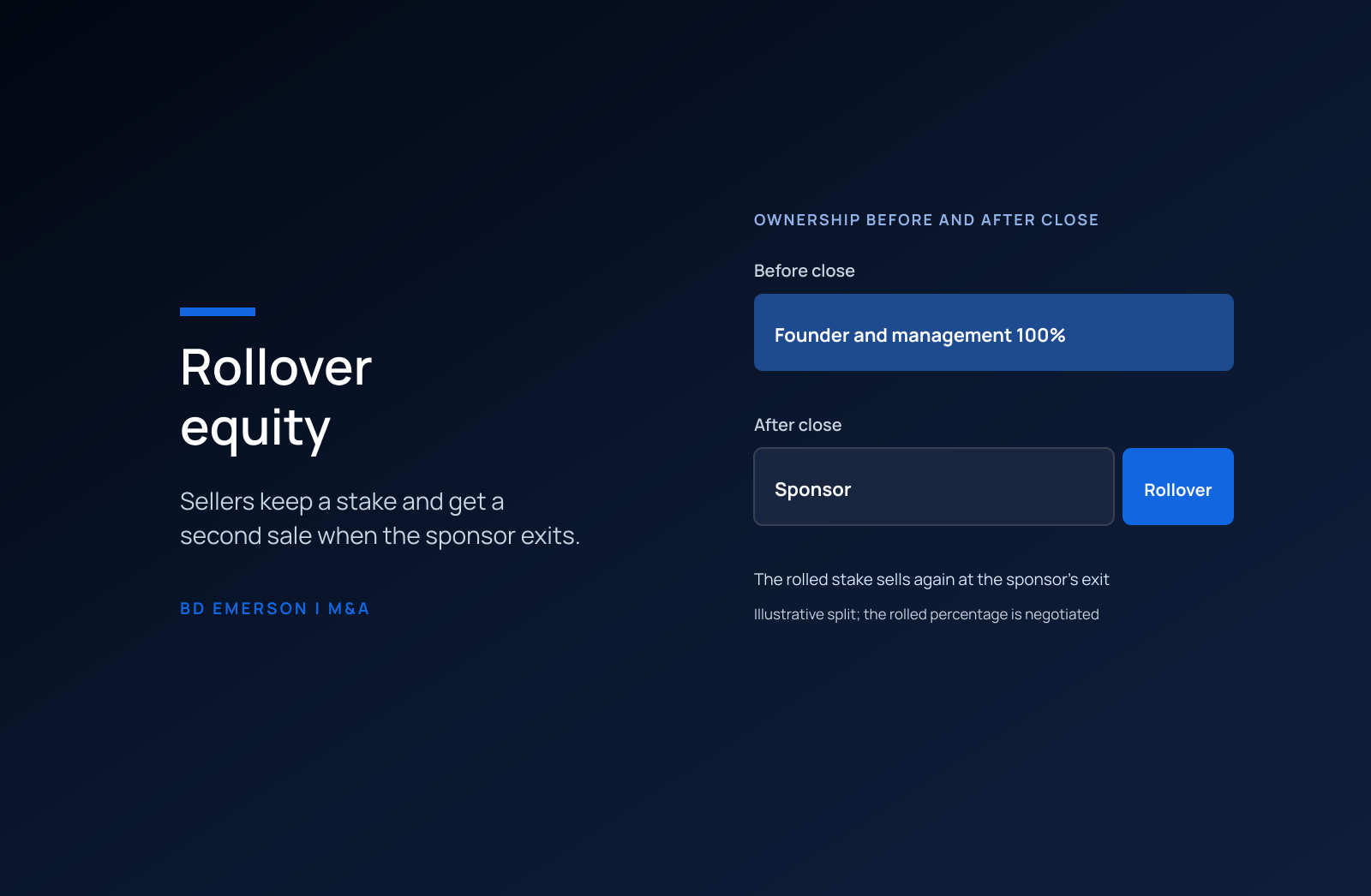
Rollover equity is the part of a sale price a seller reinvests in the buyer's acquisition company instead of taking it in cash at closing. In a private equity deal, the founder or management team rolls a minority stake into the sponsor's holding company, keeps a share of the upside when the sponsor sells again, and can often defer tax on the rolled portion if the structure qualifies. As a BD Emerson planning range, sellers in middle-market sponsor deals commonly roll 10 to 30 percent of their proceeds, and the number moves with the sponsor's equity check, the seller's role after closing, and the gap between the two sides on price. The rolled stake is only as good as the terms it sits under, so a seller should examine the buyer as closely as the buyer examines the business.
How does rollover equity work?
The sponsor usually forms a holding company, often called topco, which owns an acquisition subsidiary that buys the target. At closing, the seller receives cash for most of its equity and contributes the rest to topco in exchange for topco units or shares. The seller ends up owning a slice of the new parent alongside the sponsor's fund, and the sponsor's lenders lend to the acquisition subsidiary below it.
Consider a hypothetical deal. A sponsor buys a company for $100 million, funded with $50 million of debt and $50 million of equity. The founder rolls $10 million of proceeds and takes the remaining $90 million in cash, so the sponsor's fund contributes $40 million and the founder owns 20 percent of topco. The founder has sold the company and still holds a fifth of its equity, now with $50 million of debt ahead of it.
That last point matters more than the headline percentage. Before the sale, the founder owned an unlevered business. After the sale, the rolled stake sits behind acquisition debt, any preferred equity the sponsor holds, and any fees the sponsor charges the company. Debt magnifies gains if the plan works and losses if it does not.
How much equity do sellers roll, and why?
Sponsors ask for rollover for three reasons. It aligns a founder or management team that will keep running the company, it reduces the cash the fund has to commit, and it signals that the seller believes the price. Sellers accept it to keep upside, to defer tax on part of the proceeds, and sometimes to close a valuation gap, since a seller who believes in a higher value can take part of the price in equity that pays off only if that value is real.
The amount depends on a handful of drivers. A founder who stays as chief executive is usually asked to roll more than one who steps back after a transition period. A sponsor writing a smaller equity check, or financing a platform it plans to grow through add-ons, will press for a larger roll. Sellers who need liquidity for estate planning or diversification push the other way. Within the 10 to 30 percent planning range, the deals that land at the high end usually involve a seller who will run the company and a sponsor that sees most of its return in later acquisitions.
How is rollover equity structured and taxed?
Deal counsel and tax advisers structure the rollover, and the right answer depends on the entity types on both sides, so treat this section as orientation rather than tax advice. Two federal provisions do most of the work. When topco is a partnership for tax purposes, typically a limited liability company, Internal Revenue Code section 721 provides that no gain or loss is recognized on a contribution of property to a partnership in exchange for an interest in it.
When topco is a corporation, the rollover usually relies on section 351, which defers gain when property is transferred to a corporation solely for its stock and the transferors are in control of the corporation immediately afterward. Section 368(c) defines control as at least 80 percent of the total combined voting power and at least 80 percent of the shares of every other class. A rolling seller rarely holds 80 percent alone, so the sponsor's cash contribution is typically made at the same time and counted with the seller's, which is one reason the rollover and the sponsor's funding happen together at closing.
The cash portion of the price is taxed as a sale in the usual way. The rolled portion is deferred: the seller's tax basis carries into the topco interest, and the gain is recognized when that interest is sold. Structures that mix cash, notes, and equity in a single exchange can change the result, which is why the tax analysis belongs at the letter of intent stage rather than the week before closing.
What is the second bite of the apple?
The second bite is the payout on the rolled stake when the sponsor exits. Continue the hypothetical: five years later, the sponsor sells the company for $180 million, and the acquisition debt has been paid down to $30 million. Equity is worth $150 million, and the founder's 20 percent is worth $30 million, three times the $10 million rolled. On paper, the founder's total proceeds rise from $100 million to $120 million.
The paper number assumes several things a seller should test. It assumes the founder still owns 20 percent, although a management incentive pool and equity issued for add-on acquisitions dilute every holder. It assumes the founder's units share proceeds pro rata with the sponsor's, although a sponsor holding preferred equity with a liquidation preference or an accruing return is paid first. And it assumes an exit multiple at least as high as the entry multiple, which is the weakest assumption in most models. Run the same math with the exit multiple a full turn lower before treating the second bite as part of the price.
Which protections should a rolling seller negotiate?
A minority holder in a sponsor-controlled company has little say over operations, so the protections live in the topco operating agreement or shareholders agreement. These terms matter most:
| Term | What it does | What a seller should ask for |
|---|---|---|
| Same security as the sponsor | Puts rolled units in the same class, with the same economics, as the sponsor's equity | Pari passu treatment, or full disclosure of any preferred return ahead of the rolled units |
| Tag-along rights | Lets the seller sell alongside the sponsor on the same terms | Tag-along on any sale by the sponsor, including partial sales |
| Drag-along rights | Lets the sponsor force the seller to sell in an exit | Same price and form of consideration as the sponsor, with limits on indemnity exposure |
| Preemptive rights | Lets the seller buy new securities to avoid dilution | Participation rights in later equity raises, including add-on financings |
| Affiliate transaction consent | Limits fees and deals between the company and the sponsor | Caps or consent rights on monitoring fees, transaction fees, and related-party deals |
| Information rights | Gives the seller financial statements and valuation updates | Quarterly financials and the annual valuation the sponsor reports to its investors |
Watch the employment link. If the seller also stays as an employee, check whether a termination lets the company repurchase the rolled units, and at what price. Repurchase at the lower of cost or fair value after a for-cause termination is common, but rolled equity was purchased with the seller's own sale proceeds, and the terms should reflect that.
What diligence should a seller run on the buyer?
A rollover makes the seller an investor in the sponsor's plan, so the seller should diligence that plan the way an investor would. Ask where the fund is in its life, because a fund near the end of its investment period may want an exit sooner than the business plan supports. Ask for the debt terms, including how many turns of EBITDA the company will borrow and the covenants, since a covenant breach can wipe out junior equity even when the business is sound. Ask for the sponsor's record with other rolling sellers, and call a few of them.
Then test the operating plan. If the sponsor's return depends on add-on acquisitions, the integration plan, the financing for those deals, and the dilution they create all bear on the value of the rolled stake. Compare the rollover with other ways to bridge a price gap; our earnout guide explains how contingent payments shift risk differently. Before any of this, make sure your own house is in order, because the buyer's findings in sell-side due diligence shape both the price and the debt the sponsor can raise.
BD Emerson works with founders and management teams preparing for a sponsor sale: sell-side diligence and quality of earnings before the process starts, a review of the buyer's operating and integration plan before the seller commits to a rollover, and the post-close work that follows. Our sell-side M&A advisory page describes how those engagements run.

About the author