Clean Team Agreement: How Merging Competitors Avoid Gun Jumping
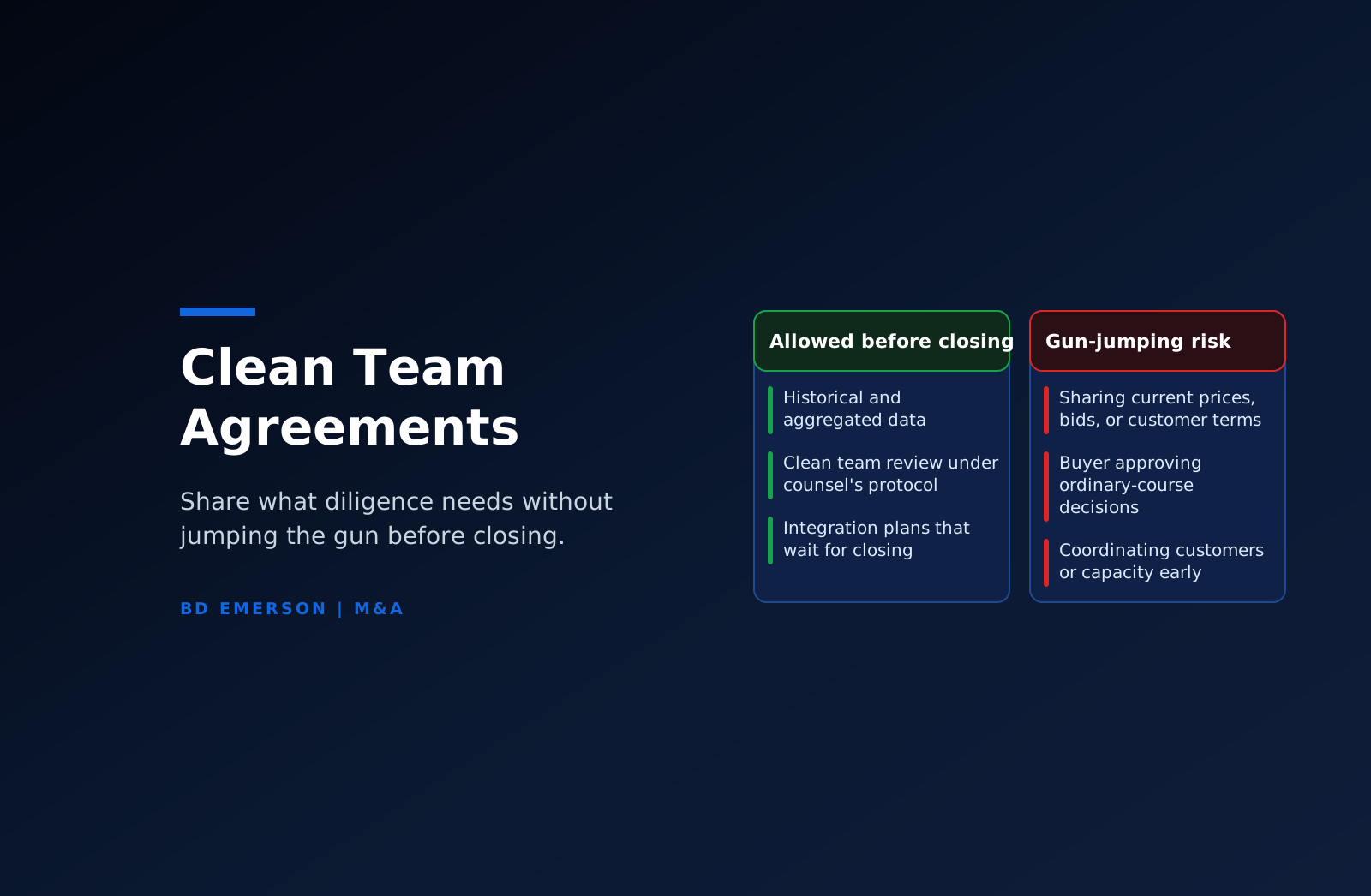
A clean team agreement is a contract between the parties to a deal that limits competitively sensitive information, such as customer-level prices, margins, costs, and bids, to a small group of people walled off from pricing and sales, so the data can inform deal pricing and integration planning without letting two competitors coordinate before closing. Merging competitors need one because they must keep competing until the deal closes. Section 1 of the Sherman Act bars agreements that restrain trade, and the Hart-Scott-Rodino (HSR) Act bars a buyer from acquiring the target before the waiting period ends, a rule the agencies apply to a buyer that takes operational control early. Breaking either rule before closing is called gun jumping. The agreement names the members, the information they may see, how it is stored, how counsel reviews what leaves, and what happens to the data if the deal fails.
What is a clean team agreement, and when do parties sign one?
A clean team agreement sits on top of the confidentiality agreement. The NDA protects the seller's information from misuse and disclosure, and the clean team agreement adds antitrust protection by controlling which people inside the buyer can see which categories of data, because some data harms competition in the hands of the buyer's commercial staff even if it never leaves the building. Parties usually sign it once the deal moves into confirmatory diligence after the letter of intent, before the seller opens folders with customer-level or forward-looking data. Clean teams matter most in horizontal deals between competitors, described in our guide to types of mergers, and in vertical deals where one party supplies or buys from the other's rivals.
Counsel decides what counts as competitively sensitive in each deal. The categories below are the usual starting point.
| Information category | Why it is sensitive | How it can be shared before closing |
|---|---|---|
| Current and future pricing, discounts, and price plans | Lets competitors align prices while they still compete | Clean team only; the deal team sees historical, aggregated price bands |
| Customer-level terms, volumes, and margins | Shows where each side can win or lose specific accounts | Clean team only; outputs aggregate the overlap and remove customer names |
| Open bids, pipeline, and proposal responses | Offers the most direct route to bid coordination | Often withheld until clearance, or shown only to outside clean team members |
| Costs, capacity, and supply plans | Reveals each side's pricing floor and planned output | Clean team for detail; the deal team sees ranges the clean team has checked |
| Compensation and benefits by employee | Can support coordination on pay in shared labor markets | Aggregated by role band, with names and individual pay held back |
| Strategic plans, roadmaps, and research | Shows where each side plans to compete next | Summaries at a level counsel approves; detail waits for closing |
In healthcare deals, payer contract rates and physician compensation belong on the list as well, and our guide to healthcare M&A due diligence covers them alongside the regulatory workstreams.
What is gun jumping, and which laws create the risk?
Gun jumping is acting as one company before the law allows it, and it has two legal sources that apply at the same time. The first is Section 1 of the Sherman Act, which declares illegal every "contract, combination in the form of trust or otherwise, or conspiracy, in restraint of trade." Section 1 applies whether or not the deal must be reported, so competitors that exchange current prices or divide customers during diligence face exposure even in a deal below the HSR thresholds, and even if the deal never closes.
The second is Section 7A of the Clayton Act, added by the HSR Act. For a reportable deal, 15 U.S.C. 18a provides that no person shall acquire, "directly or indirectly," the voting securities or assets of another until both parties file and the waiting period, generally 30 days, expires. The agencies treat a buyer that takes operational control or beneficial ownership before then as having acquired the target early. The 2026 size-of-transaction threshold, which took effect in February 2026, is $133.9 million. The statute sets a civil penalty of up to $10,000 for each day of violation, adjusted for inflation; the current maximum is $53,088 per day, set in January 2025, and the FTC said in a September 2026 notice that it would keep its 2025 penalty levels for 2026 after the Office of Management and Budget canceled that year's inflation adjustment.
The filing itself has also changed. The revised HSR form took effect on February 10, 2025, and a federal district court in Texas vacated it on February 12, 2026. After the Fifth Circuit denied the FTC's request for a stay on March 19, 2026, the agencies accepted filings on the earlier form and asked for public comment on how to revise it. As of October 2026, parties file on the pre-2025 form, the government's appeal is paused while the agencies consider a new rule, and none of it changes the waiting period or the gun-jumping rules. Other merger control regimes have standstill rules of their own: the European Commission fined Altice in 2018 for implementing its acquisition of PT Portugal before notifying the Commission and receiving its approval.
Which enforcement actions define gun jumping?
Four US cases mark the lines, and each turned on conduct a buyer could recognize in its own integration plan.
| Case | What the government alleged | Result |
|---|---|---|
| Computer Associates and Platinum Technology, settled 2002 | The buyer required approval for discounts above 20% off list price and for changes to standard contract terms, and placed an employee at the target to review and approve customer contracts | $638,000 civil penalty, and a decree barring price agreements and the exchange of prospective bid information with future merger partners |
| Gemstar and TV Guide, settled 2003 | The companies stopped competing for some customers, agreed on prices and terms, allocated customers, and jointly ran a business line during the waiting period | $5.67 million in civil penalties, then the highest paid in a gun-jumping case |
| Flakeboard and SierraPine, settled 2014 | The parties coordinated closing SierraPine's particleboard mill in Springfield, Oregon, and moving its customers to Flakeboard during the waiting period | $3.8 million in HSR penalties and $1.15 million in Sherman Act disgorgement; the deal was abandoned |
| XCL Resources, Verdun Oil, and EP Energy, settled 2025 | The buyers halted the target's planned well drilling, jointly handled its customer contracts and deliveries in Utah, and coordinated customer pricing in Texas during the waiting period | $5,684,377 civil penalty, approved by the court on February 4, 2026, with conduct limits lasting 10 years |
The line across the four cases is consistent. Interim covenants that stop a seller from stripping value before closing are standard in purchase agreements, while approval rights over the target's day-to-day pricing, contracting, spending, and output are where enforcement starts. The XCL final judgment spells out the prohibited list for those companies' future deals: no transfer of operational or decision-making control, no approval rights over ordinary-course activities or expenses, no delays to ordinary-course sales or development, and no sharing of certain competing-product information before closing.
What information can merging competitors share before closing?
Ordinary due diligence can go forward between competitors; the question is who sees which data and in what form. The 2002 Computer Associates settlement is the closest thing to a template. It allowed the buyer ordinary diligence, including limited access to pending bids material to understanding the target's future earnings, and barred employees directly involved in selling a competing product from ever seeing that information. That is the clean team idea written into a court decree.
Do not rely on old safe harbors to set the line. In February 2023 the Justice Department withdrew its health care antitrust policy statements, calling them "overly permissive on certain subjects, such as information sharing," and said it would evaluate conduct case by case. In practice, three approaches carry most deals. Historical data old enough to say little about current pricing can usually go to the deal team. Aggregated data that combines many customers, products, or periods can go to the deal team once counsel is satisfied that no single customer's terms can be read from it. Everything else goes to the clean team, whose outputs counsel reviews and approves before release. Counsel decides which approach applies to each data set, and that decision belongs in writing in the protocol.
Who should be on a clean team?
Outside advisors come first: outside counsel, economists, accountants, and consultants who have no role in either company's commercial decisions and can see raw data without carrying it into pricing. Employees join only when the analysis needs knowledge that advisors lack, and then only people who do not set prices, sell, bid, or plan capacity, such as integration leads from finance, IT, or operations. Each member signs an acknowledgment of the agreement before access starts, and the roster changes as people change roles.
The harder question is what happens if the deal fails. Employee members walk away with detailed knowledge of a competitor, so clean team agreements commonly bar them from pricing, sales, or bidding roles for a cooling-off period that counsel sets to outlast the useful life of the data. Choosing members who will not need those roles during the period is easier than enforcing the restriction later.
What does a clean team agreement contain?
Counsel drafts the agreement, and most versions cover the same seven provisions.
| Provision | What it covers | Why it matters |
|---|---|---|
| Members and roster | Named individuals or roles, their employers, the approval process for additions, and signed acknowledgments | Access follows the roster, so the roster is the first control |
| Permitted purpose | Use limited to evaluating, negotiating, and planning the integration of the deal | Any other use is a breach, including use in competing for customers |
| Information categories | Which data sets are for the clean team only and which may go to the deal team | Counsel's designations define what the room has to protect |
| Handling and storage | Where the data lives, who can download or print, watermarking, and logging | Turns the legal promise into controls that can be shown to an agency |
| Output review | Counsel's review and approval of every summary before release to the deal team | Keeps raw sensitive data from reaching decision makers through the analysis |
| Return or destruction | What happens to data and work product at closing or termination, with certification | Ends the exposure if the deal fails |
| Duration and cooling-off | How long the obligations last, and the limits on members after a failed deal | Protects against later use of what members learned |
How does a clean room work in practice?
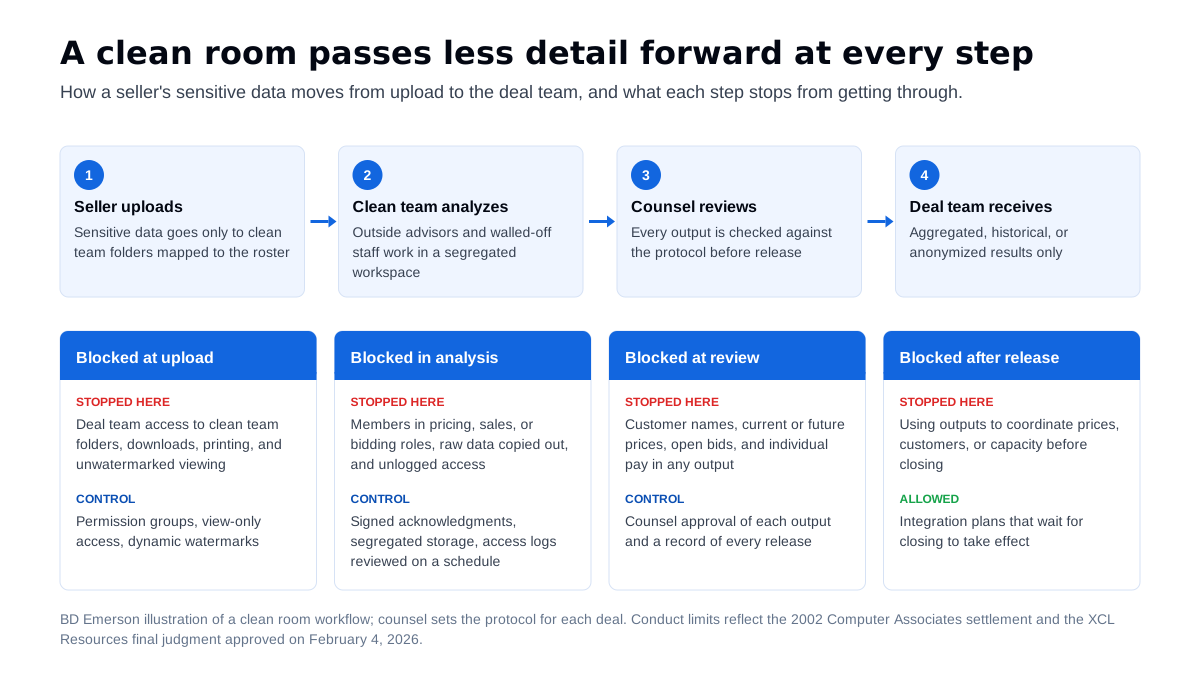
The clean room is where the agreement becomes controls. Clean team folders sit apart from the general data room in their own permission groups, mapped to the roster, with downloads and printing disabled and dynamic watermarks showing each viewer's name and the time. Analysis happens in a segregated workspace with its own storage and accounts, so raw data never sits where deal team members work. Every view, search, and export attempt is logged and reviewed, and the only path out of the room is the release workflow: a clean team member submits an output, counsel approves it, and only the approved version moves to the deal team.
Inside that structure, integration planning can start well before closing. Clean team analysts can measure customer overlap, benchmark prices and costs at an aggregated level, test the synergies in the deal model, and map the systems and data that day one will depend on. The deal team receives conclusions it can act on after closing, such as the share of revenue from shared customers or a cost range for consolidating two ERP instances, without the customer names or current prices behind them.
What can integration teams do before closing?
Integration teams can plan before closing, but they cannot run the combined business. Planning includes designing the day-one organization, mapping systems and data, drafting communications, and building the 100-day plan described in our post-merger integration framework. Running the business together is what the enforcement cases punished: directing the target's operations, approving its ordinary spending, steering its customers, or coordinating prices and capacity. Our post-merger integration team keeps plans built from clean room outputs in draft until closing, so execution starts on the day the deal closes.
How BD Emerson works inside a clean team protocol
Counsel drafts the clean team agreement and decides what is competitively sensitive, and BD Emerson works inside that protocol. We build and run the M&A clean room: data room permissions mapped to the roster, segregated workspaces, access logging and review, download, print, and watermark controls, and tracking of member acknowledgments. Our analysts serve as outside clean team members for customer overlap, cost and pricing benchmarks, testing of synergies, and systems mapping, and every output goes to counsel before the deal team sees it. At closing or termination we revoke access, return or destroy data as the agreement requires, and give counsel the access record. The same team connects the clean room to the rest of diligence through our M&A due diligence practice, so integration planning starts from tested facts.
Frequently asked questions
What is a clean team agreement? A clean team agreement is a contract between the parties to a deal that limits competitively sensitive information, such as customer-level prices, costs, margins, and bids, to a small group of outside advisors and walled-off employees. The clean team analyzes the data for deal pricing and integration planning, and counsel reviews every output before the wider deal team sees it, so the companies can plan the combination without coordinating while they still compete.
What is gun jumping in M&A? Gun jumping is acting as one company before a deal closes. Exchanging competitively sensitive information or coordinating prices and customers can violate Section 1 of the Sherman Act, and a buyer that takes operational control of the target before the Hart-Scott-Rodino waiting period ends can violate Section 7A of the Clayton Act. Enforcement examples include Gemstar and TV Guide in 2003 and XCL Resources and Verdun Oil in 2025.
Who can be on a clean team? Outside advisors are the default: outside counsel, economists, accountants, and consultants with no commercial role at either company. Employees join only when the analysis needs their knowledge, and then only people who do not set prices, sell, bid, or plan capacity. Every member signs an acknowledgment before access, and employee members usually accept a cooling-off period that keeps them out of commercial roles for a time if the deal fails.
What information can competitors share during due diligence? Competitors can share what the buyer needs to evaluate the deal, in a form that does not let them coordinate. Historical and aggregated data can usually go to the deal team once counsel approves it. Current and future prices, customer-level terms, open bids, cost detail, and individual compensation go only to the clean team, and counsel reviews the clean team's summaries before anyone else sees them.
What is the penalty for gun jumping under the HSR Act? The HSR Act sets a civil penalty for each day a party is in violation, adjusted for inflation. The maximum has been $53,088 per day since January 2025, and the FTC kept that level for 2026 after the federal inflation adjustment was canceled. XCL Resources, Verdun Oil, and EP Energy agreed to pay $5,684,377, which the FTC called the largest gun-jumping penalty in US history when it announced the settlement in January 2025.
What happens to clean team information if the deal falls through? The clean team agreement governs it. Typically the clean team returns or destroys the data and its work product, members certify the destruction, and access to the clean room is revoked and logged. Employee members are usually barred from pricing, sales, or bidding roles for a cooling-off period that counsel sets. A well-run clean room can show an agency who saw what, and when it was destroyed.
If you are preparing to share data with a competitor under a clean team protocol, our M&A clean room team can build the room to counsel's rules, run the clean team analysis, and document every access and release from the first upload to the last certificate of destruction.

About the author