

Material Adverse Effect (MAE) Clauses: What Delaware Courts Require and What the Numbers Must Show
A material adverse effect (MAE) clause, also called a material adverse change (MAC) clause, lets a buyer refuse to close a signed deal if the target suffers a severe, lasting decline between signing and closing. Delaware courts set a high bar: the buyer carries the burden of proof and must show a hit to long-term earnings power over a period "measured in years rather than months." In Hexion v. Huntsman in 2008, the Court of Chancery observed that Delaware courts had never found an MAE in a merger agreement, and the first finding came in Akorn v. Fresenius in 2018. Deal counsel drafts the definition, and the finance and diligence teams build the numbers that prove or disprove one.
What does a material adverse effect clause cover?
An MAE clause has two parts: the definition, and the provisions elsewhere in the agreement that use it. The definition describes the kind of change that counts. The merger agreement Farmer Bros. signed with Royal Cup on March 3, 2026 shows current drafting. It defines a "Company Material Adverse Effect" as any change, event, or circumstance that has or would reasonably be expected to have a material adverse effect on the "business, assets, properties, financial condition or results of operations" of the company and its subsidiaries taken as a whole, and then lists sixteen exceptions that cannot count toward an MAE.
Those exceptions cover general economic and financial market conditions, conditions in the target's industry, changes in tariff rates, regulatory and political change, war, natural disasters, pandemics, changes in GAAP or law, the announcement of the deal, actions the buyer approved, movements in the stock price, and a failure to meet projections "in and of itself." The separate exception for tariff rates shows how the carve-out list tracks whatever risk the parties are pricing on the day they sign. Several exceptions come back into play when an event hits the target harder than its peers. The Farmer Bros. agreement measures that disproportionate effect against "other companies of similar size and operating in the same segment of the foodservice industry," and it counts only the incremental harm.
The definition then does its work in three places. It is a closing condition, so the buyer need not close if an MAE has occurred since signing. It sets the standard for bringing down most representations at closing, so an inaccuracy matters only if it would amount to an MAE. And it often stands as its own representation that no MAE has occurred since the last audited balance sheet. Each of those uses turns on the same question: how large and how lasting the harm is.
How do Delaware courts decide whether an MAE occurred?
The leading decisions apply one test. In Hexion v. Huntsman, decided September 29, 2008, Vice Chancellor Lamb held that "the burden of proof with respect to a material adverse effect rests on the party seeking to excuse its performance," which in practice means the buyer. The court described the clause as a "backstop protecting the acquirer from the occurrence of unknown events" and required a change consequential to earnings power "over a commercially reasonable period, which one would expect to be measured in years rather than months." In the court's words, "A short-term hiccup in earnings should not suffice," and materiality is judged from the longer-term perspective of a reasonable acquirer.
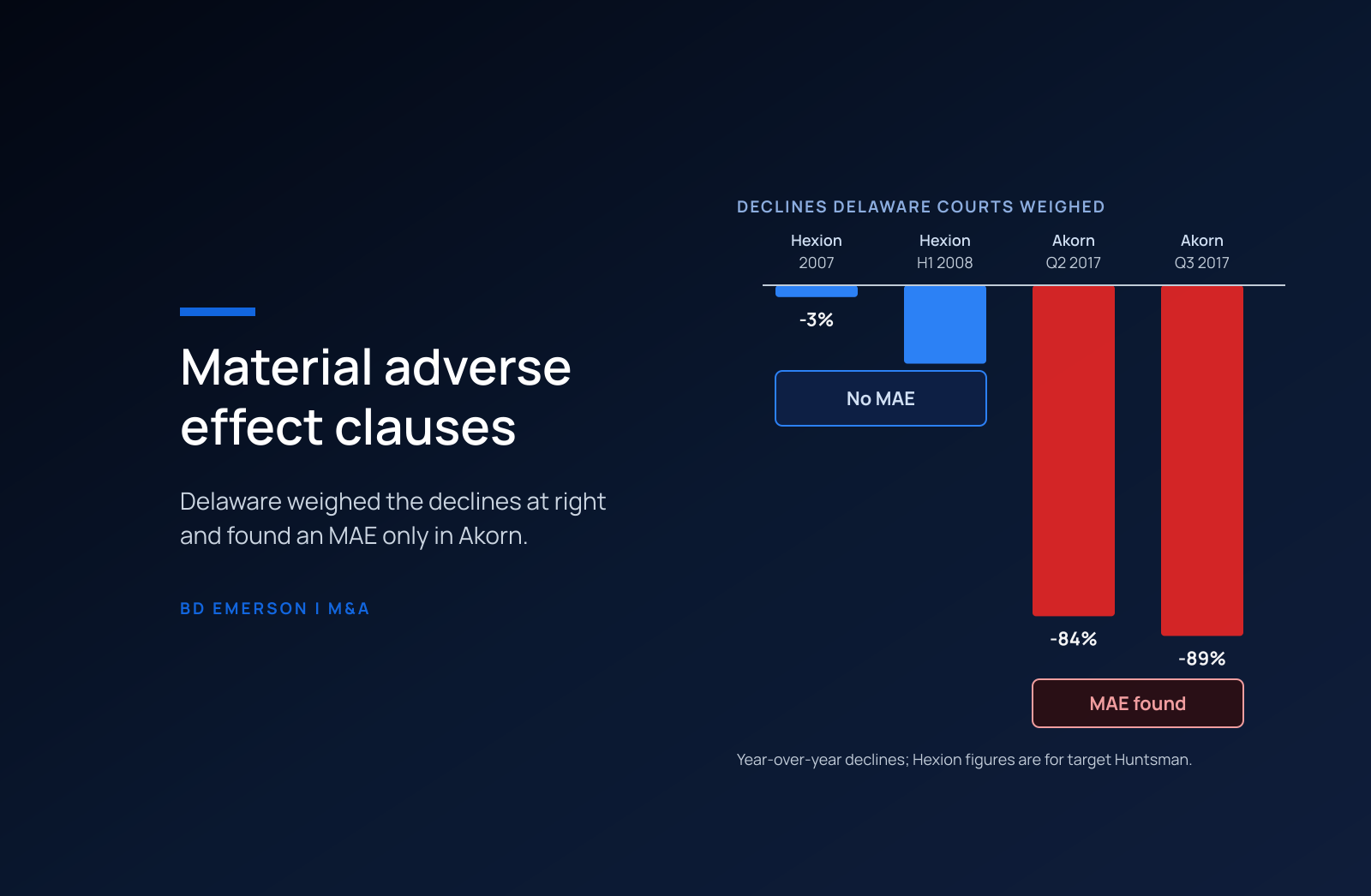
Hexion also settled which number matters. The court measured Huntsman's performance with EBITDA because earnings per share "is very much a function of the capital structure of a company," and because EBITDA was the metric the parties had relied on most heavily when they modeled the deal. On that measure, Huntsman's 2007 EBITDA was only 3 percent below 2006, and first-half 2008 EBITDA was down 19.9 percent year over year. The court held that those results did not add up to an MAE. Later decisions have followed the same frame, and the table below shows how four of them came out.
| Decision | What the buyer pointed to | Result |
|---|---|---|
| Hexion v. Huntsman (Del. Ch. 2008) | Weak results at a chemical company: 2007 EBITDA 3 percent below 2006 and first-half 2008 EBITDA down 19.9 percent | No MAE. The buyer carried the burden, and the decline was not durationally significant. |
| Akorn v. Fresenius (Del. Ch. 2018, affirmed) | Revenue down 29 percent and operating income down 84 to 89 percent year over year for two straight quarters, plus untrue regulatory compliance representations | MAE found. The buyer validly terminated, and it also won on an ordinary course covenant breach. |
| Channel Medsystems v. Boston Scientific (Del. Ch. 2019) | An executive's fraud: about $2.57 million stolen and falsified information in 6 of roughly 138 test reports submitted to the FDA | No MAE. The representations were inaccurate, but the court ordered the buyer to close. |
| AB Stable VIII v. MAPS Hotels (Del. 2021) | Pandemic losses across fifteen luxury hotels in a $5.8 billion sale | No MAE, because the pandemic fell within the carve-out for natural disasters and calamities. The buyer still walked because the seller breached the ordinary course covenant. |
Channel Medsystems shows how far a buyer must go even when it proves misconduct. Boston Scientific established that Channel's representations were inaccurate at signing, yet the Court of Chancery held on December 18, 2019 that a "mere risk of an MAE cannot be enough" and ordered specific performance of the merger. The fraud was real, but the buyer could not show that its consequences would reasonably be expected to impair the company's earnings power over the long term.
What made Akorn the exception?
Fresenius agreed in 2017 to buy Akorn, a generic drug maker, for $34 per share, a total of $4.75 billion including about $450 million of assumed debt. Akorn's results fell apart after signing. In the second quarter of 2017, revenue of $199 million was down 29 percent year over year, operating income of $15 million was down 84 percent, and earnings per share fell 96 percent. The third quarter repeated the pattern, with revenue down 29 percent, operating income down 89 percent, and a loss per share. Fresenius began receiving whistleblower letters in October 2017.
On October 1, 2018, Vice Chancellor Laster held that Fresenius validly terminated the merger agreement on three grounds. Akorn's representations about regulatory compliance were untrue by a margin that would reasonably be expected to result in an MAE, Akorn had materially breached its covenant to operate in the ordinary course between signing and closing, and Akorn had suffered an MAE. The Delaware Supreme Court affirmed. Two facts separate Akorn from Hexion. The decline was steep and persisted across consecutive quarters, and it arrived alongside compliance failures in a regulated drug business, which pointed to a loss of earnings power that would last for years.
Where does financial diligence fit in an MAE dispute?
The fight over an MAE is a fight over numbers, and the numbers start in diligence. Before signing, the quality of earnings work sets the yardstick. Courts compare post-signing results with prior-year periods and with the deal model, so a quality of earnings report that shows normalized EBITDA by quarter, with seasonality and one-time items separated, becomes the baseline that any later decline is measured against. A buyer that skips this work has no agreed starting point when results turn.
Diligence also decides which risks belong in the MAE at all. Hexion describes the clause as a backstop for unknown events, so a problem the buyer finds before signing belongs in the price, an escrow, or a specific indemnity. Representations and warranties insurance treats known issues the same way, which is why RWI policies exclude matters the deal team already knew about. A buyer that finds a regulatory gap in diligence and leaves it to the MAE clause has picked the weakest tool available.
Between signing and closing, the work shifts to monitoring. The finance team should receive monthly results against the deal model, track the operating metrics that drive earnings, and benchmark the target against the peer set the disproportionate-effect language names. When an industry-wide shock hits, the buyer has to show the target fared worse than its peers, and that comparison is much easier to build from quarterly peer data collected along the way than from a scramble after a dispute begins.
Why does the ordinary course covenant matter as much as the MAE?
In both Akorn and AB Stable, the buyer prevailed on the interim operating covenant, the promise to run the business in the ordinary course between signing and closing. In AB Stable, the seller closed two hotels, ran the other thirteen as "closed but open," and laid off or furloughed more than 5,200 full-time-equivalent employees without the buyer's consent. The Delaware Supreme Court held on December 8, 2021 that the covenant required operation "consistent with past practice in all material respects," that the MAE definition did not limit it, and that the breach excused the buyer from closing. The court measured compliance against the seller's own past operations, and it rejected the argument that industry-standard responses were enough.
The finance lesson runs both ways. Sellers should log every material operating change during the interim period and get written consent before making it. Buyers should answer consent requests with specific questions, as the AB Stable buyer did when it asked for hotel-by-hotel closure dates, because the record of those exchanges decides the case.
What should the finance team raise with deal counsel?
Deal counsel drafts and negotiates the MAE definition and the interim covenants. The finance and diligence team supplies the facts that make those provisions work, and it should raise these points before the draft is final:
- Which metric will measure a decline. Hexion chose EBITDA because the parties modeled on it, so the agreement and the model should use the same definition.
- Which peer set defines a disproportionate effect, and where the comparison data will come from.
- Which risks found in diligence move out of the MAE and into price, escrow, or a specific indemnity.
- What monthly financial information the target must deliver between signing and closing.
- Which operating changes require consent, and the standard for granting it.
BD Emerson's financial due diligence team builds the quality of earnings baseline, the interim monitoring package, and the peer benchmarking that an MAE analysis depends on, and we work alongside deal counsel, who drafts the clause. To set up that work before signing, see our financial due diligence services.

About the author













