Growth Equity: How It Works and How It Differs From Venture Capital and Buyouts
Growth equity is a minority or significant-minority investment in a profitable or near-profitable, fast-growing company, usually made with little or no debt, to fund expansion or to buy out early shareholders. It sits between venture capital and buyouts: the company has proven its product and revenue model, the investor buys a stake large enough to matter, and the founders keep control. Because the investor does not control the company, it protects itself through contract terms, usually preferred stock with a liquidation preference, protective provisions, board seats, and exit or redemption rights. This guide, written for founders, CFOs, and boards, covers how growth rounds differ from venture rounds and buyouts, how the terms work, what investors test, and what ownership looks like afterward.
Growth equity vs venture capital vs buyouts
The three strategies differ in how much of the company the investor buys, how much debt the deal uses, and who controls the board afterward. The table summarizes the differences as of September 2026.
| Dimension | Venture capital | Growth equity | Buyout |
|---|---|---|---|
| Company stage | Building product and demand, usually unprofitable | Proven product and fast growth, profitable or near-profitable | Mature, with cash flow that can service debt |
| Ownership per deal | Minority; median Series A dilution of 18% in 2025 through June (Carta) | Minority or significant minority, up to 49% (Davis Polk) | Majority or all of the equity |
| Control | Founders; the lead investor often takes a board seat | Founders, with investor board seats and vetoes over fundamental matters | The sponsor controls the board |
| Debt in the deal | None; the SEC's venture fund test excludes companies that borrow and pass the proceeds to the fund | Little or none (Davis Polk) | 5.0 times EBITDA on average for US syndicated-loan buyouts in 2025 (PitchBook) |
| Return drivers | A few outsized outcomes | Revenue growth and margin expansion, with the preference protecting the downside | EBITDA growth, debt paydown, and the exit multiple |
| Typical check size | Sized to the next funding milestone | Sized to the plan plus any secondary; much smaller than buyout checks (PitchBook) | The full equity value, with debt funding part of the price |
| Governance rights | Protective provisions, information rights, and pro rata rights | Protective provisions plus operational vetoes that widen with the stake | Full control, with management holding a minority stake |
| Holding period | Until a later round or exit; redemption rights in 6.1% of Cooley's Q1 2026 deals | Exit rights at three to five years and puts at five to 10 (Davis Polk) | About seven years at exit (Bain, 2026) |
The figures come from Carta's analysis of 12,435 priced US software rounds, PitchBook's 2025 Annual US PE Breakdown, Cooley's Q1 2026 venture financing report, Bain's Global Private Equity Report 2026, and Davis Polk's review of growth equity minority investments.
Growth equity vs private equity
Growth equity is one form of private equity: PitchBook classifies growth and expansion investments as a private equity deal type alongside buyouts and add-ons. The difference for a company is control. A buyout sponsor buys the right to run the business and funds part of the price with debt the company must service, while a growth investor buys a minority stake and relies on negotiated consent rights.
Growth equity vs venture capital
Late-stage venture and growth rounds can be the same size, so the useful distinction is what the investor underwrites: a venture investor underwrites the chance of an outsized outcome and expects failures, while a growth investor underwrites economics that already work. US rules draw a sharper line. Under the SEC's venture capital fund definition in Rule 203(l)-1, an exempt venture fund may borrow no more than 15% of its capital for no more than 120 days, and only shares bought directly from the company count as qualifying investments, so shares bought from founders fall into a 20% basket for other holdings. Our guide to what investors test from Series A to Series C covers the venture side of that line.
Is growth capital the same as growth equity?
Growth capital is the broader term for money raised to fund expansion, including growth equity, venture debt, revenue-based financing, and bank loans. Our guide to the capital raise compares the equity and debt paths with numbers.

How big is the growth equity market?
Growth equity accounts for about one in five US private equity deals by count and about a tenth by value. As of September 2026, the latest full-year figures cover 2025. PitchBook counted 1,662 US growth and expansion deals worth $116.5 billion in 2025, down 4.6% by count and 13.2% by value from 2024. That was 21.2% of US private equity deals by count, nearly level with platform buyouts at 21.3% (a figure that excludes add-on acquisitions), and about 10% of the $1.16 trillion in total US private equity deal value, because growth checks run smaller than buyout checks. Fundraising rose: McKinsey's Global Private Markets Report 2026 found growth equity fundraising up 16% in North America and 8% in Europe in 2025. That investor base makes a competitive process realistic for a company with proven economics.
How do growth investors structure a minority stake?
Growth investors trade control for contract rights. A minority owner writes its protection into the security it buys, and those terms decide what it receives in a weak exit, what the company can do without its consent, and when it can force liquidity. The table summarizes the package Davis Polk describes.
| Term | What it does | What the company should negotiate |
|---|---|---|
| Preferred equity | Stock senior to common, convertible at the holder's option; Davis Polk notes dividends often accrue at a fixed, compounding rate | Whether a dividend accrues, since accrual raises the preference each year |
| Liquidation preference | Preferred holders recover their investment, or a multiple of it, before common holders in a sale; a non-participating holder takes the greater of the preference or its as-converted share | 1x non-participating: Cooley found 1x preferences in 98.2% and non-participating stock in 96.4% of its Q1 2026 venture deals |
| Protective provisions | Consent rights over listed actions, such as issuing senior stock, amending the charter, selling the company, or borrowing above a threshold | A closed list, a debt threshold that fits the plan, and a sunset if the stake shrinks |
| Board seats | Investor directors and observers; Davis Polk describes one director above a 5% stake and proportional seats at 25% to 49% | A board on which founders and independent directors keep the majority |
| Redemption or put rights | The right to make the company or founders buy back the shares, often five to 10 years after investment, sometimes with a right to start an exit after three to five | The trigger date, the price formula, and the payment schedule |
| Drag-along rights | Approving holders can require all holders to join a sale on the same terms; Davis Polk notes the drag usually belongs to the controlling shareholders | The approval threshold and any minimum return the investor requires before it can be dragged |
| Tag-along rights | The investor can sell alongside the founders, on the same terms, when they sell to a third party | How large a founder sale must be to trigger the right |
In a US deal these rights sit in separate documents. In the NVCA's model legal documents, the certificate of incorporation carries the preference, the protective provisions, and any redemption right, the voting agreement carries board seats and the drag-along, and the co-sale agreement carries the tag-along. Work with deal counsel to read them together, because a definition in one document can undo a concession in another.
Two Delaware cases show the terms in practice. In SV Investment Partners v. ThoughtWorks, an investor that bought $26.6 million of preferred stock in 2000 sued for a $66.9 million redemption price. The Court of Chancery held in 2010 that "funds legally available" means cash on hand or readily accessible, a narrower test than balance sheet surplus, and the Delaware Supreme Court affirmed. In In re Trados (Del. Ch. 2013), a $60 million sale paid preferred holders $52.2 million against a $57.9 million preference, paid management $7.8 million, and left common holders nothing; the court said directors should generally favor the common where they have discretion. Model the preference stack at several exit values before signing.
Primary versus secondary proceeds
A primary investment buys new shares, so the cash goes to the company and all existing holders are diluted. A secondary purchase buys existing shares from founders, employees, or early investors, so the cash goes to the sellers and the share count stays the same. Many growth rounds combine both: primary capital funds the plan, and the secondary gives founders partial liquidity or buys out early investors.
Secondaries carry their own mechanics. NVCA-style agreements give the company and investors a right of first refusal and co-sale rights on founder sales, so a founder secondary needs waivers. An offer to buy shares from a broad group of employees can count as a tender offer, which SEC Rule 14e-1 requires to stay open for at least 20 business days. The price, the share class, and any company repurchase carry tax consequences, so sellers should get tax advice before the term sheet fixes them. BD Emerson's test for any secondary is whether each founder still owns enough afterward to care about the next exit, because that incentive is what the growth investor is paying for.
A worked example: ownership after a growth round
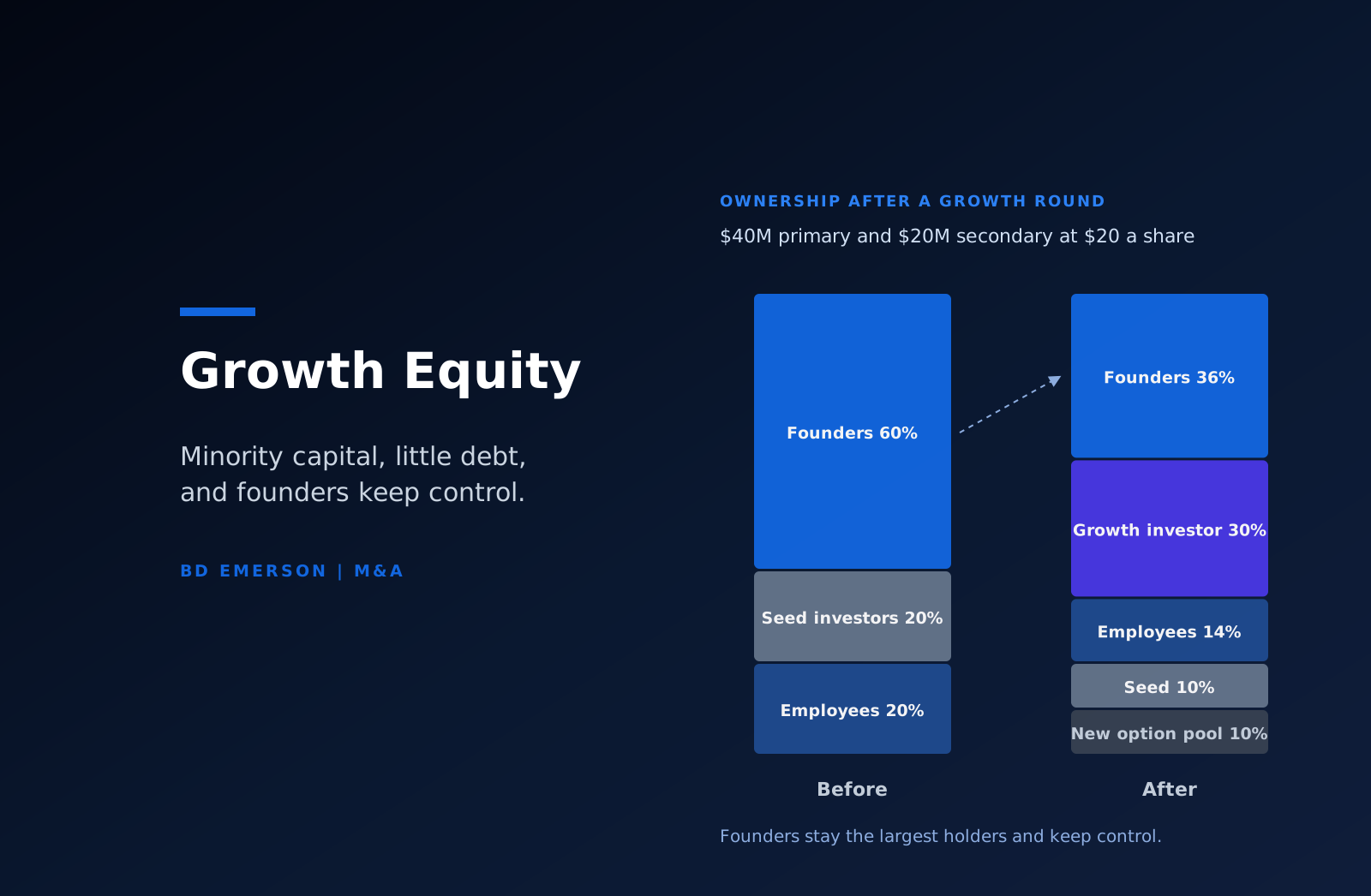
A growth round dilutes existing holders by more than the investor's percentage when the option pool grows first. The company in this example has 7,000,000 fully diluted shares: founders hold 4,200,000 (60%), seed investors 1,400,000 (20%), and employees 1,400,000 (20%) in granted options. A growth investor agrees to a $160 million pre-money valuation, invests $40 million in new preferred stock, and buys $20 million of existing shares from the founders and seed investors at the same price. The term sheet requires a new option pool equal to 10% of the post-money shares, created before the investment.
The post-money valuation is $200 million, so the $40 million buys 20%. With 20% going to the investor and 10% to the pool, the existing 7,000,000 shares become 70% of the total, which sets the post-money count at 10,000,000 shares and the price at $20.00. The secondary moves 600,000 founder shares ($12 million) and 400,000 seed shares ($8 million) to the investor.
| Holder | Before the round | After primary and pool | After secondary |
|---|---|---|---|
| Founders | 4,200,000 (60%) | 4,200,000 (42%) | 3,600,000 (36%) |
| Seed investors | 1,400,000 (20%) | 1,400,000 (14%) | 1,000,000 (10%) |
| Employees, granted options | 1,400,000 (20%) | 1,400,000 (14%) | 1,400,000 (14%) |
| New option pool | 0 | 1,000,000 (10%) | 1,000,000 (10%) |
| Growth investor | 0 | 2,000,000 (20%) | 3,000,000 (30%) |
| Total | 7,000,000 | 10,000,000 | 10,000,000 |
The investor bought 20% of the company with its $40 million, yet the founders' stake fell from 60% to 42% before the secondary, a 30% reduction, because the pool came out of the pre-money valuation. After the secondary, the investor owns 30% for $60 million, the company has $40 million of new cash, and the founders hold 36% plus $12 million and remain the largest holders.
The preference matters in a modest exit. Assume a 1x non-participating preference of $40 million on the 2,000,000 preferred shares, common stock for the secondary shares, and all options exercised. In a $150 million sale, the preferred's as-converted share would be $30 million, so the preferred takes its $40 million and the other $110 million goes to the 8,000,000 common shares, including the investor's 1,000,000 secondary shares, at $13.75 each. The founders receive $49.5 million instead of the $54.0 million an equal $15.00 per share would pay. In a $300 million sale, the as-converted $60 million beats the preference, the investor converts, and each share receives $30.00.
What do growth equity investors test in diligence?
Growth investors test whether the economics behind the valuation survive a rebuild from source data, and they reach further into technology and security than an early venture round.
| Area | What investors measure | How they test it |
|---|---|---|
| Unit economics | Gross and contribution margin by product and segment | Rebuild margins from the general ledger with hosting, support, and services costs allocated |
| Net revenue retention | Revenue from last year's customers after expansion, contraction, and churn, divided by their revenue a year earlier | Recalculate from billing data by cohort and compare with the deck's definition |
| CAC payback | Months of gross profit needed to recover the cost of acquiring a customer | Rebuild acquisition cost with fully loaded sales and marketing expense |
| Cohort data | Revenue and logo retention for each annual group of new customers | Check that recent cohorts behave like earlier ones |
| Quality of revenue | Recurring and contracted revenue, revenue recognition, and customer concentration | A quality of earnings review that ties revenue to contracts, invoices, and cash |
| Growth and margin | The Rule of 40: revenue growth plus free cash flow margin of at least 40% | Compare with software peers |
| Technology scalability | Whether the architecture, cloud costs, and team can carry the plan's volume | Architecture review, cloud cost trends, and code and open source scans |
| Security posture | Controls, audit reports, and incident history | SOC 2 or ISO 27001 reports, penetration tests, and customer notifications |
The Rule of 40 benchmark is demanding: McKinsey's analysis of more than 200 software companies found that barely one third reached it and that companies exceeded it only 16% of the time between 2011 and 2021. In our experience, growth investors commission their own quality of earnings work for larger rounds, so the metric definitions in a company's deck need to survive an accountant's rebuild.
How should a company prepare for growth equity diligence?
A company prepares by producing, before the first investor meeting, the evidence an investor would otherwise build under a term sheet deadline. BD Emerson recommends this sequence:
- Define ARR, net revenue retention, gross margin, and CAC in writing, and reconcile each to the general ledger for the last two to three years.
- Rebuild customer cohorts from billing data, with an explanation for any cohort that retained worse than the one before it.
- Commission a quality of earnings review before a large round, so revenue recognition questions surface on your timeline.
- Run a technology and security review against the questions an investor's specialists will ask, and fix what you can before outreach.
- Build the data room once: charter, cap table, board minutes, customer contracts, the model, security reports, and IP assignments.
- Decide the primary and secondary split, the board you will accept, and the protective provisions you will refuse before term sheets arrive.
Our guide to investor due diligence details the request list and the data room. Because exit and put rights can put a sale on the calendar within three to 10 years, the work in our exit readiness guide starts paying off at the growth round.
When does growth equity fit better than venture debt, a strategic sale, or a buyout?
Growth equity fits when the economics already work, the plan needs more capital than cash flow provides, and the founders want to keep control and the next stage's upside. The table states BD Emerson's decision rule for each option.
| Option | Choose it when | What it costs |
|---|---|---|
| Growth equity | Revenue, retention, and margins work, the plan needs outside capital, and founders want partial liquidity without giving up control | A minority stake, a preference ahead of the common, consent rights, and an exit clock |
| Venture debt | The company has a recent equity round, predictable revenue, and a near-term milestone that more runway will reach | Interest, warrants, covenants, and repayment that binds hardest when the plan slips |
| Strategic sale | A buyer can pay for synergies no financial investor can price, or founders want full liquidity now | Independence and most future upside, apart from any earnout or retained stake |
| Buyout | Cash flow can service acquisition debt, and founders want liquidity for most of their stake | Control passes to the sponsor, and the company carries the acquisition debt |
The rule underneath the table is to match the capital to the uncertainty. Equity should fund uncertain outcomes, debt should fund spending whose return already shows in the unit economics, and control should change hands only when a buyer's price today is worth more to the founders than the next stage. After a growth round, we recommend running the company with a lighter version of the operating discipline in our guide to the value creation plan. For funds on the other side, our private equity consulting team runs the commercial, financial, technology, and cybersecurity diligence behind growth and buyout investments.
Frequently asked questions
What is growth equity? Growth equity is a minority or significant-minority investment in a profitable or near-profitable, fast-growing company, usually made with little or no debt, to fund expansion or buy shares from early holders. The investor typically buys preferred stock with a liquidation preference, protective provisions, and board seats, while the founders keep control.
Is growth equity the same as private equity? Growth equity is a type of private equity: PitchBook classifies growth and expansion deals as a private equity deal type and counted 1,662 US growth deals worth $116.5 billion in 2025. The difference from a buyout is control. A growth investor buys a minority stake with little debt, while a buyout sponsor buys control and funds part of the price with debt.
How is growth equity different from venture capital? Venture capital funds companies that have not yet proven their economics and relies on a few large outcomes. Growth equity funds companies whose revenue, retention, and margins already work, and prices for fewer losses. Growth deals can also buy shares from early holders and use some debt, which the SEC's venture capital fund definition limits for exempt venture funds.
How much of a company does a growth equity investor take? A growth investor takes a minority stake. Davis Polk describes growth stakes up to 49%, with board seats that track the shareholding at 25% to 49%. In this article's worked example, a $40 million primary investment and a $20 million secondary purchase at a $200 million post-money valuation leave the investor with 30% and the founders with 36%.
What is a liquidation preference in a growth equity deal? A liquidation preference lets preferred holders recover their investment, or a multiple of it, before common holders receive anything in a sale. A 1x non-participating preference pays the greater of the amount invested or the holder's as-converted share, and Cooley reported 1x preferences in 98.2% of its Q1 2026 venture deals. Check growth term sheets for multiples above 1x, participation, and accruing dividends.
Can a growth equity investor force a sale? A minority investor cannot force a sale through its ownership, but it can negotiate rights with the same effect. Davis Polk describes obligations to start an exit three to five years after investment and put rights five to 10 years after it. Delaware limits redemptions to funds legally available, as SV Investment Partners v. ThoughtWorks showed, so a put right does not guarantee cash on schedule.
If your board is weighing a growth equity term sheet, our financial due diligence team can rebuild your metrics and run the quality of earnings review a growth investor will run, so the numbers in your deck hold up in the investor's own work.

About the author