

Insurance Billing Software for P&C Carriers and MGAs: What It Must Do
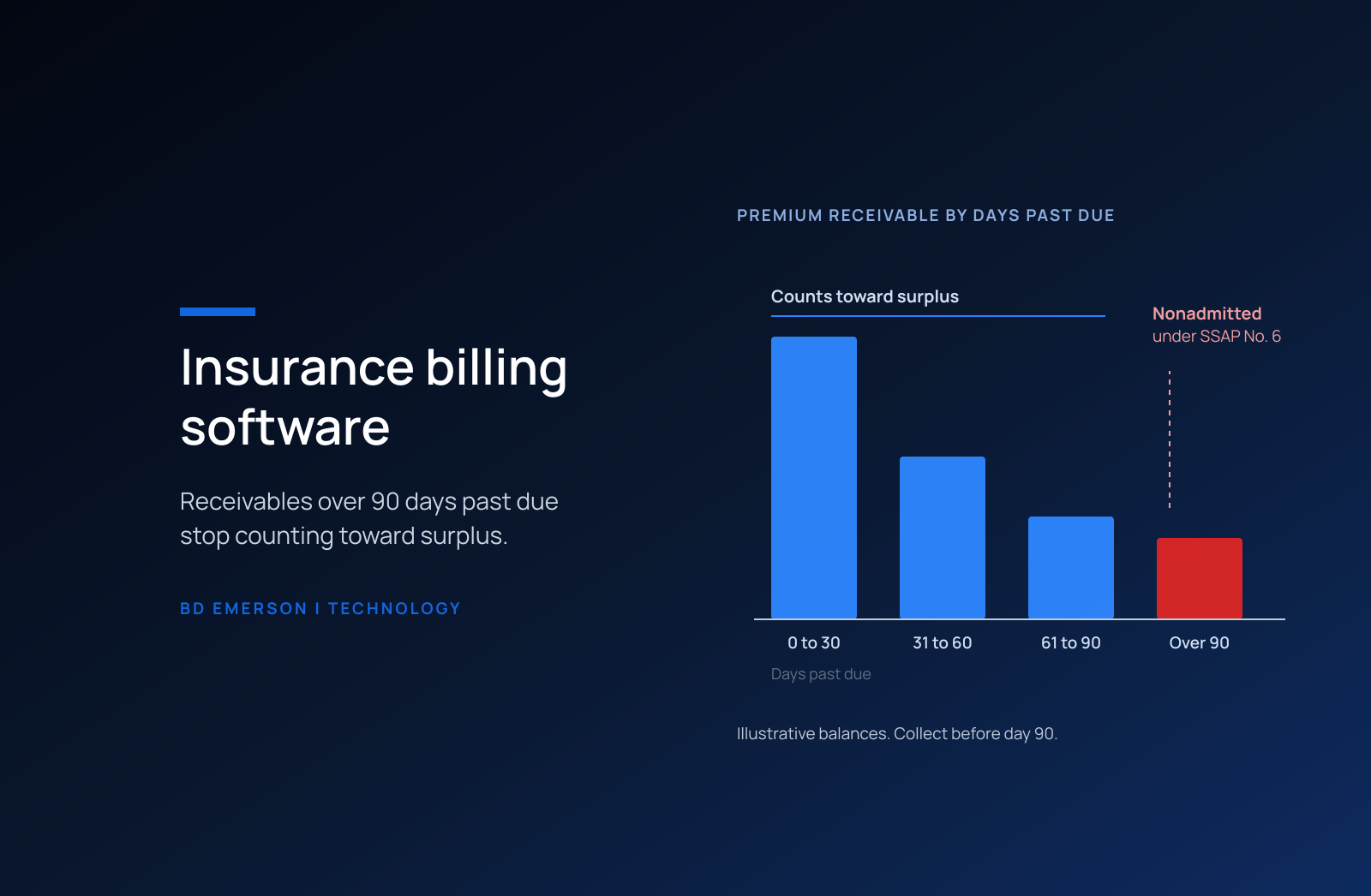
Insurance billing software is the system a property and casualty carrier or managing general agent (MGA) uses to turn the premium on a policy into collected cash. It builds installment schedules, invoices insureds directly (direct bill) or sends statements to agencies that collect for the carrier (agency bill), applies payments, calculates and pays commissions, works late accounts through notices to cancellation for nonpayment, and refunds return premium. It is a different product from the medical billing software that shares the name. For a carrier, the billing system decides how fast premium becomes cash, whether commissions are right, whether a lapsed policy is cancelled on time under state rules, and how much of its receivables count toward statutory surplus.
What does insurance billing software do?
Billing starts where the policy system stops. When the policy administration system issues, endorses, renews, or cancels a policy, it sends the premium change, the payment plan, and the payer to billing. Billing then owns every step that touches money: it spreads premium across installments, adds fees, produces invoices, applies payments from ACH, card, check, and lockbox, matches each payment to the charges it covers, and posts the result to the general ledger. When a payment does not arrive, billing runs the delinquency process, and if the account stays unpaid it tells the policy system to cancel. When a policy cancels or an endorsement lowers the premium, billing calculates the return premium and issues the refund.
Three features separate carrier billing from generic invoicing. Billing is account-based, so one insured with an auto policy, a property policy, and an umbrella gets one schedule and one invoice. Premium changes mid-term, so every endorsement re-spreads the remaining balance across the open installments. And the carrier pays commission on what it writes and collects, so billing has to track commission earned, chargebacks on cancelled policies, and payments to each producer. Duck Creek's billing product page shows how vendors frame this: commission rules "can be configured by product, role, agreement, or region," and the product manages "the full delinquency lifecycle, from notices and penalties through to reinstatement and rescission."
Direct bill vs agency bill: what is the difference?
The two billing models decide who touches the insured's money. In direct bill, the carrier invoices the policyholder, collects the premium, and pays the agent's commission separately. In agency bill, the producer invoices the policyholder and collects the premium, then remits it to the carrier net of commission. Guidewire's BillingCenter documentation puts it plainly: "In the agency bill model, the producer invoices policyholders and receives payment from them," and "the producer then sends payment to BillingCenter minus the commission earned from these payments." Most commercial carriers run both models, so their billing system has to support both on one platform.
| Question | Direct bill | Agency bill |
|---|---|---|
| Who invoices the insured | The carrier | The agency |
| Who collects the premium | The carrier | The agency |
| How commission moves | The carrier pays the agency after it collects | The agency keeps its commission and remits net premium |
| Reconciliation work | Matching payments to invoices | Reconciling statements or account currents, including short pays and disputed items |
| Where it is most common | Personal lines and small commercial | Larger commercial accounts placed through brokers |
Agency bill is where most billing projects stall. The agency remits one payment for many policies, as the Guidewire documentation notes, and that payment rarely matches the statement to the dollar. The system needs statement bill and account current support, a record of the agency's promise to pay, exception queues for short and over payments, and suspense handling for cash it cannot yet apply. A billing system that treats agency bill as an afterthought pushes that work into spreadsheets, where the balances age.
Why does billing decide how much premium counts toward surplus?
Statutory accounting turns billing quality into capital. Under the NAIC's statutory accounting principles (SSAP No. 6), premiums receivable from policyholders or agents must be nonadmitted once they are more than 90 days past due, which means they stop counting as assets when regulators measure the carrier's surplus. The rule matters enough that in 2020 the NAIC adopted a temporary interpretation, INT 20-02, to extend the 90-day rule for premiums affected by COVID-19.
For a billing system, that rule sets two requirements. The aging has to be right: every receivable must carry the due date of the installment or statement it belongs to, so the 90-day count starts on the correct day. And agency bill balances have to be reconciled before they age, because an unreconciled statement looks like unpaid premium even when the agency holds the cash. A new carrier with thin surplus feels this first, since a few hundred thousand dollars of nonadmitted receivables shows up directly in the surplus its regulator measures.
Delinquency, cancellation, and state notice rules
The delinquency process is where billing becomes a compliance system. When an installment goes unpaid, billing sends a reminder, then a notice of cancellation, then triggers the cancellation itself, and every notice has to meet the rules for that state and line: how many days of notice the insured gets, how the notice is delivered, and what it must say. Those rules differ by state and by line of business, and legislatures change them. The billing system should hold them as data with effective dates, so a rule change becomes a configuration change with a test, and every notice it sends can be traced to the rule that produced it.
Reinstatement and rescission complete the cycle. If the insured pays after cancellation, the carrier may reinstate the policy, with or without a lapse in coverage, depending on its own rules and the state's. Billing has to rebuild the schedule, reverse the cancellation in the policy system, and keep the evidence of what was sent and when. That evidence is what the carrier produces when a claim arrives on a policy whose status at the date of loss is in dispute.
Suite module, standalone billing, or a custom build?
Carriers get billing software three ways. Most buy it as a module of a core suite, such as BillingCenter in Guidewire InsuranceSuite (our Guidewire explainer covers each module) or Duck Creek Billing (our Duck Creek overview covers that vendor's suite). Some buy a standalone billing system or a billing service that sits beside whatever policy system they run. Others build billing as part of a core they own, usually when the payment model is part of the product: usage-based premium, embedded insurance sold through a partner's checkout, or program business with unusual commission splits.
The decision rule we use follows the product. If your products bill like everyone else's, buy billing and spend the effort on integration and data conversion. If billing is part of what makes the product different, or a suite's billing module would force a second system to handle the exceptions, build it, on the same data model as policy and rating, so there is one record of what each insured owes and why.
When billing and policy come from different vendors, the integration contract decides whether the two systems agree. The policy system has to send every transaction with its effective date, premium change, and payment plan. Billing has to send back payments, nonpayment cancellation requests, and reinstatements. Both have to share one definition of the account and the payer. A common source of reconciliation breaks is an endorsement that billing receives out of order, so the contract should define sequencing and replay from the first design session.
What should you test before you choose a billing system?
Vendor demonstrations show the clean path. These six scenarios show whether a billing system can run your book:
- A mid-term endorsement that raises premium on a policy with four installments left, and the re-spread across the open invoices.
- An agency bill statement where the agency pays 92 percent of the balance and disputes two items.
- A cancellation for nonpayment in two states with different notice rules, followed by reinstatement in one of them.
- A flat cancellation with a return premium refund owed to a card that has expired.
- A commission chargeback when a policy cancels after the agency has been paid.
- The conversion of open receivables and installment schedules from the legacy system, reconciled to the general ledger to the cent.
The last scenario is the one most programs underestimate. Open receivables, in-flight installment plans, unapplied cash, and agency balances all have to move at cutover with their aging intact, or the first statutory quarter after go-live starts with a reconciliation project. Card payments add one more design decision: a billing system that hands card capture to a tokenizing payment processor keeps card numbers out of the carrier's own databases and narrows the scope of its PCI DSS obligations.
BD Emerson builds billing into the policy, billing, and rating cores we build for carriers and MGAs, and integrates billing systems around policy platforms that stay in place. Our insurance core platform page shows how we build billing with policy, rating, and product configuration on one data model.

About the author













