Net Working Capital in M&A: Formula, Peg, and True-Up
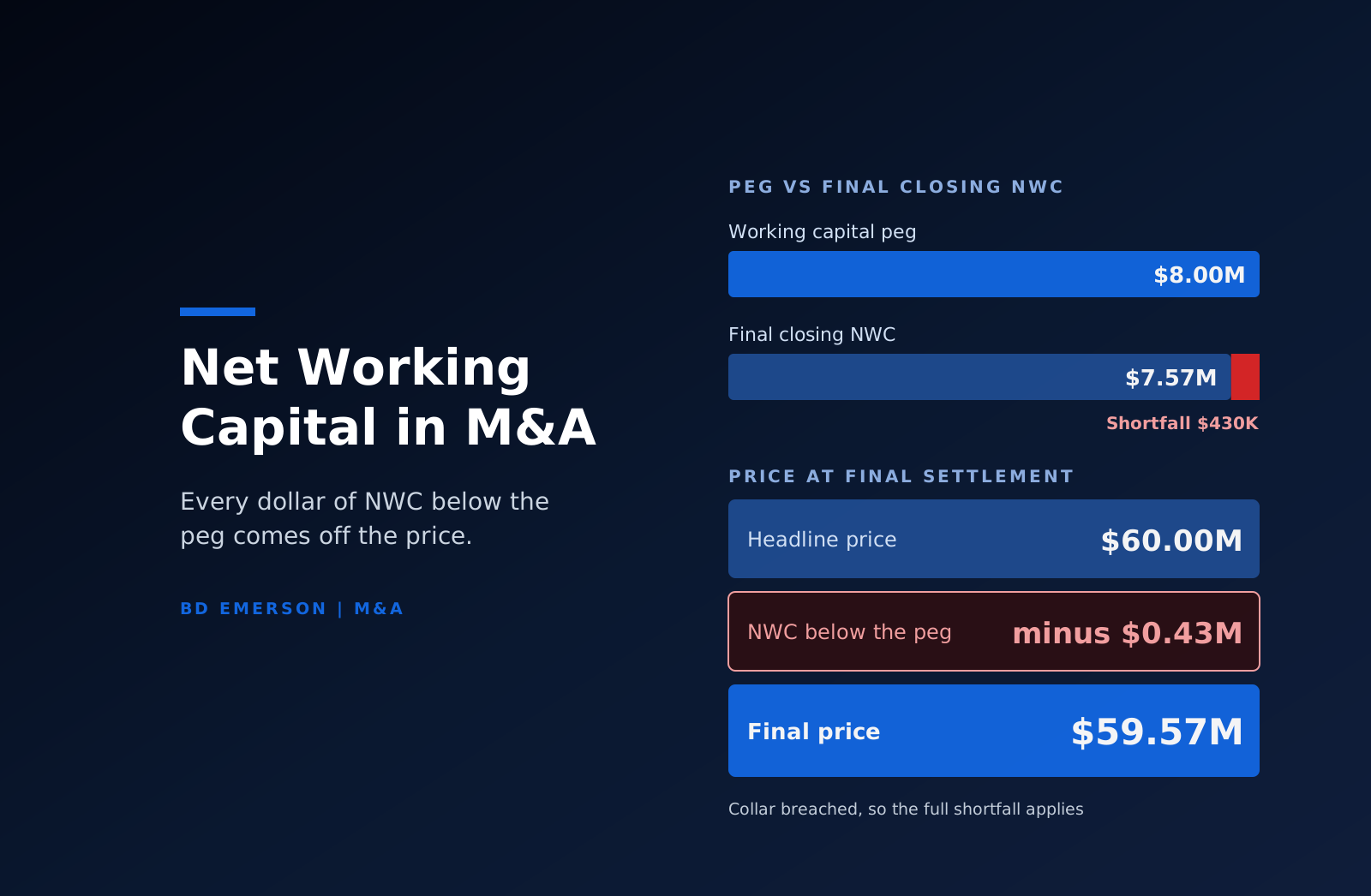
Net working capital (NWC) is current assets minus current liabilities. In an acquisition, the purchase agreement narrows that formula to operating working capital: accounts receivable, inventory, and operating prepaid expenses, less accounts payable and accrued operating liabilities, with cash, debt, debt-like items, and income taxes left out. The buyer and seller agree on a target level, called the peg, and after closing the price moves dollar for dollar by the amount that closing NWC lands above or below it. The definition, the peg, and the true-up are three separate negotiations, and on a middle-market deal each one can move the price by hundreds of thousands of dollars.
The adjustment is close to universal in private deals. SRS Acquiom's 2026 Working Capital Purchase Price Adjustment Study, which covers more than 1,570 private-target acquisitions that closed from 2020 through the third quarter of 2025, found a purchase price adjustment in 91% of deals, and 89% of those adjustments ended in a payment one way or the other. SRS Acquiom's summary of the study puts the share at about 50% a decade earlier. BD Emerson builds this analysis inside its financial due diligence practice.
What is the net working capital formula?
The accounting formula is current assets minus current liabilities. Current assets are cash and the assets a company expects to collect, sell, or use up within a year, such as receivables, inventory, and prepaid expenses. Current liabilities are the obligations due within a year, such as payables, accrued expenses, and the current portion of debt. Rule 5-02 of the SEC's Regulation S-X lists these balance sheet captions, from "cash and cash items" through "total current liabilities." A company with $14.2 million of current assets and $8.9 million of current liabilities has NWC of $5.3 million and a current ratio of 1.6.
The change in net working capital is this period's NWC minus the prior period's. An increase consumes cash, because the company has funded more receivables and inventory than its suppliers have financed, and a decrease releases cash. Free cash flow therefore equals EBITDA minus cash taxes, minus capital expenditures, minus the increase in NWC. If the company above grows NWC to $5.9 million next year, the $600,000 increase comes out of that year's free cash flow. Deal models should use the deal definition below, so the forecast and the agreement measure the same balance.
How does deal NWC differ from accounting NWC?
Deal NWC keeps only the operating items a buyer needs to run the business, because the price is quoted on a cash-free, debt-free basis and cash, debt, and taxes each have their own mechanism in the agreement. Closing cash is added to the price, debt and debt-like items are deducted, pre-closing income taxes go to the tax covenants and tax indemnity, and unpaid transaction expenses come off as a separate line. Every balance sheet line should land in exactly one of those buckets. A line that lands in two gets counted twice, and a line that lands in none becomes the first dispute.
| Balance sheet line | Accounting NWC | Typical deal NWC | Reason |
|---|---|---|---|
| Cash and cash equivalents | Included | Excluded | Closing cash is added to the price or kept by the seller |
| Accounts receivable, net | Included | Included, with reserves under the agreed principles | Operating asset |
| Inventory, net | Included | Included, with the historical costing and obsolescence method | Operating asset |
| Prepaid expenses | Included | Included when operating; excluded for prepaid taxes and deal costs | Only operating items belong |
| Income tax balances | Included | Excluded | Tax covenants and the tax indemnity govern pre-closing taxes |
| Accounts payable | Included | Included; payables aged beyond terms are often debt-like | A stretched payable is financing |
| Accrued expenses | Included | Operating accruals included; pre-closing bonuses and severance often debt-like | The buyer pays them with post-closing cash |
| Deferred revenue | Included | Negotiated: inside NWC, or debt-like for the cost to deliver | The buyer must deliver what the seller collected |
| Current debt, accrued interest, finance leases | Included | Excluded and deducted as debt | Settled in net debt |
| Unpaid transaction expenses | Included | Excluded and deducted separately | Seller costs of the sale |
Written out, the common deal definition is receivables plus inventory plus operating prepaid and other current assets, minus payables and accrued and other operating liabilities, under the agreement's accounting principles. Deferred revenue draws the most argument in software and services deals, because the buyer must perform work the seller has already been paid for.
How is the working capital peg set?
The peg is the normal level of working capital the business needs to produce the earnings the buyer is paying for. Diligence usually measures it from 24 months of monthly balances, recast on the deal definition and adjusted for the same items the quality of earnings work adjusts in EBITDA. A peg set too low hands the seller cash the buyer must put back after closing, and a peg set too high does the reverse. At a fixed enterprise value, every dollar added to the peg comes out of the seller's proceeds at any given closing balance, so the peg negotiation is a price negotiation.
| Method | How it works | Where it fits | Trade-off |
|---|---|---|---|
| Trailing 12-month average | Average of 12 adjusted month-end balances | Stable businesses with a full seasonal cycle in the data | Lags growth, so the peg sits below what a growing business needs at closing |
| Trailing 3- or 6-month average | Average of the most recent months | Businesses growing or shrinking quickly | A short window can capture a seasonal high or low |
| Month-matched peg | A peg for each possible closing month, built from the same month in prior years | Pronounced seasonality, such as retail inventory | Needs two or more years of clean monthly data, and the peg moves if closing slips |
| Percentage of revenue | NWC as a share of trailing revenue, applied to revenue at closing | Businesses whose receivables and inventory scale with sales | Moves the argument into the revenue definition |
Normalization comes before any average. The diligence team removes balances that will not exist after closing, such as related-party receivables, corrects cut-off errors, books accruals the company never recorded, applies one reserve method across every month, and moves debt-like items out of the series. Each adjustment should have an earnings counterpart: if the quality of earnings work adds an unrecorded bonus accrual to expenses, the same accrual belongs in the monthly balances. Our guide to EBITDA adjustments covers the earnings side of that pairing.
Growth decides which method is fair. A business growing revenue 25% a year carries more receivables and inventory at closing than its trailing 12-month average, so a trailing 12-month peg pays the seller an upward adjustment for working capital the business needs at its current size. Buyers in that position push for a shorter window or a percentage-of-revenue peg, and in a declining business the positions reverse.
How does the closing true-up work?
The true-up runs twice: once on the seller's estimate at closing and again on final numbers after closing, with the difference paid from an escrow or directly. The post-closing timings are SRS Acquiom's figures for more than 100 deals that closed in 2024.
| Stage | Who acts | Typical timing | What it settles |
|---|---|---|---|
| Estimated closing statement | Seller | A few business days before closing | Estimated NWC, cash, debt, and transaction expenses, which set the closing payment and fund the adjustment escrow |
| Post-closing statement | Buyer | 90 days after closing at the median, within a range of 30 to 120 days | Final NWC under the agreed accounting principles |
| Review and notice of disagreement | Seller | 30 days | Access to books and work papers, then a list of each disputed item |
| Good-faith negotiation | Both parties | 30 days | Every item the parties can settle themselves |
| Independent accountant | An accounting firm acting as an expert | 30-day review period | Only the items still in dispute, within the two positions |
Separate adjustment escrows are now standard. SRS Acquiom found one in 75% of deals that closed in the first three quarters of 2025, with a median size of 0.90% of transaction value, and recovery on 52% of buyer-favorable claims was capped at that escrow. Across deals from 2020 through the third quarter of 2025, 51% of final adjustments favored the buyer, 38% favored the seller, and 11% produced no adjustment, and the median buyer-favorable claim was 0.27% of transaction value. Deadlines also slip: 32% of buyers delivered the final calculation late, and 23% of agreements included deemed-final language that makes the closing estimate final and binding if the buyer misses the post-closing delivery deadline.
Collars and thresholds keep small differences from triggering payments. A collar sets a dollar band around the peg inside which no adjustment is paid. Outside the band, the agreement either adjusts for the full difference from the peg or pays only the excess beyond the band, and that drafting choice changes the result by the full width of the collar. A de minimis threshold works on the total adjustment instead. Thresholds of either kind are the exception: SRS Acquiom found that 11% of 2025 agreements paid an adjustment only when it exceeded a threshold.

A worked example: peg, collar, and final price
A buyer agrees to an enterprise value of $60.0 million, cash-free and debt-free, with a peg of $8.0 million, a $150,000 collar on either side that adjusts from the first dollar once breached, and a $600,000 adjustment escrow, 1% of the price. The quality of earnings work computed a trailing 12-month average of $8.31 million, then removed $210,000 of related-party receivables and added $100,000 of accrued vacation the company never booked, which brought the normalized average to the agreed $8.0 million.
| Line item | Peg basis | Seller estimate | Buyer statement | Final |
|---|---|---|---|---|
| Accounts receivable, net | $6,100,000 | $5,750,000 | $5,750,000 | $5,750,000 |
| Inventory, net of reserve | $4,300,000 | $4,250,000 | $4,130,000 | $4,250,000 |
| Operating prepaid expenses | $400,000 | $380,000 | $380,000 | $380,000 |
| Accounts payable | ($2,100,000) | ($2,050,000) | ($2,050,000) | ($2,050,000) |
| Accrued operating liabilities | ($700,000) | ($630,000) | ($760,000) | ($760,000) |
| Net working capital | $8,000,000 | $7,700,000 | $7,450,000 | $7,570,000 |
| Difference from the peg | None | ($300,000) | ($550,000) | ($430,000) |
The seller's estimate of $7.70 million sits $300,000 below the peg, outside the collar, so the closing payment drops by the full $300,000 to $59.7 million before the cash, debt, and transaction expense lines, and $600,000 of it goes into escrow. Seventy-five days later, the buyer's statement shows $7.45 million: it added $130,000 of accruals, a $60,000 customer rebate and $70,000 of unbilled vendor invoices, plus a new $120,000 inventory obsolescence reserve, for a further $250,000 claim.
The seller accepts the accruals and disputes the reserve, which the buyer calculated with a method the company had never used. The agreement requires the reserve method used in the reference balance sheet, so the independent accountant reverses the $120,000. Final NWC is $7.57 million, $430,000 below the peg, and the final price is $59.57 million. The buyer already received $300,000 at closing, so the escrow agent releases $130,000 to the buyer and $470,000 to the seller. An excess-only collar would have cut the price by $280,000 instead of $430,000, a $150,000 difference from one drafting choice. If fees are allocated by outcome, as in nearly 90% of the 2024 agreements SRS Acquiom reviewed, the buyer pays the accountant here.
What causes working capital disputes, and how are they resolved?
Most disputes come from judgment calls: reserves, accrual completeness, cut-off, and which bucket a line belongs in. SRS Acquiom found that about 29% of deals dispute the buyer's initial calculation. The agreement prevents most of them by fixing the accounting principles, an illustrative closing statement, and the accountant's authority in advance.
The accounting principles usually run as a hierarchy. Specific policies listed in a schedule control first, such as a fixed reserve percentage. Where the schedule is silent, the methods used in the reference balance sheet apply consistently, and where neither answers the question, GAAP applies. The order matters because GAAP permits more than one method for many estimates, and consistency keeps either side from changing methods at closing. Agreements have moved toward written schedules: Fasken's review of SRS Acquiom's 2026 Deal Terms Study reports a "worksheet" method in 39% of deals, the highest share SRS has recorded, while GAAP applied consistently with past practice fell to 32%.
The illustrative closing statement is an exhibit that calculates NWC at a recent balance sheet date under the agreed principles, showing which general ledger accounts map to each line and how each reserve is calculated. The independent accountant should decide only the disputed items, within the parties' positions, on written submissions. SRS Acquiom calls "expert not arbiter" the generally accepted phrase for that limit.
Delaware's leading case shows why the limit matters. In Chicago Bridge & Iron Co. v. Westinghouse Electric Co., decided June 27, 2017, Chicago Bridge sold its Stone & Webster nuclear construction business to Westinghouse for $0, subject to a true-up against target net working capital of $1.174 billion. Westinghouse's closing statement put NWC at negative $976.5 million, more than $2 billion below the target, mostly by arguing that Chicago Bridge's historical accounting did not comply with GAAP. The Delaware Supreme Court held that the true-up covered changes between signing and closing under the agreed principles, and that the independent auditor, KPMG, could not hear the GAAP challenges, because the agreement barred claims on Chicago Bridge's representations after closing. Work with deal counsel on where the agreement draws the line between the true-up and the indemnity, because that line decides which forum hears a disputed number.
How do sellers and buyers move working capital before closing?
Both sides can move the closing number, and a well-drafted agreement limits how far. Sellers stretch payables, push collections, run inventory down, and hold back accruals before a sale. Some moves wash out in a cash-free, debt-free deal: early collections raise the cash the seller keeps and lower closing NWC by the same amount. Understated liabilities and a distorted history behind the peg do not wash out.
Buyers have their own levers: new reserves, revised estimates, and stricter readings of GAAP. The protections work for both sides: an interim covenant to run the business in the ordinary course, including paying vendors and collecting receivables on normal terms; monthly NWC reporting between signing and closing; a schedule fixing each reserve method; payables beyond terms treated as debt; and a cutoff date for information used in the final calculation. Diligence should trend days sales outstanding, days payable outstanding, and days inventory on hand through the final months, because a sudden break in any of them signals a managed closing balance.
How does working capital interact with the LOI and an earnout?
Most letters of intent price the business on a cash-free, debt-free basis with a normalized level of working capital and leave the definition for later, which leaves the peg open after exclusivity has removed the seller's other bidders. Sellers should write the method into the letter of intent: the averaging period, the exclusions, the treatment of deferred revenue, and the normalization adjustments the quality of earnings work already supports.
Earnouts need the same accounting principles as the true-up, or the two mechanisms price the same balance twice. If a buyer wins a $120,000 inventory reserve in the closing statement and later releases it into income during the earnout period, earnout EBITDA rises for a balance the true-up already settled. The agreement should apply the closing statement principles to the earnout and exclude releases of balances the true-up settled. Our earnout guide covers metrics and the disputes that follow.
How does quality of earnings work support the peg?
A peg holds up in negotiation only when the monthly analysis behind it holds up. A quality of earnings report establishes the normal level of working capital by month, and that section becomes the basis for the peg and the illustrative closing statement. BD Emerson runs the working capital work in this order:
- Map every general ledger account to cash, debt, NWC, or excluded, using the draft definition.
- Build 24 months of month-end NWC on that mapping and tie each month to the trial balance.
- Apply normalization adjustments that match the EBITDA adjustments.
- Trend days sales outstanding, days payable outstanding, and days inventory on hand, and test the final months for managed balances.
- Calculate the peg under each candidate method and show the dollar effect of each choice.
- Draft the illustrative closing statement from the latest month-end, reconciled to the proposed peg.
A peg presented as a range, with the method behind each figure, gives the deal team a dollar gap it can price. Buyers commission the work through a quality of earnings engagement, and sellers commission it before going to market.
Frequently asked questions
What is net working capital? Net working capital is current assets minus current liabilities. In M&A, the purchase agreement narrows it to operating working capital, usually receivables, inventory, and operating prepaid expenses minus payables and accrued operating liabilities. Cash, debt, debt-like items, income taxes, and transaction expenses are excluded because a cash-free, debt-free price handles each of them separately.
What is a working capital peg? A working capital peg is the target level of net working capital in the purchase agreement. It represents the normal level the business needs to produce the earnings being paid for, usually an average of normalized month-end balances over the trailing 12 months. If closing working capital lands above the peg, the buyer pays more, and if it lands below, the price drops by the shortfall.
How is the working capital adjustment calculated? The adjustment equals closing net working capital minus the peg, calculated under the agreement's accounting principles. The closing payment reflects the seller's estimate, and the buyer then prepares a final statement, typically due 90 days after closing. The difference between the final and estimated amounts is paid from an adjustment escrow or directly, subject to any collar or threshold.
Is cash included in net working capital in an acquisition? Cash is usually excluded. Most private deals are priced cash-free and debt-free, so closing cash is either added to the price or kept by the seller, and including it in working capital as well would count it twice. Agreements usually define cash to exclude restricted or trapped cash and adjust for outstanding checks and deposits in transit.
What is a collar in a working capital adjustment? A collar is a band around the peg, such as $150,000 on either side, inside which no adjustment is paid. Outside the band, the agreement either adjusts for the full difference from the peg or only for the excess beyond the band. On a $430,000 shortfall with a $150,000 collar, those choices produce price reductions of $430,000 and $280,000.
How do you calculate the change in net working capital? Subtract the prior period's net working capital from the current period's. An increase means the business tied up more cash in receivables and inventory than it financed through payables, so free cash flow falls by that amount, and a decrease releases cash. If NWC rises from $5.3 million to $5.9 million, the $600,000 increase reduces free cash flow for the year.
If you are negotiating a peg or preparing for the post-closing statement, our financial due diligence team can build the monthly working capital analysis, the peg range, and the illustrative closing statement that deal counsel attaches to the purchase agreement.

About the author