

Staff Augmentation: How It Works, What It Costs, and When to Use It
Staff augmentation is adding external engineers or specialists to your own team, under your management, paid for their time, while you keep control of the work and accountability for the outcome. The vendor recruits, employs, and pays the people; your leads assign their tasks, review their code, and decide what ships. The model fits when you already have a product owner and a technical lead who can direct more hands, the need lasts months rather than years, and hiring would take too long. It fails when the gap is leadership or architecture, because augmentation adds capacity and the judgment still has to come from your side.
For a price reference, Kforce, a US technology staffing firm, reported an average technology bill rate of about $90 an hour for 2025. For models where the vendor owns delivery, see our guide to software development outsourcing.
Staff augmentation vs managed services vs project outsourcing
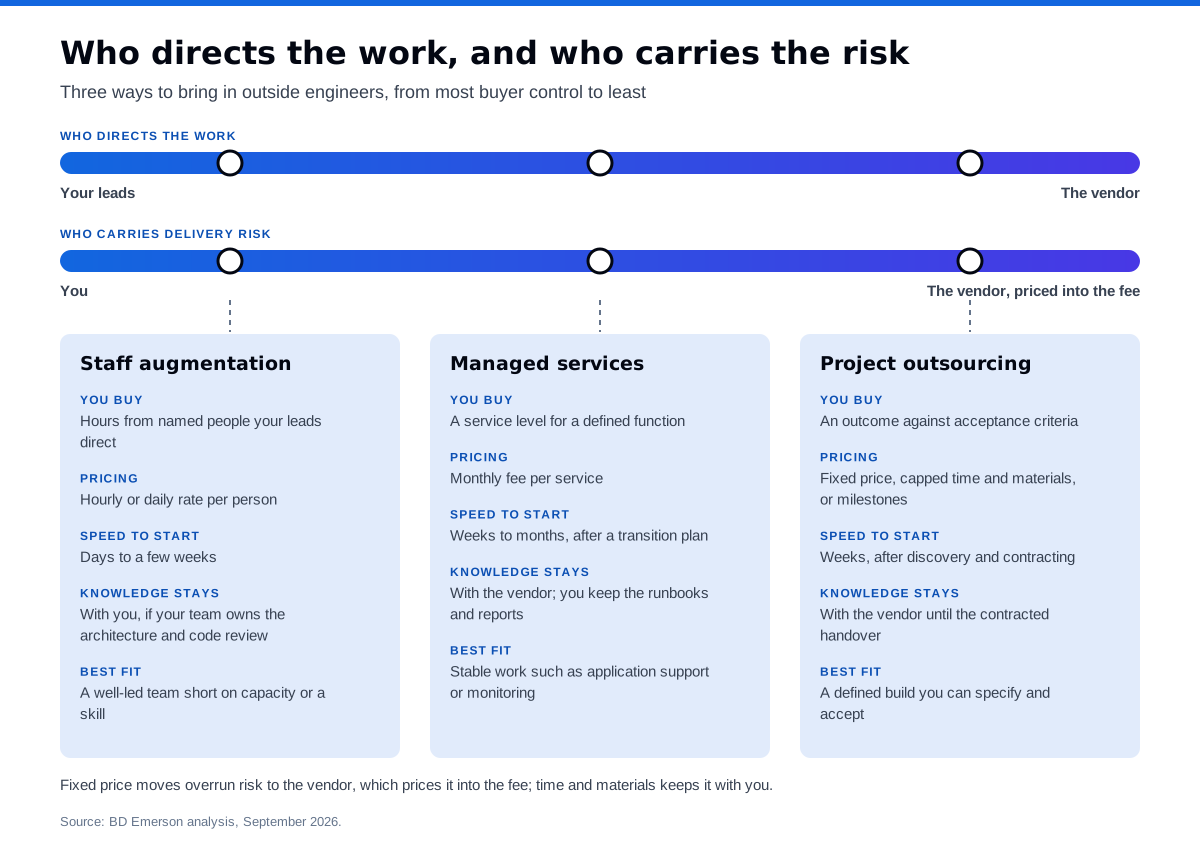
The three models answer two questions differently: who directs the work, and who pays when it is late, wrong, or over budget. Staff augmentation leaves both with you. Managed services hand a defined function to a vendor against service levels, and project outsourcing hands over an agreed scope along with its delivery risk.
| Question | Staff augmentation | Managed services | Project-based outsourcing |
|---|---|---|---|
| Who directs the work | Your leads assign tasks and review code | The vendor, against agreed service levels | The vendor, against scope and acceptance criteria |
| Who owns delivery risk | You | The vendor, for the service levels | The vendor, priced into the fee |
| Pricing model | Hourly or daily rate per person | Monthly fee per service | Fixed price, capped time and materials, or milestones |
| Speed to start | Days to a few weeks | Weeks to months, after a transition | Weeks, after discovery and contracting |
| Knowledge retention | Stays with you if your team owns the architecture and code review | Sits with the vendor; you keep runbooks and reports | Sits with the vendor until handover |
| Best fit | A well-led team that needs capacity or a missing skill | Stable, repeatable work such as application support or monitoring | A defined build with an outcome you can specify and accept |
The difference from a delivered project shows up when something slips. When an augmented engineer's feature runs late, you fix the schedule and pay for the extra hours. When a fixed-price vendor's feature runs late, the vendor absorbs the cost, which is why it prices that risk into the fee, as our custom software development cost guide explains. Buy hours when you can direct them, and buy an outcome when you cannot.
When does staff augmentation work?
Staff augmentation works when your team can absorb people faster than it can hire them, and it fails when the missing piece is direction. The test is whether someone on your side has the time and authority to assign work, review it, and say no. In BD Emerson's planning, one technical lead can direct two to four augmented engineers and still review their code; past that point the lead stops leading and starts triaging.
| Situation | Does augmentation fit? | Better alternative |
|---|---|---|
| A product owner and tech lead with time to direct, and a backlog ready to build | Yes | None needed |
| A missing skill for a defined period, such as a cloud migration or a mobile release | Yes, with knowledge transfer in every sprint | A hire, if the skill outlives the project |
| No technical leader, or architecture decisions going unmade | No: capacity without direction multiplies rework | A fractional CTO or senior hire first |
| A fixed deadline and an outcome you want guaranteed | No: the delivery risk stays with you | A fixed-scope or capped project |
| Permanent core work staffed with contractors to avoid a headcount approval | No: co-employment exposure grows with tenure | A hire |
If the gap is judgment, buy judgment before capacity: a fractional CTO holds architecture and hiring decisions for a share of a week, and augmented engineers then build against them.
How to add engineers without handing over the architecture
Keep every decision that would be expensive to reverse with people who answer to you, and give augmented engineers the work inside those decisions. Five practices hold that line.
Your technical lead owns the architecture decision records. Each significant choice, such as the data model, an integration pattern, or an authentication design, goes into a short record in the repository that your lead approves. Augmented engineers can propose a change, and your lead decides it.
Your engineers approve every merge. Branch protection should require an employee's approval on every pull request into the main branch. NIST's Secure Software Development Framework, SP 800-218 version 1.1, asks organizations to review or analyze code against their secure coding standards in practice PW.7, and that review is where your standards reach contractor code.
Repositories, pipelines, and cloud accounts live in your organization, behind your single sign-on, so ending an engagement means revoking accounts while the code and its history stay put.
Employees pair with augmented engineers on the core modules, which puts knowledge in two heads, one of which stays, and gives your lead a direct read on quality.
The definition of done includes documentation. Every story closes with tests, runbook updates, and any decision record it touched, so knowledge transfer happens in every sprint and the final week of an assignment needs only a short handover.
How much does staff augmentation cost?
Staff augmentation costs the bill rate times the hours worked. The rate covers the engineer's pay, payroll taxes, any benefits, recruiting, and the vendor's margin, and location and seniority move it most.
Kforce, whose technology business produced 93 percent of its revenue, reported in its Form 10-K for 2025 an average technology bill rate of about $90 an hour, an average assignment of 10 months, and a 25.8 percent gross margin on temporary placements. It computes gross profit as revenue minus direct costs, mainly consultant pay, payroll taxes, and certain fringe benefits. That margin puts the bill rate about 35 percent above the vendor's direct cost of the engineer (1 ÷ 0.742 = 1.35). The average spans all of Kforce's technology consultants, so senior specialists bill above it.
| Source | Who | Hourly figure | Basis |
|---|---|---|---|
| Kforce Form 10-K, 2025 | US technology staffing, all levels | About $90 bill rate | Average; 25.8% gross margin |
| BLS, May 2025 | US software developer, median wage | $65.38 | $135,980 ÷ 2,080 hours |
| Accelerance, November 2025 | Latin America | $33 to $45 junior, $60 to $75 senior | Survey of 60 development partners |
| Accelerance, November 2025 | Europe | $31 to $39 junior, $64 to $76 senior | Same survey |
| Accelerance, November 2025 | Asia | $24 to $31 junior, $31 to $41 senior | Same survey |
| BD Emerson planning range | Senior augmented engineer, US vendor | $100 to $175 | Specialists at the top |
| BD Emerson planning assumption | US onshore project firm, senior engineer to architect | $150 to $250 | Includes delivery management and overrun risk |
The wage row is the BLS median annual wage of $135,980 for software developers in May 2025, and the benefits share used below comes from its Employer Costs for Employee Compensation release of September 9, 2026; rate rows come from Accelerance's November 2025 summary of its 2026 rates guide, a vendor-reported survey. Our planning ranges are as of September 2026. Augmentation rates sit below project-firm rates because the staffing vendor neither manages delivery nor absorbs overruns, so count your lead's time as part of the price.
Read the contract terms as closely as the rate.
| Term | What to ask for | Why it matters |
|---|---|---|
| Minimum term and notice | A short minimum, such as one month, and two weeks' notice | Releases capacity when the backlog shrinks |
| Replacement | A no-cost replacement with a committed start date | Protects the schedule from turnover |
| Rate terms | Rates fixed for 12 months, increases capped | Stops repricing mid-project |
| Conversion | A written hiring fee that declines with tenure | Keeps the option to hire without a dispute |
| Intellectual property | An express assignment from the vendor, with matching agreements from every engineer and subcontractor | Copyright starts with the vendor as employer |
| Subcontracting and location | Your written consent before subcontractors or people in another country join | Keeps the people and places you approved |
Is staff augmentation cheaper than hiring? A worked comparison
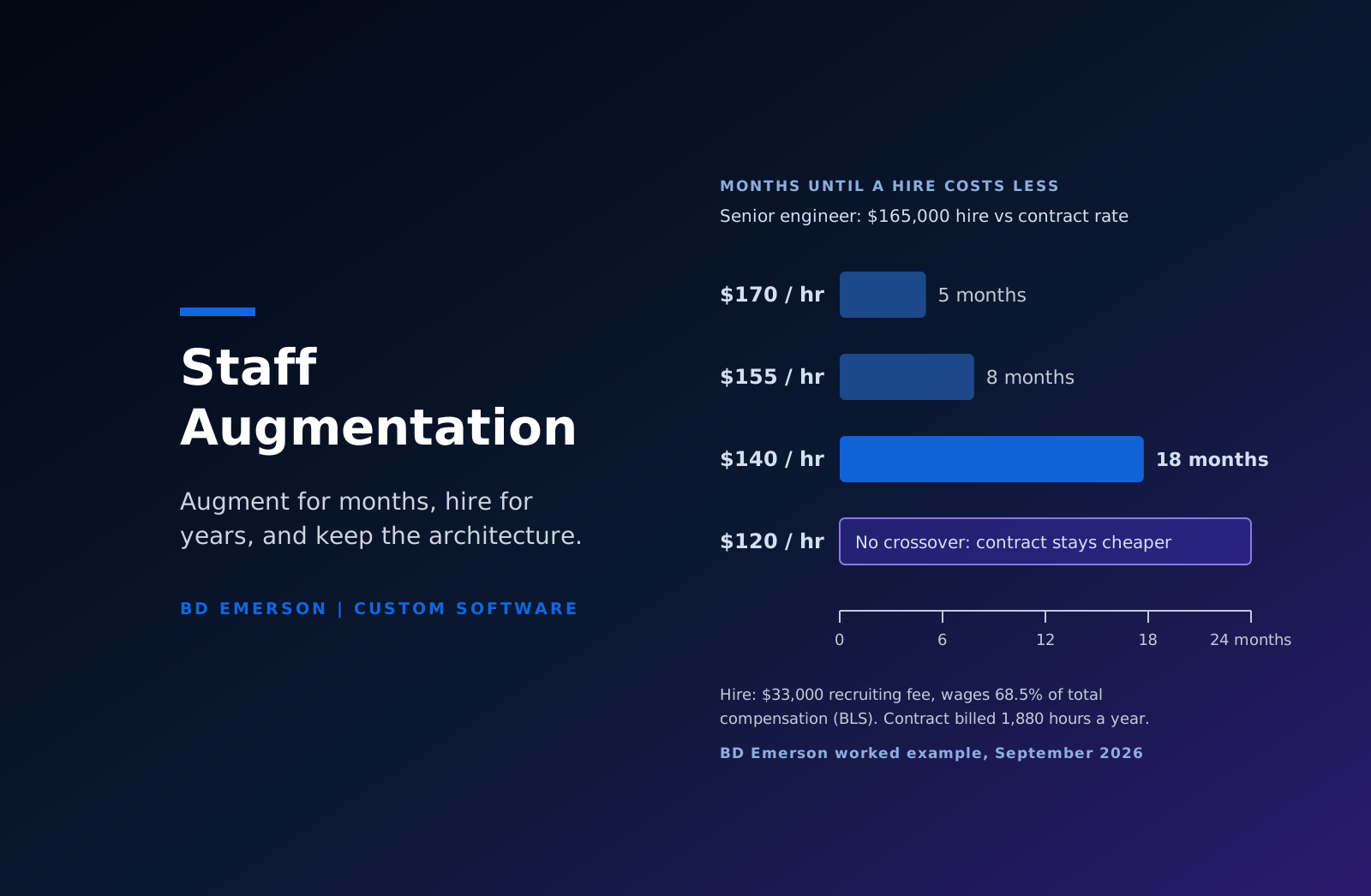
An augmented engineer costs less than a full-time hire until the need outlasts a breakeven point: about 18 months at a $140 bill rate and about 5 months at $170, on the assumptions below. Below the breakeven, augmentation is cheaper and faster to start; above it, the hire is cheaper and keeps the knowledge.
The comparison prices one senior engineer. The hire earns a base salary of $165,000, between the BLS median of $135,980 and the 90th percentile of $214,670. With wages at 68.5 percent of total compensation, the hire costs $165,000 ÷ 0.685 = $240,876 a year, or $20,073 a month. An agency search costs 20 percent of base, or $33,000, as a BD Emerson planning assumption. Both people work 1,880 productive hours a year; the employee is paid for 2,080, and the augmented engineer bills only hours worked, 156.7 a month. At $140 an hour, inside our planning range, that comes to $21,933 a month. Devices, licenses, and your lead's time cost the same either way, so they drop out.
| Cumulative cost | Full-time hire | Augmented engineer at $140 |
|---|---|---|
| Up front | $33,000 recruiting fee | $0 |
| Each month | $20,073 | $21,933 |
| After 6 months | $153,438 | $131,600 |
| After 12 months | $273,876 | $263,200 |
| After 18 months | $394,314 | $394,800 |
| After 24 months | $514,752 | $526,400 |
The augmented engineer costs $1,860 a month more, so the $33,000 recruiting fee buys 17.7 months before the lines cross (33,000 ÷ 1,860). The bill rate moves that point more than any other input. At $120 an hour the contract costs $18,800 a month and never overtakes the hire, because the rate carries none of the employee's paid leave or full benefits. At $155 the hire wins after about 8 months, and at $170 after about 5.
The arithmetic omits three costs that push long needs toward hiring: knowledge that leaves with each contractor, co-employment exposure that grows with tenure, and the monthly margin. It also omits speed, which favors augmentation for short needs: SHRM's 2025 recruiting benchmarks, drawn from more than 2,300 members, put the median time to fill at roughly a month and a half. Our decision rule: augment when the need is shorter than the breakeven at your quoted rate or must start within weeks, hire when the work is core, continuous, and longer than the breakeven, and convert when a contract role passes 12 months with no end date.
Co-employment and worker classification
Augmented engineers should be the vendor's employees, paid through the vendor's payroll, because the control that makes staff augmentation work is the control the IRS and the Department of Labor treat as evidence of employment.
IRS Publication 15-A for 2026 says that under common-law rules anyone who performs services for you is generally your employee if you have the right to control what will be done and how it will be done, and the IRS weighs behavioral control, financial control, and the type of relationship. Assigning tasks and reviewing code is behavioral control. Publication 15-A also says its misclassification relief provision does not apply to a technical service specialist, such as an engineer, computer programmer, or systems analyst, that a firm provides to another business; the common-law rules decide that worker's status. If a vendor places engineers with you as independent contractors, ask how it supports that classification.
Under the Fair Labor Standards Act, the Department of Labor applies an economic reality test. Its 2024 rule took effect March 11, 2024, and a proposal published February 27, 2026 would replace it with an analysis that treats two factors as core: control over the work and the individual's opportunity for profit or loss. Joint employment matters more here, because the vendor employs the engineer and you can be treated as an employer too. The department's April 2026 joint employer proposal would ask whether a business hires or fires the employee, supervises and controls schedules or conditions of employment to a substantial degree, determines the rate and method of payment, and maintains employment records. Both were proposals as of September 2026. The practical line follows those factors: you direct the work, and the vendor hires, fires, pays, approves leave, and keeps the records.
Long, integrated assignments raise the stakes. In Vizcaino v. Microsoft, decided July 24, 1997, the en banc Ninth Circuit held that Microsoft could not exclude from its employee stock purchase plan workers it had signed as independent contractors, whom the IRS had found to be common-law employees; they had worked on teams with regular employees, under the same supervisors, often for more than two years. Keep assignments time-limited, keep augmented staff out of employee-only programs, and route conduct issues through the vendor. State law can apply its own tests, so confirm the structure with employment counsel.
IP, security, offboarding, and knowledge transfer
Four more risks arrive with every augmented engineer, and each one has a contract or access control that contains it.
| Risk | What goes wrong | Control |
|---|---|---|
| Code ownership | The vendor, as employer, holds the copyright | An express written assignment, with matching agreements down the chain |
| System access | Standing administrator rights, personal devices, code copied to personal repositories | Single sign-on with multifactor authentication, least privilege, managed devices, monitoring |
| Offboarding | Accounts that outlive the assignment | An end date on every account and a vendor duty to report departures |
| Knowledge transfer | Designs that live only in a contractor's memory | Decision records, runbooks, and pairing |
Under 17 U.S.C. § 201(b), the employer is the author of a work made for hire, and an augmented engineer's employer of record is the vendor. A commissioned work counts as made for hire only in nine listed categories under a signed agreement, according to the Copyright Office's Circular 30, and most software falls outside them. Assume the vendor or the individual owns the work until a transfer that § 204(a) requires in writing, signed by the owner, moves it to you.
Remote augmentation also carries an identity risk. The FBI's public service announcement of January 23, 2025 warned that North Korean IT workers hired into remote roles had stolen source code and extorted employers, and it recommends identity verification throughout employment and checking that third-party staffing firms run sound hiring practices. In healthcare, the HIPAA definition of workforce in 45 CFR 160.103 covers people under a covered entity's direct control whether or not it pays them, so engineers you direct can fall inside your workforce and its training rules.
Offboarding is where augmentation leaks access. Control PS-7, External Personnel Security, in NIST SP 800-53 Rev. 5 has organizations require external providers to report, within a period the organization sets, when external personnel with credentials or system privileges transfer or leave. Write that duty into the contract and revoke access on the day an assignment ends.
Onboarding checklist for augmented engineers in a regulated environment
Plan onboarding before the contract is signed, because access approvals at a bank, insurer, or health system can outlast the first sprint. Steps map to NIST SP 800-218 practices where one applies.
- Verify identity before access and throughout the assignment, as the FBI's January 2025 announcement recommends, and check a government ID in person where you can.
- Run background checks to your employee standard and get the vendor's results in writing.
- Collect signatures first: IP assignment, confidentiality, your security policies, and in healthcare, HIPAA workforce training before any access to protected health information.
- Issue a managed, encrypted laptop or a virtual desktop, consistent with SSDF task PO.5.2 on hardening development endpoints.
- Grant access through single sign-on with multifactor authentication and least privilege, with an end date matching the statement of work.
- Add the engineer only to repositories inside your organization, with branch protection, consistent with task PS.1.1 on least-privilege access to code.
- Require an employee's review before merge under practice PW.7, and run the same automated security checks on contractor code as on everyone else's.
- Keep production data out of development environments, following task PO.5.1 on separating environments, and test with synthetic or de-identified data.
- Deliver role-based secure development training in week one, as task PO.2.2 calls for.
- Monitor for unusual remote access and code copied to personal accounts, and schedule offboarding on the day you onboard.
Frequently asked questions
What is staff augmentation? Staff augmentation is adding external engineers or specialists to your own team, under your management, paid for their time, while you keep control of the work and accountability for the outcome. The vendor recruits, employs, and pays the people, and your leads assign tasks, review code, and decide what ships.
What is the difference between staff augmentation and managed services? In staff augmentation you direct the people, carry the delivery risk, and pay an hourly or daily rate per person. In managed services the vendor runs a defined function, such as application support or monitoring, against service levels for a monthly fee, and it carries the risk of missing them.
What is the difference between staff augmentation and outsourcing? Staff augmentation buys people's time and leaves direction and delivery risk with you. Project outsourcing buys an outcome: the vendor delivers an agreed scope and absorbs overruns, pricing them into a fixed fee or capped rate. Augment when you can direct the work, and outsource when you want a vendor accountable for a result.
How much does IT staff augmentation cost? Kforce, a US technology staffing firm, reported an average technology bill rate of about $90 an hour for 2025, and senior augmented engineers from US vendors run $100 to $175 an hour in BD Emerson's planning range. Accelerance's November 2025 survey puts senior developers at $60 to $75 an hour in Latin America and $31 to $41 in Asia.
Is staff augmentation cheaper than hiring? Staff augmentation is usually cheaper for short needs and more expensive for long ones. In BD Emerson's worked example, a $165,000 hire costs $240,876 a year with benefits plus a $33,000 recruiting fee, against $263,200 a year for an engineer at $140 an hour. The hire becomes cheaper after about 18 months at that rate.
Who owns the code an augmented engineer writes? Assume the vendor owns it until a signed written transfer moves it to you. The employer is the author of a work made for hire, the vendor is the engineer's employer of record, and commissioned software rarely fits the nine work-for-hire categories. Require an express assignment with matching agreements down the chain, and keep code in your repositories.
Are augmented engineers employees or contractors? They should be employees of the staffing vendor, paid through its payroll. The IRS treats a worker as an employee when the business controls what is done and how, the control augmentation gives you, and the Labor Department's April 2026 joint employer proposal asks who hires, fires, pays, and schedules. Leave those matters to the vendor.
If you're choosing between adding engineers and handing a defined build to a partner, our custom software development team can scope the work in a paid discovery so you can price both on the same roles, hours, and rates, and our fractional CTO service covers the architecture ownership augmentation assumes.

About the author

















