

Veterinary Private Equity: How Vet Practice Deals Work and What Buyers Must Diligence
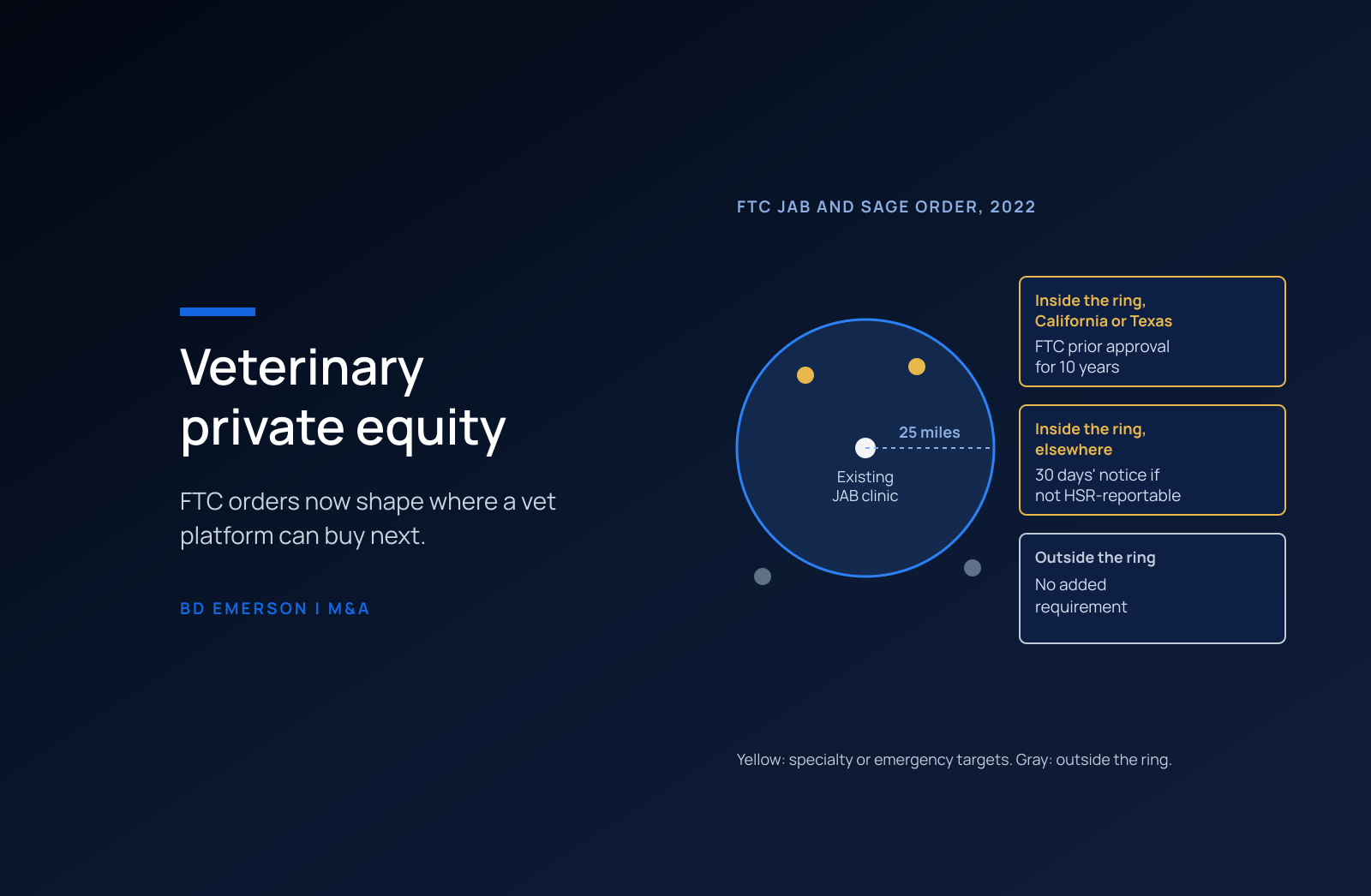
Private equity invests in veterinary medicine through consolidators. A sponsor acquires a platform group of animal hospitals, then adds general practices, specialty referral centers, and emergency hospitals one at a time, often paying the selling veterinarians a mix of cash at closing, equity in the platform, and payments tied to staying on. The model depends on three things diligence has to prove: the veterinarians will keep practicing after the sale, the clinic's earnings survive normalization of owner pay and rent, and every location holds the DEA registrations and state permits it needs on the first day of new ownership. Antitrust risk is real in specialty and emergency care, where the FTC has required divestitures in at least two veterinary deals.
How do private equity firms buy veterinary practices?
The platform-and-add-on structure works in veterinary medicine because the market is fragmented and the economics of a single hospital improve with scale in purchasing, recruiting, and back-office work. A consolidator's first acquisition is often a regional group with enough management depth to absorb others. Each add-on after that is a single practice or a small group, and the purchase price is a multiple of normalized EBITDA, the earnings left after the owner's pay and rent are reset to market terms.
Deal terms reflect the fact that the sellers are also the production engine. The selling veterinarian typically signs a multi-year employment agreement, a non-compete and non-solicit tied to the sale, and in many deals rolls part of the proceeds into equity in the platform so that the seller shares in the eventual exit. Contingent payments, such as an earnout or a holdback released after one or two years, tie part of the price to the practice keeping its doctors and its revenue. When the seller owns the building, the deal often includes a lease at market rent or a sale of the real estate to a separate buyer.
Structure decides which licenses move with the business. Many single-clinic deals are asset purchases, in which the buyer's entity takes the equipment, records, and goodwill and leaves the seller's entity behind. That choice has tax and liability advantages for the buyer, explained in our comparison of an asset sale vs a stock sale, but it also means registrations and permits held by the seller's entity do not follow the assets automatically.
What drives the earnings a buyer will pay for?
Veterinary financial statements need more normalization than most. Owner-veterinarians often pay themselves through a mix of salary, distributions, and production bonuses, run personal expenses through the practice, and rent the building from themselves. The quality of earnings work resets each of these to what the business will cost under new ownership. The adjustments that move the number most in a veterinary deal are these:
- Owner compensation, restated to the market cost of the clinical work the owner performs plus any management role a successor will fill.
- Rent, restated to a market lease when the owner holds the real estate.
- Wellness plans, which bundle a year of preventive care for a monthly fee and create a deferred revenue liability whenever clients have paid for services the hospital has not yet delivered.
- Pharmacy and diet inventory, counted at closing and tested for expired and controlled stock.
- Production by veterinarian, which shows how much revenue depends on one doctor and therefore how much rides on retention.
Revenue mix matters as much as the total. Professional services generally carry higher margins than product sales, and pharmacy and diet revenue faces price competition from online sellers, so two practices with the same revenue can produce very different EBITDA. Specialty and emergency hospitals depend on board-certified specialists and overnight emergency veterinarians, so their staffing risk sits with a much smaller pool of doctors than a general practice draws on.
Why is veterinarian retention the central diligence question?
The hospital's earnings walk out the door with its doctors. If the selling owner produces half of the practice's revenue and plans to retire within two years, the buyer is paying for a revenue stream it must rebuild through recruiting, and the price and structure should say so. Diligence measures production by doctor for at least three years, reviews every employment agreement for term, notice, and compensation formula, and identifies which associates hold the client relationships.
Retention tools work best in combination. Equity in the platform, retention bonuses that vest over several years, and production-based pay that matches or beats the local market keep associates in place more reliably than restrictive covenants, which some states limit for employed veterinarians. Buyers should also ask how clinical decisions will be made after closing, because a doctor who believes protocols and pricing will be set by a distant corporate office is a doctor who may leave.
Which registrations and permits must be in place on day one?
Controlled substances set the hardest deadline. The Drug Enforcement Administration requires a separate registration for each principal place of business or professional practice, so every hospital location that stocks controlled substances needs its own registration, as the DEA's registration guidance confirms. Registrations cannot be assigned or transferred without the DEA's written consent. When a registrant transfers its controlled substance business to another person, it must notify the DEA Special Agent in Charge at least 14 days before the transfer, and the parties take a complete inventory on the transfer date that becomes the seller's final inventory and the buyer's opening inventory under 21 CFR 1301.52.
Diligence should confirm whose registration covers each location's controlled substance stock. In some practices that is the owner-veterinarian's personal registration. If that doctor plans to leave after closing, another veterinarian or the buyer's entity needs a registration at that address in time, and the closing date should follow the DEA timeline instead of the other way around.
State premises rules add a second layer. In California, every veterinary premises must be registered with the Veterinary Medical Board, the application must name a responsible licensee manager, the registration holder must report a change of owner or operator within 30 days, and "the premises registration is nontransferable," according to California Business and Professions Code section 4853. Other states write their own rules, so the diligence team should build a matrix of every permit, registration, and licensed individual by location before the purchase agreement sets a closing date.
How does the FTC look at veterinary roll-ups?
Most single-clinic deals fall below the Hart-Scott-Rodino filing threshold, but the FTC has acted on the largest consolidations and has written conditions that reach the small deals that follow. The two orders in the table show the pattern.
| Order | Deal | Divestitures | Limits on future acquisitions |
|---|---|---|---|
| Mars and VCA, August 2017 | Mars acquired VCA for $9.1 billion | 12 clinics across 10 local markets for specialty and emergency care | 10 years of prior notice before acquiring specialty or emergency clinics in certain areas |
| JAB Consumer Partners and SAGE Veterinary Partners, announced June 2022 | JAB acquired SAGE for $1.1 billion | 6 clinics, three in Austin, Texas and three in San Mateo, Berkeley, and Fairfield, California, sold to United Veterinary Care | 10 years of prior approval for specialty or emergency clinics within 25 miles of a JAB clinic in California and Texas, plus 30 days' notice nationwide for non-reportable deals within 25 miles |
Both orders focus on specialty and emergency hospitals, where a metropolitan area may have only a few providers. The Mars order required the divestitures within 10 business days of closing. In announcing the JAB order, the director of the FTC's Bureau of Competition said that "Private equity firms increasingly engage in roll up strategies," and the 25-mile prior notice condition exists so the agency can see small deals that would otherwise close without a filing. For a sponsor building a specialty or emergency platform, the practical step is to map every target's distance from existing hospitals and model local share before signing.
What should a veterinarian selling to private equity examine?
The headline price tells a seller less than the structure behind it. A seller should break it into cash at closing, rollover equity, and contingent payments, because each carries a different risk. Rollover equity pays only when the sponsor sells the platform, usually several years out, and it sits behind the platform's debt, so its value depends on how much the platform borrows and how well it integrates the hospitals it buys. An earnout pays only if the measured result arrives, so the seller should read exactly how revenue or EBITDA is defined and who controls the pricing, staffing, and spending decisions that drive it after closing.
The employment agreement deserves the same attention: its term, the compensation formula, what happens to unvested equity if the seller leaves early, and the reach of the non-compete. A seller who understands these terms can compare two offers with different structures on equal footing, and can ask for diligence on the buyer's platform in return.
What should integration plan for?
Integration in a veterinary roll-up is mostly operational. Each acquired hospital moves onto the platform's payroll and benefits, purchasing contracts, and eventually its practice information management system, the software that holds medical records, scheduling, invoicing, and inventory. Records migration needs a plan for medical history, vaccine reminders, and controlled substance logs. Hospitals also take card payments and hold client contact and payment data, so each add-on's network and payment environment should be reviewed before it connects to the platform. Consolidators often keep the local hospital name, which protects client relationships while the back office changes underneath.
BD Emerson supports private equity sponsors and veterinary groups with financial, quality of earnings, operational, and cyber diligence on platforms and add-ons, and with the integration plan that keeps doctors and clients through the transition. To scope diligence for a veterinary acquisition, see our M&A due diligence services.

About the author













