

A global reinsurer's investment analytics ran on an Amazon Redshift warehouse. Every new question about exposure, concentration, or a single issuer meant another set of joins across positions, holdings, and reference data, and the business logic lived in SQL spread across reports instead of in one shared model of the portfolio. That meant two reports could answer the same question two ways, and the investment team wanted one answer and a shorter path to it.
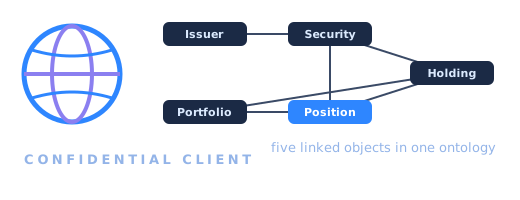
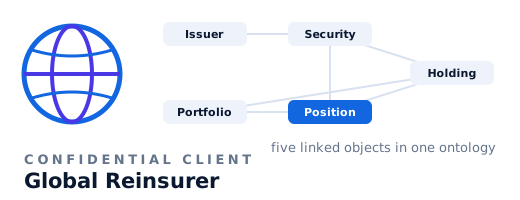
We moved the investment data into Palantir Foundry and modeled it as an ontology of securities, issuers, portfolios, positions, and holdings, with the links between them defined once. A position resolves to its security, a security to its issuer, and a portfolio to its holdings, so an exposure question becomes a walk through the model instead of a new query. Foundry pipelines replaced the warehouse loads with lineage back to each source feed, and the analytics the team relied on were rebuilt against the ontology and checked against their Redshift equivalents before the old versions were retired.
The program ran 12 to 16 weeks. Ontology design came first and was settled with the portfolio managers and risk analysts who would use it, because an object model the investment team does not recognize is one it will work around. Migration then moved by data domain, with reference data and positions ahead of the derived analytics that depend on them.
Analysts ask exposure and concentration questions of one shared model, and the answer no longer depends on which report they open. New analytics start from defined objects instead of fresh joins. Lineage from each metric back to its source feed gives investment risk and internal audit a trail they can follow on their own, and the ontology is ready for the next use case the investment team brings.
Client details in this case study are generalized, and in places combined across engagements, to protect confidentiality. The work is the core of our Palantir Foundry implementation practice, supported by our data engineering team, and our explainer on how the Palantir ontology works covers the modeling approach. We are glad to walk through comparable work under NDA.