Is ChatGPT HIPAA Compliant? Which Plans Come With a BAA
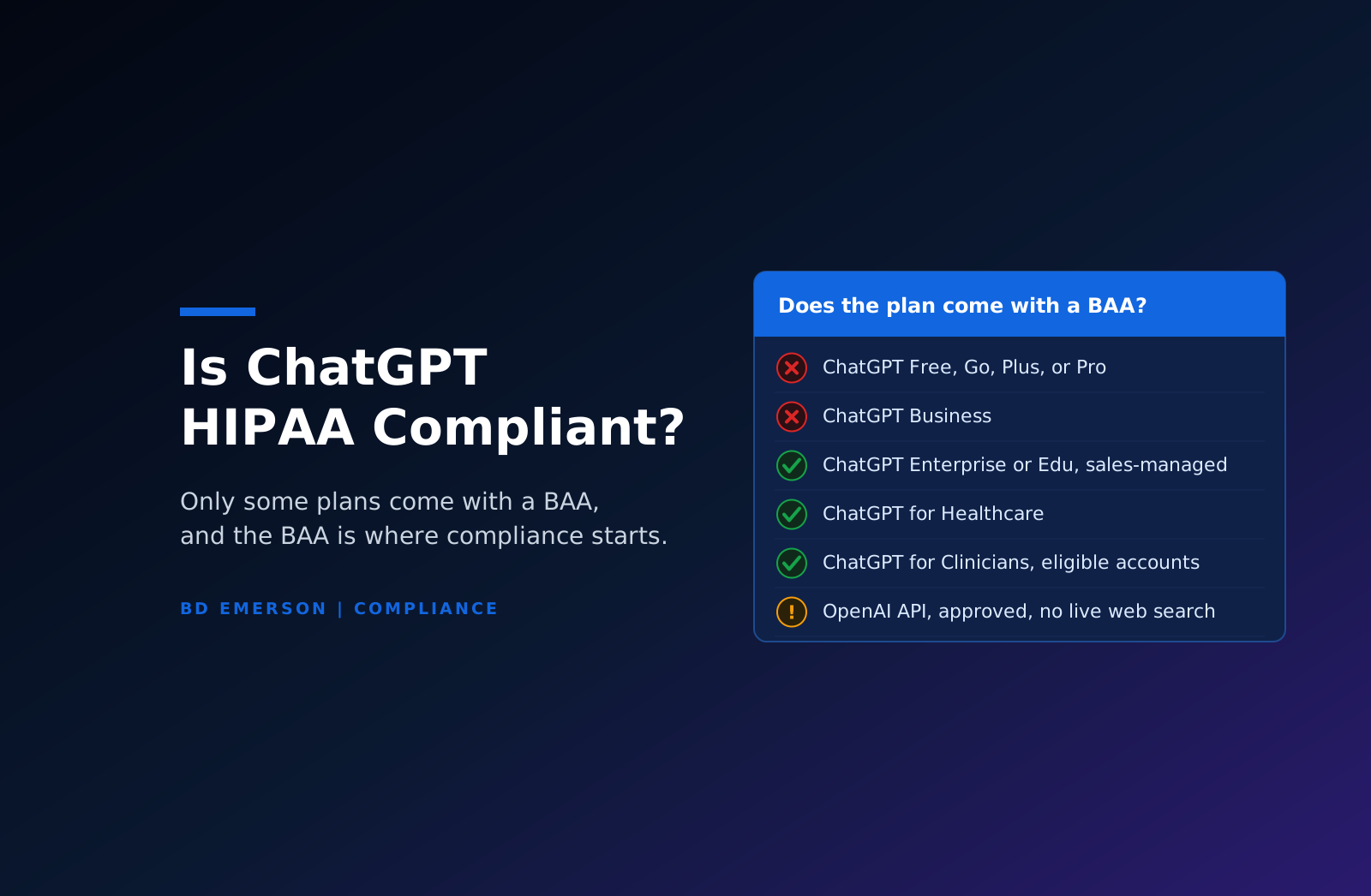
ChatGPT can be used in compliance with HIPAA only when OpenAI has signed a business associate agreement (BAA) for the exact product in use and the covered entity runs that product inside its HIPAA program. As of October 2026, OpenAI offers a BAA for sales-managed ChatGPT Enterprise and Edu workspaces, ChatGPT for Healthcare, eligible ChatGPT for Clinicians accounts, and its API platform for approved customers. It offers no BAA for ChatGPT Free, Go, Plus, Pro, or Business. Protected health information (PHI) typed into those plans is a disclosure to a vendor without a BAA, which 45 CFR 164.402 presumes to be a breach until a documented risk assessment shows otherwise. A signed BAA makes the disclosure permissible; minimum necessary limits, a risk analysis covering the tool, access and audit controls, training, and clinician review decide whether each use complies.
Which ChatGPT plans come with a BAA?
OpenAI's help center article on business associate agreements says that only ChatGPT Enterprise or Edu customers with a sales-managed account are eligible for a BAA for ChatGPT, that OpenAI does not offer a BAA for ChatGPT Business, and that API customers request one by email. The table summarizes OpenAI's own pages as of October 21, 2026.
| Offering | BAA available | Key conditions |
|---|---|---|
| ChatGPT Free, Go, Plus, and Pro | No | Consumer plans. ChatGPT Health, the consumer health space OpenAI introduced on January 7, 2026, runs on these plans, and OpenAI's announcement makes no HIPAA or BAA claim for it. |
| ChatGPT Business | No | OpenAI excludes Business data from model training by default but states that it does not offer a BAA for Business. |
| ChatGPT Enterprise and Edu (sales-managed) and ChatGPT for Healthcare | Yes, through OpenAI sales | Workspace admins set retention, and content is not used for training by default. ChatGPT for Healthcare, introduced January 8, 2026, adds options such as audit logs, data residency, customer-managed encryption keys, SAML single sign-on, and SCIM. |
| ChatGPT for Clinicians | Yes, for eligible accounts | Free since April 22, 2026 for verified U.S. physicians, nurse practitioners, physician assistants, and pharmacists. It is for individual use; OpenAI points organizations to ChatGPT for Healthcare. |
| OpenAI API platform | Yes, on approval | Requests go to baa@openai.com and are reviewed case by case. Most API services are covered; web search with live internet access is not. Abuse monitoring logs are kept up to 30 days unless OpenAI approves zero data retention. |
Two details change how a health system should read that list. The clinician offering covers an individual's own account. OpenAI's ChatGPT for Clinicians announcement says HIPAA support is available through a BAA for eligible accounts, but the BAA that covers a hospital's PHI has to bind the hospital as the covered entity under 45 CFR 164.502(e) and 164.504(e), and an employed physician rarely has authority to sign one. Organization-wide use belongs on ChatGPT for Healthcare or Enterprise under an agreement the organization signs. A BAA also covers a product, a plan, and a feature set. A workflow that is covered on Monday can fall outside the agreement when a developer adds live web search to an API call, so confirm feature coverage with OpenAI in writing before PHI touches a feature you have not used before.
How do Microsoft, Google, AWS, and Anthropic handle BAAs?
Every major AI vendor answers the BAA question at the level of a contract tier, and each draws the line differently. The table reflects each vendor's own documentation as of October 21, 2026. Where a vendor has not published coverage at the level a buyer needs, the cell says to check with the vendor.
| Offering | BAA available | Key conditions |
|---|---|---|
| Azure OpenAI in Microsoft Foundry | Yes, through the HIPAA BAA that Microsoft's Product Terms and Data Protection Addendum include by default for covered entities and business associates | Microsoft has not published BAA coverage model by model: check with vendor. Global deployments can process prompts in any geography where the model runs, and Data Zone deployments anywhere in the zone. |
| Microsoft 365 Copilot and Copilot Chat | Yes, under the same DPA and BAA | Microsoft says they support HIPAA compliance for properly configured implementations; web search queries are outside the DPA and BAA. |
| Gemini app and Gemini in Google Workspace | Yes, after a super administrator accepts the Workspace BAA in the Admin console | Google's list of covered services includes the Gemini app (excluding Gemini in Chrome) and Gemini in Workspace; third-party add-ons and Additional Google Services are excluded. |
| Gemini Enterprise Agent Platform, the April 2026 successor to Vertex AI | Yes, under the Google Cloud BAA | Google lists Generative AI on Agent Platform among covered services and tells customers to use regional resources for PHI in Agent Search. |
| Amazon Bedrock | Yes, as a HIPAA eligible service under the AWS BAA accepted in AWS Artifact | AWS says PHI belongs only in HIPAA eligible services. Coverage of newer Bedrock features and third-party models: check with vendor. |
| Anthropic Claude | Yes, for the first-party API and for Enterprise plans with HIPAA enabled | Team and individual plans cannot enable HIPAA. Anthropic's BAA terms exclude Claude Console and beta features. |
Two patterns repeat across vendors. The same model can be covered in an enterprise tenant and uncovered in a personal account, so the account a person signs in with decides the answer. And features that send a prompt to a separate service, such as web search, often sit outside the agreement, as they do for Microsoft Copilot and the OpenAI API. Microsoft states on its HIPAA compliance page that using its cloud services does not by itself make a customer's solution compliant. Our guide to Microsoft 365 Copilot security covers the tenant settings to fix before Copilot reaches PHI.
What does a BAA settle, and what does it leave to you?
A BAA settles whether a covered entity may disclose PHI to the vendor. Under 45 CFR 164.504(e), the agreement must establish the vendor's permitted uses, require safeguards and incident reporting, pass the same restrictions to subcontractors, and require return or destruction of PHI at termination. It says nothing about whether a particular prompt was appropriate, and the rest of HIPAA still governs the covered entity's own workforce.
Five obligations carry over to every generative AI use. The minimum necessary standard in 164.502(b) and 164.514(d) limits a prompt or upload to the PHI the task needs, so pasting a full chart to draft a two-line referral note fails it even inside a BAA. The risk analysis required by 164.308(a)(1)(ii)(A) has to name the tool, the PHI it receives, and where prompts, outputs, and logs are stored; our HIPAA security risk assessment guide walks through that analysis. Access control under 164.312(a)(1) means unique accounts through single sign-on and timely removal of departing users. Audit controls under 164.312(b) and the information system activity review in 164.308(a)(1)(ii)(D) require logs that someone reviews. Training under 164.308(a)(5) and 164.530(b), and the sanction policy under 164.308(a)(1)(ii)(C) and 164.530(e), have to name which AI tools staff may use with PHI and what happens when they use others.
Which ChatGPT settings matter inside a BAA?
Configuration decides how much PHI OpenAI holds and who can see it. For ChatGPT Enterprise, Edu, and ChatGPT for Healthcare, OpenAI's enterprise privacy commitments say workspace admins control how long data is retained and that deleted conversations are removed from OpenAI's systems within 30 days unless OpenAI is legally required to keep them. Set retention to the shortest period your records and legal hold policies allow, and record that choice in the risk analysis.
Five more settings need a decision before go-live. Apps and connectors pull data from other systems into a conversation, and a connector to a shared drive can expose more PHI than a user ever typed; OpenAI lets admins choose which apps are enabled. Memory carries details from one conversation into later ones, which works against minimum necessary when a user moves from one patient to the next. Shared links and published GPTs can carry content outside the workspace; OpenAI does not support external GPT sharing in ChatGPT for Healthcare, and on other plans the sharing settings need an explicit admin decision. File uploads bring whole documents into scope, so define which document types staff may upload. Administration closes the list: name an owner in IT or compliance, provision users through single sign-on and SCIM so terminated staff lose access, and send audit logs to security monitoring. API deployments add their own settings, including zero data retention, which OpenAI grants only on approval.
What happens if PHI went into ChatGPT without a BAA?
Treat it as a possible breach and start the analysis the day someone finds it. Under 45 CFR 164.402, a use or disclosure of PHI that the Privacy Rule does not permit is presumed to be a breach unless the covered entity or business associate demonstrates a low probability that the PHI has been compromised, based on a risk assessment of at least four factors: the nature and extent of the PHI, including the identifiers and the likelihood of re-identification; the unauthorized person who received it; whether the PHI was actually acquired or viewed; and the extent to which the risk has been mitigated.
For a consumer AI account, the second and fourth factors carry most of the weight. The recipient is a vendor that never agreed to BAA terms for that data, and mitigation depends on what you can still control: deleting the conversation, recording the account's data settings, collecting the details of what was entered, and applying your sanction policy and retraining. If notice is required, individuals must receive it without unreasonable delay and no later than 60 calendar days after discovery under 164.404. Whether the probability of compromise is low is a determination for the privacy officer and counsel, and it must be documented either way, because 164.414(b) puts the burden of proof on the covered entity or business associate. Most of these incidents begin as shadow AI, and our shadow AI guide covers how to find unapproved AI use before an incident does.
Can you de-identify PHI before pasting it into ChatGPT?
Yes, and information that meets HIPAA's de-identification standard is no longer PHI, so no BAA is needed for it. Section 164.514(b) recognizes two methods. Expert Determination requires a qualified expert to find that the risk of identifying an individual is very small and to document the methods and results. Safe Harbor requires removing 18 identifiers of the individual and of relatives, employers, and household members, and having no actual knowledge that the remaining information could identify the person.
Clinical text fails Safe Harbor more often than staff expect. The identifiers include every element of a date except the year, so admission, discharge, procedure, and visit dates all count, and ages over 89 must be grouped as 90 or older. Geographic units smaller than a state count, and a ZIP code may keep only its first three digits, and only for areas of more than 20,000 people. Medical record numbers, account numbers, device serial numbers, URLs, full-face photos, and any other unique identifying characteristic count too. HHS's de-identification guidance says a listed identifier must be removed wherever it appears in a record and that free-text narratives can identify a patient through context, giving the example of a record that lists a patient's occupation as former president of the State University. A note that reads "seen 3/14 for a rare sarcoma, retired fire chief from a small town" has an identifier or an identifying detail in every clause. A limited data set under 164.514(e) does not solve the problem: it is still PHI, and it requires a data use agreement.
Which state laws add duties for AI in patient communications?
Three state laws reach AI in patient care directly, and each applies whether or not a BAA exists. California's AB 3030, codified at Health and Safety Code 1339.75 and effective January 1, 2025, requires health facilities, clinics, physician offices, and group practices that use generative AI to create patient communications about clinical information to include a disclaimer that the message was AI-generated and clear instructions for reaching a human health care provider. The disclaimer goes at the start of letters and emails, stays on screen throughout chat and video, and is spoken at the start and end of audio. The requirements do not apply when a licensed or certified health care provider reads and reviews the communication, and messages about scheduling, billing, and other administrative matters fall outside the law.
Texas's Responsible Artificial Intelligence Governance Act, H.B. 149, took effect January 1, 2026. Under Business and Commerce Code Section 552.051(f), which the act added, the provider of a health care service or treatment must disclose the use of an AI system in relation to that service to the patient or the patient's personal representative no later than the date the service is first provided, or as soon as reasonably possible in an emergency. Illinois's Wellness and Oversight for Psychological Resources Act, 225 ILCS 155, in effect since August 2025, bars licensed professionals from letting AI make independent therapeutic decisions or communicate therapeutically with clients and requires written consent before AI supports recorded or transcribed therapy sessions. Which of these laws reach a given workflow, and how other states' laws apply, is a question for counsel.
A short decision path for using ChatGPT with PHI
Run every proposed use through the same four questions before anyone puts PHI into a prompt.
- Does the input contain PHI? If it meets Safe Harbor or an expert determination under 164.514(b), it does not, and the remaining questions concern accuracy and policy.
- Is there a BAA for this exact product, plan, and feature? A BAA for the API does not cover a staff member's Plus account, and an Enterprise BAA does not cover a feature the vendor excludes.
- Is the use in the risk analysis and the AI acceptable use policy? The tool, its data flows, its retention setting, and its owner should appear in both before go-live.
- Will the output affect care or reach a patient? If so, a clinician reviews it before use, and the state disclosure rules above apply to anything sent to patients.
The figure runs six common uses through that path. Internal policy questions answered from public or internal documents carry the least risk, and everything that summarizes a chart, explains a result, suggests codes, or answers a patient's clinical question needs a BAA-covered plan and a named reviewer.
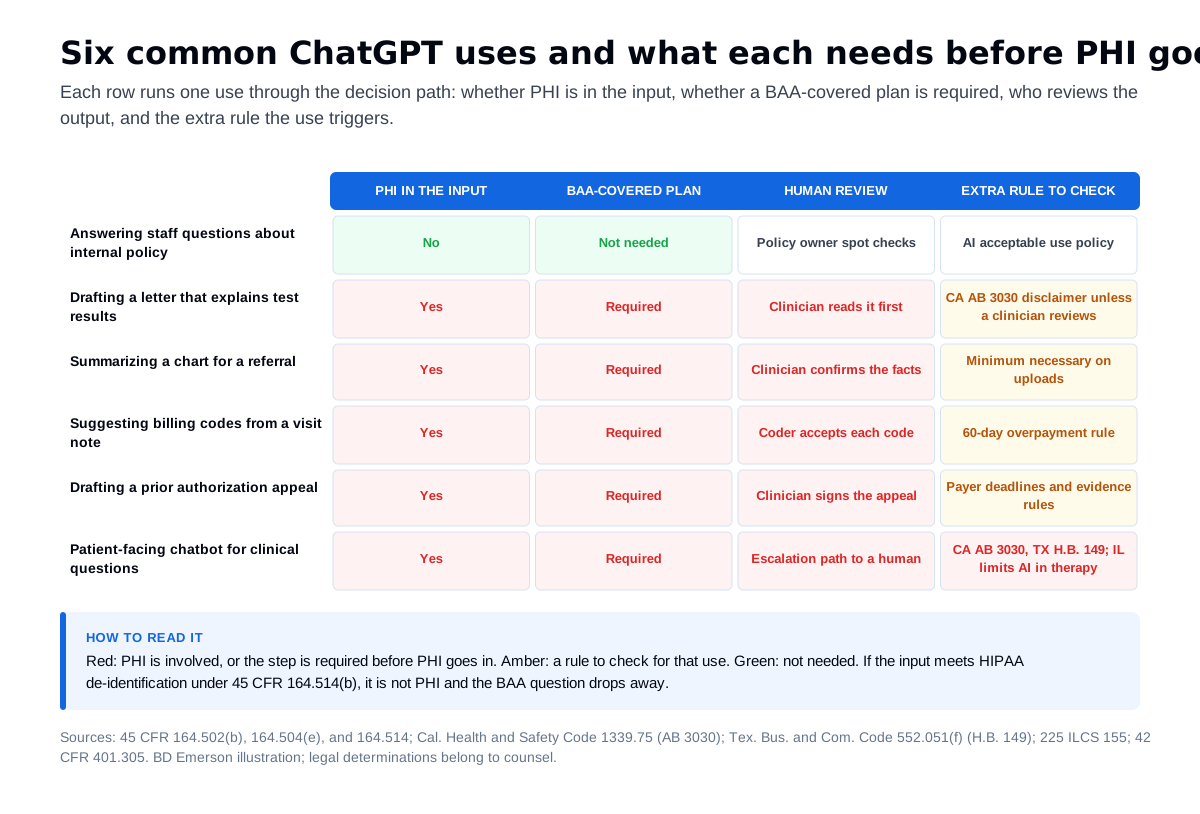
Coding suggestions add billing risk on top of privacy risk: a Medicare overpayment identified after AI-assisted coding must be reported and returned within 60 days of identification under 42 CFR 401.305. Our article on HIPAA and AI covers how the same rules apply when an organization builds an AI model or buys an AI product.
How BD Emerson helps health organizations use generative AI with PHI
BD Emerson's healthcare AI governance team starts with an inventory of the AI tools staff already use, including consumer chatbots found through network, identity, and expense data. We review each vendor's BAA and product settings against the uses you approve, update the HIPAA risk analysis to cover each tool's data flows, and write the AI acceptable use policy, training, and sanction language the Privacy and Security Rules require. When PHI has already gone into an unapproved tool, we assemble the facts for the four-factor assessment, and your privacy officer and counsel make the breach determination. Our HIPAA compliance practice covers the rest of the program, and the HIPAA compliance checklist lists the requirements that AI use sits inside. We do not resell AI software or licenses, so our view on which tool to approve carries no resale margin.
Frequently asked questions
Is ChatGPT HIPAA compliant? Only on offerings OpenAI covers with a business associate agreement, and only when used inside your HIPAA program. As of October 2026, OpenAI offers BAAs for sales-managed ChatGPT Enterprise and Edu, ChatGPT for Healthcare, eligible ChatGPT for Clinicians accounts, and approved API customers. Free, Go, Plus, Pro, and Business have no BAA. Even with a BAA, minimum necessary limits, a risk analysis that covers the tool, access and audit controls, and training still apply.
Does OpenAI sign a BAA? Yes, for some offerings. API customers request one by email at baa@openai.com, and OpenAI reviews each request case by case. For ChatGPT, OpenAI limits BAAs to ChatGPT Enterprise and Edu customers with sales-managed accounts and to ChatGPT for Healthcare, and it offers a BAA for eligible ChatGPT for Clinicians accounts. OpenAI states that it does not offer a BAA for ChatGPT Business.
Can doctors use ChatGPT? Yes, with limits. Doctors can use an approved tool for tasks without PHI, such as drafting patient education from published guidelines. With PHI, they need a BAA-covered offering their organization has approved, such as ChatGPT for Healthcare, or for independent clinicians an eligible ChatGPT for Clinicians account. They remain responsible for reviewing output before it affects care, and laws such as California AB 3030 add disclosure duties for AI-generated patient messages.
Is ChatGPT Health HIPAA compliant? OpenAI makes no HIPAA or BAA claim for it. ChatGPT Health is a consumer feature OpenAI introduced in January 2026 that lets individuals connect their own medical records and wellness apps, and a patient using it for their own records is not a covered entity. Providers should not use it for patient data on their organization's behalf; organizational use belongs on a BAA-covered offering.
What should we do if an employee pasted PHI into ChatGPT? Treat it as a possible breach. Record what was entered, have the user delete the conversation, and run the four-factor risk assessment in 45 CFR 164.402: the PHI involved, who received it, whether it was viewed, and how far the risk was mitigated. If notice is required, individuals must receive it within 60 days of discovery. Document the outcome either way, then apply your sanction policy and retrain the user.
Is a HIPAA compliant AI chatbot enough for patient-facing use? Not by itself. A BAA-covered chatbot meets the vendor contract requirement, and patient-facing use adds clinical and state law duties on top of it. California requires an AI disclaimer and instructions for reaching a human on AI-generated clinical messages unless a licensed provider reviews them, Texas requires disclosure of AI used in health care services, and Illinois bars AI from therapeutic communication. Build human escalation and clinician review into the workflow.
If your staff already use ChatGPT or you are deciding which AI tools may touch PHI, our healthcare AI governance team can inventory current use, review each vendor's BAA and settings, and update your risk analysis and policies so approved tools come with the controls HIPAA expects.

About the author