

Buy and Build Strategy: How Private Equity Platforms Grow Through Add-On Acquisitions
A buy and build strategy is a private equity growth plan in which a sponsor acquires a platform company with the management team and systems to absorb other businesses, then buys smaller add-on companies in the same or adjacent markets and integrates them into the platform. The return comes from three sources: the earnings each add-on brings, the cost and revenue gains from combining them, and the higher valuation multiple a larger and more diversified company can command at exit compared with the small companies bought along the way. The strategy fails when acquisition outruns integration, because the sponsor then exits a loose collection of small businesses that buyers value like small businesses.
How does a buy and build strategy create value?
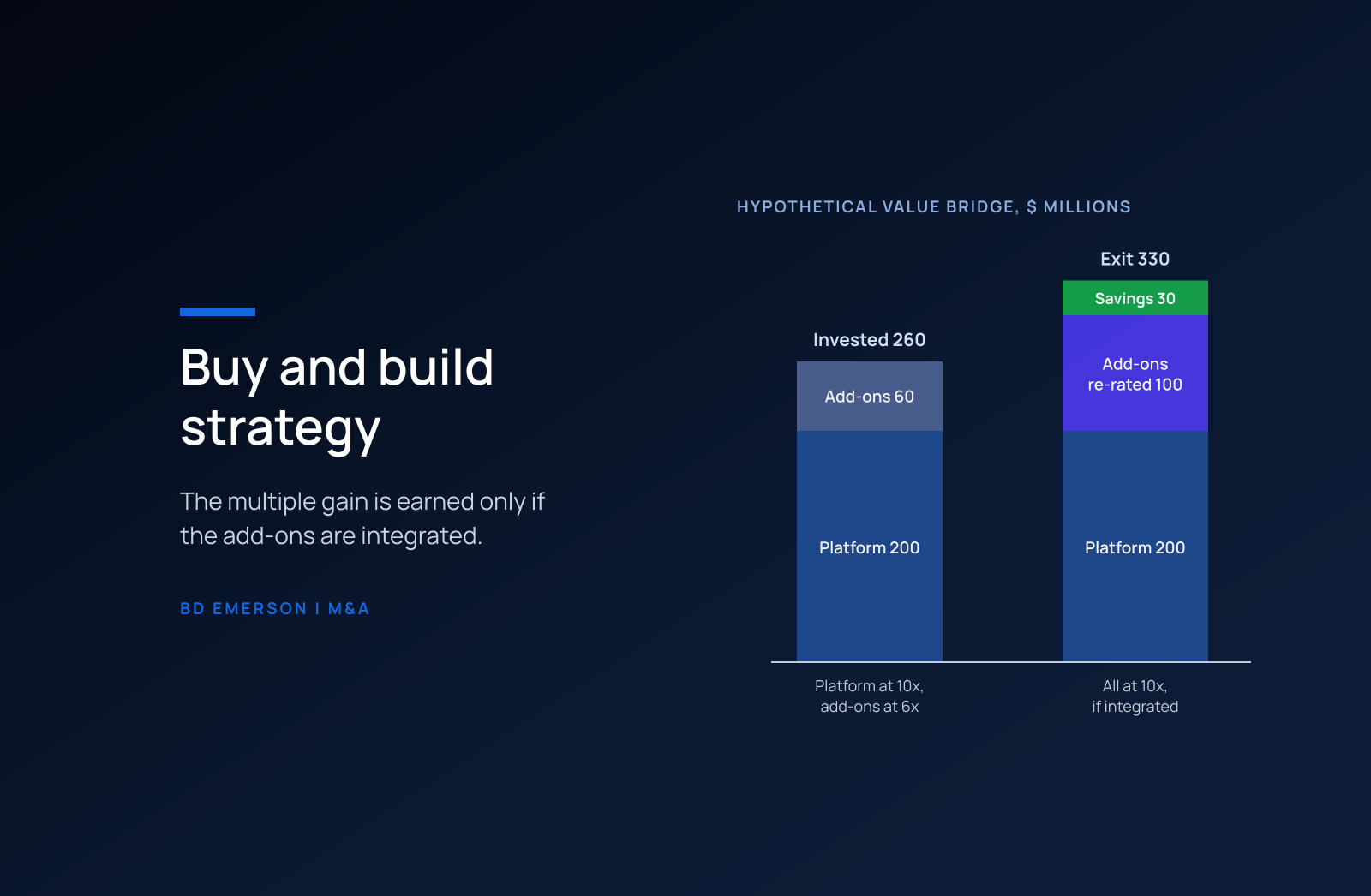
The arithmetic starts with the gap between what a sponsor pays for small companies and what a buyer pays for a large one. Take a hypothetical platform with $20 million of EBITDA bought at 10 times, or $200 million. The sponsor then buys three add-ons with $10 million of combined EBITDA at 6 times, or $60 million. If the combined company sells at the platform's 10 times multiple, its $30 million of EBITDA is worth $300 million against $260 million invested, before any growth. If integration also removes $3 million of duplicate cost, that saving is worth another $30 million at the same multiple. The illustration uses round numbers, and the exit multiple is the weakest assumption in it.
That last point is where most of the work sits. An exit buyer pays a platform multiple for a company that runs as one business: one finance function, one set of systems, consistent pricing, and a management team that has shown it can absorb acquisitions. The same buyer discounts a holding company whose add-ons still run their own payroll, their own accounting software, and their own customer contracts. Multiple arbitrage, the gap between entry and exit multiples, is earned through integration, and the sponsor's value creation plan should say so with dates and owners. Our private equity value creation work builds the add-on program into that plan from the first quarter.
The terms are used loosely, so it helps to fix them. A platform is the first acquisition in a sector, sized and staffed to be the base for the others. An add-on is any later acquisition merged into the platform. Practitioners often call a small add-on that disappears entirely into the platform's operations a tuck-in, and an add-on that keeps its brand or a separate product line while sharing the platform's back office a bolt-on. The table shows how the two roles differ.
| Dimension | Platform | Add-on |
|---|---|---|
| Role | Base for the strategy, with the team and systems others plug into | Adds earnings, geography, customers, or capabilities |
| Typical diligence | Full scope: financial, quality of earnings, commercial, operational, technology, cyber, and tax | Scaled to size and risk, with quality of earnings and integration cost always in scope |
| Integration approach | Builds the integration playbook and absorbs each add-on | Moves onto platform finance, payroll, and IT on a set timeline |
| Valuation dynamic | Bought and sold at the larger company's multiple | Usually bought at a lower multiple that the exit can re-rate |
What makes a good platform?
A good platform has more management depth than its size requires. The CEO matters, but the buy and build plan depends just as much on a CFO who can run a monthly close across many legal entities, a head of HR who can move acquired employees onto one payroll and benefits plan, and an integration leader whose full-time job is the next add-on. A platform that lacks those roles at entry spends the first year hiring them while the acquisition pipeline waits.
Systems are the second test. The platform's ERP, payroll, CRM, and network should be able to take on several more companies without a rebuild, and its cybersecurity controls should be mature enough that connecting a new add-on does not lower the security of the whole group. Market structure is the third. Buy and build works in fragmented markets where many owner-operated companies of similar size serve local or specialized customers, and where the platform's scale gives it real advantages in purchasing, recruiting, or access to larger customers. The platform itself gets full-scope diligence, as described in our guide to private equity due diligence.
How should sponsors diligence an add-on acquisition?
Add-on diligence is scaled to the size of the deal, but it should never be skipped, because small companies carry the accounting and control gaps that cause the most surprises. Many have cash-basis books, no audit, owner expenses running through the business, and related-party rent. The sponsor should require these areas in every add-on scope:
- A quality of earnings analysis that normalizes owner compensation, personal expenses, and related-party transactions, because add-on purchase prices are multiples of an EBITDA figure the seller usually prepared.
- A net working capital peg built from monthly balances, since seasonal swings in small companies are large relative to price.
- Customer overlap with the platform, because customers who already buy from both companies add less revenue than the combined totals suggest and can create a concentration problem.
- Retention of the people who hold customer relationships and technical knowledge, with agreements signed before closing.
- A cyber and IT review sized to the add-on, since its network will connect to the platform's and any compromise it carries comes along.
- A costed integration plan, including the one-time cost of moving the add-on onto platform systems.
Each add-on is also a business combination for accounting purposes, which means a purchase price allocation under ASC 805 that records acquired intangibles and goodwill and measures any earnout at fair value. Lenders read the same numbers. Credit agreements define how much acquired EBITDA and projected cost savings count toward the debt-to-EBITDA tests, and a weak add-on quality of earnings invites the lender to challenge the adjustments the sponsor wants to use.
Why does integration decide the return?
Integration capacity sets the pace of a buy and build program. Every add-on needs a Day 1 plan that keeps payroll, banking, insurance, and system access working the morning after closing, a 100-day plan that moves it onto the platform's monthly close, and a longer program that migrates customers, pricing, and data. A team that closes add-ons faster than it can complete those steps builds integration debt: separate ledgers, duplicate software licenses, inconsistent pricing, and cost savings that appear in the investment memo and never in the financial statements.
Sponsors should track integration with the same discipline they apply to deal flow. For each add-on, the operating partner should see the date it joined the platform's close, the share of its revenue billed through platform systems, and the cost savings realized against the amount underwritten. Those three measures predict what an exit buyer's diligence team will find, and they tell the sponsor when to slow acquisitions so integration can catch up.
What will the exit buyer test?
The exit buyer's diligence team will split the platform's growth into organic and acquired components. It will rebuild revenue for each add-on before and after the acquisition to see whether the add-ons grew under the platform's ownership or simply contributed the revenue they had on the day they were bought. A platform whose growth came entirely from acquisitions gets valued as an acquisition program, and buyers price those programs on the assumption that the next add-on will cost more.
The same team will test whether the cost savings in adjusted EBITDA show up in the general ledger or exist only as pro forma adjustments, and whether the company closes its books on one system or consolidates a dozen spreadsheets each month. A sponsor that wants the platform multiple at exit should assemble that evidence a year before the sale: same-store growth by add-on, realized savings reconciled to the ledger, and a systems map that shows every acquired company on platform finance and payroll.
How do antitrust agencies view roll-ups?
Many add-ons close without a premerger filing. For 2026, the Hart-Scott-Rodino size-of-transaction threshold is $133.9 million, effective February 17, 2026, so a sponsor can complete a series of smaller deals without notifying the agencies before closing. The antitrust laws still apply to every one of them, and the Federal Trade Commission has shown it will look at the series as a whole.
In September 2023, the FTC sued U.S. Anesthesia Partners and private equity firm Welsh Carson, alleging that Welsh Carson created USAP in 2012 and that USAP then acquired more than a dozen anesthesiology practices in Texas and moved each acquired group onto its own higher rates. Announcing the case, then-Chair Lina Khan said the agency "will continue to scrutinize and challenge serial acquisitions, roll-ups, and other stealth consolidation schemes," according to the FTC's announcement. A federal court dismissed Welsh Carson from that case in May 2024, and in January 2025 the firm agreed to a consent order that requires FTC prior approval for any future anesthesia investments and 30 days' advance notice of certain transactions involving other hospital-based physician practices, as the FTC's settlement release describes.
The practical lesson for sponsors is to model local market shares for each add-on before signing, in addition to the platform's national position. Roll-ups in local service markets, such as physician specialties, veterinary hospitals, and home services, concentrate share one small deal at a time, and the agencies have shown they can count the deals together.
BD Emerson supports sponsors through every stage of a buy and build program, from platform and add-on diligence to the integration playbook that turns acquired earnings into one company an exit buyer will pay for. To plan or rescue an add-on integration program, see our post-merger integration services.

About the author













