

SOC Automation: What to Automate First, and What Stays Human
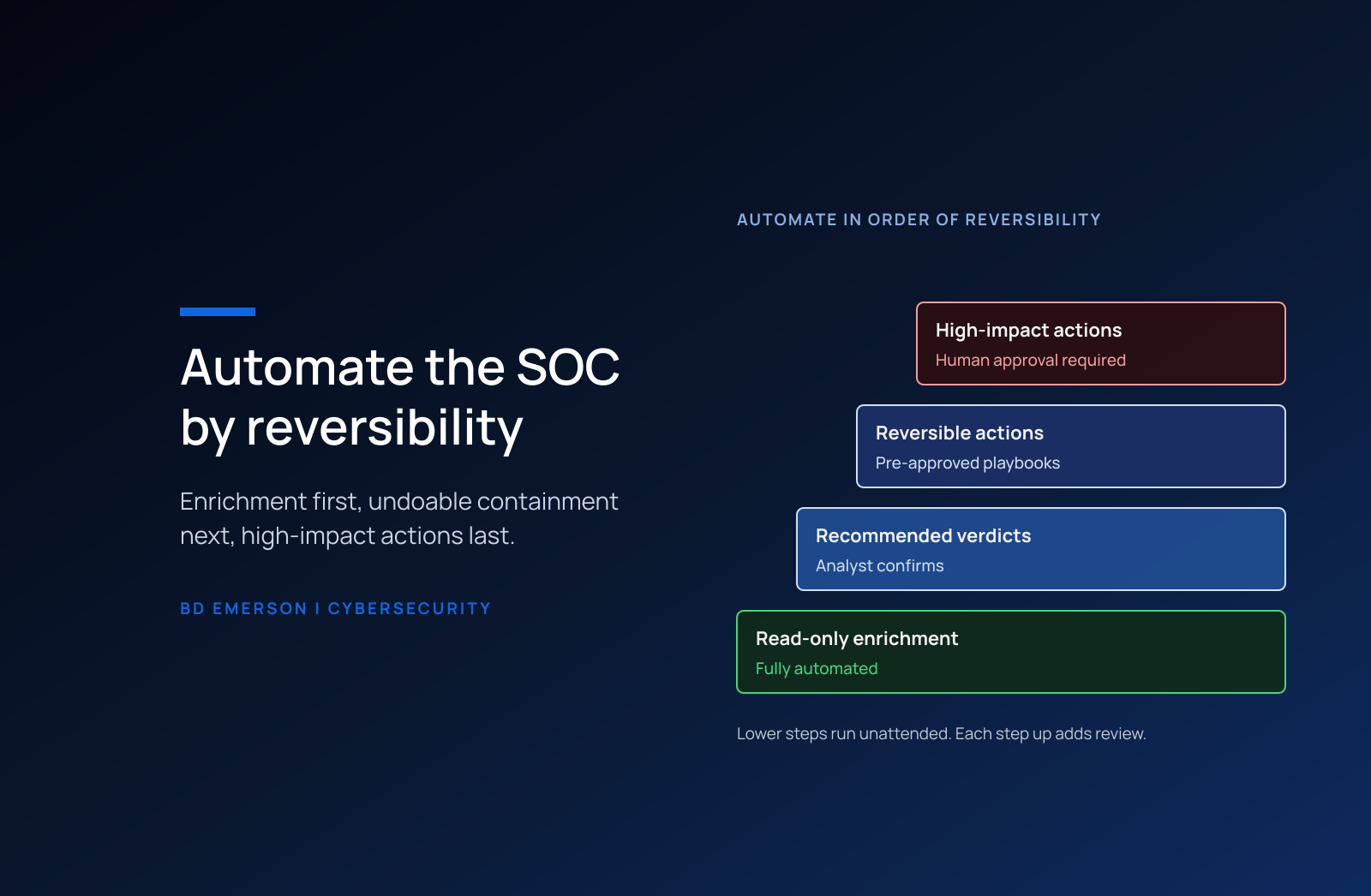
SOC automation is the use of SIEM automation rules, SOAR playbooks, and AI triage agents to perform the repeatable steps of a security operations center (SOC) without an analyst doing them by hand: enriching alerts, merging duplicates, opening and routing cases, closing known false positives, and taking pre-approved containment actions. Automate in order of reversibility. Start with the steps that change nothing in production, then let automation recommend verdicts that analysts confirm, and only then let it act, beginning with containment you can undo in minutes. Automation multiplies whatever the detection layer feeds it. A SOC with noisy, untuned rules gets faster noise, so the program starts with the rules and the runbooks behind them.
What does SOC automation cover?
Every alert in a SOC moves through the same lifecycle. A detection fires, someone gathers context, someone decides whether it matters, someone acts, and someone records the outcome. SOC automation applies software to each of those steps, and in a modern stack the work splits across three layers. The SIEM detects and opens the case. The SOAR layer, short for security orchestration, automation, and response, runs playbooks that call other tools through their APIs. Endpoint detection and response (EDR) and identity platforms hold the native response actions, such as isolating a host or revoking a user's sessions.
Those layers now overlap inside single products. Microsoft's documentation describes Sentinel as both a SIEM and a SOAR platform built to automate "recurring and predictable enrichment, response, and remediation tasks," with automation rules that manage incident handling from one place and playbooks built on Azure Logic Apps workflows. Google Security Operations includes its own SOAR, and Palo Alto Networks sells Cortex XSOAR as a separate automation layer. For a CISO, the decisions that matter are which steps to automate, in what order, and under whose approval.
Which SOC tasks should you automate first?
Rank each candidate task by two questions: what happens if the automation is wrong, and how fast can you undo it? Tasks that only read data or write to the case record can run fully automated from the first week. Tasks that make a judgment should run as recommendations that an analyst confirms until you know the error rate. Tasks that change production should run only when they are reversible, pre-approved for defined conditions, and logged.
| SOC task | If the automation is wrong | Mode to start with |
|---|---|---|
| Enrichment: IP and domain reputation, asset owner, recent sign-ins | Wasted lookups and no production impact | Fully automated |
| Deduplication and grouping related alerts into one case | Two incidents merged or one split, which an analyst can correct | Fully automated |
| Case creation, routing, and SLA timers | A case lands in the wrong queue and is caught at handoff | Fully automated |
| Closing alerts that match a documented benign pattern | A real attack closes without review | Automated, with a weekly sample reviewed by an analyst |
| Verdicts on new alerts | A missed intrusion or a wasted escalation | Recommendation that an analyst confirms |
| Reversible containment: isolate a laptop, revoke sessions, force a password reset | One user or device is disrupted until rollback | Automated under pre-approved conditions |
| High-impact containment: disable a service account, isolate a server, block a domain at the perimeter | A business process goes down | Analyst approval inside the playbook |
| Eradication and recovery: reimage, restore, purge mail across mailboxes | Data loss or destroyed evidence | Human-led |
The middle rows are where programs stall. Closing benign alerts automatically saves the most analyst time, and it is also the step that can quietly close a real intrusion. Run it with a sampling review in which an analyst re-examines a share of auto-closed alerts every week (BD Emerson planning range: 5 to 10 percent during the first quarter, tapering once misses stay at zero). Any miss sends the matching rule back for tuning.
Why does automation fail in an immature SOC?
Joint guidance published in May 2025 by the Australian Signals Directorate, CISA, the NSA, and partner agencies states that SOAR platforms are usually not suitable for immature environments, meaning organizations without a SIEM, with a newly established one, or without an experienced security team. The same guidance warns that a misconfigured platform can misidentify regular user or system behavior as an incident and disrupt service delivery. Both warnings describe one failure. A playbook that isolates any host matching a noisy rule will eventually isolate a production server, and the business will demand that the automation be switched off.
The fix is sequencing. Tune the detections first and measure each rule's true-positive rate. Then write a runbook for every rule that states what the alert means, what to check, and when to escalate. A runbook that every analyst follows the same way is a playbook waiting to be coded. A runbook that analysts handle differently each time shows that the decision still needs a person, and automating it would hard-code one analyst's guess.
Where does AI-assisted alert triage fit?
AI triage agents take on the step that fixed-logic playbooks cannot: reading an alert's evidence and deciding whether it is malicious. Microsoft's Phishing Triage Agent in Defender is a useful reference design because its documentation is specific. It handles alerts for email that users report as phishing, classifies each one as a true or false positive, explains its reasoning in natural language, resolves false positives itself, and leaves true positives open for an analyst. Analysts can change a classification and decide whether the agent learns from the correction. The agent consumes Security Copilot capacity, measured in Security Compute Units, and requires Defender for Office 365 Plan 2.
That design carries two lessons for any AI triage product. First, the risky output is the auto-closed alert, because a wrong verdict removes a real attack from human view. Track the agreement rate between the agent's verdicts and analyst review on a sample before you widen its scope to new alert types. Second, a triage agent reads attacker-controlled content, such as the body of a phishing email, which makes it a target for prompt injection. Give the agent read access and the right to update cases, keep containment rights in playbooks with fixed logic, and review its permissions as you would a privileged service account. Our guide to agentic AI in cybersecurity covers the wider risks of autonomous agents.
What guardrails keep automated containment safe?
Every automated action that changes production needs five controls before it goes live:
- A written trigger condition that names the detection, the confidence threshold, and the asset classes in scope.
- An exclusion list for domain controllers, payment systems, executive and service accounts, and any system whose isolation would cost more than the attack.
- A rate limit, so a faulty rule cannot isolate fifty hosts in ten minutes.
- A one-step rollback that the on-call analyst has tested.
- A record of every action in the case: what ran, why it ran, and what it touched.
Approval gates belong inside the playbook. Cortex XSOAR's documentation describes manual tasks where an analyst confirms information or escalates before the playbook continues. Use that pattern for every high-impact action. Test each playbook against recorded alerts in a staging environment before production, and rerun the tests whenever a vendor changes an API that the playbook calls.
How do you know the automation is working?
Measure automation by what it removes from analysts and by what it gets wrong. Four numbers cover most of it: the share of alerts closed without human touch that stay closed, analyst minutes per alert before and after each playbook, mean time from alert to containment for the alert types you automated, and the count of automated actions rolled back each month. Report the rollback count next to the time savings, because a playbook that saves an hour a day and causes one outage a quarter is a bad trade. Our article on cybersecurity metrics and KPIs for board reporting shows how to roll these operational numbers into measures a board can read.
Should you build the automation in-house or buy it with a managed SOC?
Automation is software, and it needs owners. A playbook calls APIs that vendors change, references group names that IT renames, and depends on detections that tuning alters. Teams that run a standalone SOAR need engineers who write and maintain playbooks as their main job, with a named owner and a regression test for every playbook that calls an external API. Teams that start with SIEM-native automation, such as Sentinel automation rules, can begin with their existing SOC engineers and add dedicated automation staff once the playbook library grows.
If a managed provider runs the SOC, ask who owns the playbooks. Automation built in the provider's tenant leaves with the provider. Automation built in your SIEM, under your licenses, stays when the contract ends. The same ownership question decides much of the choice between an in-house SOC and SOC as a service.
BD Emerson's SOC as a service runs on Microsoft Sentinel or a comparable SIEM inside your tenant, and every detection we deploy ships with a triage runbook that states what the alert means, what to check first, and when to escalate. Those runbooks are the raw material for the automation sequence above, and because the stack stays under your contracts, the playbooks you build on them stay yours. Some clients hand us the full queue, and others keep business-hours triage in-house and use us for engineering depth.

About the author













