363 Sale: How to Buy a Company Out of Bankruptcy
A 363 sale is a sale of a bankrupt company's assets under Section 363 of the Bankruptcy Code, approved by the bankruptcy court after notice and a hearing and usually run as an auction that starts from a stalking horse bid. Buyers use it because the court can approve the sale free and clear of liens and other interests under Section 363(f), and a good-faith buyer keeps the assets under Section 363(m) if the sale order is reversed on an appeal that was never stayed. Contracts and leases move separately under Section 365 once defaults are cured. The cost of that protection is time: bidders often get only a few weeks to diligence a distressed company, and distressed companies tend to cut IT and security spending, lose staff, and fall behind on vendor payments. Counsel runs the bankruptcy process, and the buyer's diligence has to fit inside it.
How does a 363 sale compare with other ways to buy a distressed company?
More companies are filing for Chapter 11 in 2026. Commercial Chapter 11 filings reached 6,560 in the first nine months of 2026, up 11% from the same period of 2025, according to Epiq AACER data the American Bankruptcy Institute released on October 8, 2026, although September filings fell 16% from a year earlier. A buyer looking at a distressed target usually has three routes, and the seller and its lenders have as much say in the choice as the buyer.
| Factor | 363 sale | Sale under a Chapter 11 plan | Out-of-court asset purchase |
|---|---|---|---|
| Timing | Weeks to a few months from the petition, subject to notice periods | Waits for a disclosure statement, a creditor vote, and confirmation | As fast as the parties and the seller's lenders agree |
| Liens and other interests | The court can sell free and clear under Section 363(f) | The plan can provide for a sale free of liens under Section 1123(a)(5)(D) | Each lienholder must release its lien or be paid |
| Who approves | The court, after notice, objections, and a hearing | Creditors vote and the court confirms the plan | The seller's board and lenders, with no court involved |
| Contracts and leases | Assumed and assigned under Section 365, which overrides most anti-assignment clauses, with cures paid | The same Section 365 tools, used inside the plan | The counterparty's consent wherever the contract requires it |
| Buyer protection | A court order and good-faith purchaser protection under Section 363(m) | A confirmation order | Contract terms only; no court order binds the seller's creditors |
The 363 sale trades negotiating room for speed and a court order, which suits a business that loses value every week it spends in Chapter 11. Because it is an asset purchase, the structural points in our guide to asset sales and stock sales apply, with a court order in place of the lien releases an out-of-court buyer would need.
What does Section 363 allow, and what protects the buyer?
Section 363(b)(1) lets the trustee use, sell, or lease estate property outside the ordinary course of business after notice and a hearing, and in most Chapter 11 cases the company itself exercises that power as debtor in possession under Section 1107(a). Five other parts of the statute shape what the buyer gets:
- Section 363(f) allows a sale free and clear of any interest if one of five conditions is met: nonbankruptcy law permits it, the holder consents, the interest is a lien and the price exceeds all liens on the property, the interest is in bona fide dispute, or the holder could be compelled to accept a money satisfaction.
- Section 363(k) lets a secured creditor bid at a sale of its collateral and offset its claim against the price, unless the court orders otherwise for cause, so a lender can bid its debt instead of cash.
- Section 363(m) provides that reversing or modifying a sale authorization on appeal does not affect the validity of a sale to a good-faith purchaser unless the authorization and sale were stayed pending appeal.
- Section 363(n) lets the trustee avoid a sale whose price was controlled by an agreement among potential bidders, so any arrangement with another bidder needs counsel's review before the auction.
- Section 363(b)(2) shortens the HSR waiting period for a reportable sale: the trustee files, and the waiting period ends on the 15th day after the agencies receive the notification unless it is extended.
The Supreme Court addressed Section 363(m) in MOAC Mall Holdings v. Transform Holdco, decided April 19, 2023. The case grew out of Sears' 2019 sale of most of its assets to Transform, which later designated a Mall of America lease for assignment over the landlord's objection. The Court held unanimously that Section 363(m) is not jurisdictional, so a buyer that fails to raise it in time can forfeit it. The provision still protects a good-faith buyer against an unstayed appeal, which is why buyers ask the court for an express good-faith finding in the sale order and raise the defense at the first opportunity.
How does the 363 sale process work?
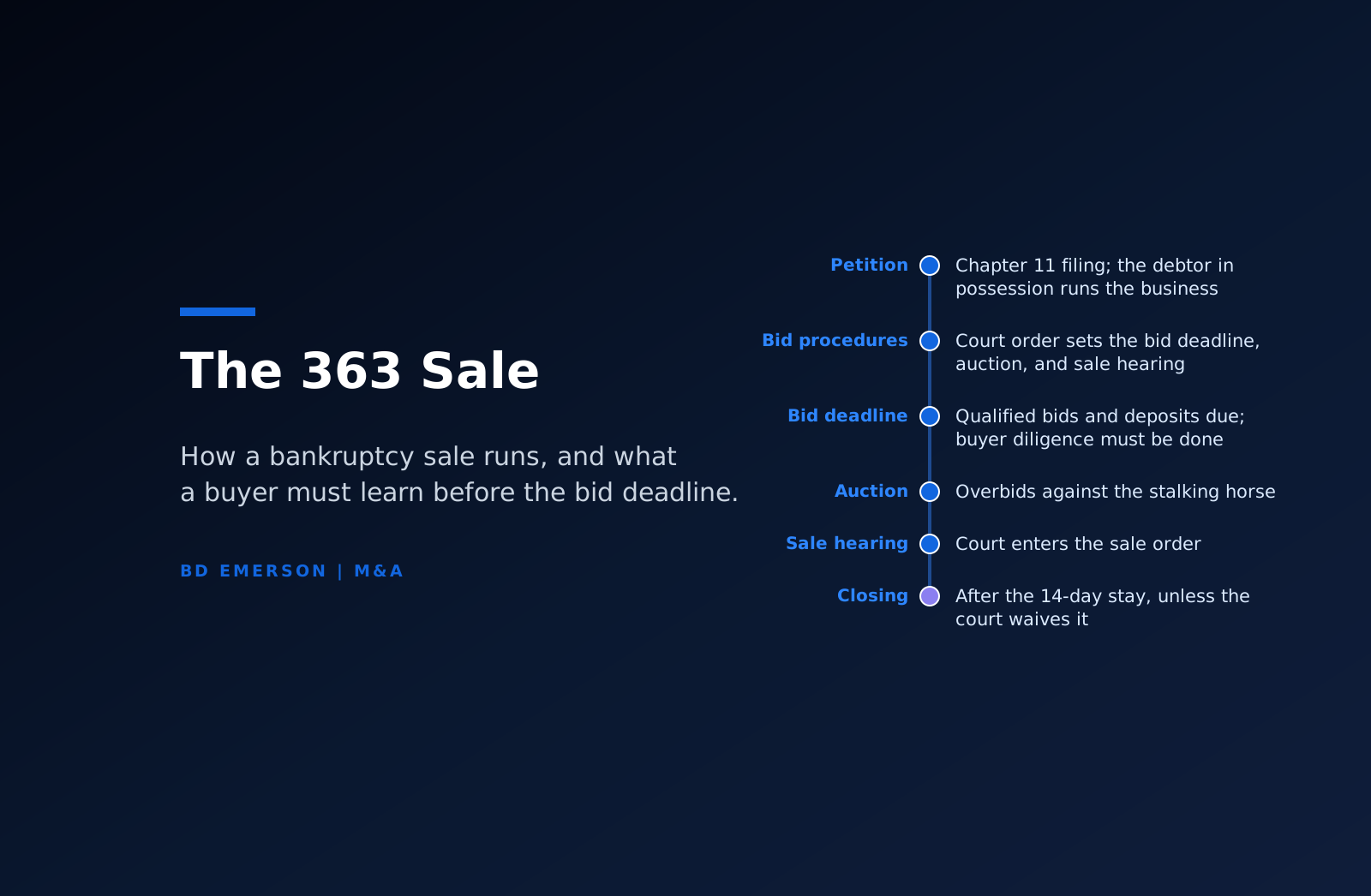
The process runs on court deadlines. The debtor in possession files a motion to approve bidding procedures, often with a stalking horse asset purchase agreement already signed. The court's bidding procedures order sets the bid deadline, the requirements for a qualified bid, deposits, the auction rules, any protections for the stalking horse, and the date of the sale hearing. Qualified bidders submit by the deadline, the auction runs if more than one qualified bid arrives, and the court holds the sale hearing to approve the winning bid in a sale order. Closing follows once the order is effective.
The Federal Rules of Bankruptcy Procedure set the minimums. Rule 6003 bars the court from approving a sale, or the assumption and assignment of contracts, within 21 days after the petition unless the relief is needed to avoid immediate and irreparable harm. Rule 2002(a)(2) requires at least 21 days' notice of a proposed sale outside the ordinary course unless the court shortens it for cause, and Rule 6004 requires objections at least 7 days before the sale, or by a date the court sets, and stays the sale order for 14 days after entry unless the court orders otherwise, which is why buyers often ask the court to waive that stay. In practice the sequence takes weeks to a few months. 23andMe was still looking for a purchaser when the FTC chairman wrote to the U.S. Trustee on March 31, 2025, and TTAM Research Institute closed its purchase of the company's personal genome and research businesses under Section 363 on July 14, 2025.
What is a stalking horse bid, and what does it get?
A stalking horse is the first bidder to sign an asset purchase agreement with the debtor, and its agreement becomes the floor and the template for the auction. Other bidders mark up the stalking horse agreement rather than writing their own, and they must beat its price by any minimum overbid the bidding procedures set. In return for doing its diligence first and letting the debtor shop its offer, the stalking horse usually negotiates bid protections that the court must approve: a break-up fee payable if another bidder wins, and reimbursement of its expenses. Their size is negotiated deal by deal, and bankruptcy counsel will know what the local court has accepted before.
The role buys influence over the agreement's terms, the definition of the assets, and the list of contracts to be assumed. The cost is running diligence on the tightest timeline and publishing a price that others can top. A secured lender can take the role with a credit bid under Section 363(k), which changes the math for cash bidders, because the lender can bid up to its allowed claim without new money.
Which contracts, licenses, and leases can the buyer take?
Contracts move under Section 365, which has its own requirements. The debtor assumes each contract the buyer wants and assigns it to the buyer. To assume a contract in default, the debtor must cure the default, compensate the counterparty for its monetary loss, and provide adequate assurance of future performance, and Section 365(f)(2) requires adequate assurance of the buyer's own future performance as assignee. Section 365(f)(1) lets the debtor assign a contract even where the contract or applicable law restricts assignment. The MOAC dispute started at this step: the landlord objected that Sears had not provided adequate assurance of Transform's future performance under Section 365(f)(2)(B).
Section 365(c)(1) is the exception that matters most for technology. It bars assumption or assignment where applicable law excuses the other party from accepting performance from anyone other than the debtor and that party does not consent. Counsel should test every material software, data, and intellectual property license against that carve-out before the bid, because a license the buyer cannot take becomes a new license or a replacement project, and either one has a price. Cure amounts are the other cost: unpaid software and cloud invoices become cure costs when the contract is assumed, and the purchase agreement decides who pays them. When the debtor licenses its own intellectual property to others, Section 365(n) lets those licensees keep their rights if the debtor rejects the licenses, so a buyer of that IP should map the existing licenses before it bids.
Can a buyer acquire customer data in a 363 sale?
A buyer can acquire customer data, subject to conditions written into Section 363(b)(1). If the debtor gave individuals a privacy policy that prohibits transferring personally identifiable information to unaffiliated persons, and that policy was in effect when the case began, the debtor can sell the data only if the sale is consistent with the policy, or if the court approves it after a consumer privacy ombudsman is appointed under Section 332 and after notice and a hearing. To approve it, the court must find that no showing was made that the sale would violate applicable nonbankruptcy law. Under Rule 6004(g) the sale motion must ask for the ombudsman's appointment, the U.S. trustee appoints the ombudsman at least 7 days before the hearing, and the ombudsman can tell the court about the policy, the privacy losses or gains for consumers, and alternatives that reduce the harm.
The FTC watches these sales. In RadioShack's 2015 case, the director of the FTC's Bureau of Consumer Protection wrote to the consumer privacy ombudsman that RadioShack had promised not to sell customers' information, and recommended that any sale bundle the data with other assets, go to a buyer in substantially the same line of business, bind the buyer to the policies in place when the data was collected, and require affirmative consent before any materially different use. In March 2025, FTC Chairman Andrew Ferguson wrote to the U.S. Trustee in 23andMe's case that any purchaser should "expressly agree to be bound by and adhere to the terms of" 23andMe's privacy policies and applicable law. The letter quoted the company's own statement that in a bankruptcy or asset sale its policy would apply to personal information transferred to the new entity.
Before bidding on data, a buyer should establish four facts: the privacy policy in force when each data set was collected, which may differ from today's version; the consent records behind sensitive data such as health, genetic, financial, or children's information; the state privacy laws that apply, since a court approving a sale over a restrictive policy must find no showing of a violation; and whether the data can be separated from the systems the estate keeps. Counsel decides how the sale order treats the data, and the buyer's diligence tells counsel what is actually there.
What technology and security diligence does a distressed target need?
Distress changes technology risk in predictable ways, and the bid deadline is the last point at which a buyer can price it. The first issue is underinvestment: patching, license renewals, hardware refresh, and security tooling are early cuts when cash runs short, so expect end-of-life systems, lapsed support contracts, and monitoring that was switched off to save money. The second is departed people. IT and security staff often leave early, taking the working knowledge of key systems with them, so ask who still holds administrator credentials and whether the departed staff's access was removed. The third is lapsed vendors. Software and cloud providers may have suspended accounts for nonpayment before the filing, and the unpaid invoices become cure costs if the buyer wants those contracts.
The fourth is incidents nobody has found. A company that cut monitoring may not know it has been breached, and a compromise discovered after closing is the buyer's operational problem even if the liability stayed with the estate. Where logs still exist, a compromise assessment before the bid deadline is cheap protection, and the rest of the review can follow our cybersecurity due diligence checklist at the depth the calendar allows. The fifth is what the estate can deliver after closing. A seller that is winding down may not be able to provide transition services for long, because its staff are leaving, its own vendors may cut it off, and the estate may not outlast the case. Size the transition services agreement to what the estate can actually deliver, and build the day-one IT plan around the systems the buyer must stand up itself.
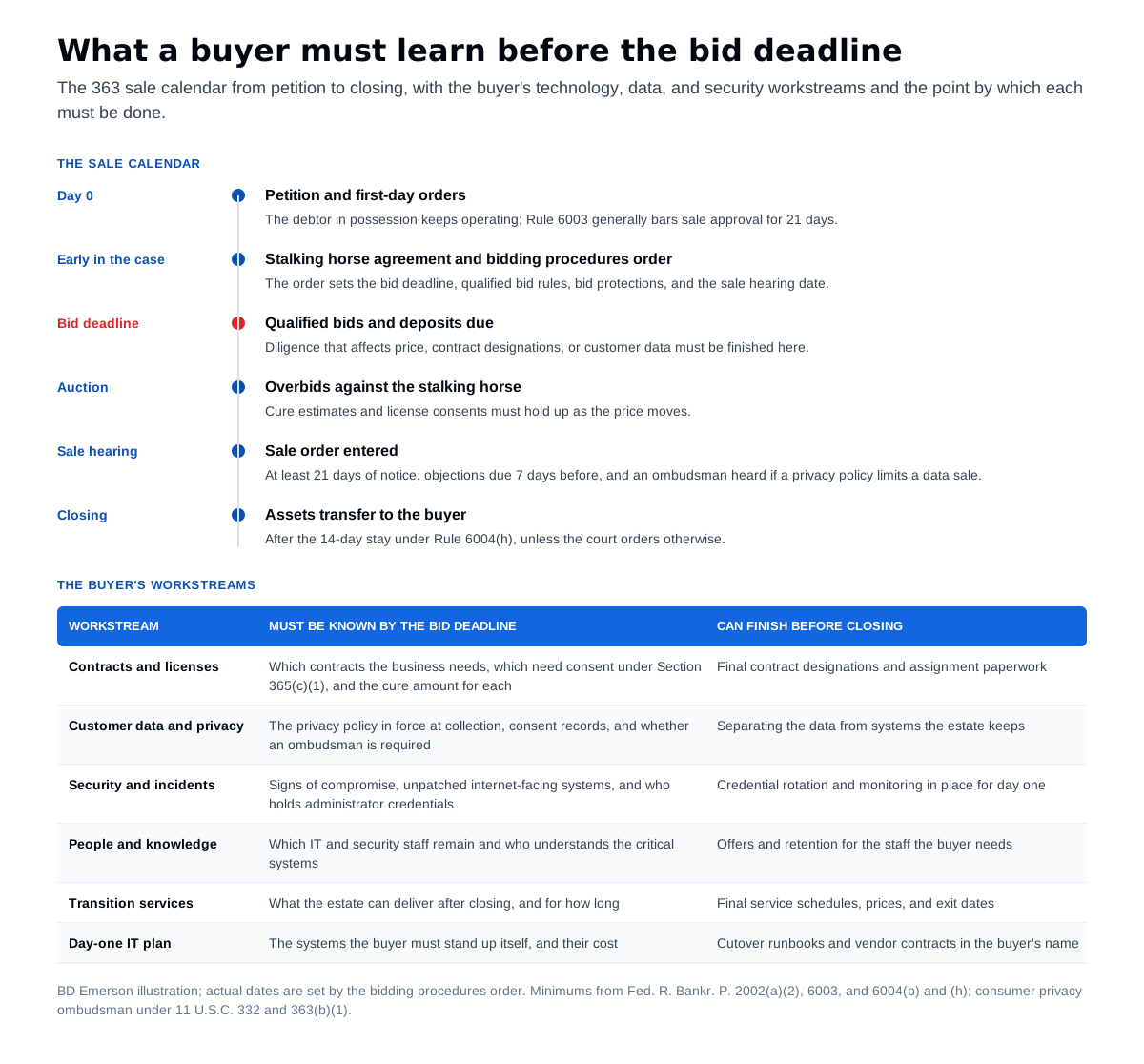
When the buyer takes only part of the business, the work looks like a carve-out from a parent that will not be around to help. Our guide to the IT carve-out covers the entangled-asset inventory and the separation patterns, and the inventory matters more here, because there will be no extension to negotiate once the seller's case has closed.
How BD Emerson supports buyers in 363 sales
Bankruptcy counsel runs the process: the bidding procedures, the asset purchase agreement, the sale order, and every question of what transfers free and clear. BD Emerson runs the buyer's technology, data, and security diligence inside that calendar through our M&A due diligence practice. Before the bid deadline we inventory the systems, contracts, and licenses the business needs, identify the ones that need consent or carry large cures, map where customer data sits and which privacy policy governed its collection, and test for signs of compromise where access allows. We then build the separation and day-one plan, including what the estate can realistically provide under transition services. Our buy-side M&A advisory and carve-out advisory teams carry that plan into the purchase agreement schedules and the first months after closing.
Frequently asked questions
What is a 363 sale? A 363 sale is a sale of a debtor's assets outside the ordinary course of business under Section 363(b) of the Bankruptcy Code, approved by the bankruptcy court after notice and a hearing. It usually runs as an auction that starts from a stalking horse bid. The court can approve the sale free and clear of liens and other interests under Section 363(f), and Section 363(m) protects a good-faith buyer if the sale order is later reversed on an appeal that was not stayed.
How long does a 363 sale take? A 363 sale usually takes weeks to a few months from the bankruptcy filing. The rules set minimums: the court generally cannot approve a sale within 21 days of the petition, creditors get at least 21 days' notice of the sale, and the sale order is stayed for 14 days unless the court orders otherwise. In 23andMe's case, the buyer closed its Section 363 purchase on July 14, 2025, about fifteen weeks after the FTC wrote to the U.S. Trustee, when the company was still looking for a purchaser.
What is a stalking horse bid? A stalking horse bid is the first signed asset purchase agreement in a 363 sale, and it sets the minimum price and the contract that other bidders must improve on at the auction. In return for doing its diligence first and letting the debtor shop its offer, the stalking horse usually receives bid protections approved by the court, such as a break-up fee and reimbursement of its expenses if another bidder wins.
What does free and clear mean in a 363 sale? It means the court orders the assets sold without the liens and other interests that attached to them, under Section 363(f). The court can do so only if one of five conditions is met, such as the holder's consent, a price above the total of all liens on the property, or a bona fide dispute over the interest. Which claims and interests a particular sale order cuts off is a question for the buyer's bankruptcy counsel.
Can a buyer get customer data in a bankruptcy sale? A buyer can, subject to conditions in Section 363(b)(1). If the debtor's privacy policy prohibited transferring personal information to unaffiliated parties, the sale must be consistent with that policy, or a consumer privacy ombudsman must be appointed and the court must approve the sale after a hearing. The FTC has weighed in on such sales, including RadioShack in 2015 and 23andMe in 2025, asking that buyers be bound by the privacy promises made when the data was collected.
Does a buyer in a 363 sale take on the seller's liabilities? A 363 sale is an asset purchase, so the buyer generally takes only the liabilities it agrees to assume, such as cure costs on the contracts assigned to it, and the court can sell the assets free and clear of liens and other interests under Section 363(f). How far a sale order protects the buyer against other claims depends on the claim and the court, so the buyer's bankruptcy counsel should answer that question for each deal.
If you are weighing a bid for a company in Chapter 11, our M&A due diligence team can run the technology, data, and security workstreams before the bid deadline and build a day-one plan that does not depend on the estate.

About the author