

Best Data Governance Tools in 2026: 10 Platforms Ranked
The best data governance tools in 2026 are Collibra, Informatica Cloud Data Governance and Catalog, Microsoft Purview, Databricks Unity Catalog, Alation, Atlan, Snowflake Horizon Catalog, Google Cloud Knowledge Catalog, BigID, and Securiti, ranked in that order for an enterprise that governs data across more than one platform. Independent suites lead the list because they catalog, trace, and set policy across every platform, platform-native catalogs enforce policy most directly inside their own platform, and privacy platforms find sensitive data the others miss. BD Emerson publishes this list, implements governance programs on several of these platforms, and resells none of them. We described each tool from its vendor's own documentation and announcements as of October 2026.
Data governance tools at a glance
The ten platforms fall into three types, and two changed owners in 2025. Ownership below is as of October 2026.
| Rank | Tool | Type | Owner |
|---|---|---|---|
| 1 | Collibra | Independent suite | Collibra, privately held |
| 2 | Informatica Cloud Data Governance and Catalog | Independent suite | Salesforce, since November 18, 2025 |
| 3 | Microsoft Purview | Platform-native and data security suite | Microsoft |
| 4 | Databricks Unity Catalog | Platform-native | Databricks |
| 5 | Alation | Independent suite | Alation, privately held |
| 6 | Atlan | Independent suite | Atlan, privately held |
| 7 | Snowflake Horizon Catalog | Platform-native | Snowflake |
| 8 | Google Cloud Knowledge Catalog | Platform-native | Google Cloud |
| 9 | BigID | Privacy and data security platform | BigID, privately held |
| 10 | Securiti | Privacy and data security platform | Veeam, since December 2025 |
Two other changes matter for buyers. ServiceNow signed an agreement to acquire data.world, a data catalog and governance provider, in May 2025, and Google renamed Dataplex Universal Catalog to Knowledge Catalog in April 2026.
How we ranked them: methodology and weighted rubric
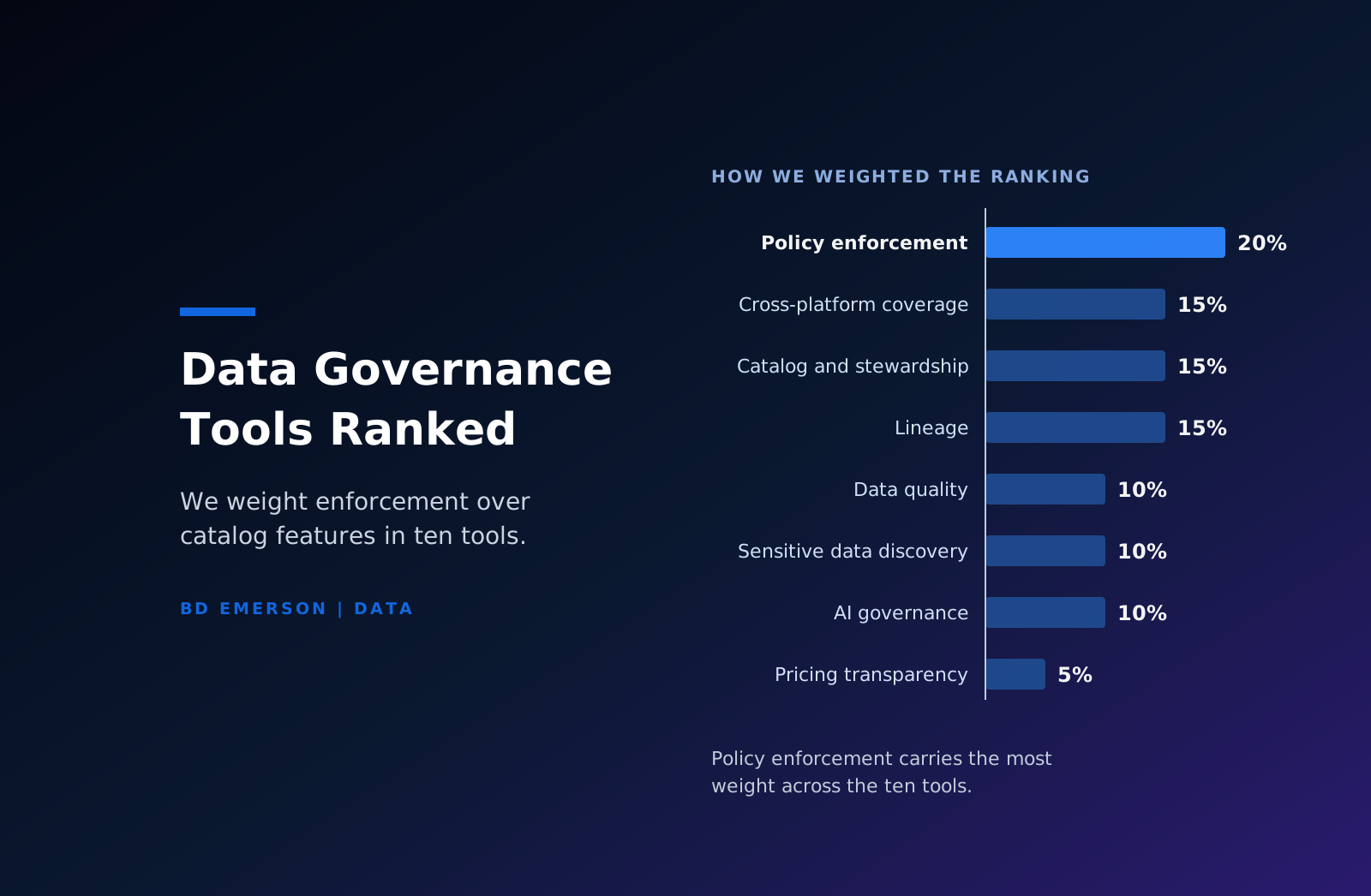
We ranked each platform against eight criteria, weighted by how much each one decides whether a governance program changes behavior in production. Policy enforcement carries the most weight, because a tool that only records a policy leaves enforcement to someone else. Descriptions come from each vendor's documentation, product pages, and press releases as of October 2026, and no vendor paid for placement or reviewed the list.
| Criterion | Weight | What we checked |
|---|---|---|
| Policy enforcement | 20% | Whether the tool applies or pushes access policies, masks, and row filters where queries run |
| Cross-platform coverage | 15% | How many data platforms, clouds, and SaaS sources it governs natively |
| Catalog and stewardship | 15% | Glossary, ownership, certification, and approval workflows |
| Lineage | 15% | Automatic, column-level lineage across systems |
| Data quality | 10% | Rules, monitoring, and scores tied to catalog assets |
| Sensitive data discovery | 10% | Discovery, classification, and privacy request handling |
| AI governance | 10% | Governance of models, agents, and AI use of data |
| Pricing transparency | 5% | Whether prices or billing meters are published |
The order reflects a typical enterprise with two or more data platforms. A company that runs nearly everything on one platform should read the stack guidance further down, because its native catalog will usually come first for it.
The 10 best data governance tools, ranked
1. Collibra
Collibra ranks first because it covers the most criteria in one governance workflow that spans platforms. The Collibra platform includes Data Catalog, Data Governance, Data Lineage, Data Quality & Observability, Data Privacy, Data Access, and a Data Marketplace, and Collibra describes its AI Command Center as a way to "see, trace, and govern every AI agent in production." Collibra's documentation says the platform is primarily deployed as SaaS, managed by Collibra, with an Edge component that ingests metadata from data sources. Collibra bought the Brussels data access startup Raito in June 2025, according to TechCrunch, to strengthen and automate its access controls, and its site now includes Deasy Labs, which prepares unstructured data for AI. Collibra, founded in 2008, is privately held and does not publish prices.
2. Informatica Cloud Data Governance and Catalog
Informatica ranks second on the depth of its lineage and data quality across hybrid estates. Salesforce completed its acquisition of Informatica on November 18, 2025, and Informatica now presents itself as Informatica from Salesforce. Cloud Data Governance and Catalog runs on Informatica's Intelligent Data Management Cloud (IDMC) and provides a centralized catalog, automated lineage across source systems, and policy automation, with Data Quality & Observability and Cloud Data Marketplace as related products. Salesforce has said Informatica will strengthen its Data 360, MuleSoft, Tableau, and Agentforce products. Informatica prices IDMC on consumption, measured in Informatica Processing Units, and quotes on request.
3. Microsoft Purview
Microsoft Purview ranks third because it pairs data governance with data security and compliance controls in one suite. Its governance side combines the Data Map with Unified Catalog, which organizes assets into governance domains and data products and tracks glossary terms, critical data elements, objectives and key results, and data quality scores. The wider Purview family adds Information Protection, Data Loss Prevention, Insider Risk Management, Audit, and Data Lifecycle Management, which extend enforcement to Microsoft 365 content. Microsoft publishes Purview's billing meters, and Unified Catalog bills when customers govern unique data assets, according to its pricing page.
4. Databricks Unity Catalog
Unity Catalog ranks fourth overall and first on enforcement for Databricks workloads. According to the Unity Catalog documentation, it governs tables, views, volumes, functions, models, and MCP services under one namespace, applies attribute-based access control with row filter and column mask policies, captures lineage automatically, records access in an audit log system table, classifies sensitive data, and monitors data quality. An open source implementation is available, and Databricks states that "no separate license is required" because Unity Catalog is included with its Premium and Enterprise tiers. Its depth is inside Databricks, which is why Collibra and Informatica rank above it for estates that span several platforms.
5. Alation
Alation ranks fifth and is the catalog-first option for regulated firms that need a customer-managed deployment. Alation describes its platform as the Alation Intelligence Operating System (AIOS), which spans catalog, lineage, quality, curation, data products, ontologies, agents, AI governance, critical data, policies, and workflows. Its documentation covers both Alation Cloud Service and customer-managed deployments, which matters to firms that cannot keep governance metadata in a vendor's cloud. Alation acquired Numbers Station, which builds AI agents for structured data, in May 2025, according to TechCrunch. Alation is privately held and does not publish prices.
6. Atlan
Atlan ranks sixth and fits teams that want governance metadata to reach AI agents and the tools people already use. Atlan calls itself "the missing context layer for enterprise AI" and offers a catalog with governance, lineage, quality, and a business glossary, a Context Lakehouse built on open formats such as Apache Iceberg, access policies, and an MCP server that delivers certified context to AI agents. Atlan says it can layer on top of existing catalogs, which suits firms that already own a platform-native catalog. Atlan is privately held, sells under a SaaS agreement, and does not publish prices.
7. Snowflake Horizon Catalog
Snowflake Horizon Catalog ranks seventh overall and is the first tool to evaluate in a Snowflake-centric estate. Horizon Catalog includes role-based access control, masking and row access policies, object tagging, automatic classification of sensitive columns, column-level lineage that extends to external databases, BI tools, and OpenLineage feeds, access history, and a Trust Center that monitors for misconfigured roles and unprotected columns. It exposes Apache Iceberg tables to engines such as Spark, Flink, and Trino through the Iceberg REST Catalog API. Horizon is built into Snowflake, and its data quality monitoring requires Enterprise Edition and bills on serverless compute.
8. Google Cloud Knowledge Catalog
Knowledge Catalog ranks eighth and is the native choice for BigQuery estates. Google renamed Dataplex Universal Catalog to Knowledge Catalog as of April 10, 2026, and kept the API, CLI, and IAM names unchanged. It harvests technical metadata automatically, supports a business glossary, column-level lineage with OpenLineage integration, automatic data quality rules, and data profiling, and catalogs third-party sources such as Oracle, SQL Server, PostgreSQL, and dbt Core alongside BigQuery, Cloud Storage, and Spanner. Google publishes its prices: standard processing costs $0.06 per DCU-hour with 100 free DCU-hours a month, and premium processing for lineage, quality, and profiling costs $0.089 per DCU-hour, per its pricing page.
9. BigID
BigID ranks ninth on a general governance rubric and belongs first on a privacy-led shortlist. BigID describes a single platform for security controls, compliance and privacy automation, and AI governance, with discovery and classification, data security posture management, data subject request automation, privacy and AI impact assessments, data retention, minimization, and deletion, data and AI access governance, and a data and AI catalog. It runs agentless across cloud, SaaS, on-premises, and mainframe sources. BigID is privately held and does not publish prices.
10. Securiti
Securiti ranks tenth on this rubric and belongs on any shortlist where data security posture and privacy automation lead. Veeam completed its $1.725 billion acquisition of Securiti AI in December 2025. Securiti markets a DataAI Command Platform with data security posture management, discovery and classification, data subject request automation, consent management, assessment automation, data access governance, a data catalog and lineage, and AI security and governance, including context-aware firewalls for large language models. It does not publish prices.
Data governance tools compared
The first table compares fit, deployment, and pricing; the second compares capabilities, as each vendor describes them as of October 2026.
| Tool | Best fit | Deployment | Strengths | Pricing disclosure |
|---|---|---|---|---|
| Collibra | Multi-platform enterprises that want one governance workflow | SaaS managed by Collibra, with Edge for metadata ingestion | Breadth across catalog, workflow, quality, privacy, and access | No public prices |
| Informatica | Hybrid estates with legacy and cloud systems | Cloud service on IDMC | Lineage and data quality depth | Consumption-based units, quoted |
| Microsoft Purview | Microsoft 365, Azure, and Fabric estates | Microsoft cloud service | Governance plus data security and compliance | Published billing meters |
| Databricks Unity Catalog | Databricks-centered lakehouses | Built into Databricks, with an open source version | Enforcement and lineage at query time | Included in Premium and Enterprise tiers |
| Alation | Catalog-led programs that need stewardship workflow | Alation Cloud Service or customer-managed | Catalog, curation, and deployment choice | No public prices |
| Atlan | Cloud data stacks that want metadata delivered to AI agents | SaaS | Context layer and MCP integration | No public prices |
| Snowflake Horizon Catalog | Snowflake-centric estates, including Iceberg tables | Built into Snowflake | Policy enforcement in the query engine | Included, with some features on Enterprise Edition |
| Google Cloud Knowledge Catalog | BigQuery and Google Cloud estates | Google Cloud managed service | Automatic metadata and data quality | Published per DCU-hour and per GiB |
| BigID | Privacy-led programs and data minimization | Agentless platform | Discovery, posture management, privacy operations | No public prices |
| Securiti | Posture management and privacy automation across hybrid multicloud | Platform spanning hybrid multicloud and SaaS | Posture management, privacy automation, AI security | No public prices |
| Tool | Catalog | Lineage | Quality | Policy enforcement | AI governance features |
|---|---|---|---|---|---|
| Collibra | Data Catalog and Data Marketplace | Data Lineage | Data Quality & Observability | Data Access | AI Command Center, MCP server |
| Informatica | Centralized catalog with business context | Automated across source systems | Data Quality & Observability | Policy automation | AI-assisted discovery and classification |
| Microsoft Purview | Unified Catalog with domains, data products, and glossary terms | Data Map lineage | Scores by asset, data product, and domain | Information Protection, DLP, access policies | Protections for generative AI apps |
| Databricks Unity Catalog | Catalog Explorer | Automatic, column-level, queryable in system tables | Data quality monitoring and profiling | Grants plus ABAC row filters and column masks | Governs models and MCP services |
| Alation | Catalog, curation, data products | Lineage | Quality | Policies and workflows | AI Governance, native and custom agents |
| Atlan | Catalog, glossary, Context Lakehouse | Data Lineage | Quality | Access policies | MCP server for AI agents |
| Snowflake Horizon Catalog | Catalog with object tagging | Column-level, including external sources | Data metric functions with expectations | Masking and row access policies | Described by Snowflake as an agentic catalog |
| Google Cloud Knowledge Catalog | Automatic metadata harvesting and glossary | Column-level with OpenLineage | Auto data quality and profiling | IAM, VPC Service Controls, governance workflows | Gemini-generated data insights |
| BigID | Data and AI catalog | Not listed as a core module | Data cleansing and labeling | Data and AI access governance | AI governance, AI posture management, shadow AI discovery |
| Securiti | Data catalog | Data lineage | Data quality | Data access governance | AI security and governance, LLM firewalls |
Three types of data governance tools
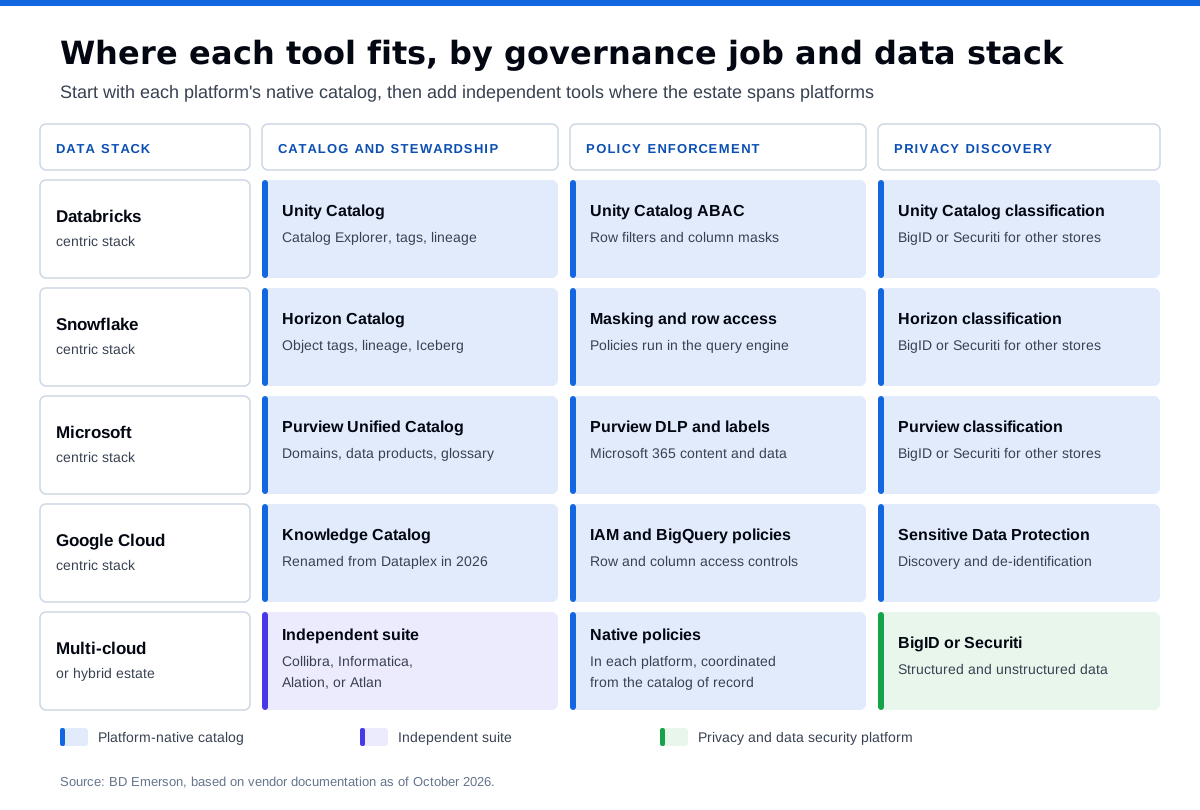
The ten platforms fall into three types, and most enterprises end up running one of each. Independent suites (Collibra, Informatica, Alation, and Atlan) own the business glossary, the stewardship workflow, and lineage across platforms. Platform-native catalogs (Unity Catalog, Horizon Catalog, Purview, and Knowledge Catalog) enforce access policies at query time inside their own platform and come with it or bill by consumption. Privacy and data security platforms (BigID and Securiti) find sensitive data in structured and unstructured stores and run privacy operations such as data subject requests. The matrix above shows where each type fits by stack.
How to choose a data governance tool for your stack
Choose by where your critical data elements live. BD Emerson's rule is that if one platform holds 80 percent or more of them, you start with its native catalog and add an independent suite only when a second or third platform holds critical data. If three or more platforms hold them, start with an independent suite and keep each native catalog as the enforcement point.
| Stack | Start with | Add when | Watch for |
|---|---|---|---|
| Databricks-centric | Unity Catalog with ABAC policies and lineage | Snowflake, SaaS apps, or on-premises systems hold critical data, then add Collibra, Alation, or Atlan | Renamed tables lose their lineage, so settle names before production |
| Snowflake-centric | Horizon Catalog with tags, masking, and row access policies | Iceberg tables are shared with other engines, or other platforms hold critical data | Data quality monitoring requires Enterprise Edition |
| Microsoft-centric | Purview Unified Catalog with Information Protection and DLP | Large non-Microsoft data platforms join the estate | Billing grows with the number of governed assets |
| Google Cloud-centric | Knowledge Catalog with Sensitive Data Protection | Critical data spreads beyond Google Cloud | Lineage, quality, and profiling bill at the premium rate |
| AWS-centric | Amazon SageMaker Catalog, built on Amazon DataZone | Other platforms hold critical data | Not ranked here; evaluate it alongside the independent suites |
| Multi-cloud or hybrid | Collibra, Informatica, Alation, or Atlan as the system of record | Personal data volume or request load is high, then add BigID or Securiti | Define each business term in one catalog only |
Regulated firms should weight two rubric rows higher than we did. Banks subject to BCBS 239 need column-level lineage from source to risk report, and healthcare organizations need discovery of protected health information in unstructured stores, which argues for adding a privacy platform early. If you are still choosing the core data platform, our Databricks vs Snowflake comparison covers that decision first.
What a data governance tool will not do
No tool on this list assigns owners, settles definitions, or approves exceptions, because people do that under a framework. A catalog filled before owners exist becomes a list of tables nobody maintains, and a masking policy without a classification standard masks the wrong columns. Our data governance framework guide covers the decision rights, operating model, and 90-day plan that should come before the purchase order.
Frequently asked questions
What are data governance tools? Data governance tools are software products that catalog data, record its meaning and lineage, measure its quality, find sensitive data, and enforce access policies. They range from independent suites such as Collibra and Alation to catalogs built into data platforms, such as Databricks Unity Catalog and Snowflake Horizon Catalog, and privacy platforms such as BigID and Securiti.
What is the best data governance tool? For an enterprise that governs data across several platforms, Collibra ranks first in BD Emerson's list, followed by Informatica and Microsoft Purview. If one platform holds most of your critical data, its native catalog, such as Unity Catalog for Databricks or Horizon Catalog for Snowflake, is usually the better first purchase because it enforces policy where queries run.
What is the difference between a data catalog and a data governance tool? A data catalog inventories data assets and their meaning so people can find and trust them. A data governance tool adds the controls: ownership and approval workflows, quality rules, classification, and access policies. Most products on this list now combine both, and they differ mainly in whether they enforce policies themselves or record policies that another system enforces.
Is Unity Catalog a data governance tool? Yes. Databricks Unity Catalog governs tables, volumes, functions, models, and MCP services, applies attribute-based access control with row filter and column mask policies, captures column-level lineage automatically, and logs access in audit system tables. Databricks includes it with its Premium and Enterprise tiers, and an open source implementation is available.
Who owns Informatica now? Salesforce owns Informatica. Salesforce completed the acquisition on November 18, 2025, and Informatica now presents itself as Informatica from Salesforce. Salesforce has said Informatica's catalog, integration, governance, and master data management products will strengthen Data 360, MuleSoft, Tableau, and Agentforce, and that Informatica will keep supporting its partner ecosystem.
How much do data governance tools cost? Pricing models vary. Collibra, Alation, Atlan, BigID, and Securiti do not publish prices, and Informatica prices on consumption units. Platform-native catalogs come with the platform or are metered: Unity Catalog is included in Databricks Premium and Enterprise tiers, Purview bills Unified Catalog per governed asset, and Google lists Knowledge Catalog standard processing at $0.06 per DCU-hour as of October 2026.
If you are building a shortlist, our data strategy team can map your critical data elements to platforms and score the finalists against this rubric with your own requirements, and our Databricks consulting practice can stand up Unity Catalog governance where Databricks is the center of the estate.

About the author

















