Transition Services Agreement Benchmark: Terms From 39 SEC-Filed Separations, 2020 to 2026
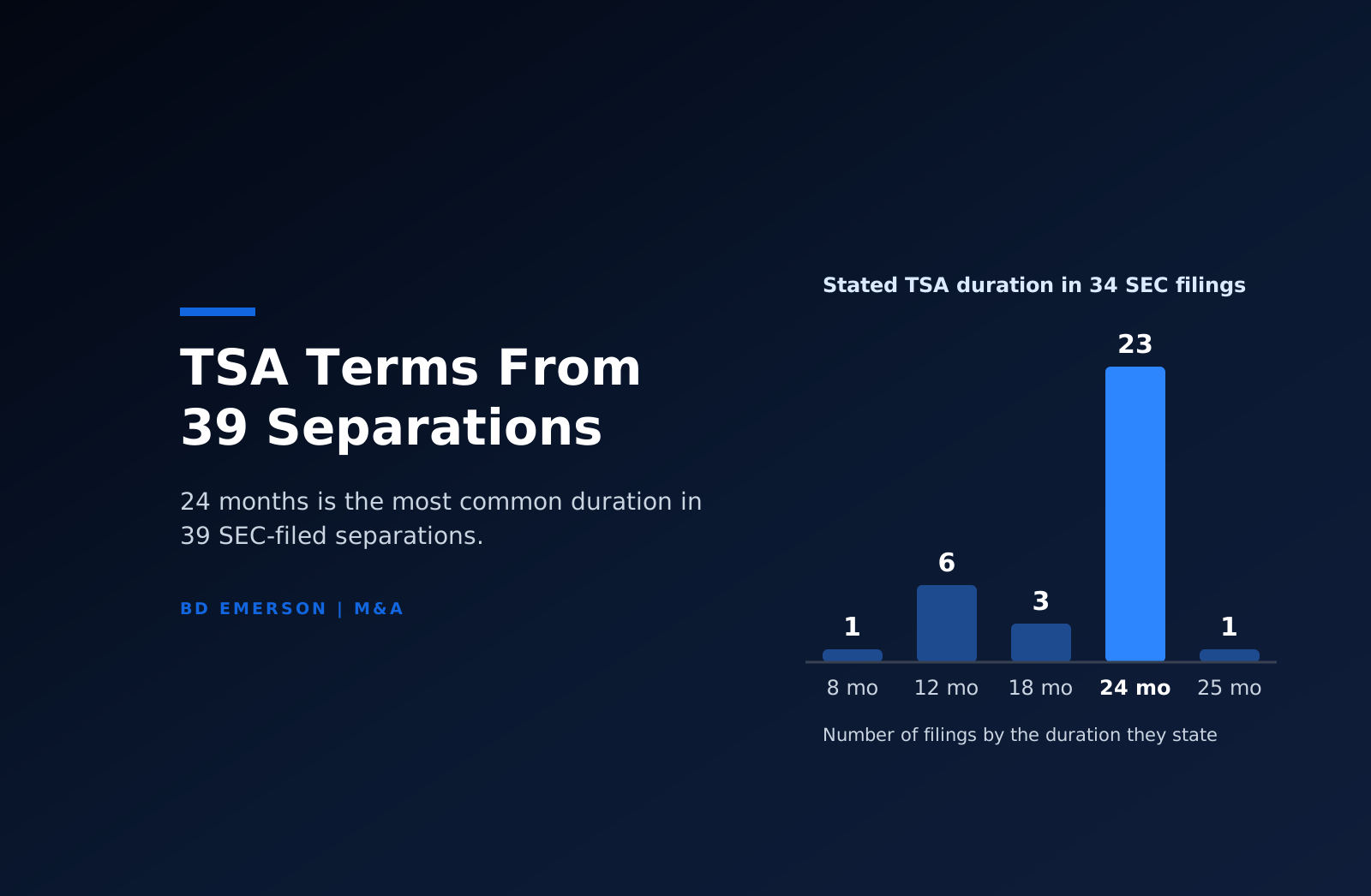
In 39 separations by SEC-registered companies completed between April 2020 and January 2026, the transition services agreement (TSA) most often stated 24 months as the period for services: 23 of the 34 filings that state a duration in months use 24 months. Twenty-four filings state an outside limit in months that also covers extended services, and 17 of those set it at 24 months after the separation. Where a filing states the price of an extension relative to the existing charge, the extension usually costs more: 14 of 16 such filings raise the price, by a median of 20% for the first extension period. Thirty-three of the 39 transactions also include services from the separated company back to its former parent.
BD Emerson (now Andersen Consulting) compiled this benchmark from TSAs that companies filed with the Securities and Exchange Commission (SEC) on EDGAR and from the companies' filed descriptions of those agreements. Two rounds of adversarial review then re-checked every value against the filings, and every quoted passage was matched word for word against the filed documents. The table near the end of this article links each transaction to its sources, and the full dataset, free to download with a work email address, carries every quote and link. For what a TSA covers and how to scope one, see our transition services agreement guide.
What do the TSAs in these 39 separations say about duration, extensions, and pricing?
The table summarizes the findings. Each count is out of the filings that state the term in question, so the totals differ by row.
| TSA term | What the filings state | Filings counted |
|---|---|---|
| Duration in months | 24 months in 23; median 24 months; range 8 to 25 months | 34 that state a duration in months |
| Outside limit that also covers extensions | 24 months in 17, of which 4 let services listed in a schedule run longer; range 12 to 36 months | 24 that state an outside limit in months |
| Extension provisions | 33 address extending services | All 39 |
| Price of extended services | Increase in 14 (median 20%, range 5% to 25%); same charge in 2 | 16 that state the price relative to the existing charge |
| Increase without a filed rate | 4 say extended services cost more but give no rate in the filed text | All 39 |
| Pricing basis | Cost in 10; cost plus 5% in 3; cost plus an unstated percentage in 6; scheduled fees with a cost basis for some services in 9 | All 39 (8 set scheduled fees with no stated method, 3 state another basis) |
| Reverse services | Both directions in 33 (29 in the same TSA, 4 in a separate reverse TSA) | All 39 (one direction in 5, not determinable in 1) |
How was this TSA benchmark built?
The benchmark covers 39 separations of businesses from SEC-registered companies, completed between April 3, 2020 and January 2, 2026, where the TSA was filed on EDGAR and at least one of its terms could be read. The set is a selection of separations we identified, and other separations in the period also filed TSAs, so each count describes only these 39 transactions. Thirty-four of the 39 involved a spin-off, in which the parent distributes shares of the separated company to its own shareholders; our article on divestitures and spin-offs explains the difference. Four were initial public offerings (IPOs) of a subsidiary, and one was a separation under a plan of arrangement. By completion year, the set includes 3 transactions from 2020, 6 from 2021, 8 from 2022, 12 from 2023, 4 from 2024, 5 from 2025, and 1 from 2026.
We read the filed agreement for all 39 transactions, filed as an exhibit to a Form 8-K, 10-Q, or 10-K. For 23 of them we also used statements in the Form 8-K or in an information statement filed with it, such as its description of the service categories or the pricing method, or its listing of a separate reverse TSA. Where such a description and the agreement both state a term, the agreement governs. For each transaction we recorded the duration, extension terms, pricing basis, and direction of services, each with a verbatim quote of under 25 words and the URL of the document quoted, and we noted other terms of interest. Where a filing does not state a term, the dataset says so, and we did not infer missing terms. After the first pass, two rounds of adversarial review re-checked every value against the cited filings, and we corrected the dataset wherever a filing said something different. We also reviewed three separations that we left out: Arconic's separation 8-K lists no TSA, and the Millrose and Curbline filings describe a management agreement and a shared services agreement instead.
The data has limits that matter when you use it:
- Most agreements were filed without their service schedules, which hold each service's term and fee. The figures here are the limits and rules in the body of the agreement or the 8-K, so per-service terms are mostly unavailable.
- Several agreements give their schedules precedence over the body of the agreement when the two conflict. Because the schedules were not filed, the limits recorded are those the filed text states.
- The inclusion rules cover spin-offs, split-offs, IPOs of a subsidiary, and plans of arrangement, so sales of a business to a buyer and private-company carve-outs are not covered.
- Filed agreements show terms as signed. Kenvue's terms come from a form of the agreement that includes later amendments, filed with its 2023 annual report; we did not track amendments to the other agreements.
- Each count is of transactions. A transaction with a separate reverse TSA counts once, and the three-party TSA covering the Carrier and Otis spin-offs from United Technologies also counts once.
How long do transition services agreements last?
Twenty-four months is the most common duration in the filings. Of the 34 filings that state a duration in months, 23 state 24 months, 6 state 12 months, 3 state 18 months, 1 states 25 months, and 1 states 8 months, and the median is 24 months. Qnity's agreement states a calendar date instead, barring any service from running beyond December 31, 2027. Four filings state no duration figure at all, and their agreements leave each service's end date to its schedule: ESAB, Worthington Steel, the Lionsgate and Starz separation, and AIG's agreement with Corebridge, whose 8-K says most services were anticipated to be completed by the end of 2023.
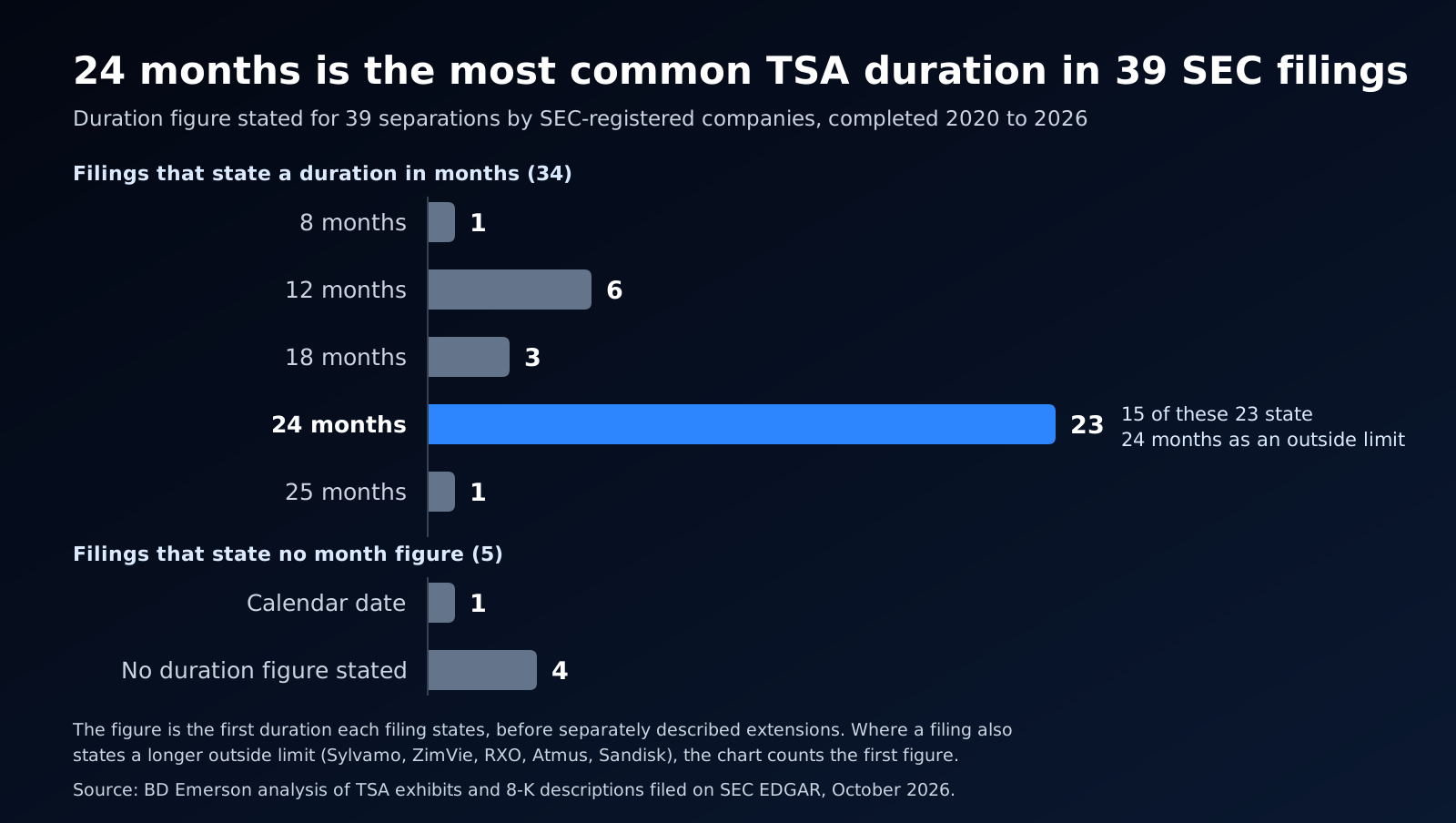
The same number can carry different weight, so the dataset records how each filing frames its figure. Twenty-four filings state an outside limit in months that also covers extended services, and 17 of those set it at 24 months after the separation. The others are 12 months (Vimeo and Solstice), 15 months (Sylvamo), 18 months (Carrier and Otis and Crane), 30 months (Atmus), and 36 months (ZimVie). Five of these limits let services listed in a schedule run longer: Kenvue's deadline gives way to later dates listed in Exhibit D, GE HealthCare's and GE Vernova's agreements except services on a referenced schedule, and Versant's and ZimVie's limits apply unless a service schedule provides otherwise. Vimeo's agreement lets the parties agree in writing to go past its 12-month limit. In five filings, 24 months is a default that applies when a schedule sets no other period: Vontier, Viatris, Atmus (alongside its 30-month outside limit), WK Kellogg, and Ralliant.
The shortest figures limit the initial term and allow extensions beyond it. Four of the six 12-month filings work this way (PHINIA, Sylvamo, Seaport Entertainment, and GXO), and RXO's eight-month initial period sits inside a 24-month outside limit. ZimVie's agreement limits service periods to 24 months unless a schedule provides otherwise and allows extensions up to the third anniversary of the separation. In four filings the figure comes from 8-K wording such as "generally" or "up to": Organon (25 months), Victoria's Secret (24 months), Bausch + Lomb (24 months), and Sandisk (18 months).
How do TSA extensions work, and what do they cost?
Thirty-three of the 39 filings address extending services, and the terms vary widely. Some set a fixed allowance: Sylvamo's agreement allows one three-month extension per term, Viatris's allows up to two six-month extensions, and embecta's allows one extension of up to 90 days at the provider's discretion. Others require both parties to agree: Organon's services can be extended by mutual written agreement of the transition managers, and Worthington Steel's recipient may extend a service on the parties' mutual written agreement of the terms. Several agreements fix an outside date that no extension can pass, such as 18 months for Carrier and Otis and Crane, and 24 months for NCR Atleos, Kyndryl, and Enhabit. Enhabit's also caps a single extension at 180 days unless the provider agrees to a longer one.
Sixteen filings state the price of an extended service relative to the existing charge. Fourteen raise it for the first extension period: 5% (Fortrea, at 105% of the original fee, and Viatris), 10% (Solventum, Kenvue, Atmus, and Qnity), 20% (Sylvamo, GXO, and RXO), and 25% (PHINIA, GE Vernova, GE HealthCare, Vestis, and embecta). The median increase is 20%. Some step up further: GE HealthCare's and GE Vernova's premiums rise to 40% for an extension of four to six months and 50% for more than seven months, Viatris adds a 10% markup in its second six-month extension against 5% in the first, Solventum's fees rise 10% for every six months, and GXO and RXO add 20% for each three-month period. Two agreements, Knife River and Everus, both with MDU Resources, set the extension charge at 100% of the existing charge.
Four more filings say extended services cost more but give no rate in the filed text: Bausch + Lomb's charges rise at the rates in an unfiled exhibit, Organon's extended fee includes markups for extended durations set in a schedule, Victoria's Secret's information technology extensions carry increased administrative charges, and Sandisk's add a surcharge set in the service schedules. Seven set the price by agreement or by another rule. AIG's agreement with Corebridge capped the agreed price at 1.5 times fully loaded cost for the first 36 months after signing, Seaport Entertainment's recipient pays any added fees or costs of extending, and Enhabit's extensions follow the existing pricing method, with any increases the parties agree.
How are transition services priced?
In this benchmark, where a filing states a pricing method, it is usually cost, with or without a markup. Ten filings state that charges recover the provider's costs. The agreements of Fortrea ("at cost"), Seaport Entertainment (time and materials at cost without a mark-up), Vimeo (actual cost without mark-up, unless a schedule provides otherwise), and Versant (fees that permit full reimbursement of all reasonably apportioned overhead, administrative, and supervisory costs) say so in their own text. For Carrier and Otis, ZimVie, Vontier, Veralto, NCR Atleos, and Solstice, the filed description of the TSA says charges are generally intended or expected to recover the provider's costs or, for Solstice, are generally based on cost. Nine more set fees in schedules and state a cost basis for some services: GXO, RXO, Knife River, Everus, Sylvamo, ESAB, and Atmus charge cost for services no schedule prices, and GE HealthCare and GE Vernova let a schedule calculate fees on a cost basis.
Three filings state a markup on cost, all 5%: PHINIA's agreement charges cost plus 5%, Viatris's adds a 5% monthly markup to the scheduled fee "to reflect arms’ length pricing terms," and Qnity's agreement sets fees under its cost principles, which a definition in the filed copy gives as "Full Cost plus a mark-up of five percent (5%)" (the term's label is blank in the filed copy, and the definition sits where Cost Principles falls alphabetically). Six more describe cost plus a percentage without stating it. AIG's 8-K says Corebridge charges are intended to recover costs "plus a percentage of such costs," Aramark's describes Vestis pricing as cost, cost plus a fixed percentage, or an hourly rate, and Organon's says services will generally be provided on a cost or, where applicable, a cost-plus basis. Victoria's Secret's agreement allows a cost-plus billing method where a schedule says so, Solventum's refers to a mark-up percentage in its fee methodology, and Sandisk's refers to an administrative mark-up within its fees.
Eight agreements set fees by schedule without stating a pricing method in the filed text: Kyndryl, embecta, Enhabit, MasterBrand, Kenvue, WK Kellogg, Worthington Steel, and Lionsgate. Three state another basis. Crane's 8-K says its services will be provided on customary commercial terms, and the filed descriptions of the Bausch + Lomb and Ralliant agreements say the cost of the services will be negotiated between the parties, though Bausch Health's 8-K adds that the agreement specifies the calculation of Bausch Health's costs.
How common are reverse TSAs?
Most transactions in the set include reverse services, meaning services the separated company provides back to its former parent. Thirty-three of the 39 do: 29 in the same agreement and 4 through a separate reverse TSA (Organon to Merck, Victoria's Secret to L Brands, Upjohn to Pfizer, and Qnity to DuPont). Five filings describe services in one direction only: IBM to Kyndryl, Johnson & Johnson to Kenvue, Howard Hughes to Seaport Entertainment, Honeywell to Solstice, and Comcast to Versant. Solstice's agreement lets Honeywell request services, and the agreement applies if Solstice agrees; its services schedule was not filed, so the filed text lists no services in either direction. In embecta's agreement the direction of each service is set in schedules that were not filed, so it cannot be determined from the filed text.
What other terms do the filings set?
Several agreements also set approval thresholds, minimum periods, and limits on what the services include. NCR Atleos's TSA requires the recipient's prior written consent for a third-party cost exceeding $30,000, Worthington Steel's reimburses an expense above $25,000 only if the recipient approved it in writing before it was incurred, the Lionsgate and Starz agreement requires advance approval for out-of-pocket costs in a calendar quarter in excess of $37,500, individually, and Sandisk's requires the recipient's prior written consent for third-party costs above $50,000 per month. Carrier and Otis, Knife River, Everus, Vestis, and embecta set 90-day minimum service periods. Enhabit's agreement states that the services do not include professional advice on tax, legal, treasury, finance, or employment matters, or the handling of environmental matters. Zimmer Biomet's 8-K says the ZimVie agreement limits each company's liability to the service fees paid to it in the preceding one-year period, subject to exceptions for willful misconduct or fraud.
Which separations are in the benchmark?
The table lists all 39 transactions in order of completion. The completion date links to the filing that reports it, the duration column gives each filing's own framing, extension and pricing terms are summarized from the quoted text, and the last column links the TSA and, where we used it, the 8-K or information statement description. The downloadable dataset carries the quote behind every value.
| Parent: separated company | Completed | Duration as stated | Extension terms | Pricing basis | Filings |
|---|---|---|---|---|---|
| United Technologies: Carrier and Otis | Apr 2020 | 18-month outside limit, including extensions | Provider uses commercially reasonable efforts; nothing past 18 months | Cost recovery (8-K) | TSA (8-K Ex. 10.1); 8-K |
| Fortive: Vontier | Oct 2020 | 24 months where a schedule sets no period | Not stated | Cost recovery (8-K) | TSA (8-K Ex. 10.3); 8-K |
| Pfizer: Upjohn (Viatris) | Nov 2020 | 24-month initial term unless the schedule differs | Two 6-month extensions; extra 5% markup, then 10% | Scheduled fee plus 5% markup | TSA (8-K Ex. 10.1); 8-K |
| IAC: Vimeo | May 2021 | 12-month outside limit, including extensions, unless both parties agree in writing | Request on 30 days' notice, considered in good faith; price by agreement | Actual cost without mark-up, unless a schedule differs | TSA (8-K exhibit) |
| Merck: Organon | Jun 2021 | Generally within 25 months (8-K); no overall limit in the agreement | By mutual written agreement; markups for extended durations in an unfiled schedule | Cost or, where applicable, cost plus (8-K) | TSA (8-K Ex. 10.3); 8-K |
| L Brands: Victoria's Secret | Aug 2021 | Generally up to 2 years, 3 for IT (8-K) | By mutual written agreement; IT extensions at increased administrative charges | Billing methods set by schedule; cost plus where a schedule says so | TSA (8-K Ex. 10.1); 8-K |
| XPO: GXO | Aug 2021 | 12-month initial period | Request on 15 days' notice; 20% increase per 3 months; over 3 months needs provider agreement | Schedule; otherwise cost | TSA (8-K Ex. 10.1) |
| International Paper: Sylvamo | Oct 2021 | 12 months per term; 15-month outside limit | One 3-month extension; 20% increase | Scheduled fee; fully loaded cost for omitted services | TSA (8-K Ex. 10.1) |
| IBM: Kyndryl | Nov 2021 | 24-month outside limit, including extensions | Only the 24-month limit is stated | Fees in service description agreements | TSA (8-K Ex. 10.1); 8-K |
| Zimmer Biomet: ZimVie | Mar 2022 | 24 months unless a schedule differs; extendable to 36 months | By mutual written agreement | Cost recovery (8-K) | TSA (8-K Ex. 10.3); 8-K |
| BD: embecta | Apr 2022 | 24-month outside limit | One extension of up to 90 days at the provider's discretion; 125% of the charge | Scheduled fee | TSA (8-K Ex. 10.1) |
| Colfax (Enovis): ESAB | Apr 2022 | Per-service periods; no overall limit stated | Not stated | Scheduled fee; additional services at cost | TSA (8-K Ex. 10.1) |
| Bausch Health: Bausch + Lomb | May 2022 (IPO) | Generally not expected to exceed 24 months (8-K) | Request on 45 days' notice, up to 1 year past the scheduled end; escalation rates in an unfiled exhibit | Negotiated (8-K) | TSA (8-K Ex. 99.2); 8-K |
| Encompass Health: Enhabit | Jul 2022 | 24-month outside limit | Up to 180 days unless the provider agrees; not past 24 months | Scheduled fee | TSA (8-K Ex. 2.2) |
| AIG: Corebridge Financial | Sep 2022 (IPO) | No overall limit; most services expected done by the end of 2023 (8-K) | Two 3-month extensions; agreed price capped at 1.5 times fully loaded cost for the first 36 months | Cost plus an unstated percentage (8-K) | TSA (10-Q Ex. 10.5); 8-K |
| XPO: RXO | Nov 2022 | 8-month initial period; 24-month outside limit | Request on 15 days' notice; 20% increase per 3 months | Schedule; otherwise cost | TSA (8-K Ex. 10.1) |
| Fortune Brands: MasterBrand | Dec 2022 | 24-month limit on the provider's obligation | Only by written agreement | Scheduled fee; expenses at cost | TSA (8-K Ex. 10.1) |
| GE: GE HealthCare | Jan 2023 | 24-month outside limit, except services on a referenced schedule | Request on 90 days' notice; provider may decline; 25%, 40%, or 50% premium | Schedule or cost basis methodology | TSA (8-K Ex. 10.1); 8-K |
| Crane Holdings (Crane NXT): Crane Company | Apr 2023 | 18-month outside limit | Only where a schedule permits, on 30 days' notice, within 18 months | Customary commercial terms (8-K) | TSA (8-K Ex. 10.1); 8-K |
| Johnson & Johnson: Kenvue | May 2023 (IPO) | 24-month deadline, later where Exhibit D says | Request 60 days ahead; 10% surcharge | Scheduled fee, adjusted yearly | TSA (10-K Ex. 10.10) |
| Cummins: Atmus | May 2023 (IPO) | 24 months where a schedule sets no period; 30-month outside limit | One extension on 45 days' notice; 10% increase | Scheduled fee; additional services at cost | TSA (8-K Ex. 10.2); 8-K |
| MDU Resources: Knife River | May 2023 | 24-month outside limit | One extension, with provider agreement; same charge | Schedule; otherwise cost | TSA (8-K Ex. 10.1) |
| Labcorp: Fortrea | Jun 2023 | 24-month outside limit | One extension of up to 6 months; 105% of the original fee | At cost | TSA (8-K Ex. 10.3); 8-K |
| BorgWarner: PHINIA | Jul 2023 | 12-month initial term | Negotiated; the shorter of 6 months or half the term; 25% increase | Cost plus 5% | TSA (8-K Ex. 10.1); 8-K |
| Aramark: Vestis | Sep 2023 | 24-month outside limit | One extension of up to 90 days, with provider agreement; 125% of the charge | Cost, cost plus an unstated percentage, or hourly (8-K) | TSA (8-K Ex. 10.1); 8-K |
| Danaher: Veralto | Sep 2023 | 24-month outside limit | Not stated | Cost recovery (8-K) | TSA (8-K Ex. 10.3); 8-K |
| Kellogg (Kellanova): WK Kellogg | Oct 2023 | 24 months where a schedule sets no date | Change order signed by both parties, at an agreed cost | Scheduled fee | TSA (8-K Ex. 10.6) |
| NCR Voyix: NCR Atleos | Oct 2023 | 24-month outside limit, including all service terms | Up to 3 more months, within the term | Cost recovery, generally without profit (8-K) | TSA (8-K Ex. 10.1); 8-K |
| Worthington Enterprises: Worthington Steel | Dec 2023 | Per-service terms; no overall limit stated | By mutual written agreement | Scheduled fee | TSA (8-K Ex. 10.1) |
| 3M: Solventum | Apr 2024 | 24-month outside limit | As a schedule provides or by consent, within 24 months; 10% increase per 6 months | Scheduled fee with an unstated mark-up percentage | TSA (8-K Ex. 10.1) |
| GE: GE Vernova | Apr 2024 | 24-month outside limit, except Schedule K services | Request on 90 days' notice; provider may decline; 25%, 40%, or 50% premium | Schedule or cost basis methodology | TSA (8-K Ex. 10.1); 8-K |
| Howard Hughes: Seaport Entertainment | Jul 2024 | 12-month service term | IT services up to 3 more months; recipient pays added costs | Time and materials at cost | TSA (8-K Ex. 10.1) |
| MDU Resources: Everus | Oct 2024 | 24-month outside limit | One extension, with provider agreement; same charge | Schedule; otherwise cost | TSA (8-K Ex. 10.1) |
| Western Digital: Sandisk | Feb 2025 | Up to 18 months (8-K); 24-month outside limit in the agreement | Request on 60 days' notice; not past 12 or 15 months; surcharge in unfiled schedules | Cost recovery (8-K); fees may carry an administrative mark-up | TSA (8-K Ex. 10.1); 8-K |
| Lions Gate (Starz): Lionsgate Studios | May 2025 | Per-service durations; no overall limit stated | Not stated | Scheduled fee; pass-through costs without mark-up | TSA (8-K Ex. 10.2) |
| Fortive: Ralliant | Jun 2025 | 24 months where a schedule sets no period | Not stated | Negotiated (Information Statement) | TSA (8-K Ex. 10.3); Information Statement |
| Honeywell: Solstice Advanced Materials | Oct 2025 | 12-month outside limit | No extension right | Generally based on cost (8-K) | TSA (8-K Ex. 10.1); 8-K |
| DuPont: Qnity | Nov 2025 | Outside date of December 31, 2027 | Where the SLA permits; extra 10% mark-up | Full cost plus 5% | TSA (8-K Ex. 10.3); 8-K |
| Comcast: Versant | Jan 2026 | 24-month outside limit, unless the schedule provides otherwise | By mutual written agreement, within 24 months | Billing methods set in the schedule; full reimbursement of apportioned overhead | TSA (8-K Ex. 10.1); 8-K |
Frequently asked questions
What is a TSA agreement? A TSA agreement, or transition services agreement, is a contract under which one company keeps providing services such as IT, finance, or human resources to a business it has separated from, for a limited time and a fee. In this benchmark of 39 SEC-filed separations, 33 also include services flowing back to the former parent.
How long does a transition services agreement usually last? In the 34 filings in this benchmark that state a duration in months, 24 months is the most common figure (23 filings) and the median. The other figures are 8, 12, 18, and 25 months. One filing states a calendar date instead, and four state no duration figure at all.
Can a TSA be extended? Thirty-three of the 39 filings in this benchmark address extending services. Some allow a fixed number or length of extensions, and some require both parties to agree. Separately, 24 filings state an outside limit in months that also covers extended services; five of those let services listed in a schedule run longer, and Vimeo's lets the parties agree in writing to go past it.
Do TSA extensions cost more? Extensions cost more in 14 of the 16 filings that state the extension price relative to the existing charge, and the other 2 keep it at 100% of the existing charge. The stated increases for the first extension period range from 5% to 25%, with a median of 20%. Four more filings say extensions cost more but give no rate in the filed text.
How are transition services priced? In this benchmark, where a filing states a method, it is usually cost. Ten filings say charges recover the provider's costs, and 9 set fees in schedules with a cost basis for some services. Three add a stated 5% markup, 6 describe cost plus an unstated percentage, 8 set fees by schedule without stating the method in the filed text, and 3 state another basis.
What is a reverse TSA? A reverse TSA covers services the separated company provides back to its former parent. In this benchmark, 33 of 39 transactions include reverse services: 29 in the same agreement and 4 in a separate reverse TSA.
Where do these TSA figures come from? They come from SEC filings on EDGAR: TSA exhibits to Forms 8-K, 10-Q, and 10-K, and descriptions of the agreements filed with Forms 8-K, for 39 separations completed between April 2020 and January 2026. In the downloadable dataset, each duration, extension, pricing, and direction value carries a verbatim quote of under 25 words and the URL of the filing.
BD Emerson's transition services agreement advisory work covers scoping, pricing, and exiting the agreement on schedule, along with the stranded cost a seller is left carrying. Our carve-out advisory practice covers the wider separation, and our guide to TSA exit planning covers the work of ending each service on time.

About the author