Best Custom Software Development Companies in 2026: A Ranked Shortlist for Regulated Enterprises
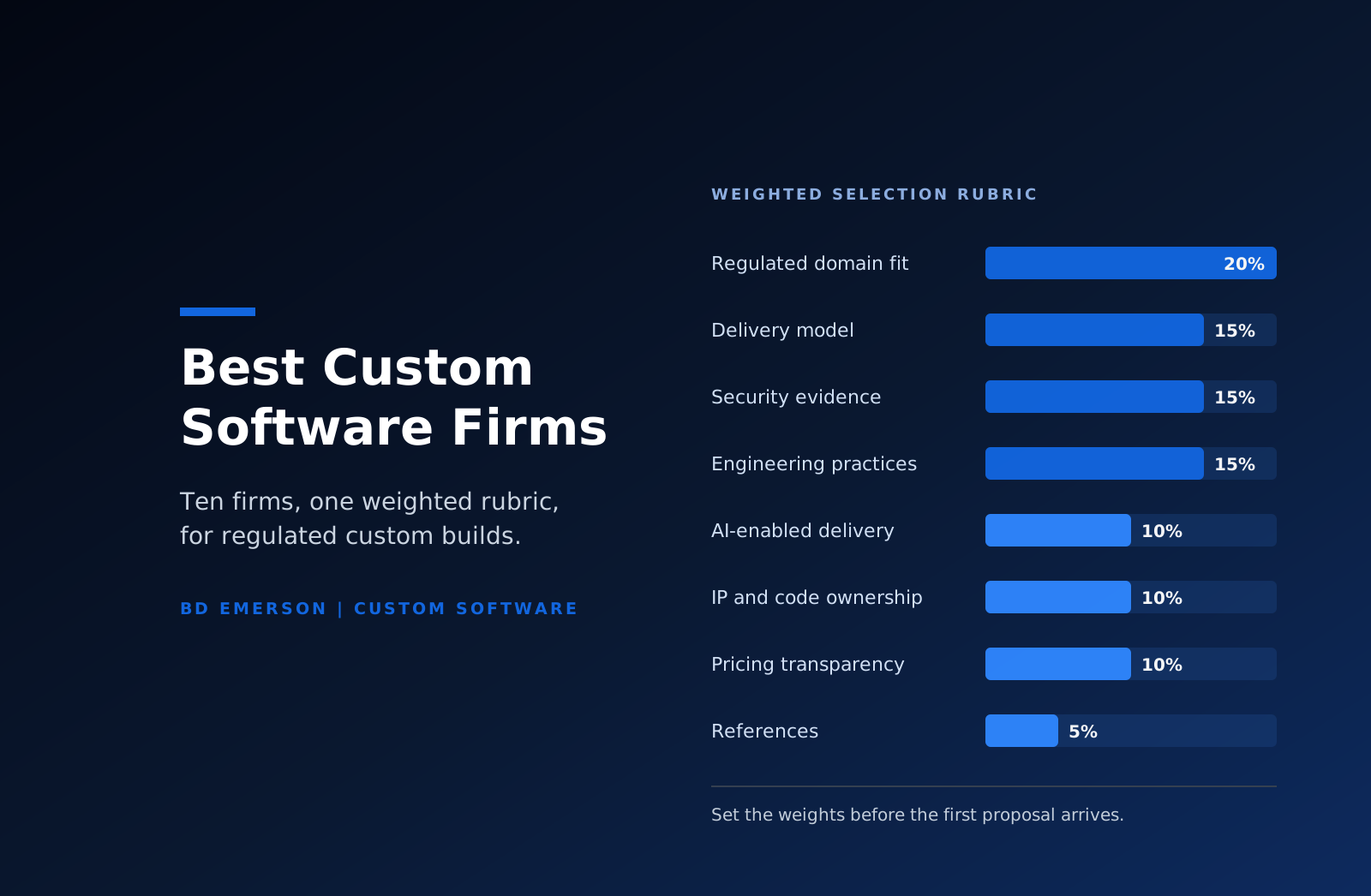
The best custom software development companies for regulated enterprises in 2026 are EPAM Systems, Thoughtworks, Endava, Cognizant, Accenture, Globant, Perficient, Slalom, and BairesDev, with BD Emerson as a boutique option for programs where build vs buy is still open. Which one is best for you depends on three facts: the size of the program, how much regulated domain knowledge it needs, and how much security and compliance evidence your risk team will demand. We ranked the firms with an eight-criterion weighted rubric, applied to each firm's own website, press releases, and investor filings as of October 2026. BD Emerson publishes this list and appears on it; we applied the same criteria to ourselves.
The rubric is the most useful part of this page: use it to score whoever bids on your work, including firms not listed here.
How we ranked custom software development companies
We weighted eight criteria for a buyer in insurance, banking, fintech, or healthcare running a custom build of roughly $2 million to $20 million, and we ordered the firms by our reading of the public evidence each publishes against them. We saw no rate cards, contracts, or private references, and your own scoring will reorder the list for your project. BD Emerson sits last because we wrote the list.
| Criterion | Weight | What good evidence looks like |
|---|---|---|
| Regulated domain fit | 20% | Revenue or named clients in your industry, people who know your regulators and data rules |
| Delivery model and team continuity | 15% | Named leads, a stated onshore and nearshore mix, replacement terms, time-zone overlap |
| Security and compliance evidence | 15% | A current SOC 2 Type 2 report and an ISO/IEC 27001 certificate whose scope covers the delivery centers on your project |
| Engineering practices | 15% | Automated testing and deployment, code review, architecture decisions in writing, delivery metrics reported monthly |
| AI-enabled delivery | 10% | A written policy on AI coding tools, where client code and prompts can go, and how AI-written code is reviewed |
| IP and source code ownership | 10% | An express assignment of copyright, repositories and cloud accounts in your name from day one, open-source terms |
| Pricing transparency | 10% | A rate card by role and estimates shown as roles, hours, rates, and weeks |
| References | 5% | Two clients with systems in production for at least 12 months in a regulated setting |
Domain fit carries the most weight because it is the hardest gap to close after signature: a team can learn your codebase in a month, and learning how an insurance department reviews rate filings takes years. For security, request a SOC 2 Type 2 report and an ISO/IEC 27001:2022 certificate, and ask how the firm follows NIST's Secure Software Development Framework, SP 800-218.
Which type of custom software firm fits your project?
Program size and domain complexity sort the market into five types of firm, and the wrong type can fail a project even when the firm is good. The figure shows where each type fits by build budget, in our view, and what your team must supply.
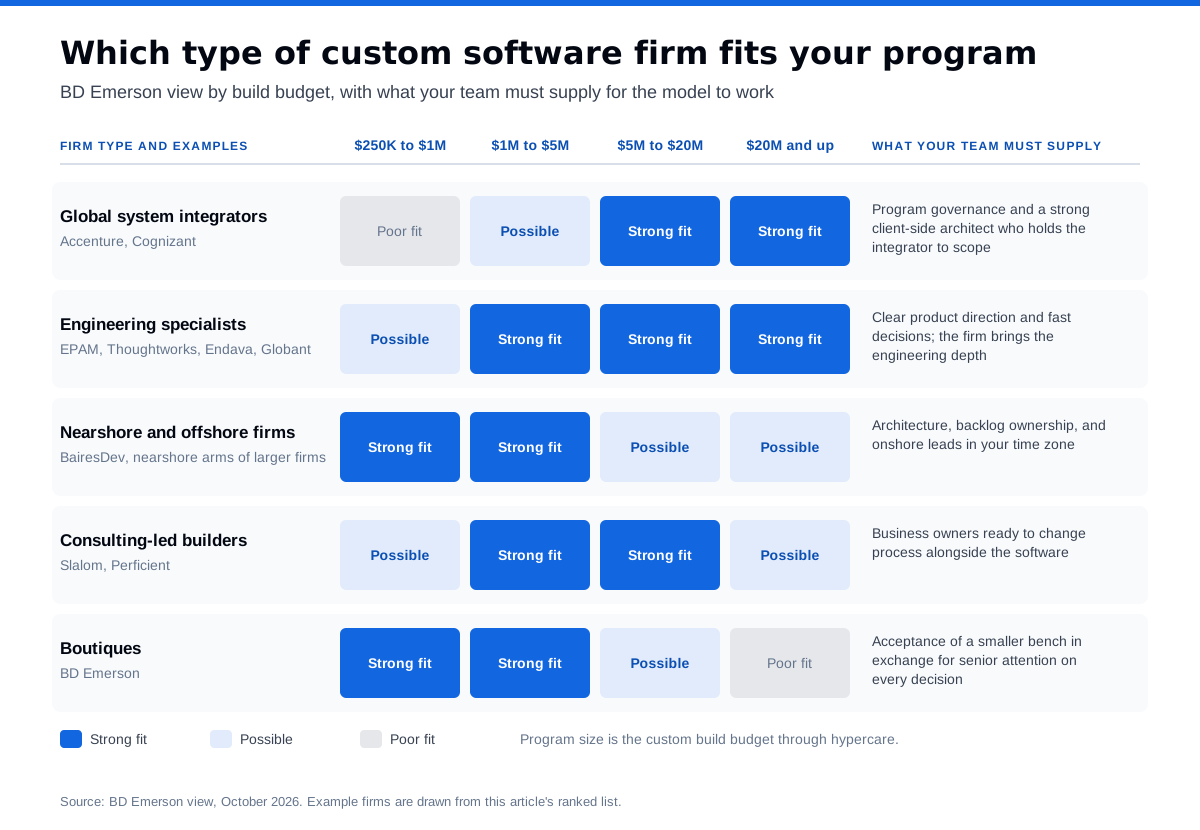
Global system integrators such as Accenture and Cognizant fit multi-year programs across many systems, vendors, and countries, with managed services after launch. Engineering specialists such as EPAM, Thoughtworks, Endava, and Globant fit complex product and platform builds where engineering quality decides the outcome. Nearshore and offshore firms such as BairesDev add capacity at lower rates when you own the architecture and backlog. Consulting-led builders such as Slalom and Perficient fit builds inside a broader change in process or platforms. Boutiques fit smaller regulated builds that need senior judgment on build vs buy, security, and compliance more than a large bench.
The 10 best custom software development companies for regulated enterprises
Entries draw on each firm's published material as of October 2026.
1. EPAM Systems
EPAM Systems is a public engineering firm that reported 2025 revenue of $5.457 billion and about 62,850 employees at December 31, 2025, including about 56,600 delivery professionals. It opened in Princeton, New Jersey, in 1993, issues its releases from Newtown, Pennsylvania, and lists 55-plus countries and regions, with industry pages for financial services, insurance, and life sciences and healthcare, on its site. Best fit: large, engineering-heavy platform builds where one firm must supply depth across many specialties.
2. Thoughtworks
Thoughtworks was founded in Chicago in 1993 and has been private since November 13, 2024, when funds advised by Apax Partners completed a take-private valued at about $1.75 billion and its shares left Nasdaq. It reports 10,000-plus employees in 47 offices across 18 countries and lists financial services among its industries on its about page. Its twice-yearly Technology Radar, at Volume 34 as of April 2026, publishes its engineering judgment on tools and techniques. Best fit: modernization and product engineering where practices such as continuous delivery and test automation matter most.
3. Endava
Endava is a public technology services firm based in London with 11,225 employees at March 31, 2026, and regulated industries dominate its mix: in its third quarter of fiscal 2026, payments produced 23 percent of revenue, banking and capital markets 22 percent, healthcare 11 percent, and insurance 9 percent. Best fit: payments and banking builds.
4. Cognizant
Cognizant (Nasdaq: CTSH) reported 2025 revenue of $21.1 billion, lists 356,700 employees, and dates its releases from Teaneck, New Jersey. Its site cites work with 20 of the top 25 healthcare plans, 9 of the top 10 European banks, and 30 of the top 30 biopharma companies. Best fit: large regulated programs in health plans, life sciences, and banking that need scale.
5. Accenture
Accenture is the largest firm on this list: its fiscal 2026 results show $74.2 billion of revenue and 814,391 employees at August 31, 2026, and its company index lists offices and operations in 52 countries and industry pages for banking, insurance, and health. It trades on the New York Stock Exchange. Best fit: multi-year programs that span many systems, vendors, and countries or need global managed services; for a single product build, ask who will staff it and what they have shipped in your domain.
6. Globant
Globant was founded in Buenos Aires in 2003, issues its releases from Luxembourg, and reported 27,411 employees at June 30, 2026, in its second-quarter 2026 results, with about $2.5 billion of trailing twelve-month revenue. North America produced 52.8 percent of second-quarter revenue. Globant organizes delivery into studios by technology and industry, as its about page describes, including a healthcare and life sciences AI studio. Best fit: digital product builds where Latin American nearshore delivery and design depth both matter.
7. Perficient
Perficient has been private since October 2, 2024, when EQT, through its BPEA Private Equity Fund VIII, completed its acquisition and the stock stopped trading on Nasdaq. Its releases are datelined St. Louis, and its site cites 7,000-plus advisors, engineers, and designers, with industry pages for banking, financial services, and insurance and for healthcare and life sciences. In October 2026 it launched a Stars AI Navigator for Medicare Advantage plans. Best fit: health plans and financial services firms that want platform implementation and custom build from one US-based consultancy.
8. Slalom
Slalom is a privately held business and technology consulting company with 54 offices in 12 countries, and its releases are datelined Seattle. Its newsroom says it is trusted by leaders across the Global 1000 and more than 500 public sector organizations, and its service list includes digital product building, with product and platform engineering. Best fit: programs where the build sits inside a broader change effort and local, in-person teams matter.
9. BairesDev
BairesDev was founded in Buenos Aires in 2009 and opened US operations in San Francisco in 2012, according to its about page. It offers staff augmentation, dedicated teams, and software outsourcing with what its home page calls "4,000+ timezone-aligned, AI-augmented software engineers," reports more than 1,480 projects across 130-plus sectors, and lists banking, finance, healthcare, and insurance among its industries. Best fit: adding vetted nearshore capacity to a team whose architecture and product ownership you already control.
10. BD Emerson (disclosure: this is us)
BD Emerson designs and builds custom software, including AI-enabled systems, for insurance, banking, fintech, healthcare, and other regulated clients, and it advises on build vs buy before anyone writes code. Its cybersecurity, compliance, and offensive security practices sit in the same firm, so penetration testing and compliance design are in the build plan from the start, and its CPA attest practice performs SOC 2 examinations under the rule that the firm that examines you does not also implement your controls. BD Emerson does not implement or resell Guidewire, Duck Creek, or any other core suite; it helps carriers evaluate their options and builds custom and agentic software to replace or extend core systems, as our insurance software development and banking software development pages describe. Best fit: regulated builds where build vs buy is still open. It is the wrong call for programs that need hundreds of engineers or global managed services.
Custom software development companies compared
The table summarizes each firm's own published material. We did not find a public hourly rate card on any of the nine other firms' websites in October 2026.
| Firm | Type | Ownership and status, October 2026 | Headquarters | Latest public size | Regulated-industry evidence | Delivery model |
|---|---|---|---|---|---|---|
| EPAM Systems | Engineering specialist | Public (NYSE: EPAM) | Newtown, Pennsylvania | About 62,850 employees; $5.457 billion 2025 revenue | Financial services, insurance, and life sciences and healthcare industry pages | Global delivery, 55+ countries and regions |
| Thoughtworks | Engineering specialist | Private; Apax take-private closed November 13, 2024 | Chicago | 10,000+ employees, 47 offices | Financial services practice | Teams in 18 countries |
| Endava | Engineering specialist | Public (NYSE: DAVA) | London | 11,225 employees | Payments and banking 45% of Q3 FY2026 revenue; healthcare 11%; insurance 9% | Europe, the Americas, Asia Pacific, Middle East |
| Cognizant | Global system integrator | Public (Nasdaq: CTSH) | Teaneck, New Jersey | 356,700 employees; $21.1 billion 2025 revenue | 20 of the top 25 healthcare plans; 9 of the top 10 European banks | Global delivery |
| Accenture | Global system integrator | Public (NYSE: ACN) | Dublin, Ireland | 814,391 employees; $74.2 billion fiscal 2026 revenue | Banking, insurance, and health industry pages | Global, 52 countries |
| Globant | Engineering specialist | Public (NYSE: GLOB) | Luxembourg; founded in Buenos Aires | 27,411 employees; about $2.5 billion trailing revenue | Financial sector consulting; healthcare and life sciences AI studio | Studios in 30+ countries, Latin American roots |
| Perficient | Consulting-led builder | Private; EQT acquisition closed October 2, 2024 | St. Louis | 7,000+ advisors, engineers, and designers | Banking, financial services, and insurance; healthcare and life sciences | US-based consultancy with global teams |
| Slalom | Consulting-led builder | Private | Seattle | 54 offices in 12 countries | Global 1000 and 500+ public sector clients | Local offices |
| BairesDev | Nearshore | Private | Founded in Buenos Aires; US operations since 2012 | 4,000+ engineers | Banking, finance, healthcare, and insurance industry pages | Staff augmentation, dedicated teams, outsourcing |
| BD Emerson | Boutique | Publisher of this list | United States | Not listed here | Insurance, banking, fintech, and healthcare software practice | Custom builds, build vs buy advice, in-house security testing |
Choosing a custom software development company in the USA
US delivery matters when a contract, a regulator, or your own policy requires it, and a US headquarters alone does not guarantee it. For banks, the Federal Reserve, FDIC, and OCC's Interagency Guidance on Third-Party Relationships, final as of June 6, 2023, lists the "use of foreign-based third parties" among planning considerations, and says due diligence "typically involves assessing the third party's information security program." Ask every firm where each named person sits, which countries can reach production data, and which subcontractors will touch the work, and write the answers into the contract.
RFP questions that separate custom software firms
Good RFP questions force answers a firm cannot copy from its brochure:
- Name the people who will work on our project, where each sits, and their allocation, and tell us what happens if one leaves.
- Send your current SOC 2 Type 2 report and ISO/IEC 27001 certificate, and show where your delivery centers fall inside their scope.
- Which countries and subcontractors will have access to our code, data, or production systems?
- Which AI coding tools do your engineers use on client code, where do prompts and code go, and how do you review AI-written code before merge?
- Show your estimate as roles, hours, rates, weeks, and contingency.
- Who owns the code, the repositories, and the cloud accounts on day one, and what pre-existing or open-source code will you bring?
- Which delivery metrics will you report every month, such as deployment frequency, change failure rate, and escaped defects?
- Name two references with regulated systems in production for 12 months or more, and let us call them without you on the line.
Red flags in custom software proposals
Each red flag points to a hidden risk and a better answer to request.
| Red flag | Why it matters | Ask for instead |
|---|---|---|
| A fixed price before any discovery | The total hides a risk premium or a change-order plan | A paid discovery and a capped first release |
| Blended rates with no roles | You cannot check seniority or the team's shape | A rate card by role and a staffing plan |
| "Work made for hire" language with no assignment | Most custom software falls outside the nine work-for-hire categories | An express written assignment of copyright and work product |
| Code in the vendor's repositories | You depend on the vendor for access and history | Repositories and cloud accounts in your name from day one |
| A SOC 2 report that excludes delivery centers | The controls protecting your code sit out of scope | A scope covering the people and systems on your project |
| No named people | The team that wins the bid may not build the system | Named leads with replacement terms |
| AI productivity claims with no baseline | Savings nobody measured cannot be held to a contract | A baseline and the metrics the firm will report |
The ownership flag has a legal basis: the US Copyright Office's Circular 30 says a commissioned work is a work made for hire only if it falls into one of nine listed categories and both parties sign a written agreement saying so. Work with counsel on the assignment clause.
How to score your finalists: a worked example
Score each finalist from 1 to 5 on every criterion, multiply by the weight, and add the results. Two hypothetical finalists show how the weights decide the outcome.
| Criterion | Weight | Firm A score | Firm A weighted | Firm B score | Firm B weighted |
|---|---|---|---|---|---|
| Regulated domain fit | 20% | 3 | 0.60 | 5 | 1.00 |
| Delivery model and continuity | 15% | 4 | 0.60 | 4 | 0.60 |
| Security and compliance evidence | 15% | 5 | 0.75 | 4 | 0.60 |
| Engineering practices | 15% | 5 | 0.75 | 4 | 0.60 |
| AI-enabled delivery | 10% | 4 | 0.40 | 4 | 0.40 |
| IP and code ownership | 10% | 3 | 0.30 | 5 | 0.50 |
| Pricing transparency | 10% | 2 | 0.20 | 5 | 0.50 |
| References | 5% | 4 | 0.20 | 3 | 0.15 |
| Total (out of 5.00) | 100% | 3.80 | 4.35 |
Firm B wins 4.35 to 3.80 even though Firm A scores higher on security and engineering, because domain fit carries a fifth of the weight and Firm A's pricing and ownership terms are weak. Move 10 points from domain fit to engineering practices, as a large platform program might, and the totals become 4.00 and 4.25. Set the weights before proposals arrive so nobody can bend the scoring toward a favorite.
What custom software development companies charge
Rates follow location more than brand: Accelerance's November 2025 rate survey puts senior developers at $60 to $75 an hour in Latin America, $64 to $76 in Central and Eastern Europe, and $31 to $41 in Asia, while US onshore firms bill $150 to $250 an hour for senior engineers in our planning. Our custom software development cost guide turns those rates into project budgets with a worked example, and for firms that lead strategy and transformation more than builds, see our ranking of top technology consulting firms.
Frequently asked questions
What is the best custom software development company? No single firm is best for every program. For regulated enterprises, EPAM Systems and Thoughtworks lead on engineering depth, Endava on payments and banking, Cognizant and Accenture on scale, Globant on design-led engineering with Latin American delivery, BairesDev on nearshore capacity, and Perficient and Slalom on consulting-led builds. Score finalists on a weighted rubric covering domain fit, delivery model, security evidence, engineering practices, AI use, IP terms, pricing, and references.
How do I choose a custom software development company? Set weighted criteria before you issue the RFP, then score every proposal against them. Weight regulated domain fit highest if you work in insurance, banking, or healthcare, and require evidence: a current SOC 2 Type 2 report, an ISO/IEC 27001 certificate whose scope covers delivery centers, named team members, and an estimate shown as roles, hours, and rates. Call two references with systems in production for at least a year.
How much do custom software development companies charge? Rates depend on where the team sits. Accelerance's November 2025 survey puts senior developers at $60 to $75 an hour in Latin America and $31 to $41 in Asia, while US onshore firms bill $150 to $250 an hour for senior engineers in BD Emerson's planning. Total project cost runs from about $150,000 for an internal tool to $6 million or more for a regulated core system replacement.
Who owns the source code when you hire a software development company? You own it only if the contract says so. Under the US Copyright Office's Circular 30, a commissioned work is a work made for hire only if it falls into one of nine listed categories and both parties sign a written agreement, and most custom software falls outside those categories. Ask for an express written assignment of copyright and work product, keep repositories in your accounts from day one, and have counsel review the clause.
Should I hire a nearshore or onshore software development company? Hire nearshore when you already own the product direction and architecture and need more engineering capacity at lower rates with overlapping work hours. Hire onshore when the work needs constant contact with your business, your regulators, or US-only data access. Many regulated programs blend the two, with onshore product, architecture, and security leads and nearshore engineers. Banks should also weigh the foreign-based third-party considerations in the 2023 interagency guidance.
What certifications should a software development company have? Ask for a current SOC 2 Type 2 report and an ISO/IEC 27001:2022 certificate, and read the scope of each to confirm it covers the delivery centers and people who will touch your code and data. Ask how its secure development process maps to NIST SP 800-218, the Secure Software Development Framework. Cloud partner badges show product training and say little about how a firm protects your code.
If you're building a shortlist for a regulated build, our custom software development team can walk your evaluation group through the rubric and the evidence to request from each finalist, ourselves included.

About the author