

Policy Administration System: What It Does and How to Choose One
A policy administration system (PAS) is the core software an insurer uses to run the policy lifecycle. It defines products, rates and quotes risks, binds and issues policies, processes endorsements, renewals, and cancellations, and keeps the policy record that billing and claims depend on. Guidewire's fiscal 2026 Form 10-K describes its PolicyCenter product as "a comprehensive system-of-record supporting the entire policy lifecycle," and that phrase fits any PAS. Property and casualty (P&C) carriers choose among suites such as Guidewire PolicyCenter, Duck Creek Policy, Majesco P&C Policy, Sapiens PolicyPro, and Insurity's policy products, while life, annuity, and group carriers use systems such as FINEOS AdminSuite and the life suites from Sapiens, EIS, and Majesco. Some carriers build their own.
Three facts decide most PAS choices: how fast the system configures your hardest product in your hardest state, what it costs over five years as premium grows, and who controls the code and the data. Facts here are current as of September 2026. We do not implement or resell any core suite. We help carriers evaluate their options, build the business case, and replace or extend a PAS with custom and agentic software.
What does a policy administration system do?
A PAS runs each transaction that creates or changes an insurance contract, and it owns the data that proves what the insurer agreed to cover, at what price, and from when. The table follows the lifecycle Guidewire's 10-K gives for PolicyCenter.
| Function | What it does | Data it owns |
|---|---|---|
| Product definition | Defines coverages, limits, deductibles, rules, forms, and state variations, each with an effective date | Versioned product models and form sets |
| Rating | Applies rate tables, factors, and algorithms, or calls an external rating engine | Rate versions and a rating worksheet per transaction |
| Quoting | Captures exposures, pulls third-party data, and prices coverage options | Submissions and quotes, including lost ones |
| Underwriting and binding | Applies eligibility rules and referral triggers, records authority, and binds coverage | Underwriting decisions and referrals |
| Issuance | Produces the policy, declarations, and forms, and opens the billing account | The issued contract and its documents |
| Endorsements | Processes mid-term changes, such as adding a vehicle or location, and the premium change | Transaction history with effective dates |
| Audits | Records premium audits, common in workers' compensation and general liability | Audited exposures and final premium |
| Renewals | Re-underwrites and re-rates the risk and issues the renewal offer | Renewal terms and term-over-term changes |
| Cancellations and reinstatements | Cancels for nonpayment, underwriting reasons, or request, sends notices, and sets return premium | Cancellation reasons, dates, and notices |
| Policy record | Answers what was in force on any date | The system of record for the contract |
The last row matters most. Billing invoices from the PAS's premium, claims checks coverage against the PAS's version of the policy on the date of loss, and examiners read the PAS's history when they review underwriting and rating. A PAS that cannot reliably answer "what was in force on March 3" pushes errors into each system downstream.
How a PAS fits with billing, claims, rating, documents, data, and portals
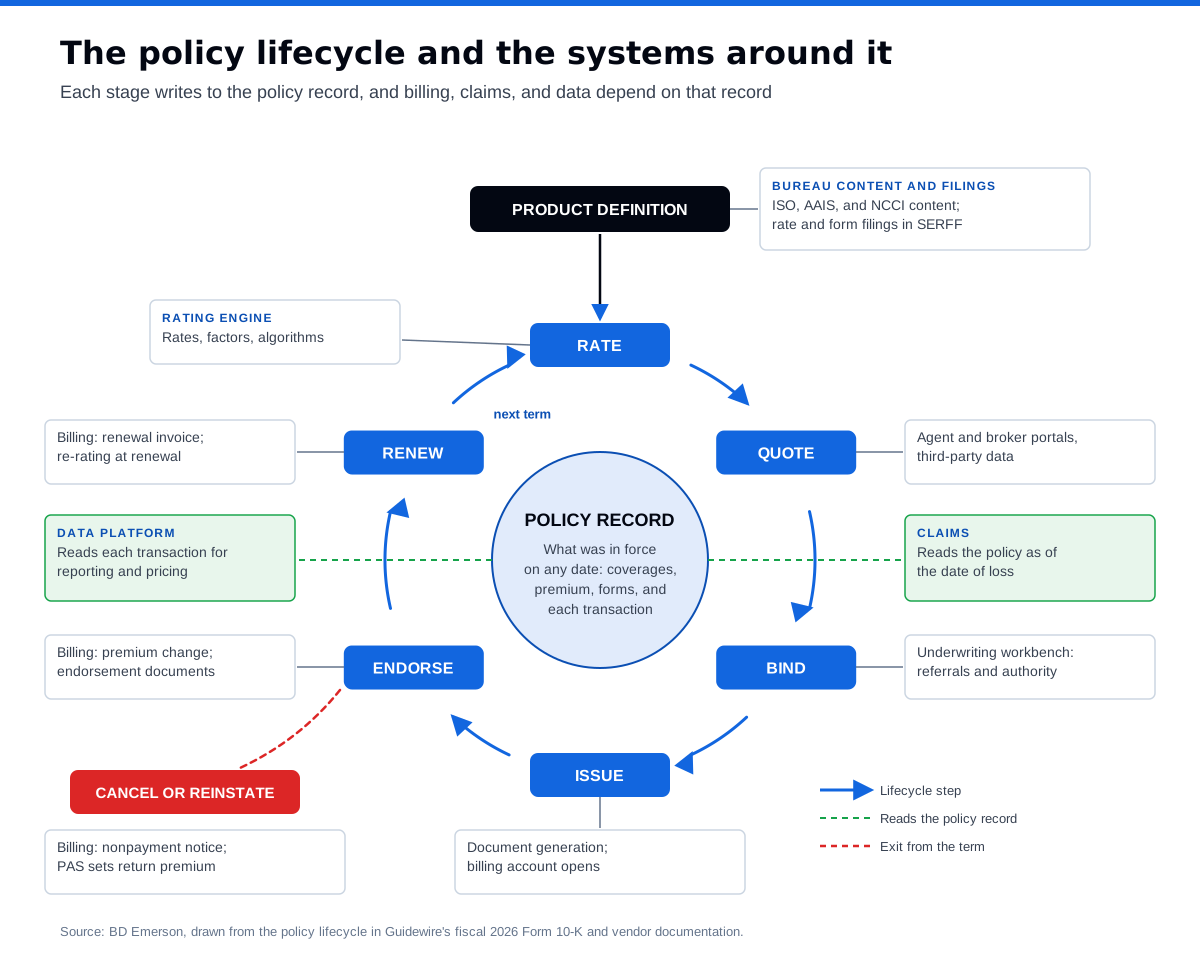
A PAS sits in the middle of the core, and most of a replacement's cost and risk lives in its connections.
| System | What flows to and from the PAS | Public example |
|---|---|---|
| Billing | Premium, installment plans, and payers go to billing; nonpayment comes back so the PAS can cancel | Guidewire's 10-K says BillingCenter "automates the billing lifecycle," including agent commissions |
| Claims | Coverages, limits, and deductibles as of the date of loss | Our claims management system guide covers the handoff |
| Rating engine | Rates, rules, and algorithms, called at quote, endorsement, and renewal | Majesco's Enterprise Rating, from its January 2024 DRC acquisition, keeps rating outside the policy system so several systems can share it |
| Document generation | Declarations, forms, endorsements, and notices | Insurity's Pro Suite includes document generation in its base deployment |
| Agency and broker systems | Quotes, applications, and policy downloads | ACORD's P&C standards describe AL3 as "a one-way, batch communication method for policy and commission data" |
Integration count, more than screen count, sets the length of a PAS program, so we inventory each interface before estimating anything. The figure shows the lifecycle as a loop around the policy record, with the system each stage depends on.
P&C vs life and annuity policy administration systems
P&C and life systems share the lifecycle idea and little else. A P&C policy runs for a term and renews, and a life or annuity contract can stay in force for decades while values build inside it.
| Dimension | P&C PAS | Life and annuity PAS |
|---|---|---|
| Contract | Terms that renew, with frequent mid-term endorsements | Long-duration contracts with cash values, loans, withdrawals, and riders |
| Product content | Bureau content from ISO, AAIS, and NCCI, which vendors such as Duck Creek package for commercial lines, workers' compensation, and inland marine | Product designs built by the insurer's actuaries, including crediting rates and charges |
| Regulatory rules | State rate and form filings, mostly through SERFF, the NAIC system "accepted in nearly all jurisdictions for almost every line of business" | Tax qualification under Internal Revenue Code section 7702, which defines a life insurance contract, plus state form filings |
| Recurring obligations | Renewal offers, premium audits, and cancellation notices | Annual reports to owners of illustrated policies under the NAIC's Life Insurance Illustrations Model Regulation (Model 582) |
| Data standards | ACORD P&C XML for real-time messages and AL3 for batch downloads | ACORD Life and Annuity standards and DTCC formats for applications, commissions, and in-force activity |
| Typical vendors | Guidewire, Duck Creek, Majesco, Sapiens, Insurity, OneShield, Socotra, EIS | FINEOS for life, accident, and health; Majesco, Sapiens, and EIS for life, annuity, and benefits |
Vendors that serve both markets sell separate cores, such as Majesco's Intelligent Core for P&C and Intelligent Core for LA&H and Sapiens' two CoreSuites. A P&C record centers on exposures and terms, and a life record centers on lives, values, and decades of transactions.
Policy administration system vendors
The table describes each vendor's PAS from its own published material as of September 2026, in alphabetical order, and it ranks no one.
| Vendor | PAS product | Lines | Public facts |
|---|---|---|---|
| Duck Creek | Duck Creek Policy | P&C and general insurance | Lifecycle "from quote to issuance, endorsement, renewal, cancellation, and rewrite"; 140+ products in production; 2,000+ APIs and extension points; owned by Vista Equity Partners since March 30, 2023 |
| EIS | Policy Administration in EIS OneSuite | Group benefits, P&C, life and annuities | Describes OneSuite as "cloud-native, API-first, and modular" SaaS |
| FINEOS | FINEOS AdminSuite: policy, billing, claims, absence, and payments | Life, accident, and health, including group benefits | Says 7 of the 10 largest US group life, accident, and health insurers use it |
| Guidewire | PolicyCenter in InsuranceSuite; InsuranceNow for mid-market carriers and MGAs | P&C | 155+ PolicyCenter customers in 20 countries; about 550 customers in 44 countries at July 31, 2026 |
| Insurity | Policy Decisions; Pro Suite for MGAs and small-to-mid-sized carriers; Workers' Comp Suite | P&C, specialty, and workers' compensation | Says it serves 22 of the top 25 US P&C carriers; owned by GI Partners and TA Associates, per a January 2026 release |
| Majesco | P&C Policy in Intelligent Core for P&C; CoreConnect for MGAs; LA&H Policy | P&C, life, annuity, and health, and pension | 375+ customers, including 275+ P&C insurers, per its February 2026 results; owned by Thoma Bravo |
| OneShield | OneShield Enterprise; Market Solutions as a managed service | P&C personal, commercial, and specialty lines | Market Solutions bundles implementation, support, and upgrades into one subscription |
| Sapiens | PolicyPro in CoreSuite for P&C; CoreSuite for Life and Annuities | P&C, workers' compensation, life, and reinsurance | 600+ customers in 30+ countries; owned by Advent International since December 17, 2025 |
| Socotra | Socotra core platform | Personal, commercial, specialty, and life and health | Configured without "bespoke programming languages"; sold as SaaS |
Read vendor AI and speed claims by their basis. Guidewire's claim that its developer assistants work "more than 40% faster than generic coding assistants" rests on "Guidewire internal productivity benchmarks." Duck Creek's "up to a 50% reduction in requirement and manuscript generation effort" comes from early results, and Majesco's homepage labels its claims triage gains modeled benchmarks. Ask each vendor for a measured result from a carrier like yours. Our guides to what Guidewire is and Duck Creek Technologies profile those two suites in depth.
Build, buy, or extend: BD Emerson's decision rule
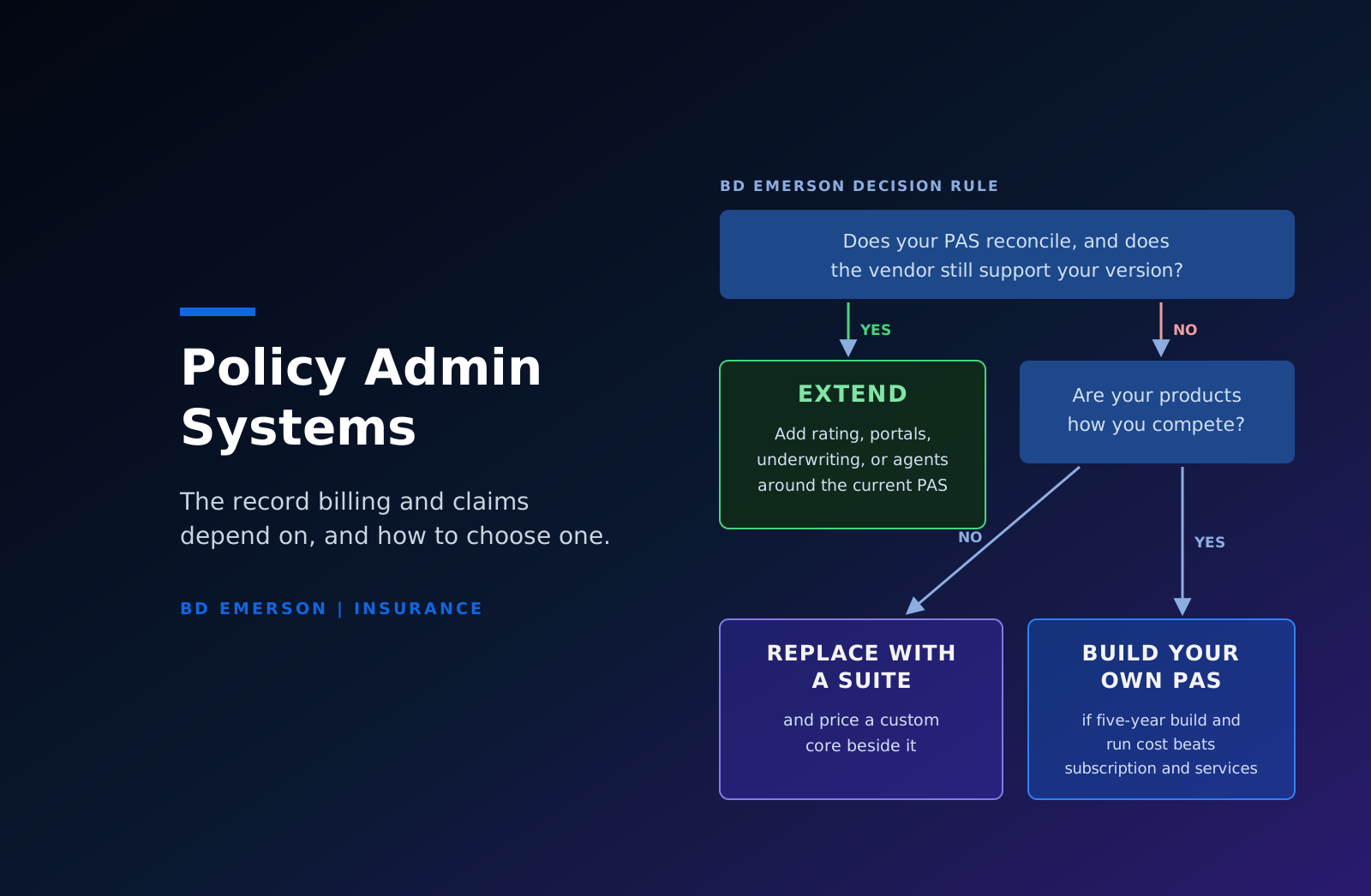
Our rule starts with the policy record and works outward: extend a PAS that reconciles, replace one that blocks change, and build only where products are how you compete. In our experience, extending is the right first answer more often than vendors suggest, and when replacement is justified, a suite is the right buy for many carriers whose products look like the market's.
| If this is true | Then | Why |
|---|---|---|
| The PAS reconciles premium, counts, and balances to billing and the general ledger, the vendor supports your version, and the delays sit in intake, rating, portals, or underwriting | Extend: add a rating service, underwriting workbench, portal, or governed agents | You fix the slow step without moving the policy record |
| The version is out of support, a new state or line takes more than a quarter, or each change needs vendor services, and your products resemble the market's | Replace with a suite, and price a custom core beside it | The record blocks change, and bureau content and a partner bench cover standard products |
| Your products are how you compete, as in program, specialty, embedded, or MGA business, and five-year build-and-run cost beats subscription plus services | Build a custom agentic PAS you own | You keep the code, data model, and roadmap, and cost follows usage instead of premium |
Premium-based pricing is the number carriers most often underestimate. Guidewire's 10-K says it prices core subscriptions "based on the amount of Direct Written Premium" on its platform, with initial terms "generally five years in duration," and Duck Creek's last public 10-K, for fiscal 2022, described rates "based on the amount of a customer's DWP." Take a carrier writing $400 million of direct written premium (DWP) that grows 7 percent a year. In year five it writes about $524 million, because 1.07 to the fourth power is 1.31, so a fee set as a flat share of DWP rises 31 percent with no change in use. Our Guidewire alternatives guide compares how each option prices premium growth, and carriers leaving PolicyCenter can start with our Guidewire replacement five-year model.
How long does a policy administration system implementation take?
Lines, states, integrations, and data conversion decide how long a PAS program takes. Guidewire's 10-K says implementation and testing of its products "typically lasts six to 24 months or longer." Vendors publish faster cases for narrow scopes: Majesco says some preconfigured CoreConnect programs "can go live in as little as 11 weeks," and the specialty MGA eMaxx went live on Majesco's P&C policy and premium audit platforms in six months, per Majesco's May 2026 announcement. We plan with the BD Emerson ranges below.
| Scenario | BD Emerson planning range | What moves it within the range |
|---|---|---|
| New carrier or MGA, one line on a vendor's prebuilt content | 3 to 9 months | Fit with bureau or program content, states, and payment and document integrations |
| Extend a retained PAS with a rating service, portal, workbench, or agent layer | 2 to 6 months | Access to the current system's APIs, channels, and volume |
| Replace the PAS with a suite, one to three lines | 9 to 18 months | Lines, states, integrations, in-force policies to convert, and configuration depth |
| Replace policy, billing, and claims, two to four lines | 12 to 24 months | The same drivers, plus open claims, billing history, and parallel running |
| Enterprise program across many lines or states | 18 to 36 months | Extensions carried forward and organization change |
| Build a custom PAS, first line | 9 to 15 months, then about 5 months per added line | Team size, rules depth, integrations, and conversion |
Configuration is the smallest of the five workstreams that fill that time, which is why we recommend staffing data conversion and test automation from the first week. McKinsey's April 2026 analysis of core modernization finds that "rewriting code or configuring the target platform is only a small portion of the work."
| Workstream | What it involves | What makes it run long |
|---|---|---|
| Product configuration | Rebuilding each product's coverages, rules, rates, and forms | Rules that live only in legacy code or underwriters' heads |
| Data migration | Converting in-force policies, or moving each at renewal, then reconciling premium, counts, and balances | Source data quality and repeated reconciliation |
| Integration | Billing, claims, documents, portals, payments, the general ledger, and the data platform | Thinly documented legacy interfaces and other owners' test windows |
| Testing | Rating parity against the legacy system by state and line, plus regression for vendor releases | Manual test suites that grow with each release |
| Regulatory filings | Rate, rule, and form filings for changed products, and bureau circulars on schedule | State review time and filed rates the new system must match exactly |
What modern and agentic approaches change
Three changes are in production or in vendor releases as of September 2026: products defined as versioned data, open interfaces that let other systems and agents act on the core, and AI agents that draft configuration under human approval.
A modern PAS stores rates, rules, forms, and state variations as versioned definitions with effective dates, so a rate change is a reviewed change to data instead of a code release. Duck Creek's Product Factory lets business and IT teams model new coverages and reuse product definitions.
Agents now ship inside the suites. Guidewire's Qusar release of August 3, 2026 added an Agentic Framework with real-time access to policy, claims, and billing data, a Policy Change agent for underwriters and service staff, and a Product Design Assistant for Advanced Product Designer, with some features limited to Early Access or Restricted Availability customers. Duck Creek's Agentic Product Configurator, launched April 29, 2026, reads "underwriting manuals, rating guides, and forms" and drafts manuscript configurations for human review. McKinsey puts agentic productivity gains at 15 to 40 percent for platform configuration, 20 to 60 percent for data mapping and conversion, and 15 to 90 percent for testing and reconciliation.
Governance travels with the agents. The NAIC adopted its model bulletin on insurers' use of AI in December 2023, and it expects AI-made or AI-supported decisions to comply with insurance law. We write the authority line before an agent touches the PAS: any action that binds coverage, changes premium, or cancels a policy goes to a person with that authority, and each action is logged with the rule that allowed it.
How to choose a policy administration system: a scoring checklist
Write the criteria and weights before the first demo, then score each option, a custom build and an extend option included, on the same scale. This is the checklist we use: score each criterion from 1 to 5, multiply by its weight, and divide the total by 5 for a score out of 100.
| Criterion | Weight | What earns a 5 |
|---|---|---|
| Configuration speed on your hardest product | 20 | The vendor configures one of your real products in your hardest state during the evaluation, and you record the time |
| Five-year cost at today's and plan premium | 20 | A written five-year cost, including subscription, services, staff, and the parallel run, at both premium levels |
| Integration fit | 15 | Documented APIs and events for billing, claims, documents, portals, and the general ledger, with your integration list priced |
| Data ownership and exit | 10 | Export format, cost, and timeline for your full policy history in the contract, and ownership of the configuration you pay for |
| Regulatory change handling | 10 | A named owner and turnaround for bureau circulars and filings, with effective-dated rates and forms |
| Agent and AI access | 10 | Your own agents, on models you choose, read and write through governed APIs with permissions and logs you control |
| Talent and partner dependency | 10 | Named, certified leads in the contract and a plan for who maintains the system after go-live |
| Vendor viability and roadmap | 5 | Roadmap commitments in writing under current ownership |
An option that scores 4 on configuration speed earns 16 of 20 points and one that scores 2 earns 8, so a slow configuration costs more than any feature gap a scripted demo can show. Run the evaluation in this order:
- Inventory your products, states, integrations, and in-force data before you contact vendors.
- Send each vendor one real product, your hardest state, and your integration list.
- Time the configuration, run your endorsement and renewal scenarios, and test rating parity.
- Price five years at today's and plan premium, including conversion and the parallel run.
- Score the custom build and extend options on the same checklist before you sign.
Frequently asked questions
What is a policy administration system? A policy administration system is the core software an insurer uses to run the policy lifecycle: product definition, rating, quoting, binding, issuance, endorsements, renewals, and cancellations. It holds the policy record that billing and claims depend on. Guidewire PolicyCenter, Duck Creek Policy, and Majesco P&C Policy are common P&C examples, and FINEOS AdminSuite serves life, accident, and health insurers.
What is the difference between a policy administration system and a rating engine? A rating engine calculates premium from rates, factors, and algorithms. A policy administration system runs the whole policy lifecycle and keeps the policy record, and it calls the rating engine at quote, endorsement, and renewal. Some PAS products build rating in, and carriers with several policy systems often move rating into one external engine so each channel prices the same way.
What is Guidewire PolicyCenter? PolicyCenter is the policy administration application in Guidewire's InsuranceSuite. Guidewire's fiscal 2026 Form 10-K calls it a system of record for the entire policy lifecycle, covering product definition, underwriting, quoting, binding, issuance, endorsements, audits, cancellations, and renewals. Guidewire reports more than 155 PolicyCenter customers in 20 countries.
How long does it take to implement a policy administration system? Guidewire's 10-K says implementation and testing of its products typically lasts six to 24 months or longer. Our planning ranges are 3 to 9 months for a new carrier or MGA on one line, 9 to 18 months to replace the PAS for one to three lines, and 18 to 36 months for an enterprise program.
Should an insurer build or buy a policy administration system? Buy when your products resemble the market's and a suite's bureau content and partner bench cover them. Extend when your current PAS reconciles and the bottleneck sits around it. Build when your products are how you compete and the five-year cost of building and running a system you own beats subscription plus services.
How is a life insurance policy administration system different from a property and casualty system? A life or annuity contract can stay in force for decades with cash values, loans, withdrawals, and riders, so a life PAS tracks values and transactions over a long life. It also supports tax qualification under Internal Revenue Code section 7702 and illustration rules such as the NAIC's Model 582. A P&C PAS centers on terms, endorsements, renewals, bureau content, and state rate and form filings.
If you are deciding whether to extend, replace, or rebuild your PAS, our policy administration system team starts with an inventory of your products, integrations, and in-force data, then scores each path on the same checklist before anyone signs a license.

About the author

















