Software License Optimization: Cut Publisher Costs and Prepare for Audits
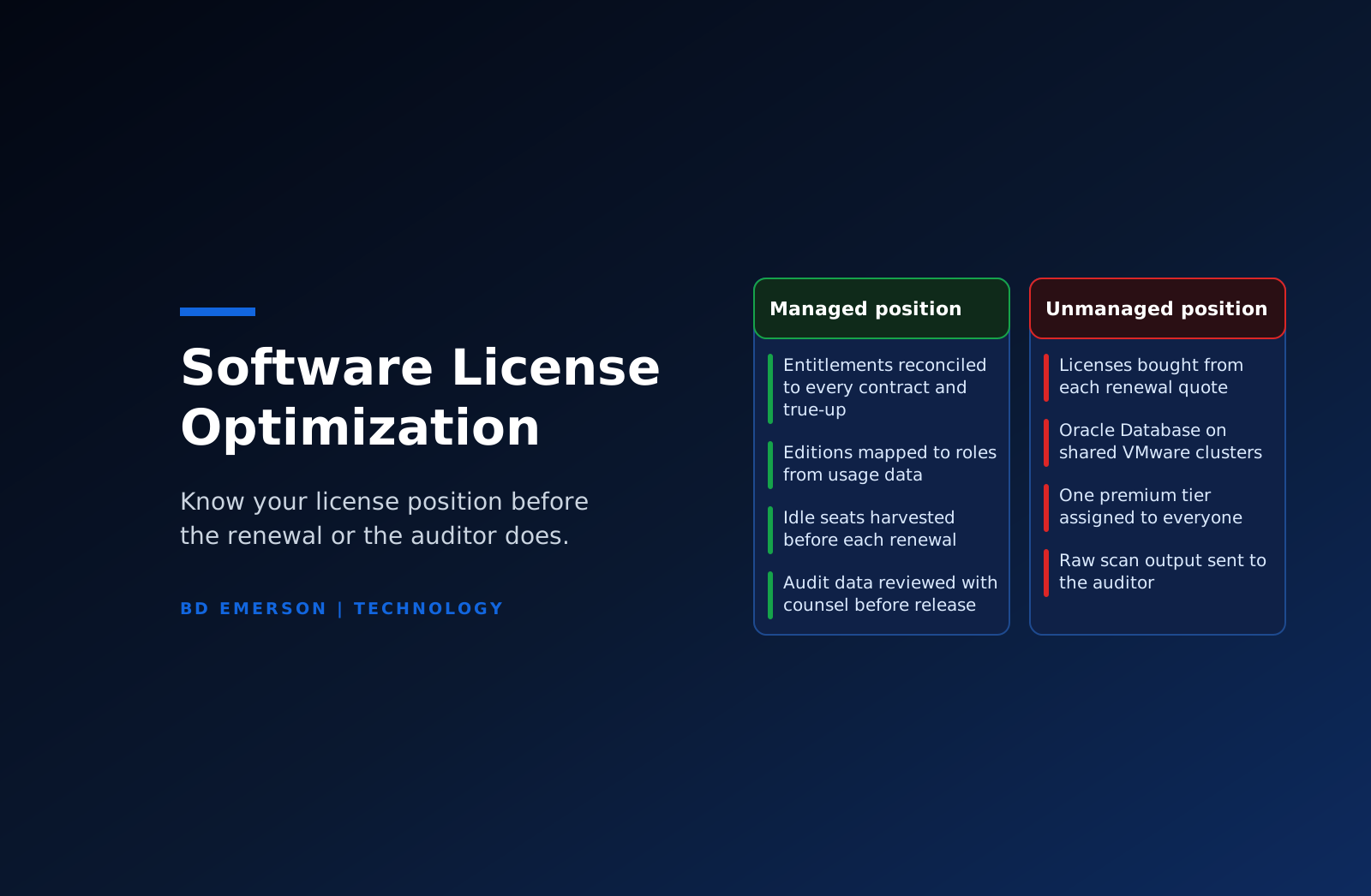
Software license optimization is the work of reconciling what you are entitled to use, what you have deployed, and what people use, then changing quantities, editions, and contract terms so you stop paying for the difference. That reconciliation, the effective license position (ELP), is the starting point for every decision, and ISO/IEC 19770-1:2017 sets the requirements for the IT asset management system that keeps it current. Each large publisher creates overspend in its own way: Microsoft through suite tiers and add-ons such as Copilot, Oracle through Java's employee-based metric and database licensing on VMware hosts, Broadcom through VMware subscriptions priced per core, and SAP through indirect use. Audits are the other side of the same work. In Flexera's 2026 State of ITAM Report, 48% of respondents said their organization was audited in the past year, and 44% of organizations had spent more than $1 million on audits over three years.
What is an effective license position?
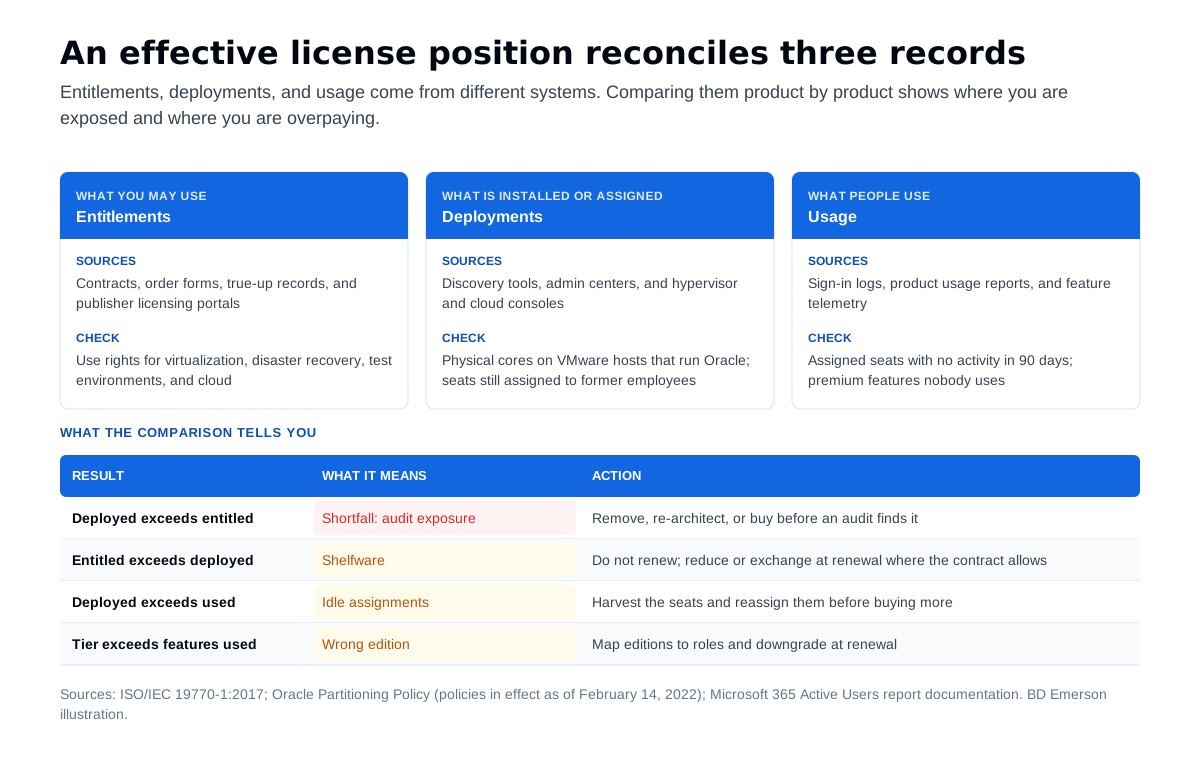
An effective license position compares three records for each product. Entitlements come from contracts, order forms, true-up records, and the publisher's licensing portal, and they include the use rights that decide an audit, such as whether a license covers virtualization, disaster recovery, or test environments. Deployments come from discovery tools, hypervisor and cloud consoles, and admin centers: every installation, assigned seat, and processor core. Usage comes from sign-in data and product reports, and it shows whether people use what they are assigned.
The comparison produces two answers. Where deployments exceed entitlements, you have a shortfall, which is audit exposure. Where entitlements exceed use, you have a surplus, which is the savings. Both can appear at the same publisher when the people who buy licenses and the people who deploy software keep separate records.
Software asset management (SAM) is the ongoing program that keeps those records current, and license optimization is the set of cost decisions it feeds. ISO/IEC 19770-1:2017, the third edition of the IT asset management system standard, which ISO last reviewed and confirmed in 2024, sets requirements for running that program as a management system. You do not need certification to use it. The value is one record of entitlements, discovery data refreshed on a schedule, and a named owner for each publisher.
Where do the large publishers create overspend?
Each publisher's licensing model produces a different kind of waste and a different audit risk, so the first step is to know which lever applies where.
| Publisher | Common overspend | Main lever | Audit exposure |
|---|---|---|---|
| Microsoft | One suite tier for everyone; Copilot seats with low use; tools now included in Microsoft 365 E3 | Tier mapping by role and seat reclaim before renewal | The most-reported auditor in Flexera's 2026 survey, named by 64% of audited respondents |
| Oracle | Java SE priced on total employee count; Oracle Database on shared VMware clusters | Java inventory; dedicated hosts for Oracle Database | Named by 50% of audited respondents in the same survey |
| VMware by Broadcom | Cores licensed on hosts that could be retired; bundles bought for unused components | Host consolidation and bundle choice before renewal | VMware audit reports rose 9 percentage points year over year in Flexera's survey |
| SAP | Indirect use by other systems that create documents in SAP | Digital access document counts measured before negotiation | Indirect access is charged by document volume |
| Adobe | Named-user seats held by people who stopped using them | Reductions in the renewal window; 3-Year Commit pricing | Adobe audit reports rose 8 percentage points year over year in Flexera's survey |
| Salesforce | Seats bought for peak headcount; editions above need | True-down rights and price caps agreed before renewal | Use above contracted limits must be reduced or bought on a new order form |
How do you cut Microsoft 365 licensing costs?
Three levers move Microsoft 365 costs, and the first is tier mapping. On December 4, 2025, Microsoft announced new list prices effective July 1, 2026: Microsoft 365 E3 rose from $36 to $39 per user per month, E5 from $57 to $60, Office 365 E3 from $23 to $26, and frontline F3 from $8 to $10, while Business Premium stayed at $22. Existing customers kept current pricing until renewal. A map that puts information workers on E3, security-heavy roles on E5, and frontline staff on F3 costs less than one tier for everyone when only some roles use E5 features. Check what each tier includes now, because the same update brought Intune Plan 2, Remote Help, and Defender for Office 365 Plan 1 into Microsoft 365 E3, which can make a separately bought endpoint or remote support tool redundant.
The second lever is seat reclaim. The Active Users report in the Microsoft 365 admin center shows license use by product over 7, 30, 90, or 180 days. Remove licenses from former employees' accounts, and from users with no activity in 90 days once their managers confirm.
The third is Copilot. Microsoft lists Microsoft 365 Copilot at $30 per user per month paid yearly, or $31.50 paid monthly on an annual commitment, on top of a qualifying Microsoft 365 plan. The Copilot usage report compares enabled users with active users, meaning people who submitted a prompt or used a Copilot feature, over 7, 28, 90, or 180 days. Move seats from enabled users with no activity to people waiting for one, and check the active rate before the add-on renews. Timing applies to every Microsoft change: new commerce subscriptions allow a prorated cancellation only within seven calendar days of purchase or renewal, and seat reductions are scheduled to take effect at renewal. Our Microsoft 365 security assessment compares the security features each tier includes with what the tenant has configured, which answers whether E5 is earning its price.
How should you handle Oracle Java and database licensing?
Two Oracle licensing models need attention: Java and Oracle Database on virtualized hosts. Since January 23, 2023, the Java SE Universal Subscription has replaced Oracle's legacy Java SE subscriptions, and it uses an employee-based metric. Oracle's price list counts all full-time, part-time, and temporary employees, plus the employees of agents, contractors, outsourcers, and consultants who support internal operations, whether or not any of them use Java. Enterprise pricing starts at $10.50 per employee per month for organizations with 3,000 or more employees. On October 8, 2026, Oracle introduced flat annual pricing for smaller organizations: $100 a year for 10 or fewer employees, $1,000 for 100 or fewer, $10,000 for 500 or fewer, and $147.20 for each additional employee up to 2,999.
The lever is an inventory of every Oracle JDK installation, its version, and the terms it was downloaded under, so you can decide whether a subscription is needed at all and for which systems. Whether a given installation requires a paid license is a question of contract and license terms, and counsel should make that call with the inventory in hand.
Oracle Database on VMware is the second exposure. Oracle's partitioning policy lists VMware as soft partitioning, which Oracle does not accept as a way to limit the number of licenses required for a server or cluster. The same document says it is for educational purposes and is not part of any contract, so your license agreement governs and its interpretation belongs to counsel. The practical lever is architecture: run Oracle workloads on hosts or clusters dedicated to them, so the processor count covers those hosts and no others.
What changed in VMware licensing under Broadcom?
In December 2023, Broadcom stopped selling VMware perpetual licenses and stopped renewing support contracts for them. It now sells VMware software as subscriptions, chiefly VMware Cloud Foundation (VCF) and VMware vSphere Foundation (VVF). Both are licensed on the physical CPU cores of every ESXi host you license, with a minimum of 16 cores per CPU under Broadcom's core-counting rules, so a host with two 8-core processors counts as 32 cores. VCF includes 1 TiB of vSAN capacity per core purchased, and VVF includes 0.25 TiB per core.
The levers sit in the core count and the bundle. Retire or consolidate hosts before renewal, because every licensed host carries at least 16 cores per CPU whether or not the workload needs them. VCF is the broader bundle, so buy it where you use what it adds over VVF. Count storage against the included vSAN entitlement before buying more capacity. For workloads that no longer need VMware, compare the subscription with a move to public cloud or another hypervisor on total cost, including migration effort.
How do you right-size SAP, Adobe, and Salesforce licenses?
SAP licenses direct human access to its ERP and S/4HANA systems by named users. Under its digital access model, SAP charges indirect access, where other systems create records in SAP, by the number of documents across nine document types, such as orders or invoices created by a web store, a CRM, or a supplier portal. SAP's Global Adoption Insights and License Compliance group offers a free estimate of digital access documents, and the result can serve as the baseline for SAP's Digital Access Adoption Program. Get the estimate and map your integrations before the contract conversation, so the document count is a number you have checked.
Adobe's Value Incentive Plan (VIP) runs on an anniversary date. Purchases during the year prorate to it, and for team licenses bought directly, the renewal window opens 30 days before it, with reductions taking effect on the renewal date. Reclaim seats in the weeks before that window opens. Organizations with 10 or more licenses can lock a set price for up to three years through VIP's 3-Year Commit, which trades flexibility for price protection.
Salesforce's Main Services Agreement (the September 15, 2025 version) states that quantities cannot be decreased during a subscription term, and that a renewal at lower volume or for a shorter term is re-priced without reference to the prior per-unit price. The savings therefore come from terms agreed before signature: a right to reduce seats at renewal at the existing unit price, a cap on renewal increases, and editions matched to roles.
How does a software audit start, and what should you do first?
A publisher starts an audit under the audit or verification clause in your license agreement, usually with a letter that names the products, the period, and who will do the work: the publisher's own compliance team or an outside audit firm. Oracle's License Management Services, for example, describes a four-phase review (kickoff, assessment, reporting, and close) and collects usage data through methods agreed with the customer. The first two weeks set the terms for everything after, and counsel should lead the correspondence from the first day.
- Acknowledge the letter in writing and name one point of contact for the auditor.
- Bring in counsel and procurement, and read the audit clause for notice, scope, frequency, confidentiality, and who pays.
- Agree the scope, the timeline, the data collection method, and a confidentiality agreement with the auditor in writing.
- Start your own effective license position for the products in scope before any data leaves the company.
- Preserve contracts, proofs of purchase, and prior true-up records, and route any change to systems in scope through counsel.
Do not hand over raw discovery output without review. A scan lists every installation it finds, including test, disaster recovery, and retired systems, and it says nothing about which entitlements or use rights cover them. Review the output with the contract owner, correct it, and provide what the clause requires. IBM adds a technical condition of its own. To license eligible products at sub-capacity, paying for the virtualized capacity a product can use instead of the whole server, you must run the IBM License Metric Tool or another approved tool such as HCL BigFix Inventory or Flexera One. Without it, IBM charges for all activated physical cores on the server.
What rightsizing techniques work across publishers?
License harvesting reclaims seats from people who left or stopped using a product and returns them to a pool, so the next new hire gets a reclaimed license before anyone buys one. Tier mapping assigns editions by role from usage data, which moves light users to cheaper editions and keeps premium tiers for the people who use their features. Removing duplicates retires overlapping products at their own renewal dates instead of mid-term, when the money is already spent.
Shelfware recovery finds licenses bought and never deployed: ERP modules, suite add-ons, or seats for a project that ended. Some contracts allow a reduction or exchange at renewal, and the rest at least should not renew. Renewal timing ties the techniques together. Line up the evidence 90 to 120 days before each renewal, as our guide to SaaS spend management describes, so the reductions make it into the contract. Licenses you already own can also lower cloud bills through bring-your-own-license programs such as Azure Hybrid Benefit, which our guide to cloud cost optimization covers.
When should you bring in a license advisor?
An outside advisor earns its fee in three situations: an audit letter has arrived, a renewal with a large publisher is less than six months away and nobody owns the effective license position, or a platform decision such as VMware, Oracle Database, or an ERP is open. Choose an advisor with no financial stake in what you buy. BD Emerson is vendor-neutral: we do not resell software or licenses and take no resale margin, so our advice does not change with the product you keep.
Our IT cost optimization team builds the effective license position from your contracts and discovery data, maps tiers to roles, prepares renewal positions, and supports your counsel through an audit response. When a renewal forces a choice between staying, switching, and building, our build versus buy advisory models the options on total cost. After the review, our virtual CIO team can own the publisher relationships and the renewal calendar.
Frequently asked questions
What is software license optimization? Software license optimization is the process of matching software entitlements to what is deployed and used, then adjusting quantities, editions, and contract terms to remove the surplus. It starts from an effective license position for each publisher and ends in renewal and contract decisions. Software asset management is the ongoing program of records and processes that makes those decisions possible.
What is an effective license position? An effective license position (ELP) reconciles the licenses you are entitled to use with what you have deployed, product by product, under the use rights in your contracts. A shortfall shows audit exposure, and a surplus shows savings. Build one for each major publisher before every renewal, and start one the day an audit letter arrives.
What triggers a software audit? Publishers audit under the audit or verification clause in your license agreement, and they do not publish how they choose whom to audit. Audits are common enough to plan for: in Flexera's 2026 State of ITAM Report, 48% of respondents said their organization was audited in the past year, and Microsoft and Oracle were the publishers named most often. A current effective license position is the practical defense.
How do I reduce Microsoft 365 licensing costs? Map tiers to roles instead of buying one tier for everyone, reclaim licenses from former employees and inactive users with the Microsoft 365 Active Users report, and check Copilot's enabled-versus-active rate before renewing the add-on. Time changes to renewal, since new commerce subscriptions allow prorated cancellation only in the first seven days, and Microsoft's July 1, 2026 list prices reached existing customers at renewal.
How is Oracle Java licensed now? Since January 23, 2023, Oracle has sold Java SE through the Java SE Universal Subscription, priced per employee instead of per installation or per user. Oracle's price list counts all full-time, part-time, and temporary employees plus those of contractors and outsourcers who support internal operations. Enterprise pricing starts at $10.50 per employee per month for 3,000 or more employees, and Oracle added flat annual tiers for smaller organizations on October 8, 2026.
Should you run a publisher's audit scripts? Run them only after agreeing in writing on what they collect, which systems they run on, and how the output will be used, and review the output before it goes to the auditor. Raw results list installations without the entitlements and use rights that cover them, and they can include test, disaster recovery, or retired systems. Counsel should approve the data request and the response.
If a Microsoft, Oracle, or VMware renewal is coming up or an audit letter has arrived, our IT cost optimization team can build your effective license position, prepare the renewal or audit response with your counsel, and map licenses to the roles that use them.

About the author