What Is Guidewire? PolicyCenter, ClaimCenter, BillingCenter, and Guidewire Cloud

Guidewire Software, Inc. is a publicly traded software company (NYSE: GWRE) that sells the core systems property and casualty (P&C) insurers use to sell and service policies, bill premiums, and handle claims. Its main product line, InsuranceSuite, pairs PolicyCenter for underwriting and policy administration with BillingCenter for invoicing and collections and ClaimCenter for claims. Guidewire runs these applications for customers on Guidewire Cloud, which it hosts on Amazon Web Services (AWS), and it still supports carriers that run InsuranceSuite in their own data centers. According to its fiscal 2026 results, more than 570 insurers in 44 countries rely on Guidewire products.
Many people search for the company as "guide wire." In medicine, a guidewire is a long, flexible wire that a doctor uses to guide a catheter or other device through a patient's blood vessels, as Terumo Aortic's patient glossary explains. This article covers the software company. Our insurance team, which includes people who helped lead a Guidewire implementation practice of thousands of professionals at a Big Four firm, wrote this guide for carriers deciding whether to stay, migrate, or replace.
Guidewire Software at a glance
Guidewire, founded in 2001, has its headquarters in San Mateo, California, according to its fiscal 2026 Form 10-K. Its shares began trading on the New York Stock Exchange on January 25, 2012, after its initial public offering, and Mike Rosenbaum became chief executive in August 2019, when Marcus Ryu moved to the chairman role.
| Measure | Fiscal 2026 (year ended July 31, 2026) | Source |
|---|---|---|
| Insurers that rely on Guidewire products | More than 570 in 44 countries | Results release |
| Customers | Approximately 550 in 44 countries | Form 10-K |
| Total revenue | $1,475.4 million, up 23 percent | Results release |
| Annual recurring revenue (ARR) | $1,242 million, up 19 percent in constant currency | Results release |
| Employees | 4,174 | Form 10-K |
The Guidewire platform and architecture
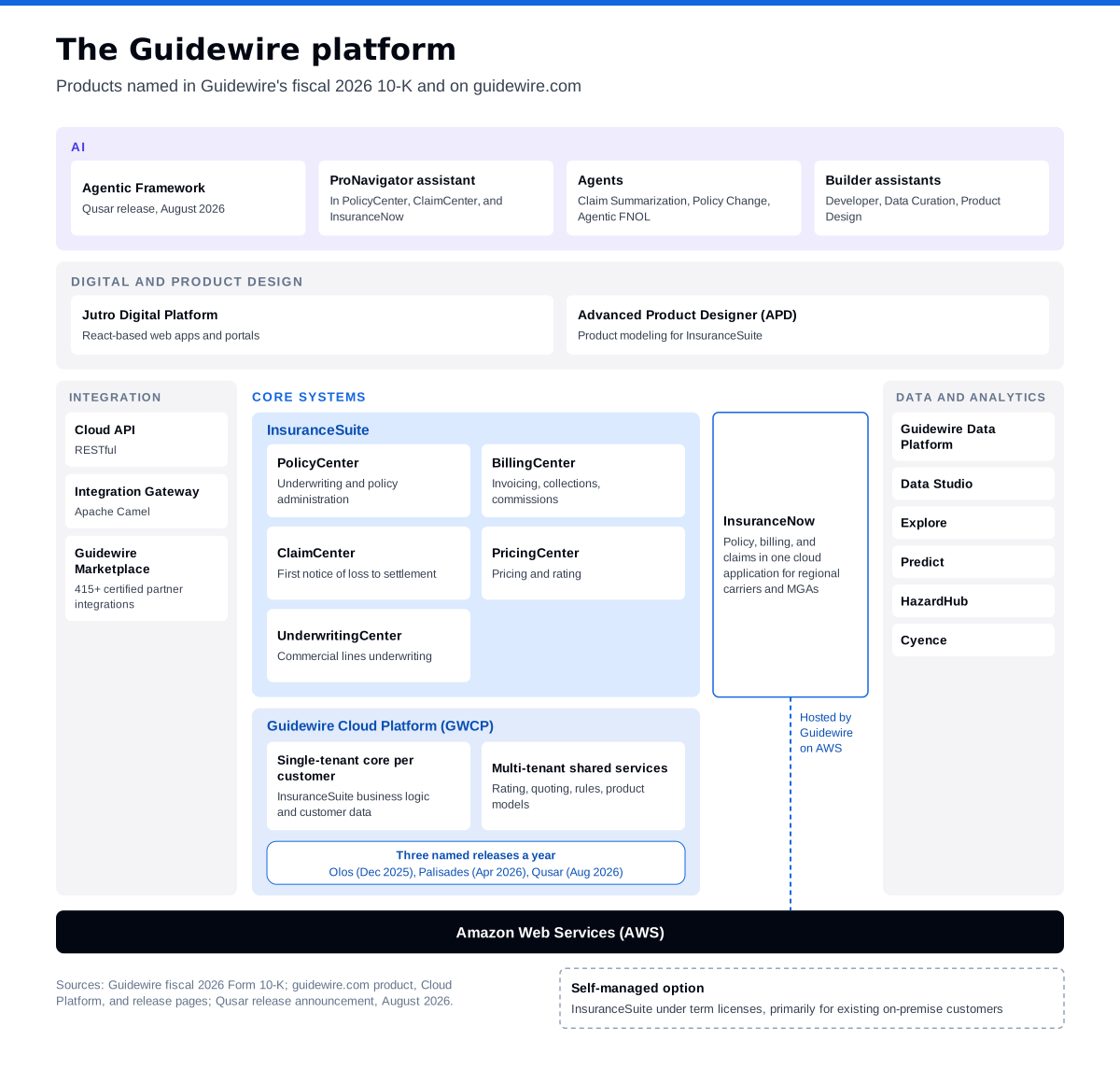
Guidewire's architecture is layered. Two core products, InsuranceSuite and InsuranceNow, hold the policy, billing, and claims records, and Guidewire hosts both on AWS for cloud customers. Data, digital, integration, and AI products surround the core, and the map below shows how the pieces fit.
Guidewire InsuranceSuite: PolicyCenter, BillingCenter, and ClaimCenter
InsuranceSuite is Guidewire's flagship, and its InsuranceSuite page now lists five applications: PolicyCenter, BillingCenter, ClaimCenter, PricingCenter, and UnderwritingCenter. Carriers can adopt the applications one at a time, and Guidewire reports a separate customer count for each.
Guidewire PolicyCenter
PolicyCenter, sometimes written as Policy Center, is the policy administration system and the system of record for a carrier's policies. The 10-K lists its scope as product definition, underwriting, quoting, binding, issuance, endorsements, audits, cancellations, and renewals. In plain terms, an underwriter or agent uses PolicyCenter to turn an application into a priced, bound, and issued policy, then to change or renew it. Guidewire's PolicyCenter page reports more than 155 customers in 20 countries. Our policy administration system page covers what carriers need from this layer.
Guidewire BillingCenter
BillingCenter manages the money that moves between a carrier, its policyholders, and its agents. Guidewire's BillingCenter page says it handles premium collection, invoicing, payment processing, disbursements, refunds, and delinquency, and it calculates and pays agent commissions. Guidewire reports more than 150 BillingCenter customers in 19 countries.
Guidewire ClaimCenter
ClaimCenter manages a claim from first notice of loss (FNOL) to settlement, covering intake, assignment to an adjuster, reserves, payments, subrogation, litigation, and closure. It is Guidewire's most widely adopted application: the ClaimCenter page reports more than 270 customers in more than 30 countries. We compare claims platforms, custom builds included, on our claims management software page.
PricingCenter and UnderwritingCenter
Guidewire has added two applications. PricingCenter, announced in October 2025, puts pricing and rating in one environment, from data preparation and modeling through API deployment. UnderwritingCenter is an AI-driven application that helps commercial lines underwriters assess risk and shape deals, then hands each deal to the policy system for issuance.
How a policy moves through PolicyCenter, BillingCenter, and ClaimCenter
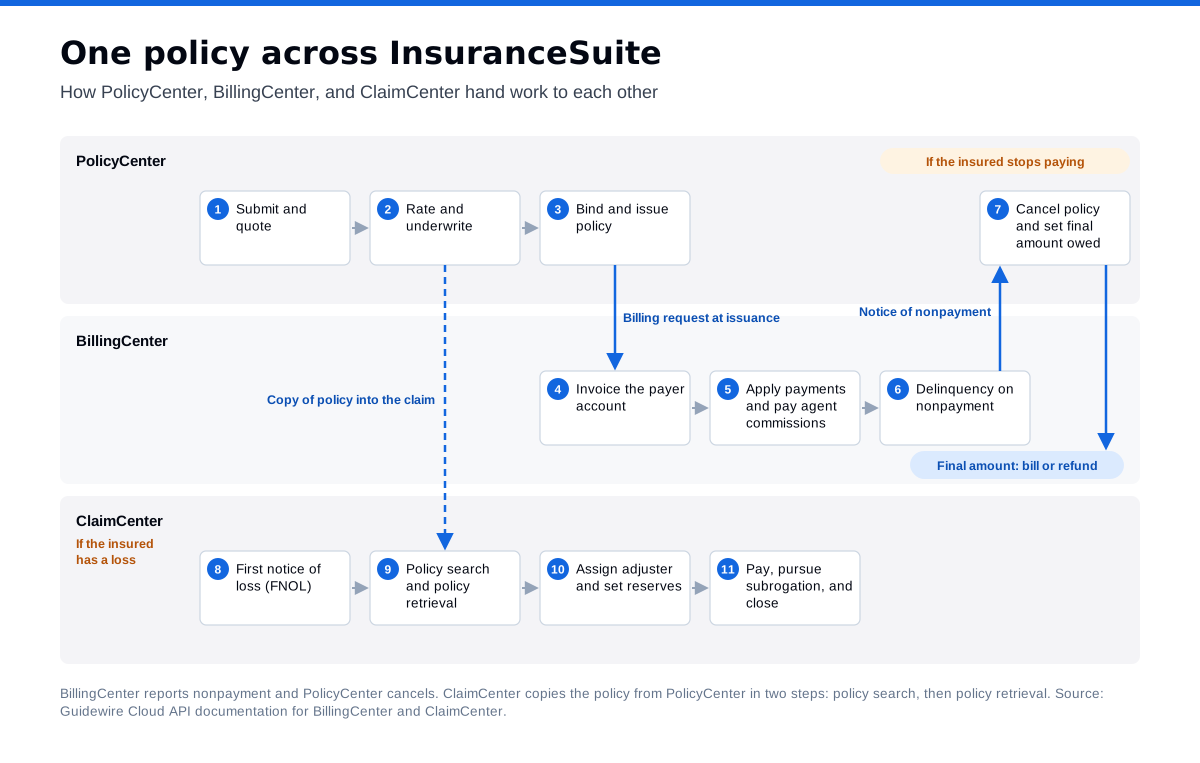
The three applications run as separate systems that exchange data through integrations, and one commercial auto policy shows the sequence. An agent submits the risk in PolicyCenter, which rates it, applies underwriting rules, and binds and issues the policy. At issuance, PolicyCenter sends BillingCenter a billing request, which BillingCenter uses to invoice the payer account, according to Guidewire's BillingCenter documentation. BillingCenter then applies payments and calculates the agent's commission.
When an insured stops paying, BillingCenter runs its delinquency process and informs PolicyCenter of the nonpayment. Guidewire's cancellation documentation gives PolicyCenter the job of canceling the policy and setting the final amount owed, which BillingCenter then bills or refunds. When the insured reports an accident, ClaimCenter opens the claim at FNOL and copies the policy from PolicyCenter in two steps, policy search and policy retrieval. An adjuster then sets reserves, issues payments, pursues subrogation, and closes the file. We see most of a Guidewire program's integration risk in these handoffs.
Guidewire InsuranceNow for regional carriers and MGAs
InsuranceNow is Guidewire's second core product, a single cloud application, hosted by Guidewire on AWS, that combines policy administration, billing, and claims. The 10-K says it suits mid-market carriers and managing general agents (MGAs) that are highly cost sensitive, and the InsuranceNow page says Guidewire purpose-built it for regional and super-regional P&C insurers and MGAs. Guidewire reports 57 carriers and MGAs in the United States on InsuranceNow, more than $10 billion of combined direct written premium (DWP), and more than 145,000 users each month. In our view, InsuranceNow suits carriers that accept Guidewire's standard processes in exchange for one vendor-run system.
Guidewire Cloud Platform: AWS, tenancy, and releases
Guidewire Cloud Platform (GWCP) is the infrastructure layer Guidewire built to run its applications as a service, and the 10-K says AWS hosts it. In a 2021 Guidewire blog post, Diego Devalle, then Guidewire's chief product development officer, described the platform's hybrid tenancy model. Each customer's InsuranceSuite core runs single-tenant, "including business logic and customer data," and shared services such as rating, quoting, rules, and product models run multi-tenant.
Guidewire has shipped three named releases a year since 2023 and names each one after a ski destination, in alphabetical order. Its releases page lists Mammoth (April 2025), Niseko (August 2025), Olos (December 2025), Palisades (April 2026), and Qusar (August 2026). Guidewire still offers term licenses, primarily to existing on-premise customers, so self-managed InsuranceSuite remains available, though new capabilities such as the Agentic Framework run on Guidewire Cloud.
Data, digital, and integration tools around the core
Guidewire Data Platform captures InsuranceSuite data in a P&C data model built for analytics, according to the Data Platform page. Data Studio, which Guidewire calls the face of the Data Platform, turns that data into curated datasets for Guidewire Explore, the Guidewire Predict machine-learning platform, and a carrier's own business intelligence tools. The 10-K also lists HazardHub for property risk and Cyence for cyber-risk modeling.
For digital experiences, Guidewire sells the Jutro Digital Platform, which combines a UI framework, a metadata-driven component library, and a design system that connects to Figma. Jutro apps are React-based single-page applications that pull business data from InsuranceSuite APIs, and carriers build policyholder, agent, broker, and adjuster portals with them. Advanced Product Designer (APD) lets business analysts design, simulate, and deploy insurance products, then generates the entities, product model, and user interface elements PolicyCenter needs.
Integration runs through three pieces. Cloud API is a set of RESTful system APIs that expose create, read, update, and delete operations on InsuranceSuite resources, and PolicyCenter generates additional endpoints for each carrier's lines of business. Integration Gateway is a cloud-native integration platform built on Apache Camel that moves integration logic out of the core applications. The Guidewire Marketplace held more than 415 partner-developed integrations certified "Ready for Guidewire" at July 31, 2026, according to the 10-K, and Stripe's payment apps for BillingCenter and ClaimCenter are one example.
Gosu and how Guidewire configuration works
InsuranceSuite applications run on the Java Virtual Machine (JVM), and a developer installs the Java Development Kit and works in Guidewire Studio, according to Guidewire's developer workstation guide. Guidewire describes the Gosu programming language as an open-source, statically typed JVM language that works with Java types and is used in more than 700 P&C core implementations. Its configuration guides say configuration files determine almost every aspect of the three core applications, from the data model and screens to security, business rules, workflows, and integrations. In practice, developers extend entities and typelists, edit page configuration (PCF) files, and write Gosu rules and plugins.
That model creates a talent dependency. Guidewire certifies developers at two levels, Certified Associate and Certified Ace, requires the Ace level for Cloud leads, and requires a developer to re-certify once a certification falls more than three releases behind. A Guidewire job posting for a senior configuration consultant asks for six to eight years of hands-on PolicyCenter experience. In our experience, few carriers employ that depth in house, so they pay system integrators for most material changes, and that cost belongs in any five-year comparison.
AI in Guidewire: the Qusar Agentic Framework and ProNavigator
Guidewire's Qusar release in August 2026 launched the Agentic Framework, which lets insurers build, deploy, and manage AI agents on Guidewire Cloud Platform with real-time access to policy, claims, and billing data. Qusar ships three insurance agents: Claim Summarization for ProNavigator, Policy Change for ProNavigator, and Agentic FNOL. It also adds a Developer Assistant for Gosu, integrations, Jutro, and Functions, a Data Curation Assistant for Data Studio, and a Product Design Assistant for APD. Guidewire says its developer assistants help teams deliver solutions more than 40 percent faster than generic coding assistants, based on internal benchmarks, and it limits some features to Early Access or Restricted Availability customers.
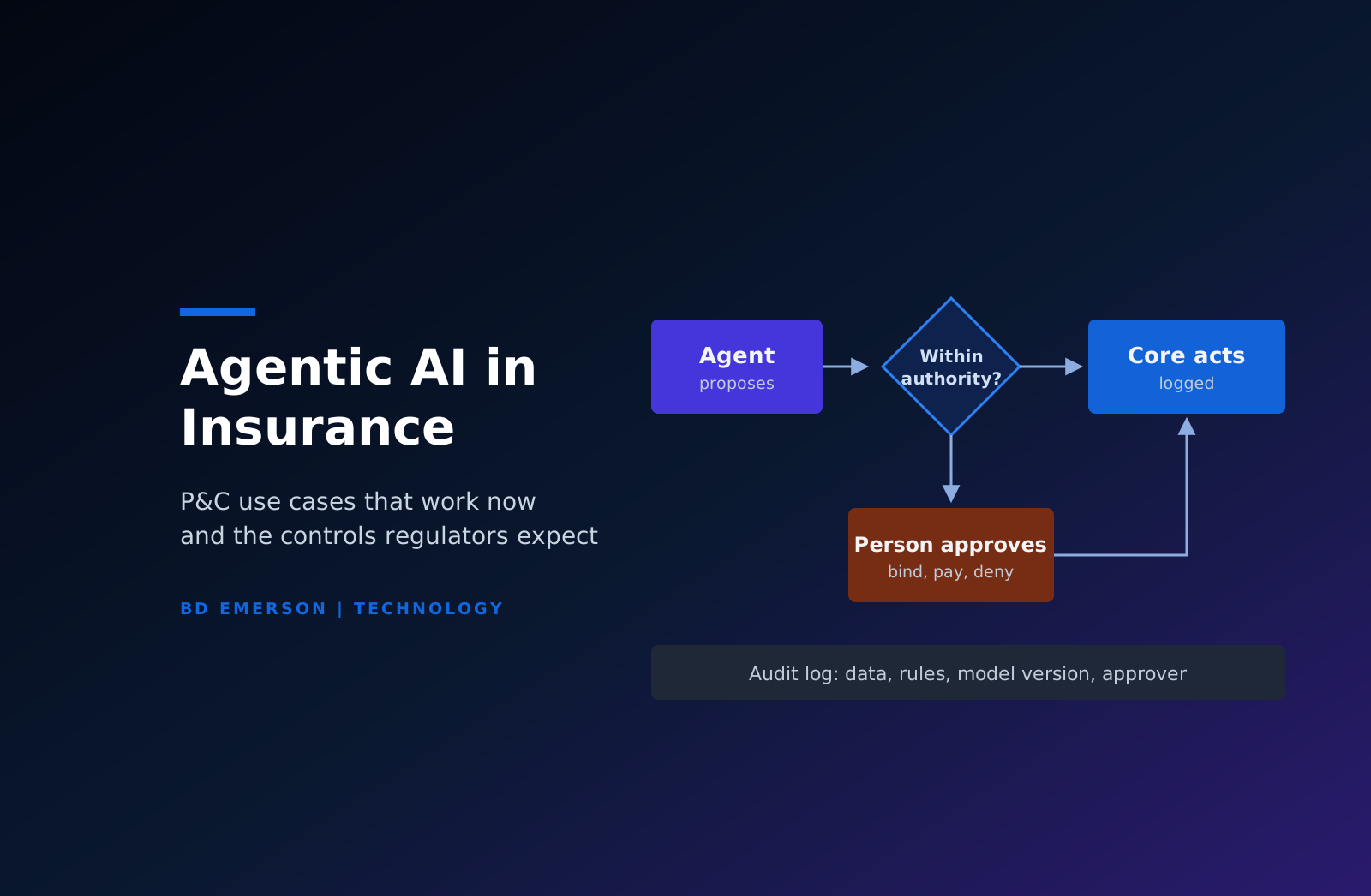
Guidewire agreed to acquire ProNavigator, an AI knowledge management platform built for insurance, in October 2025, and its April 2026 Palisades release embedded the assistant in PolicyCenter, ClaimCenter, and InsuranceNow. We recommend that carriers already on Guidewire Cloud test Qusar before they build agents elsewhere, because it gives them a credible starting point. Agents that can change a policy need the same access controls as a human underwriter, which we cover in our guide to securing AI agents.
How Guidewire is priced and how long implementation takes
Guidewire generally prices subscriptions for its core products on the amount of DWP a carrier manages on the platform, and it prices certain cloud products on usage or other metrics, according to the 10-K. Initial subscription agreements generally run five years with annual renewals after that, and some run seven years or longer. On average, that works out to about $2.3 million per customer per year: $1,242 million of ARR divided by about 550 customers. The spread around that average is wide, because the fee scales with the premium a carrier writes and the applications it subscribes to.
Implementation is the other major commitment. The 10-K says implementation and testing typically lasts six to 24 months or longer, and it warns that unexpected delays and difficulties can occur. In our experience, four factors decide where a program lands in that range: the number of lines of business, the number of states, the count of integrations, and the volume of legacy data to convert.
Who implements Guidewire
Guidewire's InsuranceSuite page cites more than 30,000 trained partner professionals and more than 750 dedicated Guidewire consultants. The 2025 ISG Provider Lens report on the global Guidewire services ecosystem named nine Leaders, among them Accenture, Capgemini, Cognizant, Deloitte, PwC, and TCS. We do not appear on that list, because we do not implement Guidewire.
Which insurance carriers use Guidewire
Guidewire's own press releases name many of the more than 570 insurers that rely on its products. The table lists recent announcements, newest first.
| Carrier | What Guidewire announced | Date |
|---|---|---|
| Lititz Mutual Insurance Company, Pennsylvania | Selected ProNavigator to bring AI-powered guidance to agents and employees | September 21, 2026 |
| Pohjola Insurance, Finland | Selected PricingCenter to work with its existing PolicyCenter | September 15, 2026 |
| The Cincinnati Insurance Company | Deployed ClaimCenter on Guidewire Cloud Platform for workers' compensation, with commercial, excess and surplus, and personal lines in progress | December 4, 2025 |
| Texas Windstorm Insurance Association | Migrated InsuranceSuite, which it has used since 2008, from an on-premise environment to Guidewire Cloud Platform | August 18, 2025 |
| Co-operators, Canada | Moved ClaimCenter to Guidewire Cloud Platform, completing an InsuranceSuite migration that began with PolicyCenter and BillingCenter in 2023 | June 9, 2025 |
| Amerisure | Went live on PolicyCenter and BillingCenter on Guidewire Cloud for workers' compensation, with commercial auto in progress | February 6, 2025 |
In these announcements, carriers go live one line of business at a time, as Amerisure and Cincinnati did with workers' compensation, and long-time on-premise customers such as Co-operators, a Guidewire customer since 2007, are moving to Guidewire Cloud.
Guidewire strengths and limitations
Guidewire earned its market position. The table pairs facts from its filings and product pages with our view of where carriers feel the cost.
| Area | Strength | Limitation |
|---|---|---|
| Product depth | Mature policy, billing, and claims applications built for P&C | Configuration spans the data model, screens, rules, and integrations, so changes need specialists |
| Ecosystem | Nine ISG Leaders, more than 30,000 trained partner professionals, and more than 415 certified integrations | Most material changes run through certified partner talent |
| Cloud | Single-tenant core on AWS, run by Guidewire, with three releases a year | Each release means regression testing of the carrier's configuration |
| Contract | Fees tied to DWP, so smaller books pay less | Fees grow with premium, and initial terms generally run five years |
| AI | Qusar agents with real-time access to core data | Agents run on Guidewire Cloud, and some features have restricted availability |
| Time to value | A proven path at more than 570 insurers | Implementation typically takes 6 to 24 months or longer |
In our view, the strengths win for carriers whose configuration stays close to Guidewire's base product and whose premium grows at a modest pace. The costs dominate for carriers with heavy customization, fast premium growth, or a product strategy that depends on launching lines and states quickly.
When carriers start looking at alternatives
The carriers we talk with start looking at alternatives at one of five moments:
- The five-year subscription term approaches renewal, and the DWP-based fee has grown with the book.
- An on-premise customer must decide whether to move to Guidewire Cloud and re-test years of customization.
- Product teams need new lines, states, or rate changes faster than the release cycle delivers them.
- Every material change requires certified talent the carrier does not employ.
- The carrier wants AI agents that act across policy, billing, and claims data under its own controls.
In BriteCore's 2025 P&C core systems report, a survey by a competing core vendor, 75 percent of insurers rated the ability to introduce new products, lines, or regions as highly important, and 42 percent said they were satisfied with their current systems. Replacement carries its own costs, and McKinsey describes the "double-bubble" periods when insurers pay to run legacy systems while funding the new one. McKinsey also finds that rewriting code or configuring the target platform "is only a small portion of the work," and it estimates that agentic AI improves productivity by 10 to 90 percent depending on the step.
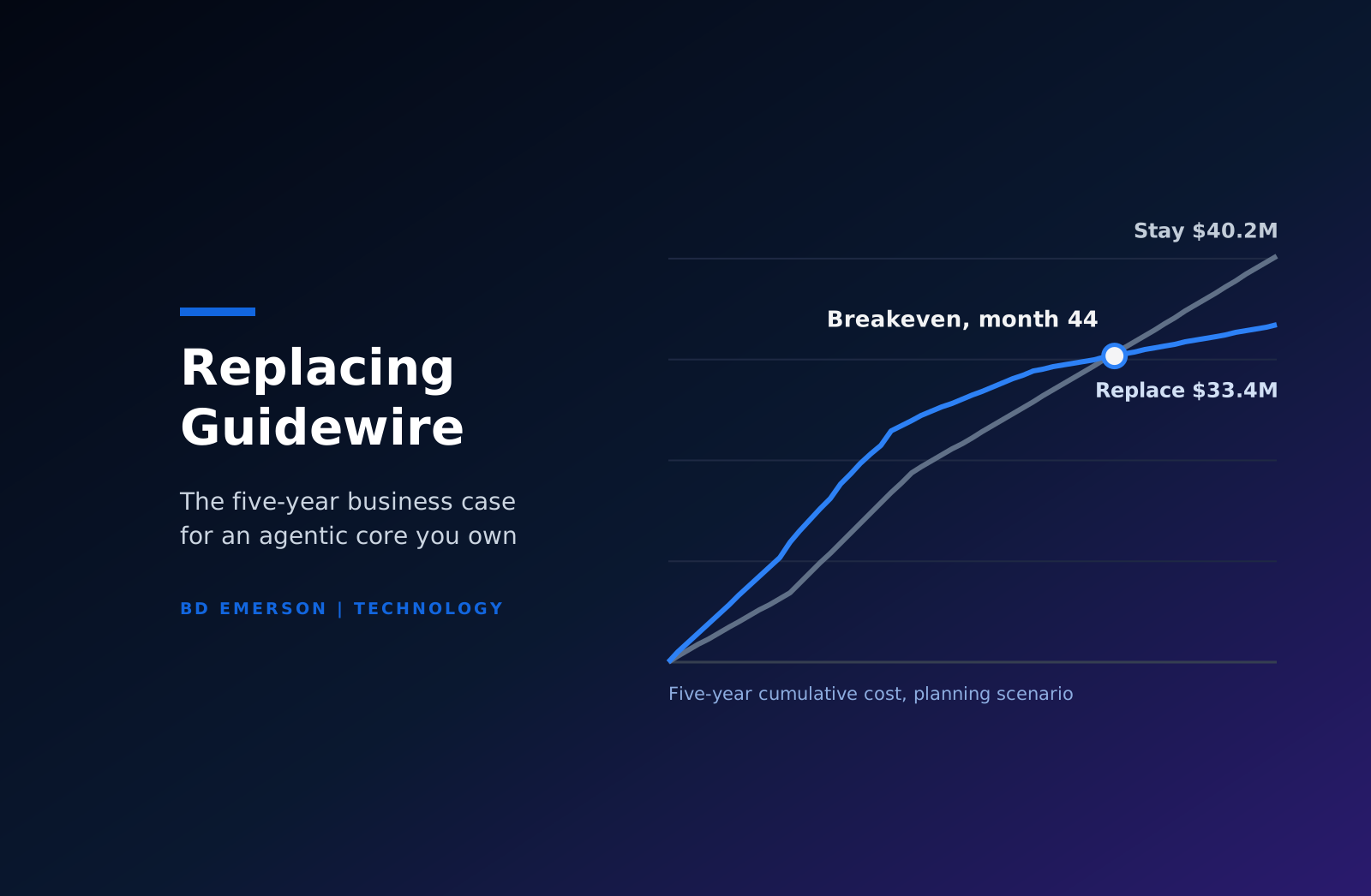
Staying on Guidewire, or moving to Guidewire Cloud, is the right call for many carriers, and we say so when the numbers show it. When the five-year numbers favor replacement, we replace InsuranceSuite with a custom, agentic core system, and our first deliverable is that math plus a working prototype of one of the carrier's own products on the new core. Our build vs. buy analysis explains how we frame that comparison.
Frequently asked questions
What does Guidewire do? Guidewire sells the core software P&C insurers run on: PolicyCenter to quote, bind, issue, and change policies, BillingCenter to invoice premium and pay commissions, and ClaimCenter to handle claims through settlement. It also sells InsuranceNow for regional carriers and MGAs, plus data, digital, integration, and AI products.
Is Guidewire built on Salesforce? No, Guidewire builds its own platform: InsuranceSuite applications run on the Java Virtual Machine, developers configure them in Gosu, and Guidewire Cloud runs on AWS. Guidewire does publish Guidewire for Salesforce Financial Services Cloud, a Salesforce managed package that integrates PolicyCenter with Salesforce, but that connector links two separate platforms.
Is Guidewire built on AWS? Guidewire's cloud products run on AWS. The 10-K describes Guidewire Cloud Platform as a Guidewire-developed infrastructure layer hosted on Amazon Web Services, and InsuranceNow also runs in AWS facilities. Carriers that run InsuranceSuite under on-premise term licenses host it themselves.
Who owns Guidewire? Guidewire Software, Inc. is an independent public company owned by its shareholders. Its stock has traded on the New York Stock Exchange under the ticker GWRE since January 25, 2012. Mike Rosenbaum has served as chief executive since August 2019.
Is Guidewire difficult to learn? In our experience, Gosu is approachable for Java developers, because it runs on the JVM and works with Java types. The platform takes longer to learn, because configuration spans the data model, PCF screens, rules, plugins, and integrations. Guidewire's own posting for a senior configuration consultant asks for six to eight years of PolicyCenter experience.
What are the different versions of Guidewire Cloud? Guidewire has shipped three named Guidewire Cloud releases a year since 2023, each named after a ski destination; the latest are Olos (December 2025), Palisades (April 2026), and Qusar (August 2026). Carriers also choose among InsuranceSuite on Guidewire Cloud, InsuranceNow, and self-managed InsuranceSuite under term licenses.
If a Guidewire renewal or cloud migration decision is on your calendar, our Guidewire replacement practice starts with the five-year math and a working prototype of one of your products, so you can compare staying, migrating, and replacing on real numbers.

About the author