Agentic AI in Cybersecurity: How It Works, Benefits, and Risks

Artificial intelligence has been part of cybersecurity for years, but until recently it mostly assisted: flagging anomalies, scoring alerts, and leaving the decisions to people. Agentic AI changes that. Instead of just answering a question or classifying a file, an agentic AI system can pursue a goal on its own, perceiving its environment, reasoning about what to do, using tools to act, and learning from the result. In a security context, that means an agent can detect a threat, investigate it, and respond with little or no human intervention.
That autonomy is why agentic AI in cybersecurity is drawing so much attention. The market for it was worth $22.56 billion in 2024 and is projected to reach $322.39 billion by 2033, a sign of how quickly it is moving from experiment to deployment. On defense, agents promise to take on the repetitive, high-volume work that overwhelms security teams, from triaging alerts to containing incidents in seconds. But the same autonomy that makes them powerful also creates new risks: an agent with broad access and the ability to act can amplify a mistake, be manipulated by an attacker, or take actions no one anticipated. Agentic AI is both a new kind of defender and a new attack surface.
This guide explains what agentic AI is, how it works, and where it stands in cybersecurity today. It covers the benefits and real-world use cases, the challenges and risks, the tools and frameworks emerging in the space, and the best practices for adopting agentic AI without losing control.
Key takeaways
- Agents act, not just advise: Traditional AI flags an anomaly and leaves the decision to a person. An agentic AI system sets a goal, reasons through the steps, uses tools to act, and learns from the result, so it can investigate a threat and respond to it with limited human intervention.
- Built for high-volume work: On defense, agents take on the repetitive tasks that overwhelm security teams, from alert triage to threat detection and incident response, easing alert fatigue and shrinking the time between detecting a threat and containing it.
- A new attack surface: The same autonomy makes agents a target. One with broad access and the ability to act can amplify a mistake, be manipulated through prompt injection, or take unintended actions, so the cybersecurity risks of agentic AI grow alongside its benefits.
- Oversight is not optional: Least-privilege access, clear boundaries on what an agent can do, continuous monitoring, and a human in the loop for high-impact actions are what keep autonomy from turning into exposure.
- Deliberate adoption wins: The technology is early but maturing fast. The organizations that get value from it are the ones that pair agents with real guardrails, least-privilege access, monitoring, and governance, rather than rushing them into production.
What is agentic AI in cybersecurity?
Agentic AI refers to artificial intelligence systems that can pursue a goal autonomously, making decisions and taking actions with limited human intervention. Instead of responding to a single prompt and stopping, an agentic AI system breaks a goal into steps, decides what to do at each step, uses tools to carry those steps out, and adjusts based on what it observes. In cybersecurity, that shift matters: an agent is not just told what a threat looks like, it can be given the objective of finding and stopping threats, and then work toward it on its own.
It helps to place agentic AI next to the kinds of AI security teams already use. Traditional AI, such as the machine learning behind anomaly detection, is good at recognition: it identifies a pattern, scores it, and hands the result to a person. Generative AI goes a step further and produces content, such as a summary of an alert or a draft of a response. Agentic AI combines reasoning with action: it can read the alert, decide what to investigate, query the tools it needs, and take a containment step, chaining those abilities together to complete a task rather than just informing one. Underneath, most agents rely on large language models to reason and plan, connected to security tools and data through APIs.
Key characteristics of agentic AI
- Autonomy. The agent can operate and make decisions on its own, without a person approving every step, within the boundaries it has been given.
- Goal orientation. It works toward an objective, such as containing an incident, rather than performing a single fixed action.
- Reasoning and planning. It breaks a goal into a sequence of steps and decides the order in which to carry them out.
- Tool use. It calls external tools, APIs, and data sources to gather context and act, which is what lets it move from analysis to response.
- Memory. It retains context across steps and interactions, so it can build on what it has already learned during a task.
- Adaptability. It adjusts its approach based on new information and the results of its own actions, improving as conditions change.
Put together, these traits are what separate an autonomous agent from a static tool or a chatbot. A traditional system waits to be asked; an agentic system, given a goal and the right access, decides what to do and does it.
How does agentic AI work?
Behind the autonomy is a loop. An agent takes in information, decides what to do, acts, and uses the result to inform its next move, repeating until the goal is met. In cybersecurity, that loop is what turns a stated objective, such as "investigate this alert," into a completed investigation. The four stages below describe how it works in practice.
1. Perceive
The agent gathers the information it needs from its environment: logs, alerts, network telemetry, threat intelligence feeds, and the outputs of other security tools. This is its input, and the quality of everything that follows depends on how complete and accurate that context is.
2. Reason and plan
Using a large language model at its core, the agent interprets what it has gathered and decides what to do. It breaks the goal into a sequence of steps, weighs the options, and forms a plan, for example deciding which indicators to investigate first and which tools to query. This reasoning step is what distinguishes an agent from a script that follows fixed rules.
3. Act
The agent carries out its plan by calling tools and APIs: querying a SIEM, enriching an indicator, isolating an endpoint, disabling a compromised account, or opening a ticket. This is the stage that sets agentic AI apart from earlier systems, because the agent does not just recommend an action, it can execute it within the permissions it has been granted.
4. Learn and reflect
The agent observes the results of its actions and feeds them back into the loop. If a step did not resolve the problem, it can reconsider and try another approach; if it did, it can move on. Over time this reflection lets the agent handle similar situations more effectively, improving as it accumulates experience.
Complex problems are often handled not by one agent but by multi-agent systems, where several specialized agents work together under an orchestration layer, one investigating, another containing, another reporting. That division of labor is powerful, but it also widens the scope of what can go wrong, which is why human oversight and guardrails belong in the design from the start. In well-built systems, low-risk steps run autonomously while high-impact actions, such as taking a production system offline, pause for human approval, keeping a person in the loop where the stakes are highest.
Benefits of agentic AI for cybersecurity
The appeal of agentic AI for cybersecurity comes down to a mismatch that most security operations centers know well: threats move faster and arrive in greater volume than human teams can keep up with. Agents help close that gap, and adoption is already underway: in one survey of 93 security leaders, 73% were already using AI agents in their SOC to a moderate or high degree. The main benefits include:
- Speed of response. An agent can detect, investigate, and contain a threat in seconds or minutes rather than hours, isolating a compromised endpoint or blocking a malicious address before an attack spreads. Against fast-moving threats like ransomware, that difference in mean time to respond can decide whether an incident is contained or becomes a breach.
- Relief from alert fatigue. Security teams are flooded with more alerts than they can review, many of them false positives. Agents triage that flood autonomously, enriching and dismissing the noise so analysts see only what genuinely needs a human.
- Around-the-clock coverage. An agent does not tire, take breaks, or lose focus at 3 a.m. It watches without pause and responds at the same speed at any hour, giving even small teams a level of coverage that would otherwise require a large staff.
- Proactive defense. Rather than waiting for an alert, agents can hunt for hidden threats and manage vulnerabilities continuously, correlating data across logs, endpoints, and network traffic to surface indicators of compromise and predict likely attack paths before they are exploited.
- Detection that adapts over time. Agents learn from each incident and from new attack patterns, refining their detection models and defenses continuously instead of waiting for analysts to push manual updates.
- More capacity for skilled analysts. By taking on the repetitive, high-volume work, agents free experienced people to focus on complex investigations, threat modeling, and strategic decisions, the work where human judgment adds the most value.
How is agentic AI used in cybersecurity? Real-world use cases
Those benefits show up in a handful of concrete jobs that agents are already taking on inside security operations. The examples below are where agentic AI is being applied most today.
Alert triage and investigation
The classic time sink in a security operations center is working through a queue of alerts to decide which ones matter. An agent can take a new alert, correlate the events around it across multiple data sources, enrich it with context, and either close it as a false positive or escalate it with an investigation already assembled. This is where much of the relief from alert fatigue comes from, and it maps closely to the case management task of classifying, tracking, and recommending a response.
Threat detection and response
Agents monitor continuously for anomalies and, when they find one, can act on it without waiting for a person. On detection, an agent can immediately initiate an investigation, then execute a containment step such as isolating a compromised endpoint, blocking a malicious IP address, or disabling an account. Because the whole loop from detection to containment runs in seconds or minutes, it is well suited to fast-moving attacks where dwell time is the difference between an event and a breach.
Proactive threat hunting
Instead of waiting for an alert to fire, an agent can go looking for threats that have not tripped a rule yet. It analyzes large volumes of security data to uncover hidden patterns and indicators of compromise, correlating signals that a human hunter might not have time to connect. This adaptive hunting is especially useful against stealthy threats like advanced persistent threats, which are designed to blend in.
Vulnerability management
Agents can continuously scan an organization's assets, identify misconfigurations and exploitable weaknesses, and weigh them against real-world threat intelligence to judge which ones matter most. Rather than handing analysts a flat list of thousands of findings, an agent can prioritize the vulnerabilities most likely to be exploited and, in some setups, even predict the attack paths they open, so remediation effort goes where it counts.
Offensive security testing
Agentic AI is not only defensive. Agents can simulate cyberattacks to identify vulnerabilities in networks, applications, and cloud environments, acting as an automated red team that probes defenses the way an attacker would. This lets organizations run security testing continuously rather than only at the point of a periodic penetration test, surfacing weaknesses before a real adversary finds them.
Challenges and risks of agentic AI in cybersecurity
The same autonomy that makes agentic AI useful on defense also makes it dangerous when it is deployed carelessly. An agent that can act, connect to tools, and decide on its own is a new kind of target, and the cybersecurity risks of agentic AI grow in step with the access it is given. These are the main challenges to weigh before putting agents to work.
A larger attack surface
Every tool, API, data source, and permission an agent touches is another door an attacker can try. Autonomy and broad access are what make an agent effective, but they also mean a single compromise has a wider blast radius: an over-permissioned agent that gets manipulated can do far more damage than a chatbot that can only talk.
Prompt injection and manipulation
Because agents act on the instructions and data they take in, an attacker who can plant instructions can hijack them. In an indirect prompt injection, malicious commands are hidden inside a document or web page the agent reads, and the agent carries them out without recognizing them as hostile. Related attacks manipulate an agent's goals or poison its memory, so it drifts from its intended behavior over time.
Excessive permissions and identity risk
Agents are often handed broad, standing access so they can move fast, which is exactly what an attacker wants to hijack. Leaked credentials or a spoofed agent identity let an adversary act with the agent's privileges. The safeguard is least privilege: give each agent its own identity and only the permissions it needs for the task in front of it, nothing more.
Unpredictable and cascading behavior
Agents can hallucinate, inventing a file path or a step that does not exist and then acting on it. They can also fall into loops that consume resources and run up cost. In multi-agent systems the danger compounds: one agent's mistake, or a poisoned message passed between agents, can cascade through the rest, and a wrong autonomous action such as isolating a critical production system can cause real disruption.
Supply chain and tool risk
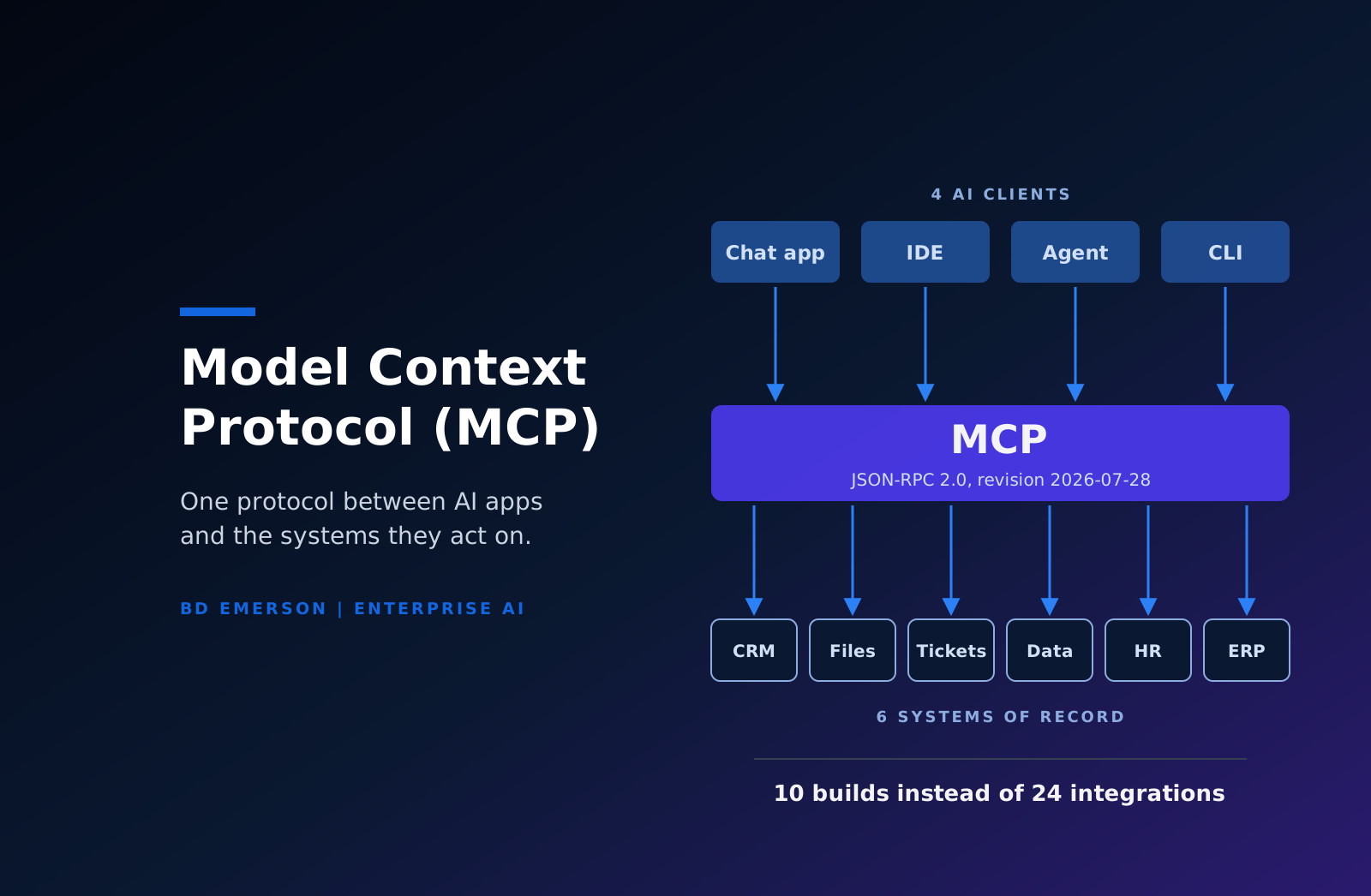
Agents rarely work alone; they connect to third-party tools and services, increasingly through connectors like the Model Context Protocol. Each integration is a dependency that can be misconfigured, vulnerable, or malicious, turning a trusted tool into an entry point.
Accountability and over-reliance
When an agent acts on its own, it is harder to say who is responsible for the outcome, and the reasoning behind a decision can be a black box that analysts cannot easily inspect. Leaning too heavily on automation can also erode the human oversight that is supposed to catch the agent's mistakes in the first place. This is why governance, not technology alone, decides whether agentic AI is safe to adopt, and as AI regulation expands around the world, that governance is fast becoming a requirement rather than a choice.
Popular agentic AI tools and frameworks
The landscape splits into two parts: security platforms that have built agentic AI into their products, and the general-purpose frameworks teams use to build agents of their own.
Security tools and platforms
Most of the established security vendors are now embedding agentic capabilities into their platforms:
- CrowdStrike Charlotte AI: Part of the AI-native Falcon platform and billed as the brain of the agentic SOC, it triages detections, filters false positives, and, through its agentic SOAR, uses agents that think, decide, and act on user-authorized responses.
- Palo Alto Networks Precision AI: Detects, prevents, and resolves threats in real time across cloud, endpoint, and network.
- Microsoft Security Copilot: Adds autonomous, adaptive agents for tasks such as phishing and alert triage, vulnerability remediation, and incident response.
- Darktrace ActiveAI Security Platform: Its Cyber AI Analyst is built to accelerate alert triage several times over.
Alongside the big platforms, a wave of purpose-built agentic products has arrived:
- Dropzone AI: An autonomous AI SOC analyst that investigates alerts end to end across the tool stack, around the clock, with no analyst on the keyboard.
- Sysdig Sage: Billed as the first agentic AI cloud security analyst, it uses an autonomous agents architecture and multi-step reasoning across cloud detection, posture, and vulnerability management.
- SOCRadar Agentic Threat Intelligence: A platform of specialized autonomous agents that triage, investigate, and respond to external threats such as phishing and brand abuse with minimal human intervention.
Frameworks for building agents
Organizations that want to build their own security agents rather than buy them turn to general-purpose agent frameworks. These are not security tools themselves: they are the scaffolding for connecting a large language model to memory, tools, and multi-step workflows. The most widely used include:
- LangChain and LangGraph. LangChain is an open-source framework for building applications on large language models, and LangGraph is its runtime for stateful, multi-agent systems that need loops, persistent memory, and human-in-the-loop control.
- CrewAI. An open platform for orchestrating a "crew" of AI agents that collaborate on a task, aimed at getting multi-agent workflows into production quickly.
- Microsoft Agent Framework. The direct successor to AutoGen and Semantic Kernel, combining their agent abstractions with graph-based workflows for explicit multi-agent orchestration and enterprise features.
- OpenAI Agents SDK. A lightweight, low-abstraction framework for building multi-agent workflows on OpenAI's models.
Because these frameworks are powerful but security-agnostic, the guardrails, permissions, and oversight discussed earlier are the responsibility of the team building on top of them.
Best practices for implementing agentic AI safely
Adopting agentic AI safely is less about slowing agents down and more about setting the boundaries they work within. The practices below move roughly in the order you would apply them, from before an agent goes live through running it in production. They are also the operational backbone of a wider AI compliance program.
Start with a risk assessment
Before an agent goes live, map every system, data source, tool, and API it will be able to reach, and document what each connection exposes if it is misused. You cannot scope permissions, choose guardrails, or judge how much autonomy is safe until you know what the agent can touch and what the worst case looks like.
Enforce least privilege and give each agent its own identity
Do not hand agents broad, standing access. Give every agent a unique identity of its own and only the permissions the task in front of it requires, ideally scoped to the access of the user it is acting for and issued as short-lived, ephemeral credentials rather than permanent keys. Authenticate and authorize each action instead of trusting an agent once at setup, so a zero-trust posture holds at the infrastructure level and not just the prompt. The point is to shrink the blast radius: if an agent is compromised or misled, least privilege keeps it from becoming a path to everything it could otherwise touch.
Vet your tools and supply chain
Treat every tool, plugin, and connector an agent uses, including Model Context Protocol integrations, as part of your attack surface. Run security testing on them, including static, dynamic, and dependency analysis, to surface vulnerabilities and misconfigurations, and secure the connections themselves with encryption and zero trust authentication so a third-party tool cannot quietly become an entry point.
Sandbox agents and simulate before executing
Run agents, and especially any code they generate, inside constrained sandboxes with restricted network access and resource limits, so a bad action cannot reach beyond its box. Where the platform supports it, have the agent simulate the outcome of a tool call and check it against policy before it executes, catching a policy violation before it happens rather than cleaning up afterward.
Defend against prompt injection
Treat every input an agent reads as untrusted. Harden system prompts so an agent will not disclose its instructions or step outside its role, constrain which tools it is allowed to call, and validate and sanitize the data and documents it ingests. Run content filtering that detects injected instructions, tool-schema extraction, and memory manipulation at runtime. Because indirect prompt injection hides inside ordinary-looking content, layered input defenses matter more than any single filter.
Protect the agent's memory
Agents that carry context across steps can be poisoned: a malicious input written to memory can quietly steer an agent long after the moment it slipped in. Scope what each agent is allowed to remember, validate or sanitize what gets written to its memory, and isolate memory between agents and sessions so a single poisoned entry cannot persist or spread.
Secure communication between agents
In multi-agent systems, treat the messages agents pass to each other as untrusted, just like external input. Authenticate agents to one another and validate the data they exchange, so a compromised or manipulated agent cannot poison the decisions of the others through the channels they share.
Keep a human in the loop for high-impact actions
Let agents run low-risk, reversible steps on their own, but require explicit human approval before consequential actions like taking a production system offline, disabling accounts, or pushing a change into production. Calibrate the level of autonomy you grant to the stakes and reversibility of each action, and define clear escalation paths so high-impact decisions always reach a person before they happen. That caution is widely shared: in a survey of 194 practitioners, only 13% said they would trust AI recommendations without human oversight.
Monitor agent behavior and keep audit trails
Continuously watch agents for behavioral drift and anomalous access patterns, the early signs that one has been manipulated or is misbehaving. Log every action an agent takes and require it to expose its reasoning, so any decision can be reconstructed and reviewed after the fact. Observability and explainability are what turn an opaque agent into an accountable one, and they are also what make an audit possible.
Red-team agents and build in a kill switch
Probe your agents the way an attacker would, before and after deployment, including with adversarial agents that continuously try to manipulate or misdirect them. Build in fail-safes, and give operators a kill switch that can cut an agent off automatically, for example disconnecting it from its tools, when its behavior crosses a set anomaly threshold. Testing tends to lag deployment: in one industry survey, 44% of teams ran adversary simulations only twice a year or less, if at all, even as their agents run continuously.
Govern agentic AI, do not just deploy it
No single safeguard is enough, so layer these controls into a defense-in-depth program rather than leaning on any one of them. Established frameworks give you the structure: OWASP's agentic AI guidance for the threat vocabulary, the NIST AI Risk Management Framework for organizational risk, and ISO 42001 for an AI management system, alongside emerging standards for AI agents. Turn those into enforceable policies rather than static documents, with clear accountability for what agents do, and start with a well-scoped pilot you expand as trust is earned.
Ready to operationalize agentic AI governance?
Read our guide to AI governance and compliance strategies for businesses for a step-by-step approach.
Conclusion
Agentic AI is a real shift in cybersecurity. For the first time, software can not only spot a threat but investigate and respond to it on its own, at a volume and speed no human team can match. On defense, that means faster containment, fewer alerts drowning analysts, and protection around the clock, which is why it is moving from experiment to deployment so quickly.
The catch is that the same autonomy makes an agent a new attack surface, and its risk grows with the access it holds. So the organizations that benefit will be the ones that adopt it deliberately, with least privilege, human oversight for high-impact actions, continuous monitoring, and a governance framework around it all. Adopted that way, agentic AI is a genuine advantage; adopted carelessly, it becomes a liability.

About the author