

9 Box Grid: What Each Box Means and How to Run Calibration
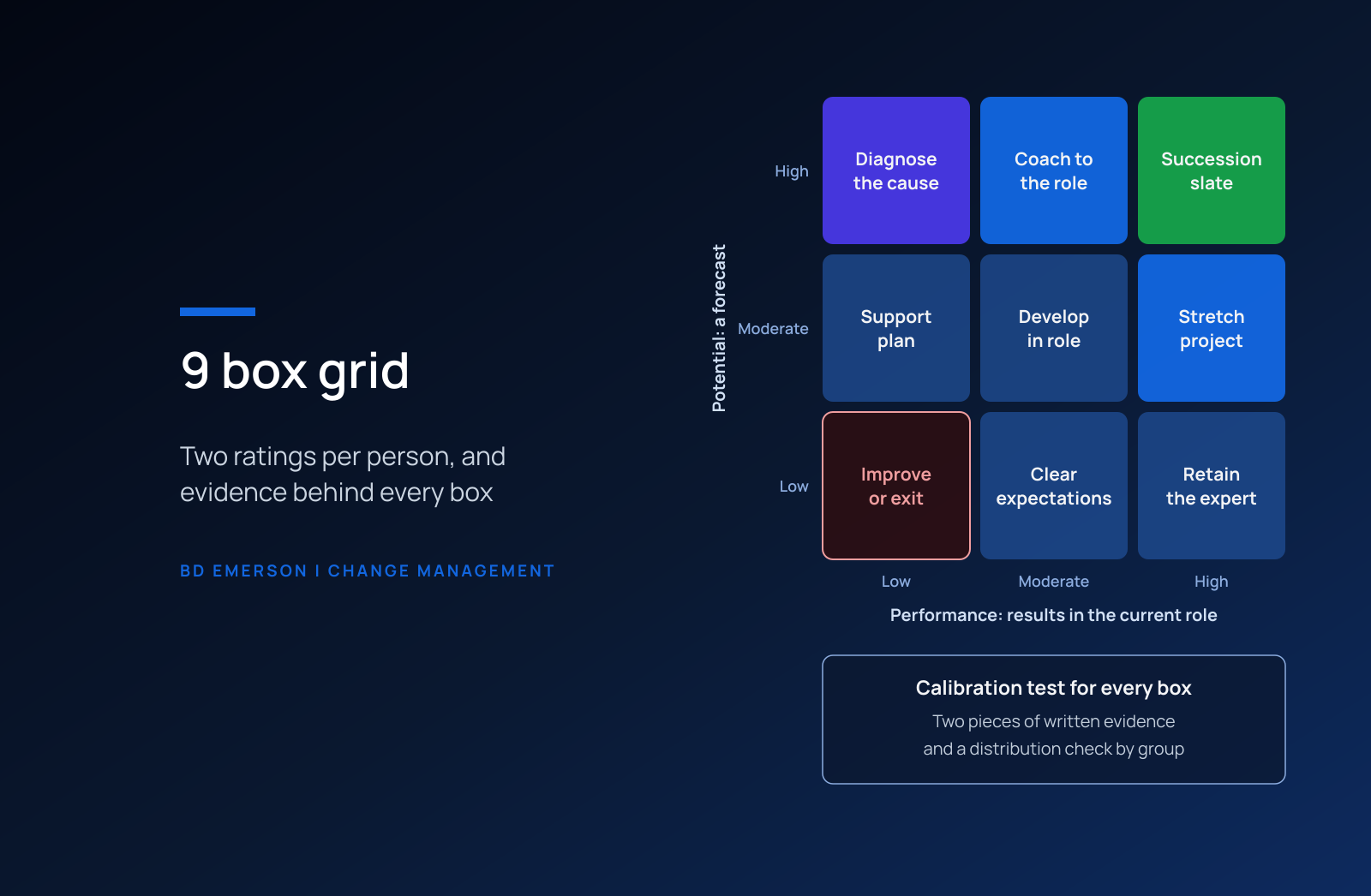
A 9 box grid is a talent review tool that rates each employee on two scales, current performance and potential, and places them in one of nine cells on a three-by-three grid. Performance usually runs along the horizontal axis as low, moderate or high results in the current role. Potential runs up the vertical axis as a forecast of how well the person could perform in a larger role. The top-right box holds strong performers with high potential, who become successor candidates, and the bottom-left box holds people who are struggling in their current role. The grid itself only records judgments, so its value depends on how clearly leaders define potential and how hard the calibration session tests each placement.
How does the 9 box grid work?
Each axis has three levels, so a manager makes two separate calls about each person. The performance rating looks backward at results in the current role over the last review cycle, usually from the annual review. The potential rating looks forward to how the person would perform with a wider scope, more people to lead or different stakeholders. With both calls on one page, a leadership team sees who is ready for more, who is solid where they are, and who needs a different plan.
The layout matches the GE and McKinsey nine-box matrix, a strategy tool that McKinsey Quarterly traces to the early 1970s. Decentralized corporations used it to plot their business units by industry attractiveness and competitive strength and decide where best to invest cash. The talent grid uses the same three-by-three layout with performance and potential on the axes, and it serves a similar purpose, because a talent review decides where to put scarce stretch assignments, sponsorship, development budget and succession slots.
The two axes measure different things, and the grid only works when raters keep them apart. Jean Martin and Conrad Schmidt of the Corporate Executive Board studied more than 20,000 employees labeled emerging stars in more than 100 organizations, and in Harvard Business Review in May 2010 they reported that only about 30 percent of high performers were high potentials. A strong year shows someone is good at the current job and says much less about a role with different demands.
What does each box in the 9 box grid mean?
There is no standard set of box names. Teams and vendors attach labels such as "star" or "workhorse," and those labels follow people long after the review. We recommend naming each box by its two ratings, so a placement reads as two judgments with evidence behind them. The table follows that convention.
| Box (performance, potential) | What it usually signals | Next step |
|---|---|---|
| High, high | Ready for a larger role now or within a cycle | Name on a succession slate, give a stretch role, hold a retention conversation |
| High, moderate | Strong in role, with readiness for a bigger role unproven | Test with a project outside the current scope |
| High, low | A valued expert, or someone who does not want a bigger role | Reward the expertise and confirm aspiration before assuming a ceiling |
| Moderate, high | Often new to the role or poorly matched to it | Coach to the role standard and check fit with the manager and the job |
| Moderate, moderate | The core of most teams | Develop in role and review again next cycle |
| Moderate, low | Meets parts of the role, with little sign of growth | Set clear expectations and provide in-role training |
| Low, high | Misplaced, new, or blocked by something outside the job | Diagnose the cause and re-review on a set date |
| Low, moderate | Underperforming, with some capacity to recover | Agree on a support plan with measurable goals and a review date |
| Low, low | Not meeting the role and unlikely to grow into it | Document a performance plan, a role change or an exit |
Two boxes deserve extra attention. The high-performance, high-potential box is a retention risk as much as a reward, because Martin and Schmidt found that one in four high potentials in the companies they studied intended to leave within the year. The low-performance, high-potential box is the one most easily filled on impression. Before anyone lands there, the team should name the evidence of potential that exists despite current results, or the placement is a hopeful guess.
How to assess potential with evidence instead of impressions
Start by answering the question "potential for what?" A potential rating means little until the team names the target, whether that is one level up, a general management role or a broader version of the same specialty. Write the target into the rating definition for each level, so a high rating for a sales manager points at a specific next role.
Then decide which indicators count. In their 2009 review in Industrial and Organizational Psychology, Silzer and Church group the indicators of potential into foundational, growth and career dimensions. Martin and Schmidt use a simpler test with three attributes, ability, engagement and aspiration, and warn that a shortfall in even one of them sharply cuts a candidate's chance of success. Aspiration is the easiest of the three to check, because you can ask the employee whether they want the next role and what they would trade to get it.
Evidence of potential comes from what a person did when the work changed. Useful sources include results on a stretch assignment or a project outside the role, how quickly the person became productive in an unfamiliar area, a structured interview built around the next role, and validated assessments used for development. Our guide to talent assessment methods covers which tools hold up and why validity matters. Tenure, confidence in meetings and visibility to senior leaders are not evidence of potential, although they drive the rating when nobody asks for evidence.
A workable rule is that every high or low potential rating needs at least two pieces of written evidence, submitted before the meeting, and that moderate is the default when the evidence is thin. That rule moves the discussion away from who argues best and toward what the person has done.
How to run a 9 box calibration session
Calibration is the meeting where managers present their proposed placements and the group tests them against shared definitions, so that a high rating means the same thing in every team. It is the step where one manager's ratings get tested against everyone else's, and a session that holds up follows this sequence.
- Agree on definitions before anyone rates. Write two or three sentences for each level of each axis, including the target role for potential, and send them to managers with the pre-work.
- Collect pre-ratings with evidence. Each manager submits a proposed box and the evidence for both ratings ahead of the meeting, so the facilitator can spot thin cases in advance.
- Staff the room with a facilitator who has no stake in the outcome, the managers who know the people, and one senior leader who settles disagreements.
- Budget the time. Forty people in three hours leaves about four and a half minutes each, so give the most time to the top-right box, the bottom-left box and any low-performance, high-potential placement.
- Ask every placement the same challenge questions: what did this person do that shows it, is this a performance point or a potential point, and would we place someone else with the same evidence in the same box?
- Record the decision, the evidence and the next action, with an owner and a date, before moving to the next person.
- Check the distribution before you close. Compare placements by gender, race, age group, location and remote status, and ask why if any group clusters in the lower or middle boxes.
Calibration also exposes whether senior leaders agree on what the business needs. When two of them describe the next step for the same role differently, the ratings drift with them, which is the problem our article on leadership alignment examines for strategy.
Is a 9 box talent assessment fair?
A 9 box talent assessment is as fair as the evidence behind its potential ratings, and field research shows how far those ratings can drift. Researchers Alan Benson, Danielle Li and Kelly Shue studied Nine Box ratings for 29,809 management-track employees at a large North American retail chain who were employed between 2011 and 2015. Women in the data received higher performance ratings than men and lower potential ratings, and the authors found that differences in potential ratings accounted for up to half of the gender gap in promotions. The potential ratings also underestimated the women. They went on to outperform men who had received the same potential ratings, and women were less likely to leave the firm.
The firm in that study held calibration meetings to ensure managers applied similar standards, and the gap still appeared in the finalized ratings. A session that only compares managers' opinions with each other can confirm a shared bias, which is why the written definitions, evidence rule and distribution check described above matter. The study's method also gives you a test to run on your own data: compare past potential ratings with what people went on to do. If people rated low potential keep beating the forecast, the definition or the raters need work.
Other distortions are more ordinary. A strong performance year bleeds into the potential rating, recent events outweigh the full cycle, people who resemble the senior leaders in the room get the benefit of the doubt, and remote employees have fewer moments in front of the raters. The facilitator catches each one by asking for the evidence behind a rating out loud.
There is a legal dimension in the United States as well. The Uniform Guidelines on Employee Selection Procedures define a selection procedure as any "measure, combination of measures, or procedure used as a basis for any employment decision," and 29 CFR Part 1607 lists promotion among those decisions. A potential rating that gates promotion or a succession slate can fall inside that definition, which brings adverse impact monitoring, such as the four-fifths comparison of selection rates, into scope. This is general information, and employment counsel should review how your grid feeds promotion decisions.
After the review: development, succession and what employees hear
Every placement should leave the room with a next step. People in the high-potential row should appear on a succession slate for at least one critical role, marked ready now or ready later, with a development plan attached. For high-potential employees, that plan usually combines a stretch assignment, a sponsor and structured feedback. Our leadership development consulting builds the experiences, coaching and exposure that prepare high-potential employees for larger roles.
Decide in advance what employees hear. We recommend keeping the box among the people in the calibration room and sharing the outcome: the development plan, the new assignment or the performance expectations. That keeps a label from following someone for years. Whatever you choose, apply it the same way across teams, because inconsistent disclosure creates its own fairness problem.
Run the grid at least once a year alongside the performance cycle, and check again at mid-year on anyone in the low-performance, high-potential box or on a performance plan. Over several cycles, track whether people rated high potential succeeded after a move and whether low ratings held up, because that record shows whether the grid measures anything real.
Where BD Emerson fits
BD Emerson, part of Andersen Consulting since October 2026, delivers talent management consulting with Daniels Consulting Group, founded by Amy Daniels, Ph.D., an organizational psychologist with a doctorate in industrial and organizational psychology. For a talent review, we map critical roles, write a success profile for each one, assess leaders against those profiles with individual feedback, facilitate the talent review session where leaders reach a shared, evidence-based view of each placement, and name ready-now and ready-later successors with a development plan for each person. Your leaders make the placement decisions, and each decision rests on written evidence they can defend.

About the author
















