Change Impact Assessment: Steps, Rating Table, and How to Use the Output
What is a change impact assessment?
A change impact assessment is a structured analysis of who a change affects, how it affects them, how much, and when. It breaks a change into specific impacts on specific groups, such as a new approval step for accounts payable clerks or a new reporting line for regional sales managers, and rates each impact as high, medium, or low. The output is a rated list of impacts by stakeholder group. The change team uses that list to decide which groups need the most communication, training, and support, and in what order.
The assessment is a recognized part of professional practice. The Association of Change Management Professionals lists "Conduct the Change Impact Assessment" as a process within section 5.1 of its Standard for Change Management, which covers evaluating change impact and organizational readiness. The Australian Public Service places the same work in the Assess stage of its change framework, which calls for assessing the nature, size, and scale of the change and the stakeholders it affects.
What does a change impact assessment cover?
A complete assessment answers four questions for every affected group.
Who is affected?
The unit of analysis is a stakeholder group whose members experience the change in the same way. Job role is usually the right level. "The finance department" is too broad when accounts payable clerks, financial analysts, and controllers will each see a different change. The Australian Public Service framework asks for the roles, group sizes, and locations of affected stakeholders, and those three facts are the minimum to record. Size drives the cost of training and support, and location determines the delivery channels.
How are they affected?
Each impact is classified by type so that the right response can be matched to it. The University of Exeter's change impact assessment guidance uses seven types: systems and tools, business processes, organizational design, skills, culture and behavior, responsibility, and health and wellbeing. Most assessments work well with four or five types. The important discipline is to look beyond the system. A new platform changes screens, and it often also changes who approves a transaction, who can see performance data, and which skills make someone valuable. Those three changes seldom appear in a system design document, so the assessment has to ask about them directly.
How much are they affected?
Each impact receives a rating. The Exeter guidance defines high impact as extensive process or system changes with a high degree of change to roles and skills, medium impact as a change that requires some behavior change and has interdependencies to manage, and low impact as minor process or system change that requires no behavior change. Written definitions matter more than the number of levels, because two assessors should reach the same rating for the same impact.
When are they affected?
Timing covers the date each impact lands and what else the group is dealing with on that date. A medium impact that arrives during a retailer's holiday peak or a finance team's year-end close is harder to absorb than a high impact in a quiet month. Timing also shows collisions, where two or three projects reach the same group in the same period.
What are the steps in a change impact assessment?
The assessment follows eight steps. The first three set it up, the middle three produce the ratings, and the last two turn the ratings into decisions.
- Define the change. Describe the current state and the future state for each process, system, and structure in scope. An impact is the difference between the two, so the assessment can only be as specific as the future-state design.
- Identify the stakeholder groups. List every role that touches the affected processes, including groups outside the project's home function and external parties such as customers and suppliers.
- Agree on the impact types and the rating scale. Write the definitions down before anyone rates anything.
- Collect the impacts. Walk process owners and subject matter experts through the current and future design, step by step, and record what changes for each group. Workshops and interviews give the most detail. Surveys reach large groups at lower cost and with less depth.
- Record each impact as one row. Each row names the group, states what changes from and to, assigns an impact type, and notes whether the group will see the change as helpful or disruptive.
- Rate and validate. Rate each impact against the definitions, then review the ratings with the managers of the affected groups. Managers correct the project team's assumptions about how work is really done.
- Summarize by group. Roll the rows up into a table or heat map that shows the rating for each group and impact type. This is the view that sponsors and steering committees use.
- Assign a response to every medium and high impact. Each one gets a communication, training, or support action with an owner, and the assessment is updated whenever the design changes.
What does an impact rating table look like?
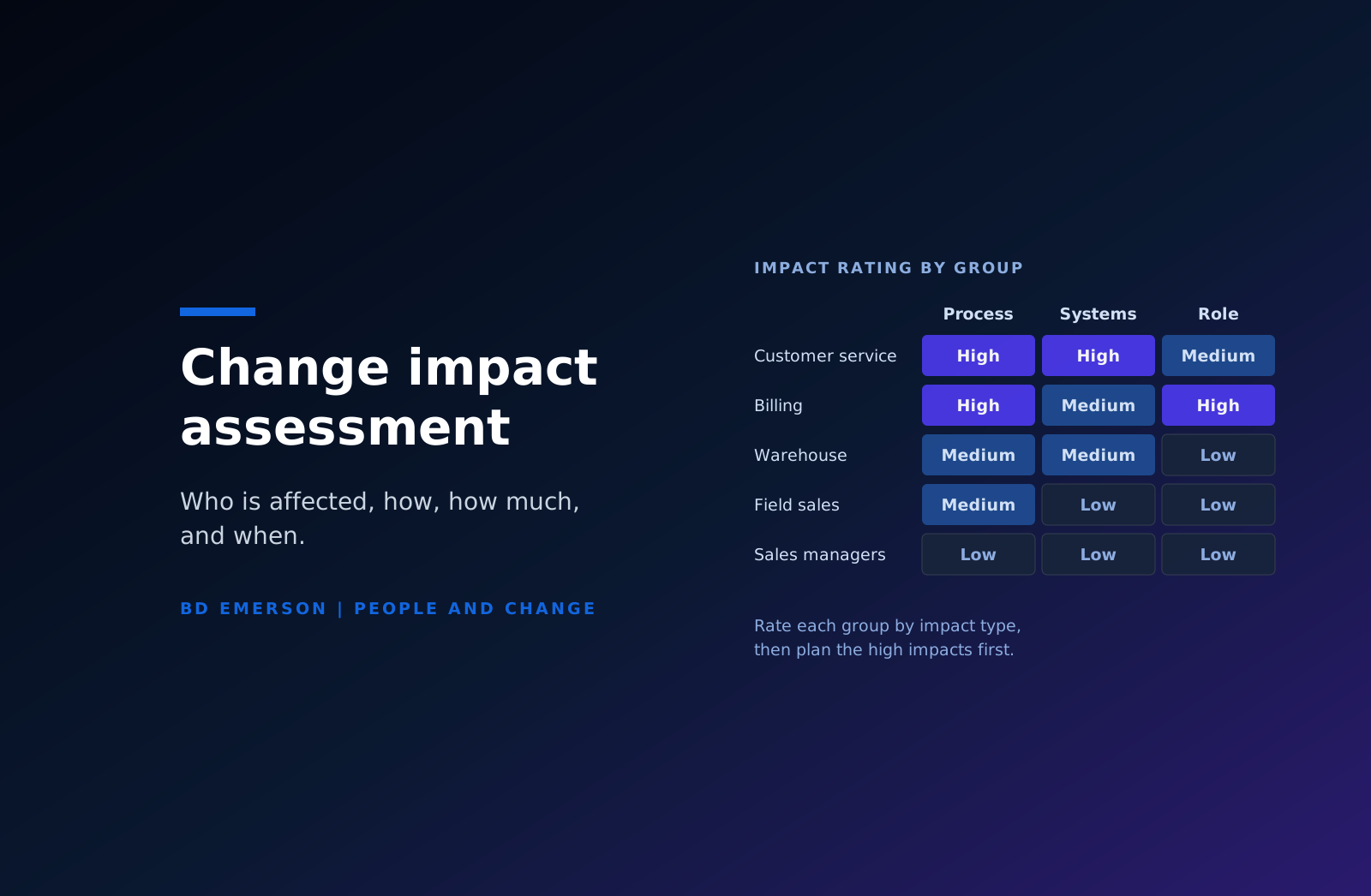
The summary table has one row per stakeholder group and one column per impact type. The example below is an illustration for a company that is replacing its order management system. It is a teaching example and does not describe a client.
| Stakeholder group | What changes | Process | Systems | Role and skills | Overall |
|---|---|---|---|---|---|
| Customer service representatives | Order entry moves to new screens, and exceptions follow a new workflow | High | High | Medium | High |
| Billing analysts | Invoices generate automatically, and the role shifts from keying invoices to resolving exceptions | High | Medium | High | High |
| Warehouse supervisors | Pick lists arrive in a new format and release on a fixed schedule | Medium | Medium | Low | Medium |
| Field sales representatives | Order status is self-service, and phoned-in orders are no longer accepted | Medium | Low | Low | Medium |
| Sales managers | A new dashboard replaces the weekly order report | Low | Low | Low | Low |
Three conventions keep a table like this useful. The overall rating takes the highest rating in the row, because one high impact is enough to disrupt a group's work. The "what changes" column is written in the group's own terms and avoids project vocabulary. Every rating traces back to detailed rows, so that anyone who questions a rating can see the evidence for it.
The table also shows why a rating by department would mislead. Customer service representatives and sales managers both sit in the commercial organization. One group needs hands-on practice before go-live, and the other needs a short briefing.
How does the output feed communications and training?
The assessment earns its cost when every later change activity draws on it. The Exeter guidance states that an understanding of the impacts on each stakeholder group contributes to the communication strategy and plan, and that the interventions chosen in response form the core of the change strategy and the foundation of the change management plan. In practice the output feeds four workstreams.
Communications
The "what changes" entries supply the content of the messages. A group rated high hears about the change early, in detail, and from its own manager, with time to ask questions. A group rated low receives a short notice close to the date. Without the assessment, communication plans default to broadcast messages that tell every employee the same thing, and the people most affected learn the least about what will happen to their own work.
Training
The role and skills ratings define the training need by role. High ratings point to instructor-led practice on realistic scenarios, medium ratings to short guided sessions, and low ratings to a job aid. The detailed rows become the curriculum, since each row describes a task that someone has to perform differently. The same data sizes the effort, because the number of people in each group is already recorded.
Manager and sponsor engagement
Managers of high-impact groups need to be briefed before their teams, and sponsors need to be visible to those groups. Prosci's ADKAR Model names five outcomes an individual needs to reach in a change: awareness, desire, knowledge, ability, and reinforcement. The impact assessment tells the change team which groups have the furthest to go on each one. Communications and manager conversations build awareness and desire, and training and coaching build knowledge and ability.
Readiness and support
High-impact groups are the ones to watch in readiness checks before go-live and to staff with extra support afterward. The assessment tells the project where to place floor support, which help desk scripts to write, and which performance measures may dip while people learn.
All four workstreams come together in the change plan. Our change management plan template places the stakeholder and impact map second among its seven sections, ahead of the sponsorship, communications, and training sections that depend on it.
What mistakes weaken a change impact assessment?
Five mistakes weaken an assessment. The first is working at too high a level, which produces ratings by department that hide the roles with the largest change. The second is recording only system impacts and missing changes to authority, responsibility, and expected behavior. The third is treating the assessment as a single deliverable. Design decisions keep changing the impacts until the build is frozen, so the assessment needs an owner and a review point at each design milestone.
The fourth mistake is completing the assessment inside the project team. People who do the work know details that process maps omit, and their managers will support ratings they helped to set. The fifth is ignoring the rest of the portfolio. A group that is rated medium on your project may be rated high on two others in the same quarter, and only a view across projects shows the combined load. Large programs such as an organizational transformation need that portfolio view from the start.
When should you run the assessment, and who should lead it?
Start the first pass as soon as the future state is defined well enough to compare with the current state. An early pass will have gaps, and it still tells the sponsor which groups carry the most change while there is time to adjust scope and sequence. Later passes add detail as the design firms up. The change lead usually runs the assessment, with process owners supplying the design detail and line managers validating the ratings.
How long the assessment takes depends on the number of stakeholder groups, the number of processes in scope, how complete the future-state design is, and how available the process owners are for workshops.
BD Emerson delivers change management work, including impact assessments, with our Andersen Consulting colleagues at Daniels Consulting Group, a firm of organizational psychologists and experienced business professionals. To plan an assessment for your program, see our change management consulting service and book a consultation.

About the author