
A global logistics operator managed thousands of frontline employees across multiple sites. Daily staffing ran on handwritten attendance logs, HR systems that did not talk to each other, and supervisor judgment. Unplanned absenteeism regularly exceeded 8 percent on critical shifts, and each absence opened a skills gap that slowed operations and pushed up overtime. The HR and timekeeping systems recorded what happened but could not support a reallocation decision in the moment, so supervisors spent hours each day reconciling attendance, checking certifications, and arranging replacements by email and phone.
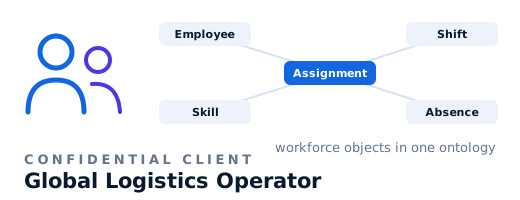
The team unified HR, time and attendance, training records, and Microsoft 365 data in a governed ontology on Palantir Foundry. Its core objects are the employee, skill, training record, shift, absence event, role, and assignment, each with consistent identifiers and quality checks. Pipelines validate attendance events and enforce data freshness, and role-based access controls protect sensitive employee information.
On top of the ontology, capability-fit scoring matches employees to open roles using certifications, training history, and recent attendance. In Palantir AIP, a supervisor can propose a reallocation and commit an assignment, and every recommendation carries its rationale. When a forklift-certified operator reports an unplanned absence, the system ranks qualified backfill candidates by proximity, recent shift load, and compliance constraints. Each output is explainable and auditable, and the logic respects labor and privacy requirements.
Supervisors work from one control tower application that shows absenteeism, skills coverage by workstation, and staffing risks before the shift begins. Approved reallocations sync to downstream systems and send Microsoft Teams notifications, which removes the manual handoff after the decision.
The build went from kickoff to production in eight weeks. Sprints covered discovery, data integration, the application build, user acceptance testing, and deployment across pilot sites. AI engineers, data modelers, and workforce specialists worked alongside the client's HR and operations leaders, and change management ran inside the same team so that training and support were in place before the rollout widened.
During pilot shifts, unfilled critical roles fell by a double-digit percentage. Supervisor time spent on attendance reconciliation and staffing coordination dropped by more than 30 percent. A staffing decision that used to take 15 to 30 minutes now takes under two minutes and comes with a consistent rationale. More precise reallocations reduced unnecessary overtime within the first quarter, and employees reported clearer assignments and a fairer spread of work. The operator is extending the system to more sites and adding demand forecasting and training use cases.
Client details in this case study are generalized to protect confidentiality. BD Emerson is part of Andersen Consulting, and this engagement was delivered by Andersen Consulting's AI and Advanced Analytics practice, the team we work with on Palantir Foundry and AIP programs. Our Palantir AIP page describes how these builds are staffed, and our guide to what Palantir AIP is explains where the platform fits. We are glad to walk through comparable work under NDA.