Change Management Models Compared: Lewin, Kotter, ADKAR, Bridges, Kübler-Ross, and 7-S
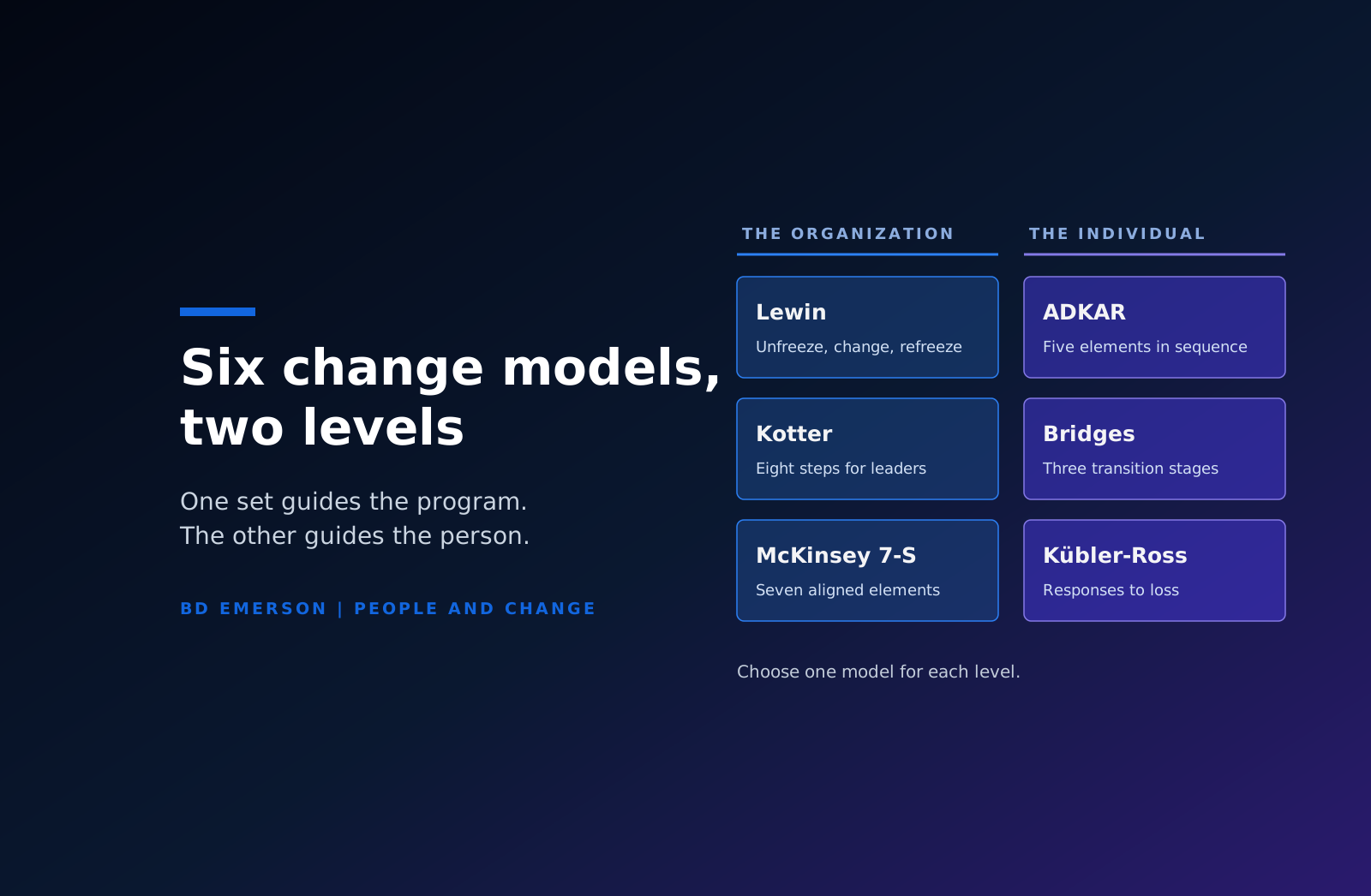
Change management models are frameworks that describe how change happens in an organization and what leaders should do about it. Six are in common use: Lewin's three steps, Kotter's eight steps, Prosci's ADKAR, the Bridges Transition Model, the Kübler-Ross change curve, and the McKinsey 7-S framework. They answer different questions. Lewin and Kotter describe the sequence of an organizational change, ADKAR and Bridges describe what an individual goes through, Kübler-Ross describes the emotional response to loss, and 7-S diagnoses whether the parts of an organization fit together. We recommend choosing one model for the program and one for the individual, and applying both consistently.
What are change management models?
A change management model is a simplified account of how people and organizations move from one way of working to another. A model gives a leadership team a shared vocabulary, a checklist of what to attend to, and a way to explain the plan to people who were absent when it was made. A model is a thinking aid. The schedule, owners, audiences, and measures belong in a change management plan, which any of these models can inform.
The six models sort into two levels. Organizational models describe what the enterprise and its leaders do. Individual models describe what one employee needs or feels. Confusion between the two levels causes most arguments about which model is best, because a model built for one level performs poorly when it is judged at the other.
How do the six major change management models compare?
| Model | Origin | Level | Core idea | Best fit | Main limit |
|---|---|---|---|---|---|
| Lewin's three steps | Attributed to Kurt Lewin | Organization | Unfreeze, change, refreeze | Explaining the logic of a change to any audience | Too general to plan from |
| Kotter's eight steps | John Kotter, Harvard Business Review, 1995 | Organization | Eight steps from urgency to anchoring the change in culture | Large transformations led from the top | Says little about individual adoption or training |
| ADKAR | Prosci | Individual | Awareness, desire, knowledge, ability, and reinforcement, in sequence | System and process rollouts where adoption by role matters | Covers the individual only and needs a program method beside it |
| Bridges Transition Model | William Bridges | Individual | An ending, a neutral zone, and a new beginning | Reorganizations and mergers where people lose roles or identity | Describes the experience and prescribes few actions |
| Kübler-Ross change curve | Elisabeth Kübler-Ross, On Death and Dying, 1969 | Individual | Emotional responses to loss, drawn as a dip and a recovery | Preparing managers for emotional reactions | Derived from dying patients, with no fixed order |
| McKinsey 7-S | Peters, Waterman, Athos, and Pascale at McKinsey, published 1980 | Organization | Seven elements that must align | Diagnosing what has to change before a redesign or merger | A snapshot that gives no sequence for running the change |
What does each model say, and when does it fit?
Lewin's three steps
The model says that change has three steps. The organization unfreezes its current way of working, changes to a new one, and refreezes so the new way holds. It is the oldest model on the list and the simplest to explain. Its attribution is less settled than most textbooks suggest. A 2016 study in Human Relations compared Lewin's own writing with later presentations of the model and concluded that he never developed it in this form, and that it took shape after his death. The three steps fit as a way to frame any change for executives or a town hall. They are too general to plan from, since they name no activities, owners, or measures.
Kotter's eight steps
John Kotter introduced this model in a 1995 Harvard Business Review article, "Leading Change: Why Transformation Efforts Fail." The article lists eight errors, and each error implies a step: establish a sense of urgency, create a powerful guiding coalition, create a vision, communicate the vision, remove obstacles to the vision, plan for and create short-term wins, hold off on declaring victory, and anchor the changes in the corporation's culture. Kotter writes that skipping steps creates only the illusion of speed and never produces a satisfying result.
The eight steps fit an enterprise transformation where the main risk is weak or divided leadership. They give a chief executive a sequence and a way to check whether the leadership team has done its part. The model looks at change from the top of the organization, so it offers little guidance on what a claims adjuster or a plant supervisor needs in order to work differently.
ADKAR
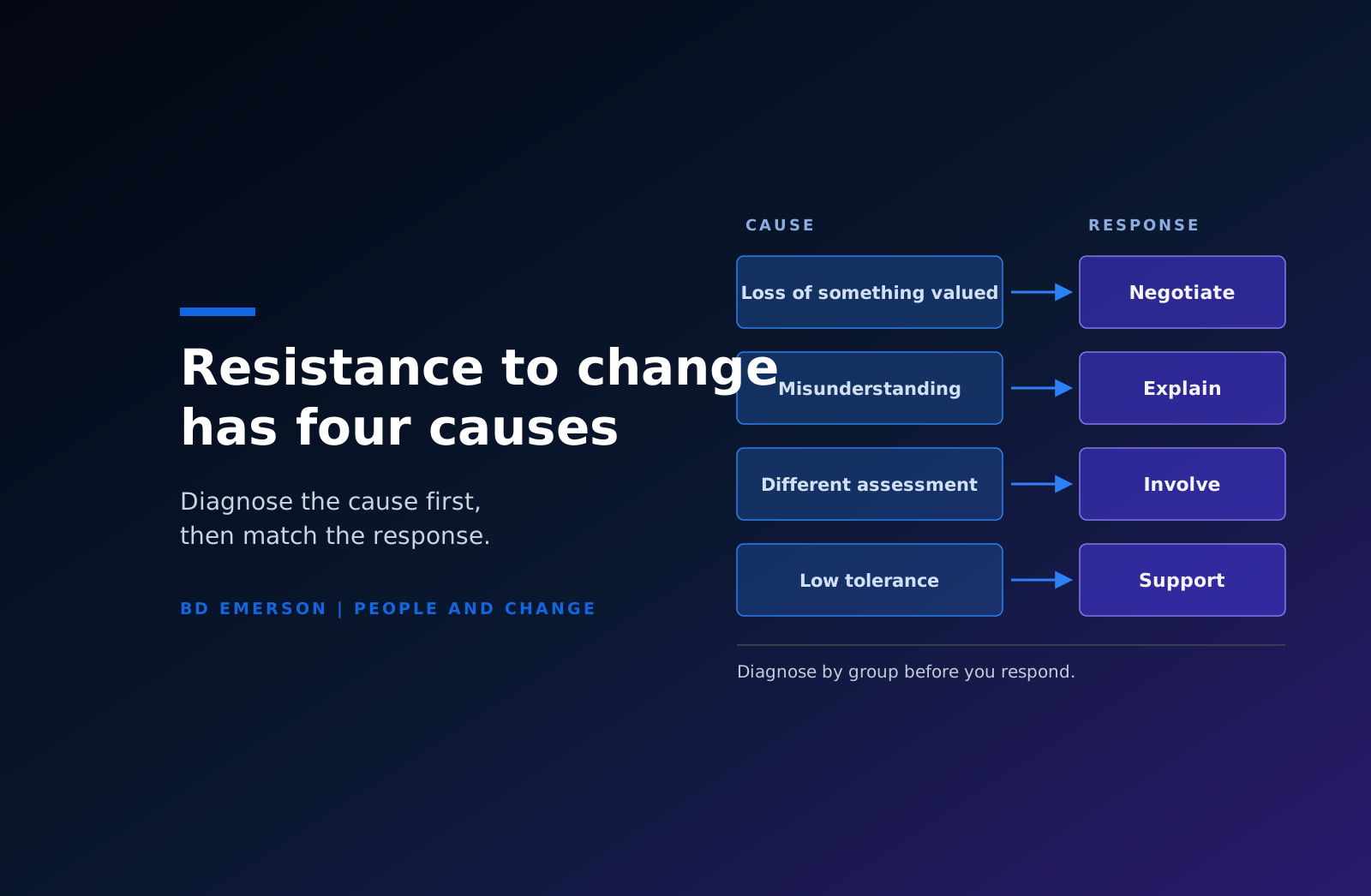
ADKAR is owned by Prosci, which describes it as a model for individual change. The letters stand for awareness, desire, knowledge, ability, and reinforcement. Prosci states that the elements are sequential, and it uses the model to find the earliest element a person has yet to reach, which it calls the barrier point. A person who lacks awareness of why the change is happening will get little from training, because training addresses knowledge.
ADKAR fits system and process rollouts, where success depends on each role adopting a specific new way of working. It also works as a diagnostic: a survey by element shows whether a team is stuck on desire or on ability, and those two problems need different responses. Prosci's own page notes that the processes and tools for planning an organizational change come from its wider methodology, so ADKAR needs a program method beside it.
Bridges Transition Model
William Bridges separated change from transition. In his model, change is the external event, such as a new strategy, a merger, or a new leader, and transition is the inner psychological process people go through as they come to terms with the new situation. The transition has three stages: ending what currently is, the neutral zone, and the new beginning. The model starts with an ending, which reminds leaders that people have to let go of something before they can take up something new.
The Bridges model fits changes that cost people a role, a team, or a professional identity. Reorganizations and acquisitions are the clearest cases, and the model pairs well with M&A change management, where two workforces go through an ending at the same time. It describes the experience well and prescribes few actions, so it works as a guide for leaders and managers and needs a plan beside it.
Kübler-Ross change curve
The change curve comes from Elisabeth Kübler-Ross's 1969 book On Death and Dying, which described the responses of seriously ill patients: denial and isolation, anger, bargaining, depression, and acceptance. Business later drew those responses as a curve of morale over time. The Elisabeth Kübler-Ross Foundation states that people do not complete the areas on the curve as steps, and that they may enter, leave, and return to them. The Foundation also holds the Kübler-Ross Change Curve as a registered trademark.
The curve fits one job, which is preparing managers to recognize emotional reactions and to treat a dip in morale as normal. It was derived from patients facing death, so it says nothing about sponsorship, communication, or training, and it should never be used to schedule how people ought to feel.
McKinsey 7-S
The 7-S framework names seven elements of an organization: strategy, structure, systems, skills, style, staff, and shared values. Tom Peters, one of its developers, recounts that the model was built at McKinsey with Bob Waterman, Tony Athos, and Richard Pascale, and that it first appeared in the journal Business Horizons in June 1980 in an article titled "Structure Is Not Organization." Strategy, structure, and systems are the hard elements. Style, staff, skills, and shared values are the soft ones. The model gives no element precedence, and its central claim is that all seven have to align for an organization to move.
The 7-S framework fits the diagnosis that comes before a change. It shows a leadership team that a new structure will fail if the systems, skills, and shared values still support the old one. It is useful in operating model redesign and in strategy execution, where the question is which elements have to move together. It offers a snapshot and no sequence, so it needs a process model to run the change it identifies.
ADKAR vs Kotter: which should you use?
ADKAR and Kotter work at different levels, so the choice depends on where the change is failing. Kotter's eight steps describe what leaders do to move an organization. ADKAR describes what each person needs in order to change. A program can follow all eight of Kotter's steps and still have a warehouse team that lacks the ability to use the new scanner. A program can score well on ADKAR in one department and still stall because the executive team never agreed on the reason for the change.
- Choose Kotter when the change is a broad transformation, the leadership team is not yet aligned, and the first task is to build urgency and a coalition.
- Choose ADKAR when the change is specific, such as a new system or process, and the task is to get defined groups of people to adopt it.
- Use both on a large program. Kotter structures the leadership work, and ADKAR measures adoption group by group.
The two models also overlap. Kotter's urgency, vision, and communication steps build what ADKAR calls awareness and desire. Kotter's short-term wins and cultural anchoring correspond to reinforcement. The gap sits in the middle. None of Kotter's eight steps addresses training, which is where ADKAR's knowledge and ability elements add the most. That difference makes ADKAR the stronger fit for technology programs and Kotter the stronger fit for the start of an enterprise transformation.
How do you choose a change management model?
Three questions settle the choice. The first is what the model has to do. A team that needs to understand what must change should start with a diagnostic model such as 7-S. A team that needs a sequence for leaders should use a process model such as Kotter. A team that needs to track and support adoption should use an individual model such as ADKAR or Bridges.
The second question is what kind of loss the change involves. A new expense system costs people a habit. A merger can cost them a title, a team, and a sense of who they work for. The heavier the loss, the more the Bridges model and the change curve earn a place in manager preparation.
The third question is what the organization already uses. A model that managers know and trust will outperform a better model that nobody recognizes. Organizations that run change often turn their chosen models into a standard method with templates, training, and a common vocabulary, and consistency across programs matters more than the choice of model.
The choice does not affect how long a change takes. The timeline depends on the number of roles affected, the depth of the behavior change, and how much other change the same people are absorbing.
BD Emerson selects and applies these models with our Andersen Consulting colleagues at Daniels Consulting Group, a firm of organizational psychologists and experienced business professionals. Our change management consulting service starts with the change you are planning and builds the readiness assessment, change plan, and adoption measures around it. Book a consultation to speak with BD Emerson and Daniels Consulting Group.

About the author