Change Management Strategy: The Six Decisions That Come Before the Plan
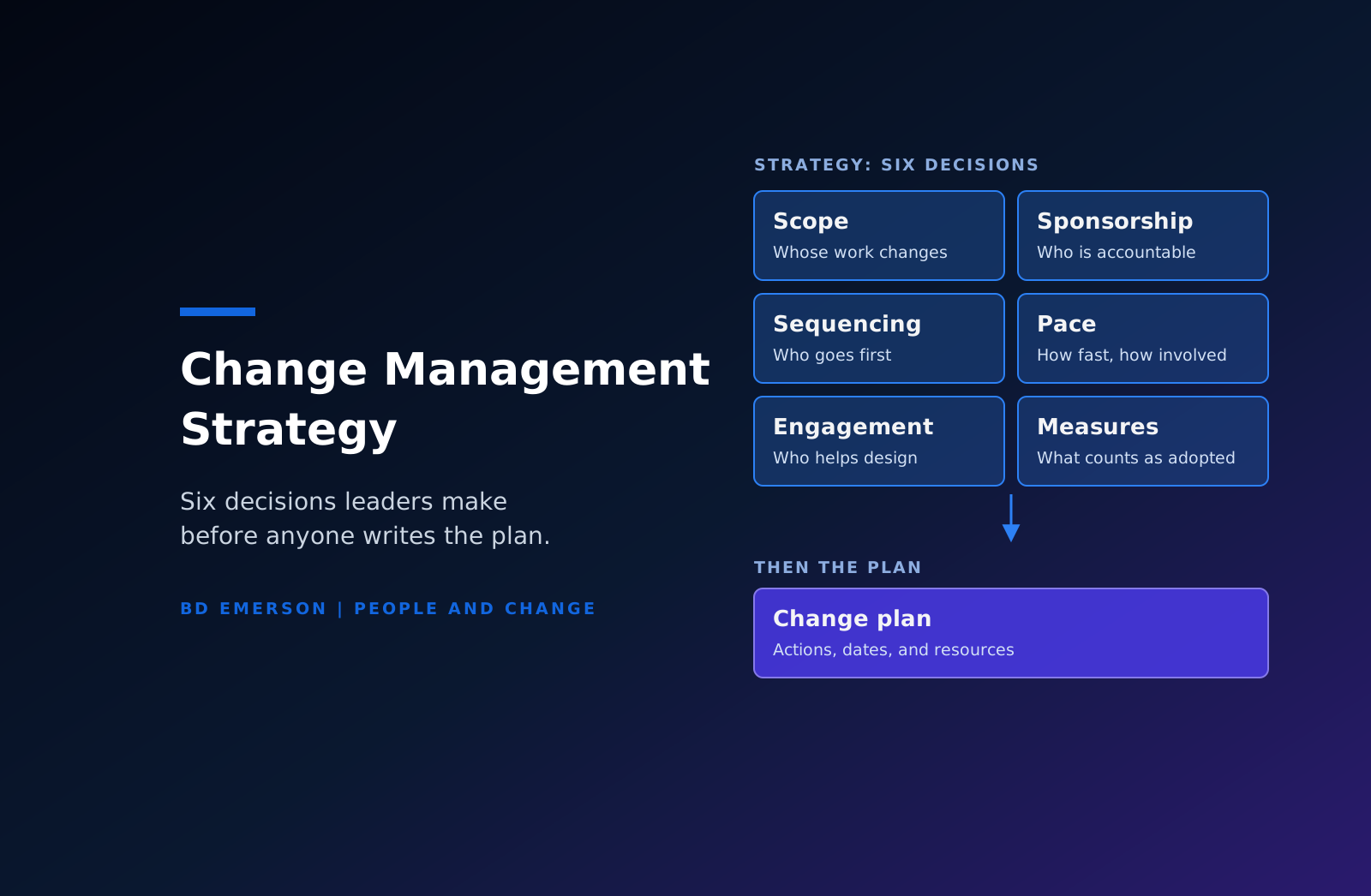
A change management strategy is the set of decisions that determines how an organization will move its people from the current way of working to a new one. It settles six things: the scope of the change, the sponsorship model, the sequence, the pace, the engagement approach, and the measures of success. A change plan comes second. The plan documents the actions, dates, and resources that carry out those decisions. Leaders own the strategy, it fits on a few pages, and it should be settled before anyone drafts a communications calendar or a training schedule.
What is a change management strategy?
The Association of Change Management Professionals (ACMP) publishes the Standard for Change Management, which divides the discipline into five areas: evaluating change impact and organizational readiness, formulating the change management strategy, developing change management plans, executing those plans, and closing the change management effort. Strategy sits second in that order. It follows the assessment of impact and readiness, and it precedes the plan.
ACMP's study aid for the Standard describes the purpose of the strategy as developing an overarching approach for how an organization transitions from its current state to its future state. The Standard breaks that approach into component strategies for resources, communication, sponsorship, stakeholder engagement, readiness, learning and development, measurement and benefit realization, and sustainability.
In practice, a strategy is a set of choices with reasons attached. A useful test is whether the document rules anything out. "We will communicate early and often" rules nothing out. "We will pilot in two plants before the other four, because the pilot plants have the strongest supervisors and the most stable order volume" is a choice that a leader can challenge, approve, and be held to.
What does a change management strategy decide?
Six decisions make up the core of a change management strategy. We use a manufacturer replacing its ERP system across six plants as a running illustration.
Scope
Scope defines whose work changes, which behaviors must change, and what stays the same. It names the affected groups, the size of the change for each group, and the definition of "adopted" for each one. Scope also states what the change excludes, because employees fill silence with rumor. In the ERP illustration, scope would state that production planners, buyers, and warehouse leads change how they work every day, that plant accountants change their month-end routine, and that reporting lines and job grades stay as they are.
Sponsorship model
The sponsorship model names the executive who is accountable for the change and describes what that person will do. It also decides whether one sponsor is enough or whether the change needs a coalition, which is common when the change crosses business units that report to different executives. The model extends below the executive level, because employees take their cues from their direct manager. A sound strategy states what the sponsor commits to in person, what each plant manager or department head owns, and how the organization will prepare frontline managers to answer questions from their teams.
Sequencing
Sequencing decides the order in which groups go through the change. The main options are a single cutover for everyone, a pilot followed by waves, or a rollout by function or region. The strategy records which group goes first and why. Good reasons include strong local leadership, lower operational risk, and the chance to learn before the largest group moves. Sequencing also has to respect the technical schedule, so the change lead and the project manager should agree on it together.
Pace
Leaders often set the pace by default, because they accept whatever the project schedule implies. John Kotter and Leonard Schlesinger addressed pace directly in Choosing Strategies for Change, first published in Harvard Business Review in 1979. They describe a strategic continuum. At the fast end, the change is clearly planned, involves few other people, and attempts to overcome resistance. At the slow end, the change is not clearly planned at the beginning, involves many other people, and attempts to minimize resistance.
Kotter and Schlesinger name four situational factors that should set a change effort's position on that continuum:
- The amount and kind of resistance that is anticipated.
- The position of the initiator relative to the resisters, especially with regard to power.
- The person who has the relevant data for designing the change and the energy for implementing it.
- The stakes involved.
The factors pull in different directions, which is why pace is a strategic decision. High stakes and a short runway argue for speed. Strong anticipated resistance, and a design that depends on knowledge held by frontline employees, argue for a slower pace with more involvement. The authors warn that a common mistake is to move too quickly and involve too few people.
Engagement approach
The engagement approach decides how much say each group has. The team informs some groups, consults others on the design, and asks a few to help build it. The strategy assigns a level of involvement to each stakeholder group and explains the reason.
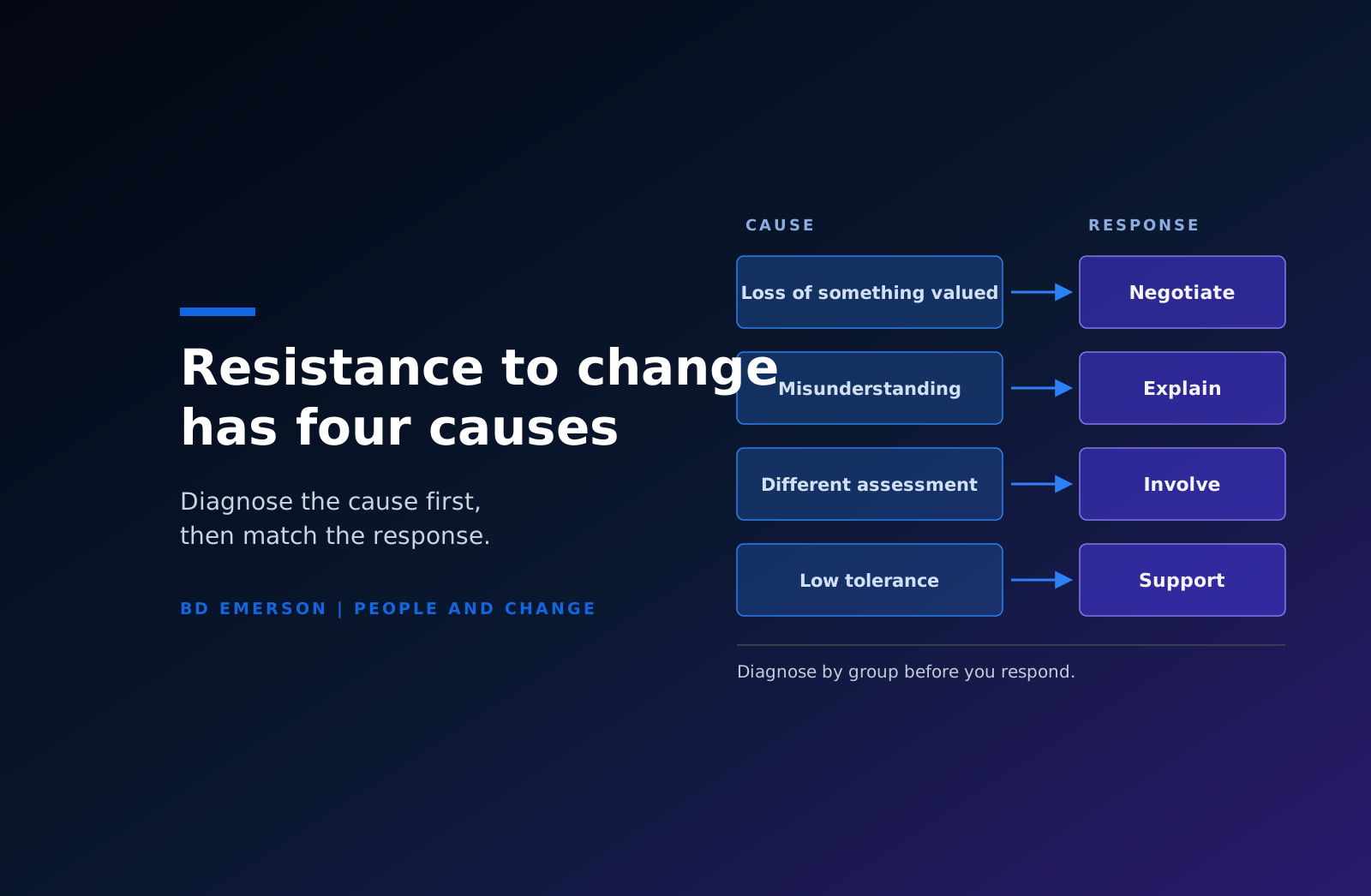
The reason should follow from why a group is likely to resist. Kotter and Schlesinger identify four common reasons: a desire not to lose something of value, a misunderstanding of the change, a belief that the change does not make sense for the organization, and a low tolerance for change. Each reason calls for a different response. Clear information corrects a misunderstanding. Information does little for a planner who believes the new system will slow the plant down. That planner may be right, and involving the planner in the design is how the organization finds out.
Measures
Measures define success in numbers before the change starts. A strategy names a small set of adoption measures, such as the share of purchase orders created in the new system, and a small set of outcome measures, such as schedule adherence or inventory accuracy. It records the baseline for each measure and names the person who keeps measuring after the project team disbands. It also sets the thresholds that would cause leaders to intervene, pause a wave, or change the approach.
How does a change strategy differ from a change plan?
The strategy makes the choices, and the plan schedules the work that follows from them. ACMP describes the purpose of the plan as documenting the actions, timelines, and resources needed to deliver the change. The table shows the practical differences.
| Dimension | Change strategy | Change plan |
|---|---|---|
| Question it answers | How will we approach this change, and why this way? | Who does what, and when? |
| Owner | The sponsor and the leadership team | The change lead and the project team |
| Form | A few pages of decisions with reasons | Schedules, audience lists, and logs |
| When it changes | At decision gates, or when the situation shifts | Every week during delivery |
| Example content | Pilot two plants first, and consult planners on the design | Planner workshop dates, the training calendar, and manager briefings |
Teams still produce a plan when no strategy exists, and that plan tends to copy the last program's activities at the last program's pace. Our change management plan template covers the seven sections of the plan. Each section is easier to write once the six strategy decisions are made, because the stakeholder map inherits the scope, the sponsorship plan inherits the sponsorship model, and the adoption metrics inherit the measures.
How do you build a change management strategy?
Start with evidence. The ACMP Standard places the evaluation of change impact and organizational readiness before strategy, and the order matters. An impact assessment shows which groups face the largest change in daily work. A readiness assessment shows how prepared those groups and their leaders are, and how much other change they are already absorbing. Without both, the six decisions rest on assumptions.
Next, frame each decision as a choice between real options. For sequencing, write down the single cutover and the phased rollout, with the risks of each. For pace, work through the four Kotter and Schlesinger factors with the sponsor. Leaders commit more firmly to a decision when they have seen the alternative they turned down.
Then test the draft with the people who will carry it. Middle managers and supervisors can tell you quickly whether the sequence is workable and whether the engagement approach matches the mood on the floor. Their review is also the first act of engagement, so it serves the strategy as well as improving it.
Finally, record the strategy in a short document that the sponsor signs. Revisit it at each major gate of the program, and whenever the scope, the schedule, or the leadership team changes. When the change is one part of a larger strategic program, the change strategy should also reference the program's priorities, which is the link to strategy execution.
What makes a change strategy fail?
Four patterns account for most weak strategies. In the first, the document lists activities and makes no choices, so it gives the plan nothing to inherit. In the second, the team applies the approach from its last program regardless of the situation. Kotter and Schlesinger call that the most common mistake managers make: using only one approach, or a limited set of them, in every circumstance.
In the third pattern, the go-live date sets the pace by default, and nobody asks whether the affected groups can absorb the change at that speed. In the fourth, the sponsor's name appears on the governance chart with no specific commitments beside it, and the measures stop at go-live. A strategy that avoids these four patterns gives the change plan a sound base.
BD Emerson builds change management strategies with our Andersen Consulting colleagues at Daniels Consulting Group, a firm of organizational psychologists and experienced business professionals. Their published client work includes building an internal change management capability: a change readiness assessment, a standardized methodology and toolkit, an integrated change plan framework, and a custom training curriculum. To discuss the decisions in front of your program, see our change management consulting service or book a consultation.

About the author