Change Management vs Project Management: Differences and How They Work Together
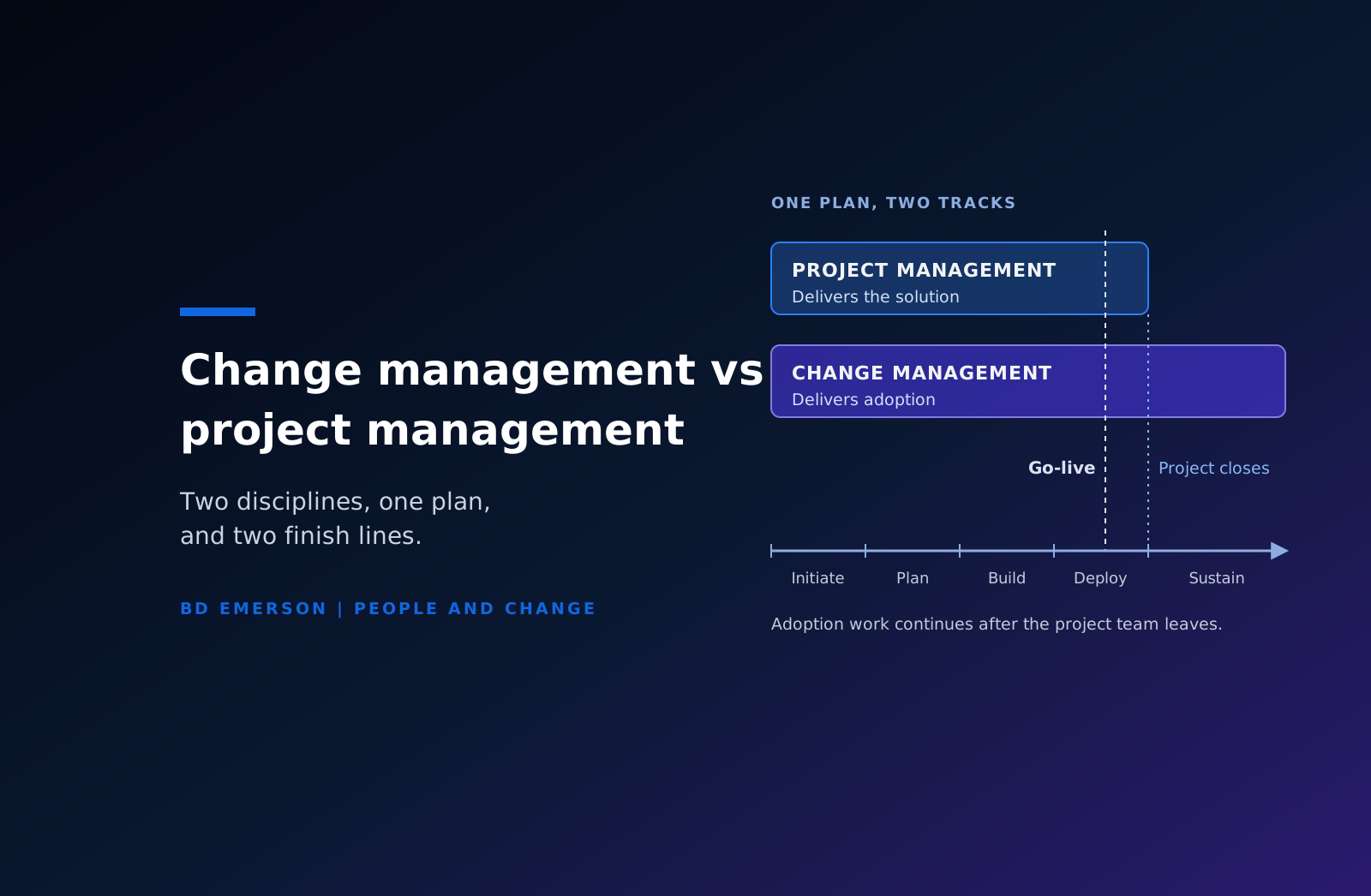
Project management delivers a defined solution within an agreed scope, schedule, and budget. Change management prepares the people affected by that solution to adopt it and to work in the new way. The two disciplines have different goals, owners, deliverables, and measures, and a transformation needs both of them on one plan. Project management gets the new system, process, or structure to go-live. Change management gets employees to use it well enough for the business case to come true.
What is the difference between change management and project management?
The Project Management Institute (PMI) defines a project as "a temporary endeavor undertaken to create a unique product, service, or result." PMI describes project phases as collections of related activities that end in one or more deliverables. Project management is the discipline that plans those activities, assigns the resources, controls the scope, schedule, and budget, and hands over the finished result. A project manager can run the work with a predictive, adaptive, or hybrid approach, and in every case the object being managed is the solution.
The Association of Change Management Professionals (ACMP) defines change management in its Statement of Change Management as the application of knowledge, skills, abilities, methodologies, processes, tools, and techniques "to transition an individual or group from a current state to a desired future state" so that the intended outcomes are achieved. The object being managed is the people: what they know, what they can do, and whether they choose to work in the new way.
ACMP treats the two as separate and connected disciplines. The same statement describes project management as "the structured management of the resources, deliverables and schedule for the change process," calls it complementary to change management, and lists integration with project management among the change management knowledge areas.
A warehouse system replacement shows the split. The project manager owns the vendor contract, the configuration, the data migration, the testing cycles, and the cutover date. The change lead owns the answers to a different set of questions: which roles change and how, what supervisors need to say to their teams, who needs training before the first live shift, and how the organization will know that pickers and planners have stopped using the old spreadsheets.
Change management vs project management at a glance
The table compares the two disciplines on the five points that matter most when you staff and plan an initiative.
| Dimension | Project management | Change management |
|---|---|---|
| Goal | Deliver the defined solution within scope, schedule, and budget | Get the affected people to adopt the solution and use it proficiently, so that the benefits arrive |
| Owner | The project manager, who answers to the project sponsor and the steering committee | The change lead, who works through the executive sponsor and the managers of the affected groups |
| Deliverables | Charter, scope statement, schedule, budget, risk register, status reports, and the solution itself | Stakeholder analysis, change impact assessment, communication plan, training plan, sponsor plan, and reinforcement plan |
| Measures | Milestones met, budget variance, scope delivered, defects, and the go-live date | Awareness and readiness survey results, training completion and proficiency, usage rates, and benefits realized |
| Timing | Starts at project approval and ends at handover and closeout | Starts when leaders make the case for change, peaks around go-live, and continues until the new behavior is routine |
The timing row explains a common staffing mistake. Project teams disband at closeout, and adoption work is at its most demanding in the period that follows go-live. A plan that ends change management on the same day as the project leaves the reinforcement work without an owner.
How do change management and project management work together on one plan?
PMI makes the case for integration in its practice guide Managing Change in Organizations, published in 2013. PMI states that organizations succeed more often when they combine standardized portfolio, program, and project management techniques with rigorous change management approaches. Three practices put that principle to work.
One schedule
Change activities belong on the project schedule as tasks with owners, dates, and dependencies. The dependencies run in both directions. Training content depends on a stable design, and go-live depends on trained users. When the change plan sits in a separate document, a slip in the build quietly compresses the training window, and nobody sees the conflict until the week before cutover. Our change management plan template shows the sections that feed the shared schedule.
Each project phase has matching change work, and the two streams fit together in the following sequence.
- Initiate. The project team writes the charter and business case. The change team confirms the executive sponsor, identifies stakeholder groups, and assesses the organization's readiness.
- Plan and design. The project team defines requirements, scope, and the schedule. The change team completes the change impact assessment by role and sets the change strategy.
- Build and test. The project team configures and tests the solution. The change team runs communications, builds training, and briefs the managers who will lead their teams through the change.
- Deploy. The project team executes cutover and stabilizes the solution. The change team delivers training, checks readiness against agreed criteria, and supports users in the first days of live operation.
- Close and sustain. The project team hands over to operations and closes the project. The change team measures adoption, corrects the gaps, and transfers reinforcement to line managers.
One governance structure
The change lead sits on the project leadership team and reports at the same steering committee as the project manager. People risks go into the same risk register as technical risks, with the same scoring and the same escalation path. Readiness becomes a formal go-live criterion alongside testing results, so that the steering committee decides on cutover with evidence about both the solution and its users.
A two-way exchange of information
The project team gives the change team design decisions, scope changes, and date changes as soon as they happen, because each one alters what employees need to hear and learn. The change team gives the project team impact findings, readiness data, and feedback from future users. That feedback often exposes a design problem while it is still cheap to fix.
A model of individual change gives the change team a shared language for this reporting. Prosci's ADKAR Model, for example, names five elements of individual change: awareness, desire, knowledge, ability, and reinforcement. A change lead who reports that planners have the knowledge and lack the ability gives the project manager a specific request: more practice time in the test environment before cutover.
What happens when one discipline is missing?
Project management without change management
The solution goes live on time, and the organization then discovers that go-live was the midpoint. Employees keep their old spreadsheets, managers approve workarounds, the help desk fills with questions that training should have answered, and productivity falls further and stays low longer than the business case assumed. A PMI Global Congress paper by Steve Garfein, Nick Horney, and Marvin Nelson states the general case: "Projects and programs by their very nature cause change," and when the change impact of a project is overlooked, "the business often fails to realize the full benefit that was originally intended."
A partial version of this failure is easy to miss. The project includes change management in name, and the work consists of a launch email and a training session scheduled for the final weeks. Communication and training are two change deliverables among several. Sponsor alignment, impact assessment, manager preparation, and reinforcement have to start early to work, and no amount of late effort replaces them.
Change management without project management
The opposite failure gets less attention. Leaders announce the change, employees attend town halls, and expectations rise. The solution then arrives late, incomplete, or over budget because nobody controlled scope, dependencies, and resources. Each missed date damages the credibility of every message that preceded it, and training delivered on a system that changes again before go-live has to be repeated. People who prepared for a change that did not arrive are harder to mobilize the second time.
Can one person do both jobs?
On a small project that affects one team and changes little about daily work, a project manager can carry the change tasks. The answer shifts as the number of affected people grows, as the change to daily work deepens, and as roles, reporting lines, or pay come into scope.
The reason for separate roles is a conflict of measures. The project manager is accountable for the date and the budget. The change lead is accountable for readiness and adoption. When one person holds both accountabilities and the schedule tightens, the date wins, because a missed date is visible on the day it happens and weak adoption becomes visible months later. Two people with equal standing in the governance structure keep that trade-off in front of the sponsor, who is the right person to decide it.
The amount of change management an initiative needs depends on five factors: how many people it affects, how much their daily work changes, how past changes went in this organization, how active the executive sponsor is, and how well managers can explain the change to their own teams. A digital transformation that rebuilds core processes sits at the high end on every factor. So does an organizational transformation that changes structure and roles.
BD Emerson delivers change management with our Andersen Consulting colleagues at Daniels Consulting Group, a firm of organizational psychologists and experienced business professionals. If your project plan has a go-live date and no adoption plan, see our change management consulting service or book a consultation.

About the author