

GxP Compliance: The Rules, Data Integrity, and System Validation
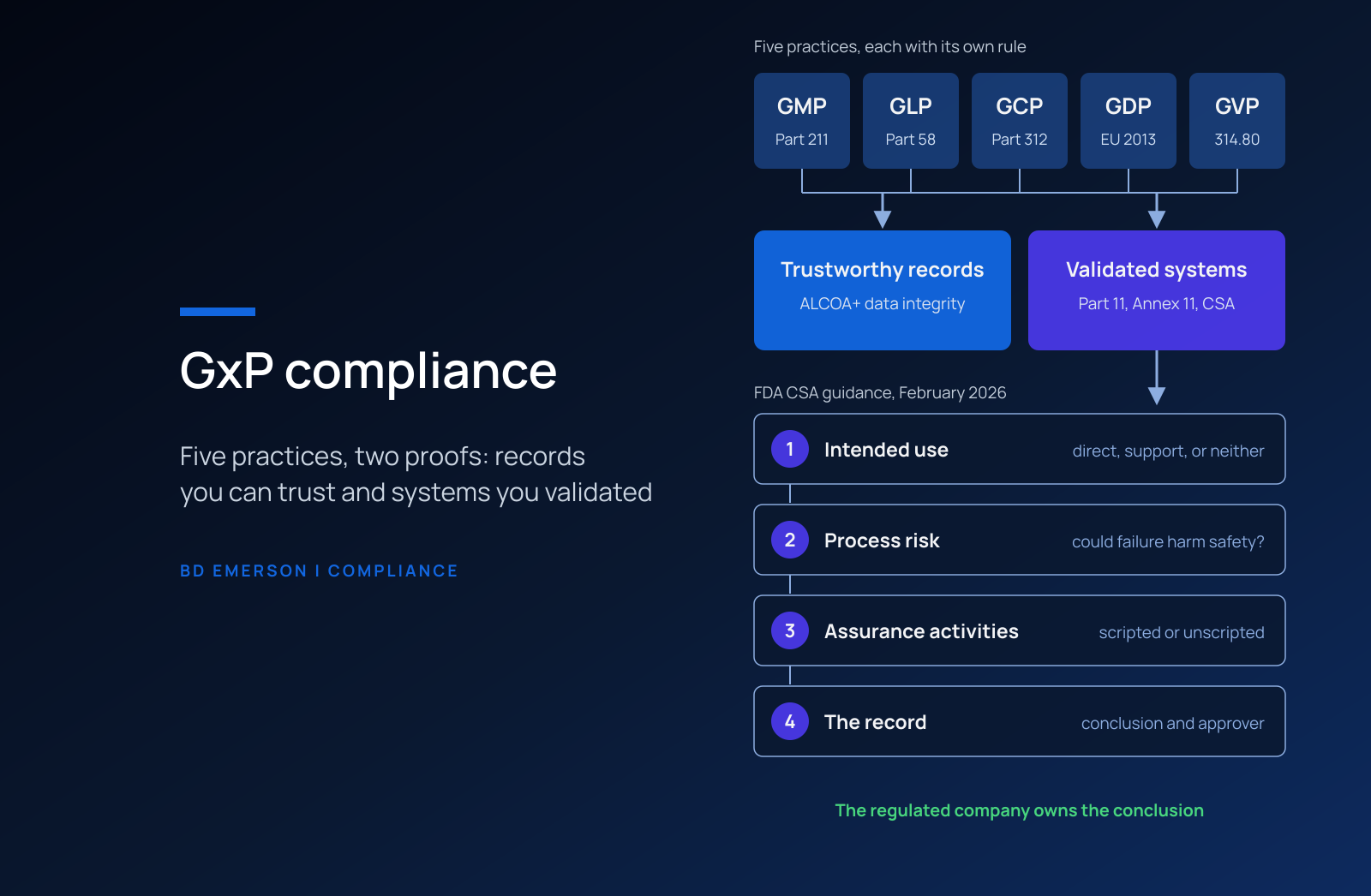
GxP compliance means meeting the good practice regulations that govern how life sciences companies make, test, study, ship, and monitor regulated products. The x stands for the practice area: manufacturing (GMP), laboratory (GLP), clinical (GCP), distribution (GDP), and pharmacovigilance (GVP). In the United States these are binding rules in Title 21 of the Code of Federal Regulations, including Parts 210 and 211 for drugs, Part 58 for nonclinical laboratories, Part 312 for investigational drugs, and Part 820 for devices, which has incorporated ISO 13485:2016 since February 2, 2026. Each of them asks a company to prove two things to an inspector: its records are trustworthy, and the computerized systems that hold those records work as intended.
What is GxP compliance?
GxP is shorthand for a family of quality rules with one purpose: products that reach patients are safe, effective, and what their labels say. Under 21 CFR 210.1(b), failing to follow the drug CGMP rules makes the drug adulterated under section 501(a)(2)(B) of the Federal Food, Drug, and Cosmetic Act. The trigger is a failure in how the drug was manufactured, processed, packed, or held, which is why GxP compliance in the pharmaceutical industry centers on evidence of how a product was made, tested, and released.
| Practice | What it governs | Primary rules |
|---|---|---|
| GMP, drugs | Manufacturing, processing, packing, and holding | 21 CFR Parts 210 and 211; EudraLex Volume 4 in the EU |
| GMP, devices | Device quality management systems | 21 CFR Part 820 (QMSR), incorporating ISO 13485:2016 |
| GLP | Nonclinical laboratory safety studies | 21 CFR Part 58 |
| GCP | Clinical investigations in people | 21 CFR Part 312; ICH E6(R3), issued by FDA as final guidance in September 2025 |
| GDP | Wholesale storage and transport of medicines | EU Guidelines of 5 November 2013 (2013/C 343/01) |
| GVP | Safety monitoring after approval | 21 CFR 314.80 in the US; EMA GVP modules in the EU |
Part 58 covers nonclinical studies that support applications for FDA-regulated products such as drugs, devices, biologics, and food and color additives, and section 58.35 requires a quality assurance unit that is separate from and independent of the study staff. Section 314.80(c)(1)(i) requires an applicant to report each serious and unexpected adverse drug experience no later than 15 calendar days after first receiving the information. The EU GDP guidelines apply to wholesale distributors and to manufacturers that distribute their own products, and section 9.2 requires a risk assessment of delivery routes and calibration of transport temperature monitoring equipment at least once a year.
What does FDA require for GxP compliance?
The predicate rules, meaning the regulations that say which records you must keep, vary by practice, and the same core controls recur in each. Drug manufacturers need a quality control unit with the authority to approve or reject all components and to review production records for errors (21 CFR 211.22). Laboratories need written standard operating procedures, a dated history of SOP revisions, and study director authorization of every deviation (58.81). Batch production, control, and distribution records must be kept at least one year after the batch expiration date (211.180(a)). Unexplained discrepancies must be investigated and documented whether or not the batch has already shipped (211.192).
Part 11 carries those predicate rules into electronic systems. Section 11.1(b) applies it to any record in electronic form that is created, modified, maintained, archived, retrieved, or transmitted under an FDA records requirement. For closed systems, section 11.10 requires validation that shows accurate and consistent performance (11.10(a)), secure, computer-generated, time-stamped audit trails that do not obscure earlier entries (11.10(e)), and authority checks that limit who can sign or alter records (11.10(g)). Section 211.68(b) adds that only authorized personnel may change master production and control records in a computer system and that a backup of entered data must be kept.
The Quality Management System Regulation took effect February 2, 2026 and incorporates ISO 13485:2016 by reference, along with clause 3 of ISO 9000:2015 for definitions. On the same date FDA stopped using the Quality System Inspection Technique (QSIT) and began inspecting device makers under Compliance Program 7382.850. If your quality manual follows the old QSIT subsystems, map it clause by clause to ISO 13485.
Data integrity and ALCOA+
FDA's data integrity guidance, finalized in December 2018, defines data integrity as the completeness, consistency, and accuracy of data. It expects records to be attributable, legible, contemporaneously recorded, original or a true copy, and accurate, which the industry shortens to ALCOA. The Pharmaceutical Inspection Co-operation Scheme (PIC/S) adds four attributes in PI 041-1, in force since July 1, 2021: complete, consistent, enduring, and available. Together these form ALCOA+.
Three points in the FDA guidance shape daily practice. First, the quality unit must review and approve all production and control records, audit trails included, under 211.192, so audit trail review belongs inside record review before release. Second, shared logins break attribution because a unique individual cannot be identified, and FDA accepts shared accounts only for read-only viewing. Third, FDA's definition of an audit trail covers system-level actions such as access attempts as well as changes to data. EU Annex 11 clause 9 sets the same bar: audit trails must be convertible to a generally intelligible form and regularly reviewed, and any change or deletion of GMP-relevant data needs a documented reason.
Our data governance framework guide covers the data owners, retention rules, and access rights that data integrity controls depend on.
Computerized system validation, GAMP 5, and CSA
Validation produces documented evidence that a system performs consistently for its intended use. EU GMP Annex 11, in operation since June 30, 2011, requires user requirements specifications based on a documented risk assessment and GMP impact, traceable through the system life cycle (clause 4.4), and periodic evaluation to confirm the system remains in a valid state (clause 11). The European Commission consulted on a revised Annex 11, a revised Chapter 4 on documentation, and a new Annex 22 on artificial intelligence from July 7 to October 7, 2025. The EudraLex Volume 4 page still lists the January 2011 revision of Annex 11 as the current text.
GAMP 5 Second Edition, published by the International Society for Pharmaceutical Engineering (ISPE) in July 2022 as "A Risk-Based Approach to Compliant GxP Computerized Systems," asks subject matter experts to apply critical thinking, supports iterative and incremental development, and tells regulated companies to maximize supplier involvement.
FDA's Computer Software Assurance guidance became final on September 24, 2025. CDRH and CBER replaced that version with "Computer Software Assurance for Production and Quality Management System Software," dated February 3, 2026, which supersedes Section 6 of the General Principles of Software Validation guidance. Its scope is software used in medical device production and quality management systems. Drug manufacturers answer to 211.68 and Part 11 for their systems, and GAMP 5 Second Edition, which discusses FDA's CSA approach, applies risk-based thinking to them. Four of the framework's six parts set the decisions you document.
| CSA decision | Question it answers | What you record |
|---|---|---|
| Identify intended use | Is the software used directly in production or the quality system, used to support them, or neither? | The intended use |
| Determine the risk-based approach | Could a failure foreseeably compromise safety (high process risk)? | The risk analysis result |
| Select assurance activities | Scripted, hybrid, or unscripted testing? | Testing performed and issues found |
| Establish the record | Is the software acceptable for its intended use? | The conclusion, who tested, when, and any approval |
The guidance gives automated measurement with limited or no human review and automated adjustment of process parameters as examples of high process risk, for which it suggests more rigor, such as scripted testing or a hybrid of scripted and unscripted testing. Functions that collect process data for monitoring, or that automate quality system workflows such as CAPA routing and change control, generally fall below that threshold and can use scenario testing, error guessing, or exploratory testing. An exploratory test record needs high-level objectives and pass or fail criteria, with no step-by-step script. FDA prefers system logs and audit trails over screenshots as evidence. The guidance generally places business applications such as email and accounting, and infrastructure such as networking and backup, outside its scope.
GxP compliance in the cloud and GxP compliance software
A vendor can supply evidence, and the regulated company owns the validation conclusion. Annex 11 clause 3.1 requires formal agreements with any third party, internal IT included, that provides, configures, maintains, or processes data for a GxP system. The CSA guidance lets manufacturers rely on validation work by developers, suppliers, and cloud service providers, and it recommends a risk-based evaluation of each vendor. FDA acknowledges that auditing a software vendor may not be feasible and lists alternatives: third-party assurance reports, ISO certifications, the vendor's development and cybersecurity practices, software bills of materials, and its data integrity controls.
When infrastructure as a service stores quality records, the guidance treats that storage as direct use, and assurance focuses on the features that protect record integrity and meet Part 11. In the software as a service example, a manufacturer assessed a product life cycle management vendor's development process, quality system, cybersecurity, and infrastructure, then signed a service agreement covering security, data integrity, privacy, availability, change management, and business continuity. For automatic updates, the vendor sends a summary of each change and its test results, and the manufacturer assesses the impact and runs risk-based testing where needed.
The same logic applies to GxP compliance software such as an eQMS, a LIMS, or a document control system. Its audit trails, electronic signatures, and access controls count only once you configure them, and validating that configuration is your record to keep. Supplier qualification for these vendors is a third-party risk management program with quality terms added: tier vendors by GxP impact, assess them before go-live, and reassess on a set cadence.
GxP compliance checklist for inspection readiness
Investigators ask for evidence that controls ran, so readiness means having these records current and retrievable:
- An inventory of computerized systems showing GxP impact, intended use, and risk rating for each one.
- A current validation or assurance record for each system, with its conclusion and approver.
- Evidence that audit trail review happens as part of record review before release under 211.192.
- Unique user accounts, with any shared account limited to read-only viewing.
- Signed agreements with every supplier that hosts, configures, or processes GxP data, per Annex 11 clause 3.1.
- Periodic evaluation records for each system, per Annex 11 clause 11.
- SOPs with revision history, plus deviation, investigation, and corrective and preventive action records.
- Retention schedules that meet each predicate rule, such as 211.180(a) for batch records.
When investigators observe conditions that may violate the Federal Food, Drug, and Cosmetic Act or related Acts, FDA issues a Form FDA 483 to firm management at the close of the inspection. FDA states that the 483 is not a final agency determination, and it encourages a written response with a corrective action plan. The form is not all-inclusive, and FDA holds the company responsible for correcting related conditions the investigator did not cite. A mock inspection run by people outside the process tests the checklist the way an investigator would, and our internal audit guide covers scoping, risk prioritization, and reporting.
Where BD Emerson fits in GxP compliance
BD Emerson does not approve validation packages, release batches, or speak for a regulator. Your quality unit approves, and FDA investigators or an EU inspectorate decide whether you comply. We prepare you for that review, and our independence from the decision keeps our assessment honest about where you stand.
Through our GRC consulting practice, BD Emerson builds the obligation inventory for the GxP rules that apply to you, the risk register with named owners, and one control set that maps Part 11, Part 211 or Part 820, and Annex 11 alongside ISO 27001 and HIPAA. We configure the GRC platform that tracks it, such as ServiceNow GRC or AuditBoard, and we design the supplier tiering and reassessment program for your GxP vendors, so the evidence an investigator asks for already exists when the inspection starts.

About the author
















