

Change Management Certification: Prosci, CCMP, APMG and Universities
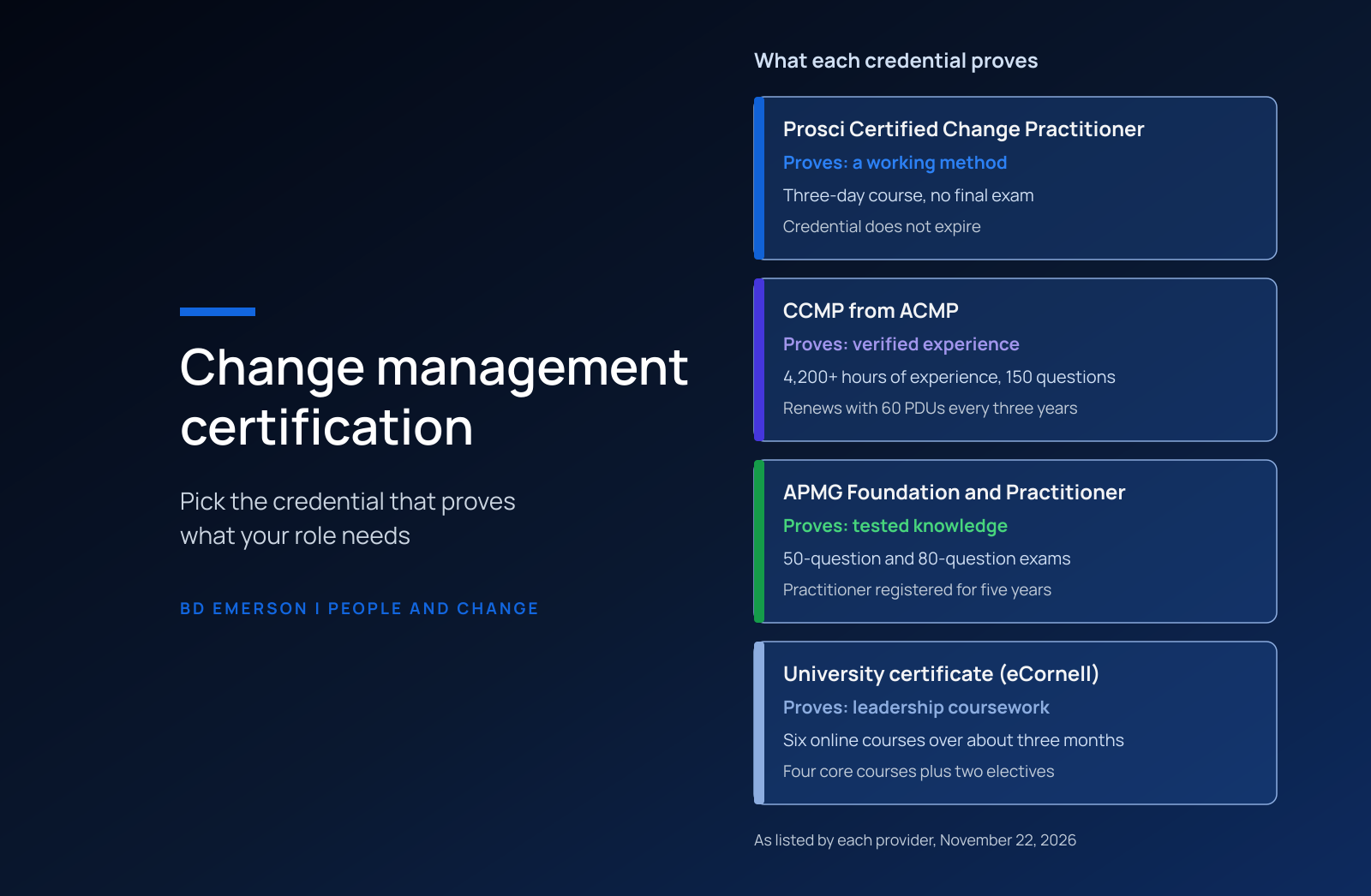
A change management certification is a credential that shows you can plan and lead the people side of organizational change. This guide compares four routes to one. The Prosci Certified Change Practitioner comes from a three-day methodology course with no final exam. The Certified Change Management Professional (CCMP) from ACMP requires documented experience and a 150-question exam. APMG International's Change Management Foundation and Practitioner are exam-based qualifications you can earn through self-study. University certificates, such as Cornell's online Change Management Certificate, are earned through coursework and projects. Choose Prosci if you need a working method, the CCMP if you need to prove experience, APMG if you want an exam-tested qualification, and a university program if you want broader leadership coursework.
What are the main change management certifications?
The four credentials differ most in what they test, which makes that the most useful way to compare them. Prosci tests whether you can apply one methodology to a live project. The CCMP tests whether you have done change management work across a full project and know ACMP's Standard for Change Management. APMG tests knowledge of change theory and your judgment on a written scenario. University programs assess you through coursework and projects. The table shows what earns each credential and the cost each provider lists on its own site as of November 22, 2026.
| Credential | What earns it | Listed cost, November 22, 2026 |
|---|---|---|
| Prosci Certified Change Practitioner | A three-day program, two knowledge checks and a final presentation | $4,500 online, $4,850 in person (USD list prices) |
| CCMP from ACMP | 21 hours of training, at least 4,200 hours of experience, an application with essays, and a 150-question exam | $595 application fee for ACMP members, $795 for non-members |
| APMG Change Management Foundation and Practitioner | A 50-question Foundation exam, then an 80-question scenario-based Practitioner exam | Usually included in a training provider's course fee; APMG's UK store gives £448 including VAT as the usual Practitioner exam price |
| eCornell Change Management Certificate | Six online courses over about three months | $3,900 |
What is the Prosci change management certification?
The Prosci change management certification is the Prosci Certified Change Practitioner designation, which you earn by completing Prosci's Certification Program. Prosci's program page lists the online program at $4,500 and the in-person program at $4,850, which includes breakfast and lunch. Prosci says pricing varies by region and delivery format, so check the schedule for your location before you budget. The program page lists the program at 3 to 5 days depending on format and describes the core program as three days. The online version runs about eight hours a day, plus roughly an hour of self-study on each of the first two days.
The three days cover the PCT Model, the ADKAR Model of individual change, and the Prosci 3-Phase Process: Prepare Approach, Manage Change and Sustain Outcomes. Participants work on a current project of their own. They complete a PCT Assessment and a risk assessment, build a change management strategy and core plans, and start a master change management plan. That project work is the most useful part of the program, because you leave with a draft plan for work you already own.
The completion rules are simple. According to Prosci's training FAQ, you may miss no more than 90 minutes across the program, you pass two short knowledge checks, and you deliver a presentation on Day 3. There is no final exam and no prerequisite, and the credential does not expire. The program carries 19.5 PMI professional development units and 23 hours of ACMP continuing education credit. The trade-off is scope. The credential certifies you in Prosci's own methodology, so it carries the most weight in organizations that already use Prosci's tools and language.
The CCMP: ACMP's experience-based credential
The Certified Change Management Professional is the credential of the Association of Change Management Professionals (ACMP), and it is the one credential in this group built around documented experience. ACMP bases it on the Standard for Change Management. The exam covers five domains: evaluating change impact and organizational readiness, formulating change management strategy, developing the change management plan, executing that plan, and closing the change management effort.
Eligibility has two parts, set out in the CCMP Candidate Handbook. You need 21 hours of structured change management training aligned with the Standard and completed within seven years of applying. Recorded or live webinars and conference sessions do not count toward the initial application. You also need experience as a change management lead or practitioner: 4,200 hours, about three years, if you hold a four-year degree, or 7,000 hours, about five years, if your highest qualification is what the handbook calls a secondary degree, meaning a high school diploma, an associate's degree or a global equivalent. The application includes essays that describe that experience.
According to ACMP's CCMP FAQ, the application fee is $595 for ACMP members and $795 for non-members, and ACMP lists no separate fee for a first exam attempt. The exam has 150 multiple-choice questions, 25 of them unscored, and a three-hour limit. It is closed book, and Kryterion proctors it online or at a test center. ACMP keeps the passing score confidential. You have one year from application acceptance to pass and up to three attempts, with retakes at $300 for members and $375 for non-members. To keep the credential, you earn 60 professional development units every three years and pay a renewal fee of $100 for members or $150 for non-members.
Prosci training can count toward the CCMP. Prosci states that its program provides 23 hours of qualifying education toward the CCMP's 21-hour requirement and that Prosci holds ACMP Qualified Education Provider status. ACMP also reviews courses from providers outside its pre-qualified list: you submit a course description with an outline, learning objectives and the hours of instruction, and ACMP credits only the portion that aligns with the Standard. Taking Prosci or another qualifying course early and sitting the CCMP once your experience hours qualify is a workable sequence.
APMG Change Management Foundation and Practitioner
APMG International runs a two-level, exam-based scheme. The current version is the third edition, which APMG calls CM3 and launched in April 2024. Per APMG's certification page, a typical course runs three days for Foundation and two days for Practitioner, and self-study candidates can book an online exam with a proctor watching by webcam. The scheme is built on the APMG Change Management Study Guide, which you receive when you enroll with an accredited training provider or book an exam with APMG.
The APMG exam guide sets out both papers. Foundation is 50 multiple-choice questions in 40 minutes, closed book, with a pass mark of 25, or 50%. Practitioner is 80 questions in two and a half hours, based on a scenario of two to three pages, and you may consult the Study Guide during the exam. Its pass mark is also 50%. Some Practitioner questions ask for the right response to a situation and the reason for choosing it, so the paper tests applied judgment as well as recall.
The Foundation certificate does not expire. Practitioners hold Registered status for five years and keep it by passing a re-registration exam within three to five years of certification. APMG says most training providers include the exam in their course fee. On November 22, 2026, APMG's UK store gave £448 including VAT as the usual price of the Practitioner exam. APMG names its audience as current and aspiring change managers, project managers and their teams, HR, communications and learning specialists, and managers who lead teams through change.
University change management certificates
University certificates are coursework programs in which you complete assignments and projects that instructors or facilitators review. Cornell's Change Management Certificate, offered online through eCornell by the Cornell SC Johnson College of Business, is a representative example. It consists of six courses, four core and two electives, taken over about three months at three to five hours of study a week, and it lists at $3,900. Facilitators give feedback on each course's applied projects. The core courses cover power relationships, negotiation, leading strategic change initiatives and leading organizational change. The program also carries 50 SHRM professional development credits and 50 HRCI recertification credit hours.
The strength of a university certificate is breadth. The coursework spends more time on influence, negotiation and leadership than on a project toolkit, which suits managers and HR leaders who sponsor change more often than they write change plans. Check the roles you are targeting before you enroll. When a posting lists Prosci or the CCMP as a requirement, a university certificate will not meet that requirement on its own.
Which change management certification should you choose?
Start from what you need the credential to prove, then match it to the option that proves it.
- If you are new to change management or your organization runs on Prosci, take the Prosci program. It has no prerequisites, gives you a method and a draft plan for a live project, and, according to Prosci, counts toward the CCMP's education hours.
- If you have about three years of change management work as a lead or practitioner and a four-year degree, or about five years without one, pursue the CCMP. It is the credential here that verifies experience, and its exam covers the full project life cycle in the ACMP Standard.
- If you want an exam-tested qualification you can earn through self-study, take APMG Foundation and then Practitioner. You can study on your own schedule and sit the exam online.
- If you lead or sponsor change more than you run change plans, a university certificate covers leadership, negotiation and influence in more depth.
Prosci's program teaches ADKAR, one of the six frameworks compared in our guide to change management models. Project managers who already hold a PMI credential should read change management vs. project management to see how the two disciplines divide the work on one project and why a transformation needs both.
Change management training for employees and managers
Certification programs train change practitioners. The employees affected by a change need different training: instruction on the new process or system in their own role, delivered close to go-live, and a manager who can answer their questions. Managers need practice explaining why a change is happening, handling resistance on their teams, and reinforcing the new way of working. A public certification course prepares one practitioner at a time, and it teaches the provider's templates instead of yours.
Organizations building internal capability get more from a curriculum built on their own methodology, templates and current projects. That is how organizational change management becomes a repeatable in-house practice, and it lets certified practitioners apply what they learned inside the organization's own process.
BD Emerson's change management training is built for one organization at a time: a practitioner curriculum taught on your methodology and live projects, leading-change workshops for managers and executive sponsors, and coaching for your internal change team. We deliver it with our Andersen Consulting colleagues at Daniels Consulting Group, who draw on a background in organizational psychology and business. We issue no public certification, so the training works alongside whichever credential your practitioners hold.

About the author
















