

Custom Manufacturing Software for Discrete Manufacturers: When to Build an MES
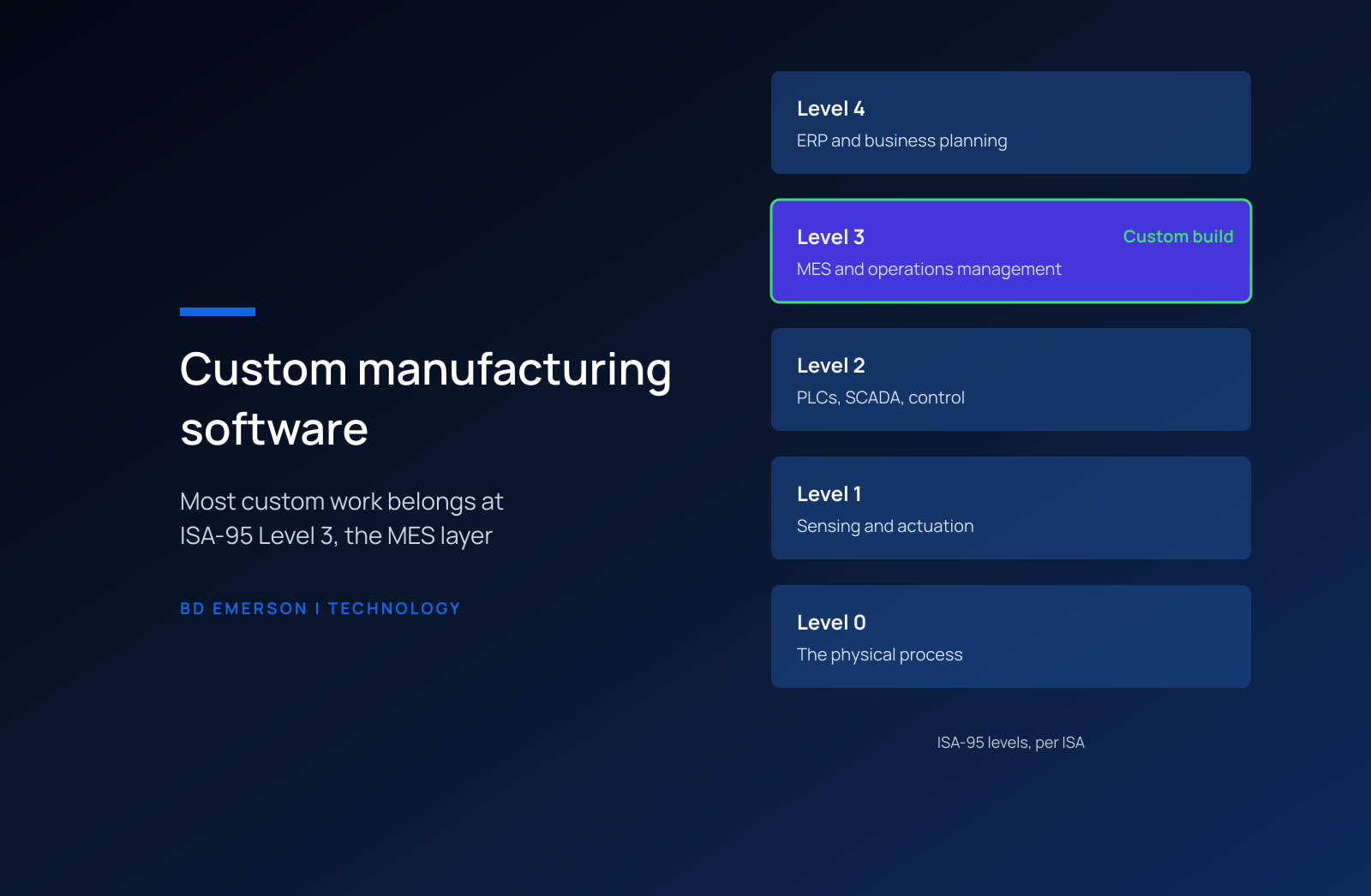
Custom manufacturing software is software built around how a specific plant runs: its work orders, routings, quality checks, genealogy, and the machines on its floor. For discrete manufacturers, the build usually sits at the manufacturing operations management layer, the MES and the applications around it, between the ERP that plans the business and the controllers that run the equipment. Build when your routing, product configuration, or traceability is a source of advantage, or when packaged MES would force you to change a process your customers pay for. Buy when your operations look like your industry's standard. Most plants end up with a mix: a packaged ERP, a custom or heavily extended MES layer, and custom applications where the packaged tools stop.
What does discrete manufacturing software need to cover?
Discrete manufacturers make countable things: pumps, control panels, aircraft components, medical devices, vehicle parts. Each unit has a bill of materials, a routing through work centers, and often a serial number that has to be traced back to the lots, operators, and machines that touched it. Process manufacturers blend and batch; discrete manufacturers assemble and test.
That shape drives the software. A discrete plant needs work order dispatch by work center, operator instructions tied to the product revision, in-process quality checks with hold and release, labor and machine time capture, serial and lot genealogy, nonconformance and rework tracking, and equipment status and downtime. Plants that build to order also need configuration management, because the routing changes with every option the customer chooses. Generic ERP modules cover the planning side well and the shop floor side poorly, which is why manufacturing operations management software exists as its own category.
What should you measure before you decide?
A build decision should rest on numbers from your own floor. Before scoping anything, we collect six measures for the value stream in question:
- Overall equipment effectiveness and the top three causes of lost time
- First pass yield and the rework hours it drives
- Schedule adherence, meaning the share of work orders finished in the planned shift
- How long it takes to trace one serial number back to its lots, operators, and test results
- How long a completed order takes to appear in the ERP
- The share of work instructions and quality records still kept on paper or in spreadsheets
Those figures set the business case. If tracing a serial number takes two days and a customer audit requires two hours, the genealogy requirement alone can justify the build. If the main loss is unplanned downtime, a maintenance application on top of your existing MES may return more than a new MES would.
Where does custom MES sit in the ISA-95 model?
The reference architecture most plants use is ISA-95, also published as IEC 62264. ISA describes five levels. Levels 0 through 2 cover the physical process, sensing, and control equipment such as PLCs and distributed control systems. Level 3 covers manufacturing execution systems and other systems that manage manufacturing operations. Level 4 covers business activities, including ERP. ISA notes that the standard mainly addresses the interface between Levels 3 and 4, and that the model applies across discrete, continuous, and logistics industries.
That framing is useful for scoping a build. Most custom work belongs at Level 3, where the plant's own way of working lives, and at the Level 3 to 4 interface, where orders, materials, and completions move between the MES and the ERP. Building at Level 4 usually means rebuilding commodity ERP functions nobody needs to own. Building at Level 2 is controls engineering, a separate discipline with its own vendors.
When should a manufacturer build instead of buy?
Packaged MES products are mature, and for many plants they are the right answer. Four situations favor a custom build or a substantial custom layer on top of a package.
The first is a configure-to-order or engineer-to-order product line where routings and work instructions change with each order, and the package handles that only through heavy customization. The second is a traceability requirement that goes beyond the package's data model, for example genealogy that has to link test data, torque values, and operator certifications to every serial number for a customer audit. The third is a plant whose throughput depends on a scheduling or dispatch rule the package cannot express. The fourth is a portfolio of plants on different packages, where a custom operations layer gives one view without replacing every system at once.
Buy when none of those apply, when the plant runs standard processes, or when the team cannot staff a product owner for the software after launch. Our build vs buy calculator compares the cost of each path over a horizon you choose and treats MES and plant systems as their own category. For a broader view of the trade-off, see custom software vs off the shelf.
What does a custom manufacturing software build look like?
The safest builds start small and run in parallel with what exists. A typical first release covers one value stream: work order dispatch, operator instructions, quality checks, and genealogy for one product family, integrated with the ERP for orders and completions. It runs beside the current process until the data matches, then takes over. Later releases add scheduling, downtime capture, more product families, and other plants.
Integration carries most of the risk. The ERP interface needs agreed definitions for orders, materials, and confirmations. The shop floor interface needs a data path from PLCs and test stations, usually through an OPC UA server or a historian, with the controls team involved from the first design session. Plan for offline operation too: a work center cannot stop because the network is down, so the client needs to queue transactions and sync later.
As a BD Emerson planning range, a first release for one value stream takes four to seven months, and the drivers are the number of integrations, the depth of genealogy, and how many product variants the routing logic must handle. Each additional value stream on the same platform takes less time, because the integrations, data model, and deployment pipeline already exist.
| Decision | Packaged MES | Custom operations layer |
|---|---|---|
| Time to first value | Faster when processes match the package | Slower at first, faster for the second and third value streams |
| Process fit | Plant adapts to the product | Software adapts to the plant |
| Traceability depth | Limited to the package data model | Built to the customer or regulator requirement |
| Ongoing ownership | Vendor roadmap and license fees | Internal product owner and a support team |
| Best fit | Standard processes, single plant | Configure-to-order, deep genealogy, multi-plant estates |
Where does AI fit in manufacturing software?
AI earns its place in manufacturing software where it reads something a person reads today. Vision models inspect parts at a station and flag defects for a quality technician to confirm. Models trained on sensor and maintenance history rank which assets are likely to fail next, so planners schedule work before a breakdown. Language models turn engineering change notices into draft work instructions for an engineer to approve. In each case the operations software holds the record and the approval step, and the model supplies a proposal. Our manufacturing maintenance case study shows the predictive maintenance pattern in a plant setting.
How do you secure software that touches the shop floor?
Manufacturing software connects the business network to operational technology, which makes it part of the plant's attack surface. Design it to the ISA/IEC 62443 series, which sets security requirements for industrial automation and control systems and addresses asset owners, integrators, and product suppliers. In practice that means placing the MES in its own network zone, controlling every conduit between the office network and the floor, using separate identities for services and people, and logging every change to a recipe, routing, or quality limit.
Regulated manufacturers carry additional obligations. Medical device and pharmaceutical plants that keep records electronically fall under 21 CFR Part 11, which requires secure, computer-generated, time-stamped audit trails for record creation, changes, and deletions. Build those audit trails into the data model on day one, because adding them later means migrating every record. Our manufacturing practice covers the OT security assessment that should precede any connection between new software and the floor.
How BD Emerson helps
BD Emerson builds custom manufacturing operations software for discrete manufacturers, from a first value stream to a multi-plant operations layer, with OT security and audit trails designed in. We start with a build vs buy assessment, so you know before you commit whether a package, an extension, or a custom build fits your plant.
If your MES no longer fits how your plant runs, our custom software development team can scope the first release, build it beside your current process, and hand your team a system they can own.

About the author
















