

Change Management Software: The Tools, Sorted by the Job They Do
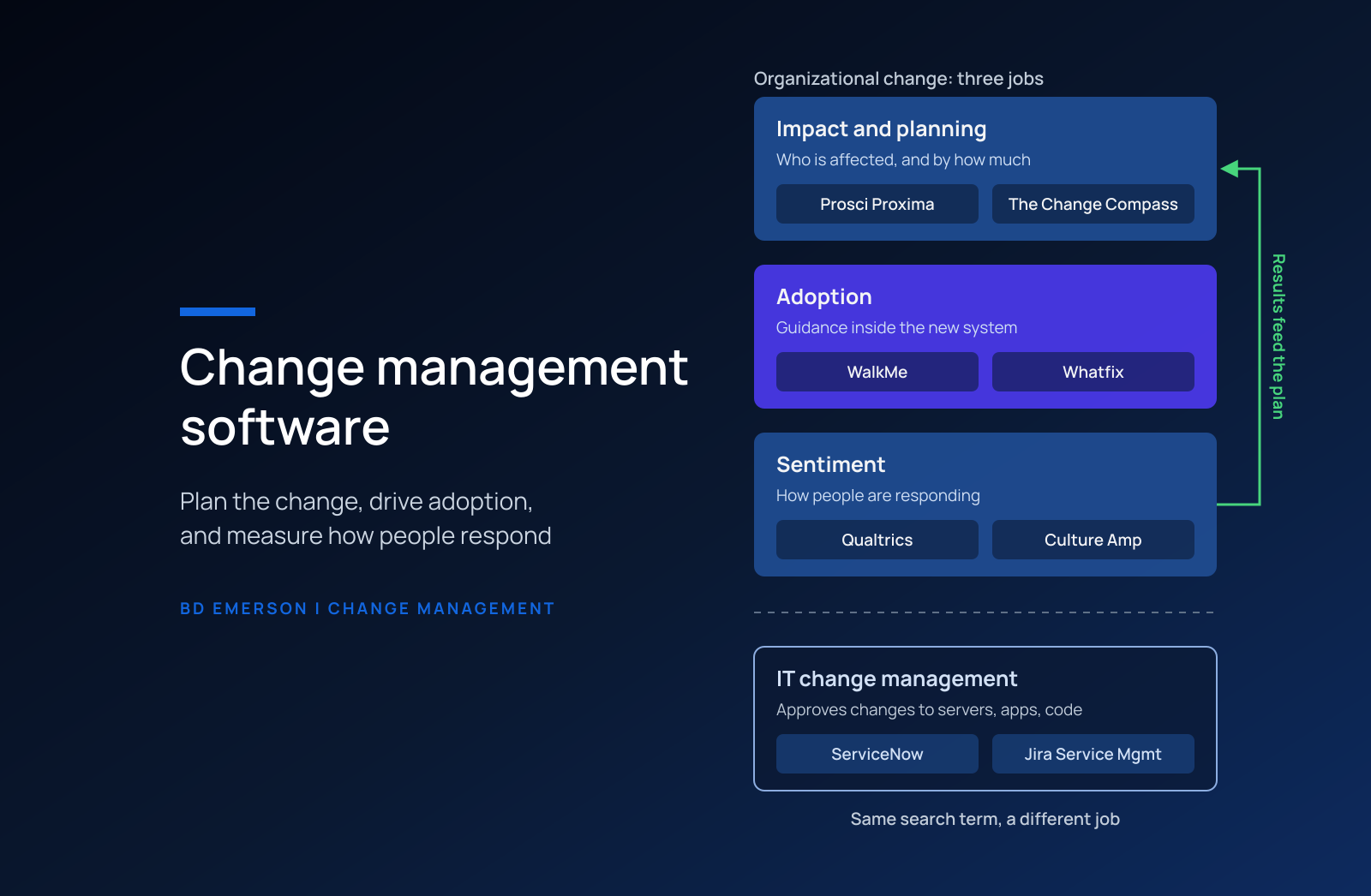
Change management software helps a change team plan, deliver, and measure the people side of a change, such as a new ERP system, a reorganization, or an AI rollout. The products sort into three jobs. Impact assessment and planning tools, such as Prosci Proxima and The Change Compass, record who is affected and by how much. Digital adoption platforms, such as WalkMe and Whatfix, guide employees inside the software they are learning and report who is using it. Survey tools, such as Qualtrics and Culture Amp, measure how people are responding during the change. The term also covers IT change management software, such as ServiceNow and Jira Service Management, which approves changes to servers, applications, and code.
This guide describes each product using what its vendor states on its own site as of November 22, 2026. We do not score or rank the tools, because the right set depends on what is changing, how many people it touches, and what your organization already licenses.
What is change management software?
Change management software supports work a change lead already does by hand: assess the impact, plan sponsor and communication activity, train and support people through go-live, and measure adoption. Many teams run that work in spreadsheets, slide decks, and a general survey tool, and that holds up for a single project with a few hundred affected employees. Dedicated software starts to pay for itself when the organization runs several changes at once, when leaders want adoption data in place of anecdotes, or when the change is a software rollout where usage can be measured directly.
Planning tools differ in how much method they build in. Prosci Proxima follows the Prosci 3-Phase Process and the ADKAR model, while configurable products let you define your own phases and templates. Settle on a method before you buy, because a tool that encodes one imposes it on every project. Our comparison of change management models covers Lewin, Kotter, ADKAR, Bridges, and the other frameworks these products are built around.
The three jobs change management tools do
A digital adoption platform and a survey tool answer different questions, so sort the shortlist by job before you compare products.
| Job | What the tool produces | Examples |
|---|---|---|
| Impact assessment and planning | Impact by role and team, readiness baselines, change plans, and a view of how much change each group is absorbing | Prosci Proxima, The Change Compass |
| Adoption | In-app guidance, practice environments, and usage data for the system being rolled out | WalkMe, Whatfix |
| Sentiment measurement | Scheduled pulse surveys, comment analysis, and manager-level reports on how people are responding | Qualtrics, Culture Amp |
Plan to buy at most one tool per job and fill the rest with what the organization already owns. A company that licenses Qualtrics for its annual engagement survey can run the change pulse from the same account and send it only to the affected groups.
Impact assessment and planning tools
Planning tools hold the change team's working record: who is affected, how far their work changes, how ready they are, and what the plan does about it. Prosci Proxima is a web application that walks a practitioner through the phases, stages, and activities of the Prosci 3-Phase Process: prepare approach, manage change, and sustain outcomes. In the first phase it guides an initial PCT Assessment that baselines the health of the project. In the second it supports formal plans that move individuals through the ADKAR transitions, and in the third it reviews PCT scores and ADKAR outcomes. Prosci states that Proxima is included in Prosci Membership, supports multiple languages, and exports data to other applications. It fits organizations that have trained their practitioners in the Prosci method and want every project documented the same way.
The Change Compass works one level up, across the portfolio. It calls itself a change intelligence platform, and its homepage says it shows the cumulative change impact on each team across all of its projects. For example, a business unit receiving four initiatives in the same quarter appears as one combined load, so the conflict is visible before anyone commits a go-live date. Short pulse surveys and one-tap leader ratings feed readiness and adoption scores into its dashboards, and the platform flags initiatives that are trending to miss adoption before go-live. That portfolio view matters most to a central change office or transformation office that sequences many projects, and it adds little for a team running one.
Whatever tool you choose, the impact assessment is the input everything else depends on. Our guide to the change impact assessment lays out the method, which rates each impact for each stakeholder group, usually at the level of job role. For a single project, a spreadsheet built on that method does the job.
Adoption tools: digital adoption platforms
A digital adoption platform, or DAP, sits on top of the business applications employees use and puts guidance inside them. When the change is a new system, such as an ERP, CRM, or HR platform, a DAP answers the question leaders ask most after go-live: are people completing the new process in the new tool?
WalkMe describes itself as an overlay on every application that provides in-app instructions and walkthroughs, carries out workflow steps such as filling forms and routing approvals, and reports on workflow performance. Its Discovery product reports which applications employees use, how many people use each one, and how often, and it identifies licenses the organization can cut or reassign. SAP completed its acquisition of WalkMe on September 12, 2024, so organizations running SAP should ask how WalkMe fits into their existing SAP agreements before they price it separately.
Whatfix organizes its product into four parts. The Digital Adoption Platform provides Flows, Smart Tips, Pop-Ups, and Task Lists inside the application, plus Self Help for in-app support. Mirror clones an application into a simulation environment so people can practice before go-live without touching production data. Product Analytics captures product and workflow events automatically and includes session replay. Whatfix AI generates in-app guidance from plain-text prompts.
Two cautions apply to every DAP. Guidance content needs maintenance each time the underlying application changes its screens. Whatfix includes content lifecycle management with approvals, QA, version control, and rollback for that work, and whichever DAP you choose needs a named owner for the upkeep after go-live. Usage analytics and session replay also record how individual employees work, so bring HR, privacy, and any employee representatives into the configuration before launch, and decide in advance whether managers see individual or aggregate data.
Sentiment measurement: survey tools
Survey tools tell you how people are responding while there is still time to adjust the plan. Qualtrics states that its pulse survey software sends surveys on automated weekly, biweekly, or monthly cadences, rotates question sets to limit survey fatigue, delivers role-based dashboards to executives, HR business partners, and people managers, tracks action plans, and offers configurable anonymity thresholds. Culture Amp offers pulse surveys whose reports place results against built-in benchmarks, and it lists ready-to-use surveys, action plans, and AI comment summaries among its engagement features.
The survey design matters more than the vendor. A change pulse works when it asks a short set of questions tied to the stages of the change, goes only to the affected groups, runs on a fixed schedule from announcement through stabilization, and reports at a level small enough for a manager to act on and large enough to protect anonymity. Each round of results should shape the next round of messages, so the survey schedule belongs inside the change management communication plan, owned by the change lead.
What are IT change management tools?
IT change management tools control changes to technology: servers, network devices, applications, and code. They make sure a change is reviewed, approved, scheduled, and recorded before it reaches production, and they produce the change records that auditors sample when they test SOX IT general controls or NIST SP 800-53 control CM-3, Configuration Change Control. Organizational change teams rarely work in these systems, though the two meet on a large system rollout, where the IT change ticket and the people-side go-live plan share a date.
ServiceNow Change Management supports the three change types ITIL describes. A standard change is pre-authorized, low risk, and frequently implemented with repeatable steps, so it skips group, peer, and change advisory board (CAB) approval. A normal change is any change that is neither standard nor emergency, and it needs an assessment, peer or technical approval, and CAB authorization before implementation. An emergency change must be implemented as soon as possible, for example to resolve a major incident or apply a security patch, so it skips group and peer review and goes straight to CAB approval. Jira Service Management classifies standard and normal changes, keeps a shared change calendar, and creates change records automatically from deployments in tools such as Bitbucket Pipelines, Jenkins, CircleCI, and Octopus Deploy, and it enforces approval gates on those deployments.
The search term picks up three more meanings, each with its own category of software.
| Meaning | What changes | Example |
|---|---|---|
| Regulatory change management | Laws, rules, and guidance, routed to owners who decide applicability and update policies and controls | ServiceNow Regulatory Change Management, fed by providers such as Thomson Reuters or LexisNexis |
| Engineering change management | Parts, drawings, and bills of materials, tracked through change records in a product lifecycle management system | Siemens Teamcenter |
| Network change management | Router, switch, and firewall configurations, backed up and approved before upload | SolarWinds Network Configuration Manager |
The phrase enterprise change management software covers both main meanings: portfolio tools such as The Change Compass on the people side, and enterprise service management platforms such as ServiceNow on the technology side.
How do you choose change management software?
Start from the measurement plan and work back to the tools. These six questions narrow most shortlists to one product per job, or to none.
- What will you measure, and where does that data live today? If adoption means system usage, a DAP or the application's own reports supply it, and if it means readiness and sentiment, a survey tool does.
- How many changes hit the same people at once? One project rarely justifies a portfolio tool, while a transformation office sequencing dozens of initiatives usually needs one.
- What does the organization already license? Many enterprises already hold Qualtrics, Culture Amp, Microsoft Forms, or ServiceNow seats that cover part of the need.
- Which method will the tool enforce? Prosci Proxima follows the Prosci method, and a configurable tool needs someone to build your phases and templates.
- Who will maintain it? DAP guidance, survey schedules, and impact records each need a named owner after the project team disbands.
- What employee data will it collect? Usage analytics and survey comments are personal data, so privacy and HR should review the configuration before launch.
Sponsors who explain the reason for a change and managers who coach their teams through it carry adoption. The software shows whether that work is reaching people, and where it is not.
BD Emerson, part of Andersen Consulting since October 2026, runs the people side of system implementations, reorganizations, and AI rollouts through its change management consulting practice, where organizational psychologists from Daniels Consulting Group lead the work. We assess readiness and impact, map sponsors, design communication and training, and set up the measurement: readiness scores by team, pulse surveys against a pre-launch baseline, and adoption dashboards. When the adoption trend holds, we transfer the playbook to your PMO or transformation office, and you keep the scores and dashboards.

About the author
















