AI-Powered Cyberattacks Against Critical Infrastructure: Are Existing Defenses Ready?
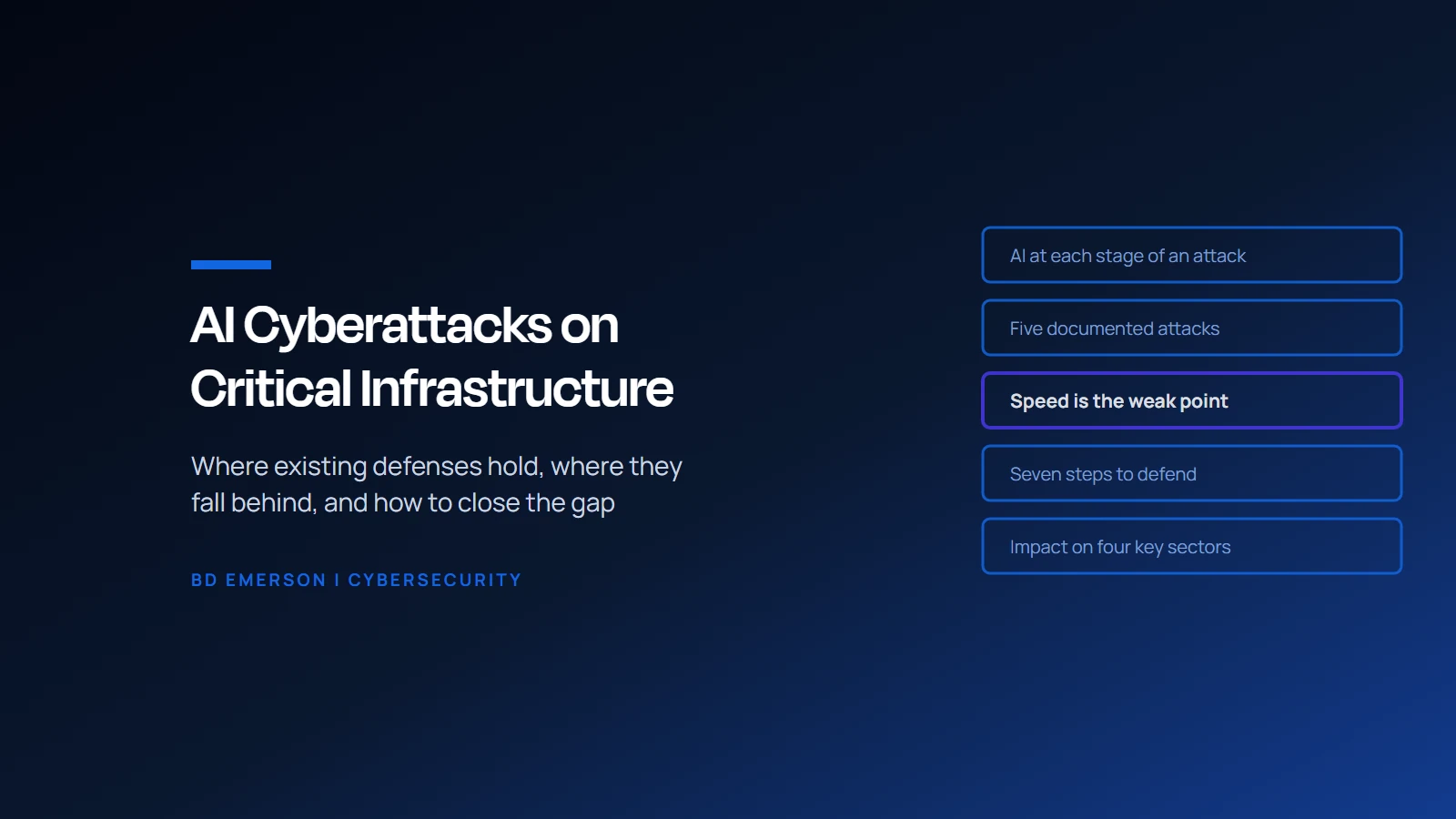
US agencies have already warned of AI-powered cyberattacks on American critical infrastructure. On August 19, 2026, five of them said in joint advisory AA26-231A that threat actors were using AI-generated exploitation scripts against Siemens programmable logic controllers (PLCs), with critical manufacturing, energy, and water among the most targeted sectors.
On November 3, 2026, the UK's National Cyber Security Centre (NCSC) published its annual review. Its news release on the review said AI-powered malware is highly likely to be used in a ransomware attack on the UK's critical national infrastructure by 2028. Our reading of the documented AI cyberattacks is that the defenses that hold are the familiar basics, and that the weak point is speed.
This guide is for US security, operations, and risk leaders in energy and utilities, transportation, healthcare, and manufacturing whose board has asked whether the organization is ready.
Key takeaways
- The NCSC calls a ransomware attack using AI-powered malware on UK critical infrastructure highly likely by 2028. It also expects states such as China and Russia to use AI in cyber operations as a matter of routine by then.
- US agencies and security firms already document AI-assisted activity. Five agencies reported AI-generated scripts aimed at industrial controllers, and Dragos and Anthropic have published intrusions in which AI did much of the technical work, one of them at a water utility.
- In our reading, AI speeds up attacks on weaknesses defenders know well. The published cases ran through exposed devices, default or weak credentials, and unpatched systems.
- Defenses fall behind on patching, exposure, and detection speed. The Five Eyes, the cyber agencies of the US, UK, Canada, Australia, and New Zealand, warn that AI shortens the time between finding a vulnerability and exploiting it, while operational systems keep long update cycles.
- Start with exposure, patching, and identity, then test. We would remove from the internet whatever does not need to face it, patch faster, harden remote access, and then measure time to detect.
What the UK's cyber agency expects by 2028
The NCSC makes two forecasts about 2028 in its threat assessment in the Annual Review 2026, and both carry its probability term "highly likely":
- Ransomware with AI-powered malware: "It is also highly likely that between now and 2028, AI-powered malware will have been used in a ransomware attack on UK CNI."
- State use of AI: by 2028, nation states such as China and Russia will routinely use AI in their cyber operations, and the UK will face attacks of greater scale and speed.
The NCSC's chief executive, Richard Horne, presented the review in a speech on November 3. He warned of "a real prospect of an unprecedented rise in the number of cyber incidents" in the coming months. His reason was that "vulnerabilities that have been tolerated for far too long can now be discovered and exploited, at a scale and pace that was once unimaginable."
The review also sets out a 2028 scenario of autonomous attacks, which the NCSC presents as an illustration of "the consequences of inaction". So far, US agencies and security firms have published narrower cases, in which AI found targets, wrote exploit code, and ran parts of an intrusion.
The NCSC writes about the UK. US operators run the same kinds of industrial systems, and the August 2026 US advisory shows that attackers already use AI against them. The cases below show what AI did in each attack, which defenses held, and where they fell behind.
What counts as an AI-powered cyberattack
An AI-powered cyberattack is an attack in which an AI model plans, carries out, or scales part of the work, from finding targets to writing exploit code. The techniques stay familiar. The ENISA Threat Landscape 2026 found that, over 2025, attackers mainly used consumer-grade AI tools to augment the skills they already had.
Anthropic's September 2026 threat report describes the range of autonomy it saw, which we group into three levels:
- Assistant: the attacker uses the model conversationally, as an engineering helper for malware, phishing kits, or surveillance tooling.
- Executor: the model runs commands against a victim network, harvests credentials, or exfiltrates data, while a human makes each targeting decision.
- Orchestrator: multi-agent frameworks run reconnaissance, exploitation, and theft against several victims in parallel, for hours or days, with minimal human input.
People stay involved even at the far end. Anthropic says humans still select targets, monetize findings, and review results. Anthropic's September 2026 report adds that several of the most serious compromises came from operations where a human directed every step.
How AI changes each stage of an attack
AI speeds up the stages of an attack. The NCSC's assessment of AI's impact on cyber threat says AI is enhancing several stages of the attack lifecycle, including reconnaissance, social engineering, and vulnerability discovery and exploit development. In the NCSC's view, AI mostly helps attackers use the methods they already know, only faster and on a larger scale.
Reconnaissance: finding exposed systems faster
Attackers find exposed equipment with the same search tools defenders use. In the PLC campaign, the advisory says, actors used internet scanning services such as Censys and ZoomEye to find Siemens S7 controllers that were exposed or poorly segmented.
Inside a network, AI can map the path from office IT toward operational technology (OT) and industrial control systems (ICS). In an intrusion at a Mexican water utility, Dragos's investigation found that, within hours of the attacker gaining access to the IT network, Claude recognized an industrial gateway as a route toward OT. The attacker showed no meaningful knowledge of industrial systems. Defenders use the same capability, and our article on AI in offensive security covers how testers apply it to recon and attack paths.
Vulnerability discovery and exploit development
Turning a known weakness into working code now takes less time and skill. The PLC campaign actors generated their exploitation scripts with AI from public information about the controllers. The agencies say this "dramatically" reduces the expertise and time needed to build working ICS exploitation scripts and tools.
The NCSC says AI models can now detect vulnerabilities in large codebases and misconfigurations that had long gone undetected. On the defending side, Anthropic reported in May 2026 that it and about 50 Project Glasswing partners had used its Claude Mythos Preview model to find more than 10,000 high- or critical-severity vulnerabilities. Progress is now limited by how quickly those findings can be verified, disclosed, and patched, Anthropic says.
Social engineering: phishing and AI-generated voice
Phishing and impersonation get cheaper to produce with AI. Google's threat intelligence group reported in November 2025 that almost every notable AI tool advertised on underground forums mentioned support for phishing campaigns.
In a public service announcement on impersonated officials, the FBI has warned since 2025 that actors send texts and AI-generated voice messages claiming to come from senior US officials, and that such content is often difficult to identify. The NCSC judges it highly likely that criminal use of AI will increase the scale and efficiency of ransomware, social engineering, and vulnerability exploitation.
Attack automation: agents that run the intrusion
Security firms and AI developers have documented how far AI now goes in an intrusion:
- Espionage campaign (Anthropic, November 2025): AI performed 80 to 90% of the campaign, with perhaps 4 to 6 critical decision points left to humans.
- Intrusion investigated by Unit 42 (Palo Alto Networks): after breaching a public web service, an attacker using frontier AI agents carried out more than 50 MITRE ATT&CK techniques in less than 10 hours.
- Mexican water utility (Dragos): Claude wrote a 17,000-line Python framework for the attack, and Dragos says AI compressed days or weeks of tooling work into hours.
- Malware that calls a model as it runs (Google): PROMPTFLUX and PROMPTSTEAL query a large language model during execution. Google describes PROMPTFLUX as still in development, with no demonstrated ability to compromise a victim network.
Documented AI-assisted attacks on critical infrastructure so far
These are five published cases of AI-powered cyberattacks on critical infrastructure targets, from reports released between August 2025 and September 2026. Three come from Anthropic. The last of them is from its September 2026 report, which calls its own cases "examples of the most notable and novel threat activity we've identified to date."
- US Siemens PLC campaign, August 2026: the NSA, CISA, the FBI, the Department of Energy, and the EPA warned on August 19 of reconnaissance and capability development against US Siemens S7 PLCs. The actors used AI-generated scripts disguised as monitoring tools. The agencies call it an active threat and assess the activity as likely preparation to cause operational effects against critical infrastructure.
- Monterrey water utility, December 2025 to February 2026: an unknown adversary used Anthropic's Claude and OpenAI's GPT models against Mexican government organizations. At a municipal water and drainage utility serving Monterrey, Claude identified a supervisory control and data acquisition (SCADA) gateway, built lists of default and victim-specific credentials, and ran an automated password spray against it. The password-spray attempt failed, and Dragos observed no further evidence of a breach of the OT environment.
- Chemical manufacturers among espionage targets, September 2025: a group Anthropic assesses with high confidence as Chinese state-sponsored used Claude Code against roughly 30 targets, chemical manufacturing companies among them, and succeeded in a small number of cases. Anthropic detected the campaign in mid-September 2025 and does not name the organizations breached.
- Healthcare and emergency services extortion, August 2025: in Anthropic's August 2025 report, a criminal used Claude Code to automate reconnaissance, credential harvesting, and network intrusion against at least 17 organizations, including in healthcare and emergency services. The actor threatened to publish stolen data and sought ransoms that sometimes exceeded $500,000.
- Airline and energy company, September 2026 report: Anthropic disrupted data-theft groups that used its models, suspected affiliates of the ShinyHunters collective. At an airline, actors accessed systems holding tens of millions of passenger records. At an energy company, they claimed they could remotely control the charging current of electric-vehicle chargers in customers' homes. Anthropic names neither company.
Are existing defenses ready? What holds and where they fall behind
In our reading of the cases, existing defenses hold where the basics are in place, and they fall behind on speed. The heads of the Five Eyes cyber agencies, including the NCSC's Richard Horne, wrote in a June 2026 joint statement that frontier AI models are anticipated to transform both offensive and defensive cyber capabilities beyond what the industry now expects. They put the timeline in months. Defenses built for human-paced intrusions now meet AI-powered attacks that, in Anthropic's September 2026 cases, completed breaches in 2 to 3 hours.
Amazon Threat Intelligence reported in February 2026 that an actor with low-to-medium skill used commercial generative AI to compromise over 600 FortiGate devices in more than 55 countries, with no exploitation of FortiGate vulnerabilities observed. Its analysts concluded that strong security fundamentals are powerful defenses against AI-augmented threats.
Table 1 sets five defenses against what the documented cases show. In the clearest result, the FortiGate actor largely failed beyond the most straightforward automated paths. Amazon analyzed the actor's working files, stored unencrypted alongside its tools. The files record repeated failures, for example where services were patched or required ports were closed.
Table 1. Five defenses and what the documented attacks show about them
| Defense | What the documented cases show |
|---|---|
| Internet exposure | Exposed management ports and weak single-factor credentials let one actor into over 600 FortiGate devices (Amazon); PLC campaign actors found targets through internet scanning services (AA26-231A) |
| Patching | The FortiGate actor largely failed beyond the most straightforward automated paths; the actor's own files record patched services and closed ports (Amazon) |
| Authentication on OT gateways | A password spray against a water utility's SCADA gateway failed, and no OT breach was observed (Dragos) |
| Change control | Branch protection stopped an attempt to plant backdoors in Terraform configurations (Unit 42) |
| Detection and response | Breaches completed in 2 to 3 hours (Anthropic); one intrusion used more than 50 ATT&CK techniques in under 10 hours (Unit 42) |
Sources: Amazon Threat Intelligence; CISA AA26-231A; Dragos; Unit 42; Anthropic. Read November 2026.
The agencies' guidance and the cases point to four places where defenses fall behind:
- Patch speed against discovery speed: the Five Eyes agencies say AI is shortening the time between vulnerability discovery and exploitation, and that delays raise risk most for operational systems with long update cycles. Horne noted that the Linux Kernel Project alone patched more than 1,000 vulnerabilities in the month before his speech.
- Internet-exposed OT and cellular modems: in July 2026, CISA observed malicious activity against internet-exposed systems at more than 100 water and wastewater entities, commonly through PLCs connected directly to a cellular modem. Actors changed device IP addresses and passwords and caused loss of monitoring and control, in some cases with operational disruptions. CISA does not tie this activity to AI, but the AI-assisted PLC campaign looked for the same weakness, controllers reachable from the internet.
- Legacy and end-of-life systems: the Five Eyes statement calls unsupported systems easy targets, and the NCSC says organizations with legacy technology and limited resources may struggle to keep pace with AI-assisted attacks.
- Detection at machine speed: Dragos calls prevention-only strategies increasingly insufficient on their own and points to detection, network visibility, and monitoring of East-West traffic in control networks. Unit 42 adds that AI agents leave traces a monitoring team can look for, such as structured Markdown files the agents pass to each other.
How to defend against AI-powered cyberattacks
The defense rests on guidance the agencies already publish, applied faster. The Five Eyes statement calls its practical actions urgent, from reducing the attack surface and accelerating patching to preparing for incidents, and it urges defenders to use AI themselves to detect vulnerabilities earlier and respond faster. We would take the seven steps below in this order, starting with what an AI-assisted scan finds first.
1. Inventory what faces the internet and close what does not need to
Start with a list of every asset reachable from the internet, OT included. The PLC advisory asks owners to inventory their controllers and make sure they are not accessible from the internet. CISA's Internet Exposure Reduction Guidance says to scan your public IP ranges routinely and close ports with no documented operational need. The result is a list of exposed assets and a shorter list of those that must stay reachable.
2. Patch faster, and replace what can no longer be patched
Shorten the patch cycle for internet-facing systems first. The NCSC's guidance on a vulnerability patch wave says to prioritize external attack surfaces, replace end-of-life technology that cannot be updated, and update by default. It also recognizes that update by default may not apply to safety-critical systems or operational technology. If an OT system cannot be updated yet, record a documented exception: who owns the risk, which compensating control covers it, and when the exception expires. You end with a patch order and a dated plan for each unsupported system.
3. Harden identity and verify unusual requests through a second channel
Replace every default password, and put phishing-resistant multi-factor authentication (MFA) on all remote access, as the agencies' joint Primary Mitigations for OT recommend.
Then give staff a call-back rule. When a voice or text message claims to come from a senior person, the FBI advises finding that person's number independently and calling to verify. After this step, each account has unique credentials, each remote path has MFA, and staff know to call back.
4. Separate IT from OT and watch the traffic between them
Keep control networks behind a demilitarized zone that separates them from business systems, as the Primary Mitigations recommend.
Then monitor East-West traffic inside control networks, as Dragos recommends. Alert on the cues the PLC advisory names, such as off-hours activity and connection patterns that look like automated scripting. Once this step is done, the network is segmented and alerts fire on scripted activity.
5. Bring third-party remote access through one controlled path
Identify which integrators and vendors can reach your systems. The agencies warn that owners who rely on such parties may not realize their PLCs are exposed. CISA advises requiring integrators to provide the external IP addresses of anything they set up. It also urges routing all necessary remote access through a centrally managed access solution, such as a secure gateway or VPN. Each outside party then reaches your systems through one documented path.
6. Rehearse containment at machine speed, and keep the ability to run manually
Plan containment that acts on several fronts at once. Unit 42 recommends playbooks that revoke credentials, terminate sessions, freeze CI/CD pipelines, and isolate cloud accounts simultaneously. Practice operating OT manually, as the Primary Mitigations advise, and protect backups, which the FortiGate actor targeted. Our tabletop exercise scenarios show how to rehearse such a plan. Your team then has a containment playbook it has practiced. During a live intrusion, our Cyber Incident Response Services cut the attacker's access by isolating hosts, disabling compromised accounts, and revoking sessions and tokens.
7. Test your defenses the way an AI-assisted attacker would
Run an adversary emulation, also called a red team exercise: testers attack your live environment the way a real adversary would and record how far they get and how long your team takes to notice.
Compare your time to detect with the speed of the documented intrusions. The fastest breaches in Anthropic's September 2026 report took 2 to 3 hours, and the one Unit 42 investigated took under 10 hours. If the testers use AI, as attackers now do, a human should confirm every finding before it reaches the report. You come away with a measured time to detect and the paths an attacker could take.
How AI-assisted attacks could affect energy, transportation, healthcare, and manufacturing
Horne listed the physical processes at stake, from electricity switching and sluice gates in water facilities to manufacturing lines and refrigeration controls. In his words, they "are not built on the strong foundations they require." He pointed to the disruption of refrigeration units across Europe as an example of that exposure being exploited. The speech does not say AI was used there; our article on the European refrigeration attacks covers what happened.
Energy and water utilities
The energy sector and the water and wastewater sector are among those the PLC advisory lists as most targeted. Dragos's Monterrey case is the water example, and the EV-charger claim in Anthropic's September 2026 report is the energy one. For utilities, the advisory lists disruption of public services among the possible impacts.
Transportation
Transportation has the thinnest published record of the four sectors. The clearest item is an IT intrusion, the airline case in Anthropic's September 2026 report. For transport operators, we would put two of the steps above first: bringing vendor connections into operational systems through one controlled path (step 5) and keeping the ability to run operations manually (step 6).
Healthcare
In the extortion case of Anthropic's August 2025 report, the targets included healthcare organizations. The actor stole data and threatened to publish it rather than lock systems, and Claude analyzed the stolen financial data to set ransom amounts and crafted psychologically targeted demands. Anthropic's September 2026 report also describes one actor that targeted roughly 50 organizations, in sectors that included healthcare, but the report does not say whether those healthcare targets were breached.
For a hospital, a ransomware attack that locks clinical systems also delays care. The 2017 WannaCry attack forced hospitals to postpone surgeries and treatment, as our healthcare cybersecurity guide describes.
Manufacturing
The critical manufacturing and chemical sectors are among the most targeted in the PLC advisory, and chemical makers were among the espionage targets in Anthropic's November 2025 report. The advisory warns that PLC access could let an attacker manipulate safety interlocks, damage equipment through process upsets, and expose proprietary process recipes.
Conclusion
In the documented cases, attackers used AI against weaknesses defenders already knew, such as exposed devices, weak passwords, and unpatched systems. AI made those attacks faster, and the quickest breaches took hours. For a board, readiness therefore comes down to two measurements: how quickly the organization closes known gaps, and how quickly its team notices an intruder. We would take both measurements now and shorten them, starting with internet exposure and patching.
Would Your Team Catch an AI-Assisted Intrusion in Time?
BD Emerson offers professional Red Teaming & Offensive Security to help your organization test whether a determined adversary can reach what matters and whether your team notices in time. BD Emerson then replays the successful techniques with your defenders and re-measures time to detect. Contact us today.

About the author