AI Change Management: Why AI Adoption Is Harder Than a System Swap
AI change management is the work of getting people to use AI tools well in their daily jobs. It covers four things: deciding which tasks AI should support, building trust that matches what the tools can do, redesigning roles around the new division of work, and measuring whether the work improves. It is harder than a system replacement for a specific reason. A new ERP or CRM system changes where people perform a defined task, and an AI tool changes how they exercise judgment. Use is optional at each task, output quality varies from one task to the next, and every employee has to decide when to rely on the tool.
What is AI change management?
AI change management applies the discipline of change management to the adoption of AI assistants, copilots, and agents. The familiar parts still apply: a sponsor who is visible, managers who can answer questions, training, and measures of adoption. The parts that differ come from the nature of the technology. Employees choose whether to use an AI tool dozens of times a day, and each choice depends on whether they understand what the tool does well and whether they trust it to the right degree.
The goal is a workforce that uses AI where it helps, checks it where it can fail, and knows which is which. License counts and login rates say little about whether an organization has reached that goal.
Why is adopting AI harder than a system swap?
A system replacement has a cutover date. After that date the old system is gone, the new one is mandatory, and the same input produces the same output for every user. AI tools differ on each of those points, as the table shows.
| Dimension | System replacement | AI tool adoption |
|---|---|---|
| Use | Mandatory after cutover | Optional at every task |
| Output | The same result for the same input | Quality varies by task and by prompt |
| What people learn | Steps and screens | When to rely on the tool and how to check it |
| Effect on roles | Tasks stay with the same roles | Tasks move between people and the tool |
| Proof of adoption | Transactions run in the new system | Better work on the tasks the tool supports |
Three of these differences deserve a closer look, because each one changes what the change program has to do.
AI changes judgment work
The clearest evidence comes from a Harvard Business School field experiment, Navigating the Jagged Technological Frontier, which studied 758 knowledge workers at a global consulting firm. On tasks inside the capability of the AI tool, the participants who used AI completed 12.2 percent more tasks and finished them 25.1 percent more quickly, with significantly higher quality. On a task chosen to fall outside the tool's capability, the participants who used AI were less likely to produce a correct solution than those who worked without it.
The authors call the boundary between those two kinds of task the jagged technological frontier, because tasks of similar difficulty fall on different sides of it. Nothing on the screen tells an employee which side a task is on. A change program therefore has to teach judgment: which tasks in a given role sit safely inside the frontier, which sit outside, and how to verify output in between. Feature training cannot do that, because the answer depends on the role and the task.
Trust has to be calibrated
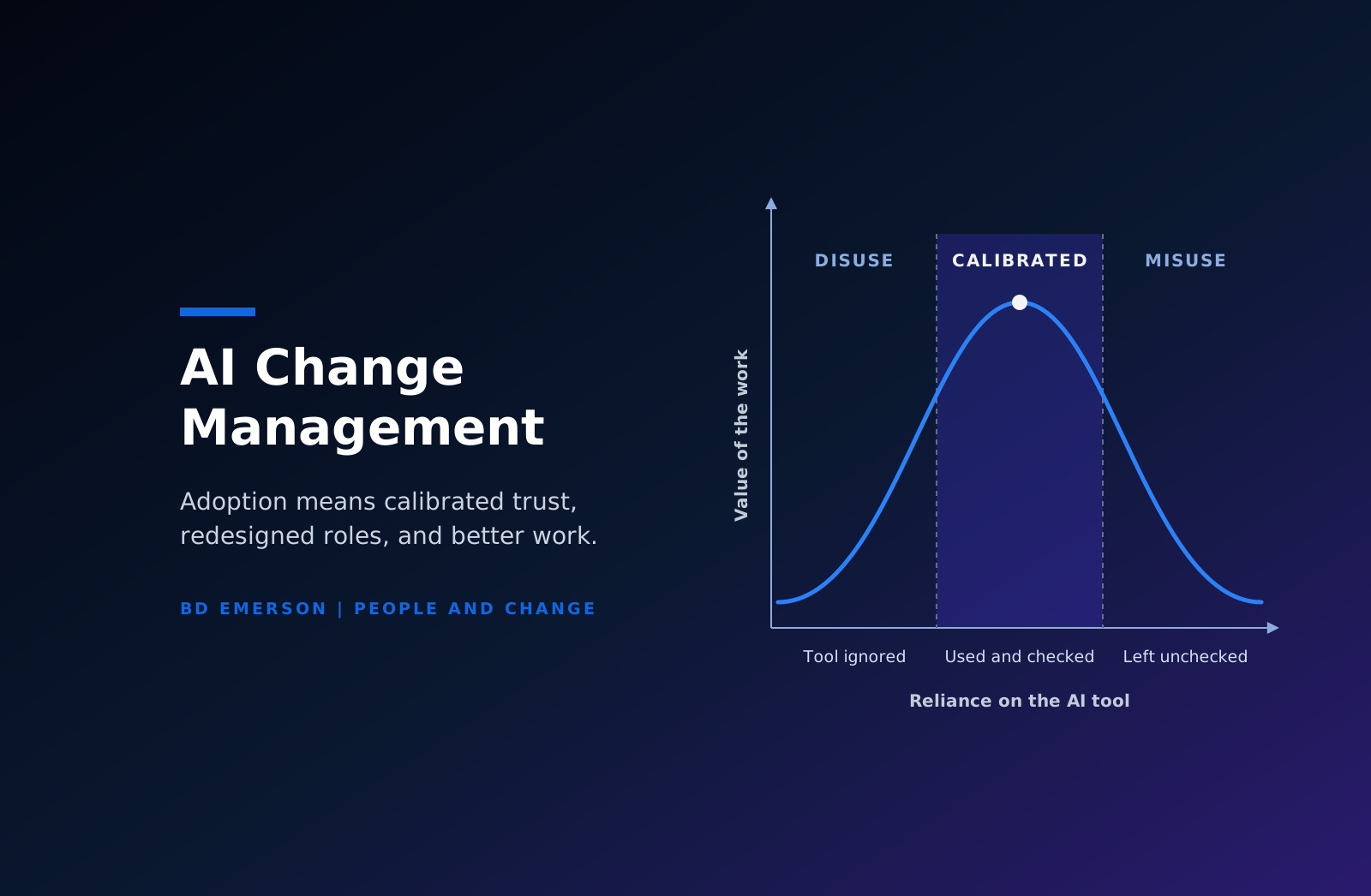
Research on automation described the trust problem decades before generative AI. In Humans and Automation: Use, Misuse, Disuse, Abuse, published in the journal Human Factors in 1997, Raja Parasuraman and Victor Riley defined misuse as over reliance on automation, which can result in failures of monitoring or decision biases. They defined disuse as the neglect or underuse of automation.
Both failure modes appear in AI rollouts. Misuse is the analyst who pastes a generated summary into a client report without reading the source. Disuse is the engineer who saw one wrong answer in the first week and has not opened the tool since. Mandates and enthusiasm campaigns push people toward misuse, and unaddressed errors push them toward disuse. The change program aims for calibrated trust, which means people rely on the tool to the degree its performance on that task warrants.
Roles have to be redesigned
Parasuraman and Riley also defined a third failure, abuse: automating functions without due regard for the consequences for human performance, which tends to define the operator's role as a by-product of the automation. That pattern is common with AI. A team receives a tool, the tool takes over drafting or first-pass analysis, and nobody decides what the people do with the time, who reviews the output, or who is accountable when the output is wrong.
The NIST AI Risk Management Framework treats this as a governance requirement. It calls for policies and procedures that define and differentiate roles and responsibilities for human-AI configurations, and for AI risk management training that enables personnel and partners to perform their duties. Role redesign answers practical questions. Which activities stay with a person? Which does a person do with AI assistance? Which run with little human involvement, and who checks them? Our Andersen Consulting colleagues at SPR run AI workforce transformation programs that sort each activity into human-led, AI-assisted, or agent-enabled work and clarify ownership and decision rights for the result.
What must leaders decide?
Employees cannot adopt a tool well while the basic rules are unsettled. Leaders need to make six decisions and communicate them before a broad rollout:
- Which work. Name the approved uses for each role, starting with tasks where the tool performs reliably and the gain is easy to see.
- What stays human. Name the decisions and outputs that require human review, and state that the person who signs the work remains accountable for it.
- Which rules apply. State which tools are approved and which data employees may enter into them.
- How roles change. Update job expectations, review steps, and handoffs for the roles the tool affects most.
- What happens to the time saved. Say whether the organization will use the capacity for growth, for higher-value work, for cost reduction, or for a combination.
- How success is measured. Set the adoption and outcome measures before the rollout and record a baseline.
The fifth decision is the one employees care about most and the one leaders most often leave unstated. People who suspect that efficiency gains will cost them their jobs have a reason to use the tool quietly or to avoid it. An honest answer, including an honest "we have not decided yet, and here is when we will," earns more adoption than silence.
How do you run AI change management?
Start with the work. Pick a small number of roles, map the tasks in each role, and classify the tasks by how well the tool handles them. This task map becomes the content of the training and the basis for role redesign. Our enterprise AI consulting team selects and builds the use cases, and the task map gives the technical build and the people plan one shared view of the work.
Train on real tasks. Employees learn calibrated trust by working through their own documents, data, and cases with the tool, and by seeing where it fails. Sessions built around a role's actual tasks teach the frontier for that role. Generic prompt training teaches the features and leaves the judgment to chance.
Equip managers first. Managers set the norms that decide daily use: whether it is acceptable to use AI on a deliverable, how much checking is expected, and whether admitting an AI error is safe. A manager who has not used the tool cannot set those norms, so manager enablement belongs ahead of the general rollout.
Use peers to spread practice. In every team, a few people find effective uses early. Give them time to show colleagues what works, and collect their examples into a library organized by role. Peer examples are specific to the work, which makes them more persuasive than central communications.
Build a feedback loop. Employees need a simple way to report wrong outputs, risky uses, and tasks where the tool does not help. Each report improves the task map and the training, and it tells employees that leaders want accurate information about the tool.
How is AI adoption measured?
AI adoption needs four layers of measurement, because each layer can look healthy while the next one fails.
The first layer is access: the number of licenses assigned and the share of licensed employees who are active in a given week. Access shows whether the rollout reached people. The second layer is depth of use: how often people use the tool, on which tasks, and how use varies by role and team. A team with full access and low use on its target tasks is showing disuse, and the cause is usually a gap in training or in manager support.
The third layer is quality of use. Review results show whether people verify output: error rates in AI-assisted work, issues caught at review, and reported incidents. A rise in unchecked errors is the signature of misuse. The fourth layer is outcomes, measured against the baseline: cycle time, quality, rework, customer measures, and employee experience on the tasks the tool supports. Where possible, compare teams that have the tool with similar teams that do not yet have it.
Self-reported time savings are estimates. Pair them with measured cycle times before reporting a productivity gain to the board.
Where do AI rollouts stall?
Rollouts stall in predictable places. The organization buys licenses before it names the tasks the tool should support. Training covers features and skips the judgment that each role requires. Leaders say nothing about what happens to jobs and time. Managers hear about the rollout at the same moment as their teams. The dashboard counts logins, so nobody sees misuse or disuse until an error reaches a customer. Each of these is a change management gap, and the technology works as designed in every one of them. Our article on why AI pilots stall covers the technical and governance causes that sit alongside these.
BD Emerson delivers AI change management with our Andersen Consulting colleagues at Daniels Consulting Group, a firm of organizational psychologists and experienced business professionals. To plan the people side of an AI rollout, see our change management consulting service or book a consultation.

About the author