

Operational Risk Management: Framework, Process and Tools
Operational risk management is the work of identifying, assessing, controlling and reporting the risk of loss from inadequate or failed internal processes, people and systems, or from external events. That definition comes from the Basel Committee on Banking Supervision, and it includes legal risk while excluding strategic and reputational risk. A working program has five parts: a board-approved risk appetite and tolerance statement, a risk and control self-assessment (RCSA) of every material process, key risk indicators (KRIs) tracked against thresholds, a loss event database that records what went wrong and what it cost, and scenario analysis for severe events that have not happened yet. Banks follow the Basel Committee's 12 principles, last revised on March 31, 2021, and companies outside banking can use the same structure.
What is operational risk management?
The Basel Committee defines operational risk in paragraph OPE10.1 of the Basel Framework operational risk standard as "the risk of loss resulting from inadequate or failed internal processes, people and systems or from external events." Operational risk management keeps that risk inside limits the board has approved. A lawsuit over a mis-sold product counts as operational risk. A failed acquisition or a damaged brand falls outside it, because strategic and reputational risk are excluded.
The primary objective, which follows from Basel Principle 4, is to keep losses from people, process, system and external failures within the level the board accepts while the business keeps operating. Zero loss is the wrong target, because a bank that removed every operational risk would stop lending and processing payments.
The military meaning of ORM
The phrase also names a US military safety discipline. The Navy cancelled its ORM instruction, OPNAVINST 3500.39, upon release of OPNAVINST 3058.1. The Department of the Navy Risk Management Guide describes a five-step process (identify hazards, assess hazards, make risk decisions, implement controls, supervise and evaluate) applied at in-depth, deliberate and time critical levels, so that commanders, functional managers, supervisors and individuals can maximize capabilities while limiting risks. The rest of this article covers the financial and enterprise discipline.
Operational risk management examples by Basel event type
Paragraph OPE25.17 of the Basel Framework sorts every operational loss into seven Level 1 event types, each with Level 2 subcategories. Using one taxonomy across the risk register, the loss database and board reports lets a firm compare what it assessed against what it lost. The Level 2 names follow Basel Table 2, and the examples in the last column are our illustrations.
| Event type (Level 1) | Level 2 categories | Example |
|---|---|---|
| Internal fraud | Unauthorized activity; theft and fraud | A trader books positions above limits and hides them |
| External fraud | Theft and fraud; systems security | A business email compromise redirects a supplier payment |
| Employment practices and workplace safety | Employee relations; safe environment; diversity and discrimination | A wage and hour class action |
| Clients, products and business practices | Suitability, disclosure and fiduciary; improper business or market practices; product flaws; selection, sponsorship and exposure; advisory activities | Selling a complex product to retail customers it does not suit |
| Damage to physical assets | Disasters and other events | A flood takes a data center offline |
| Business disruption and system failures | Systems | A failed software release stops payment processing |
| Execution, delivery and process management | Transaction capture, execution and maintenance; monitoring and reporting; customer intake and documentation; customer or client account management; trade counterparties; vendors and suppliers | A keying error sends a wire to the wrong account |
Two boundaries need a written rule. Basel places hacking damage and theft of information with a monetary loss under external fraud, Level 2 "systems security," and places hardware, software, telecommunications and utility failures under business disruption and system failures. A vendor that fails to deliver falls under execution, delivery and process management, which is why third-party risk management belongs inside the same program.
What does an operational risk management framework include?
The Basel Committee's Principles for the Sound Management of Operational Risk, revised on March 31, 2021, are the reference framework. The revision aligned them with the finalized Basel III operational risk capital standard and updated the guidance on change management and information and communication technology (ICT).
Principles 1 and 2 set the foundation: the board leads a strong risk management culture, and the bank integrates the framework into its overall risk management. Principles 3 to 5 cover governance. The board approves and periodically reviews the framework, the board approves a risk appetite and tolerance statement for operational risk, and senior management builds the governance structure that carries it out. Footnote 16 defines tolerance as the variation around the appetite that the bank is willing to accept, and paragraph 26 asks for a statement that is forward-looking and, where applicable, tested through scenario and stress analysis.
Principles 6 to 9 cover the daily work: identifying and assessing risk in every material product, activity, process and system, a change management process for anything new, regular monitoring and reporting, and a strong control environment that paragraph 55 says management can complement by transferring risk through insurance. Principles 10 to 12 cover ICT risk management, business continuity plans linked to the framework, and public disclosures that let stakeholders assess the bank's approach and exposure without describing unaddressed control vulnerabilities.
The principles assign the work through three lines of defense. Business unit management owns and manages the risk in its activities. An independent corporate operational risk function sets policy, challenges the first line and monitors the risk profile. The third line gives the board independent assurance, and paragraph 12 says the bank's internal or external audit generally performs those reviews.
The operational risk management process
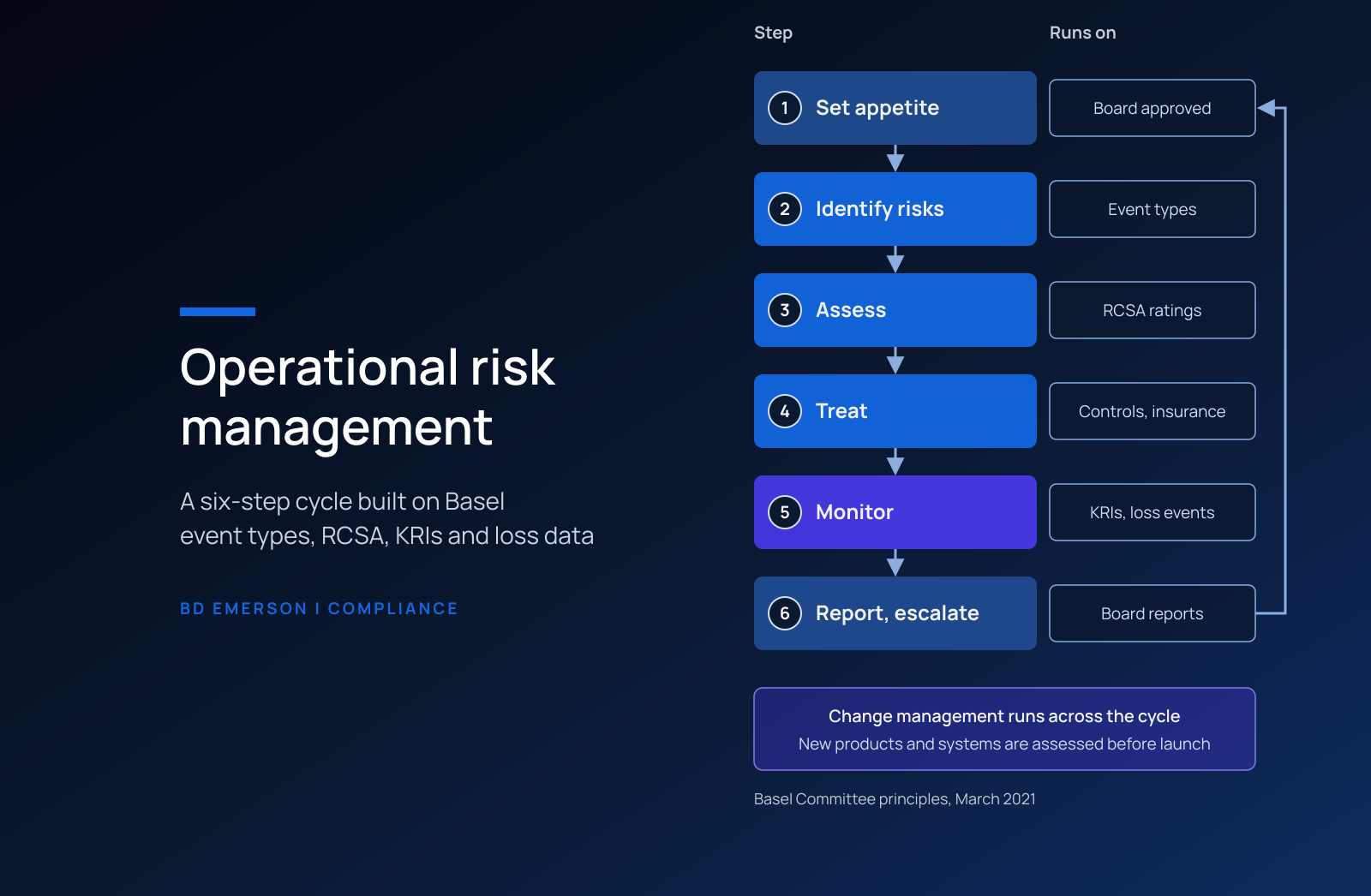
Run as a process, the principles become a repeating cycle.
- Set the appetite: the board approves how much operational loss the firm accepts, with tolerance bands.
- Identify the risks: map each material process and tag its risks with the event type taxonomy.
- Assess them: the RCSA rates inherent risk, control effectiveness and residual risk.
- Treat what sits outside appetite: fix controls, transfer risk through insurance or contracts, or formally accept it.
- Monitor exposure: track KRIs against thresholds and record every loss event and near miss.
- Report and escalate: send the risk profile, breaches and open issues to senior management and the board, and track each issue to closure.
Change management under Principle 7 cuts across every step. A new product, system migration or outsourcing decision changes the risk profile before any loss shows up, so the assessment happens before launch.
RCSA, KRIs, loss data and scenario analysis: the core tools
Paragraph 35 of the principles lists seven tools for identifying and assessing operational risk.
| Tool | Question it answers | What good practice looks like |
|---|---|---|
| Event management | What happened, and why? | Set protocols that analyze each event for new risks, root causes and control weaknesses |
| Operational risk event data | What have we lost, and where? | Material events and near misses classified by the taxonomy, plus external loss data where feasible |
| Risk and control self-assessment | Where are we exposed today? | Ratings of inherent risk, control effectiveness and residual risk, detailed enough for an independent reviewer to follow |
| Control monitoring and assurance | Do the key controls work? | Structured tests of control design and operation |
| Metrics and KRIs | Is exposure rising? | Indicators tracked against agreed thresholds, with escalation on a breach |
| Scenario analysis | What could hurt us most? | Expert workshops on low-probability, high-severity events, with independent review |
| Benchmarking and comparative analysis | Do our tools agree? | RCSA ratings compared with loss experience and with industry peers |
OPE25 requires banks to identify gross loss, non-insurance recoveries and insurance recoveries for every loss event, and to collect the dates of occurrence, discovery and accounting. Under OPE25.10, the standardized approach calculates its loss component from 10 years of loss data, and during the transition a bank without 10 years may use a minimum of five. OPE25.18 sets the collection threshold at EUR 20,000 per event, which supervisors can raise to EUR 100,000 for banks with a business indicator above EUR 1 billion. A company outside banking sets its own threshold, and a low one serves it better, because small recurring losses and near misses reveal a weak control before a large loss does.
How is operational resilience different from operational risk management?
Operational resilience is the outcome, and operational risk management is one of the ways to reach it. The Basel Committee's Principles for Operational Resilience, published the same day as the revised operational risk principles, define it as "the ability of a bank to deliver critical operations through disruption" and call it "an outcome that benefits from the effective management of operational risk." Operational risk management asks how likely a loss is and whether controls reduce it. Operational resilience tells the bank to assume disruptions will occur, identify its critical operations, set a tolerance for disruption for each under severe but plausible scenarios, and show it can stay inside that tolerance.
The resilience principles cover governance, operational risk management, business continuity planning and testing, mapping of interconnections and interdependencies, third-party dependency management, incident management, and ICT including cybersecurity. Mapping is the weak spot. A Basel Committee supervisory newsletter of November 27, 2023 reported that in most jurisdictions, bank mapping of interconnections and interdependencies does not give a sufficiently granular end-to-end view of critical operations, and it named the third-party principles among the most significant challenges for banks. A business impact analysis supplies much of the input, because it sets how long each process can be down and what it depends on, and it feeds the plans compared in our guide to business continuity versus disaster recovery.
In the US, the Federal Reserve, the FDIC and the OCC issued Sound Practices to Strengthen Operational Resilience, distributed as SR 20-24 in November 2020, for banking organizations with $250 billion or more in average total consolidated assets, or $100 billion or more with at least $75 billion in cross-jurisdictional activity, weighted short-term wholesale funding, nonbank assets or off-balance-sheet exposure. The paper does not amend, expand or alter existing regulations or guidance, and the Federal Reserve's posting shows the attachment revised on June 2, 2026 to remove references to reputational risk. In the EU, the Digital Operational Resilience Act, Regulation (EU) 2022/2554, has applied to financial entities since January 17, 2025, with binding rules on ICT risk management, incident reporting, resilience testing and ICT third-party risk.
Operational risk management software and tools
Operational risk management software holds the taxonomy, the RCSA, the KRIs, the loss database and the issue log in one system, so a loss event links to its risk, the control that failed and the action that fixes it. Spreadsheets work until the second line needs to compare RCSA ratings with loss history across business units. When you evaluate operational risk management solutions, check for a configurable risk and control taxonomy, RCSA workflows that rate inherent risk, control effectiveness and residual risk separately, KRIs that pull data automatically and alert on breaches, loss events that capture recoveries and all three dates, and issues that link back to risks and controls.
ServiceNow's Operational Risk Management product lists risk and control self-assessment, control assurance and testing, continuous monitoring against defined thresholds, and incident and loss capture. IBM OpenPages Operational Risk Management lists loss event management, RCSA, scenario analysis and issue management. Our GRC software evaluation compares the wider market. Choose the platform after the taxonomy, appetite and RCSA method are written down, because a tool configured first encodes the vendor's defaults.
BD Emerson, part of Andersen Consulting, builds risk programs through its GRC consulting team in that order, designing the program before configuring any tool. We set up the operating model with named risk owners and committee decision rights, build one risk register and one control set with owners and test frequencies, design board packs that report risk movement and remediation status, and then configure ServiceNow GRC or the platform you already run. We take no margin on any platform, so the recommendation follows your program.

About the author
















