

HIPAA Violation Examples: Real OCR Cases, Fines and Prevention
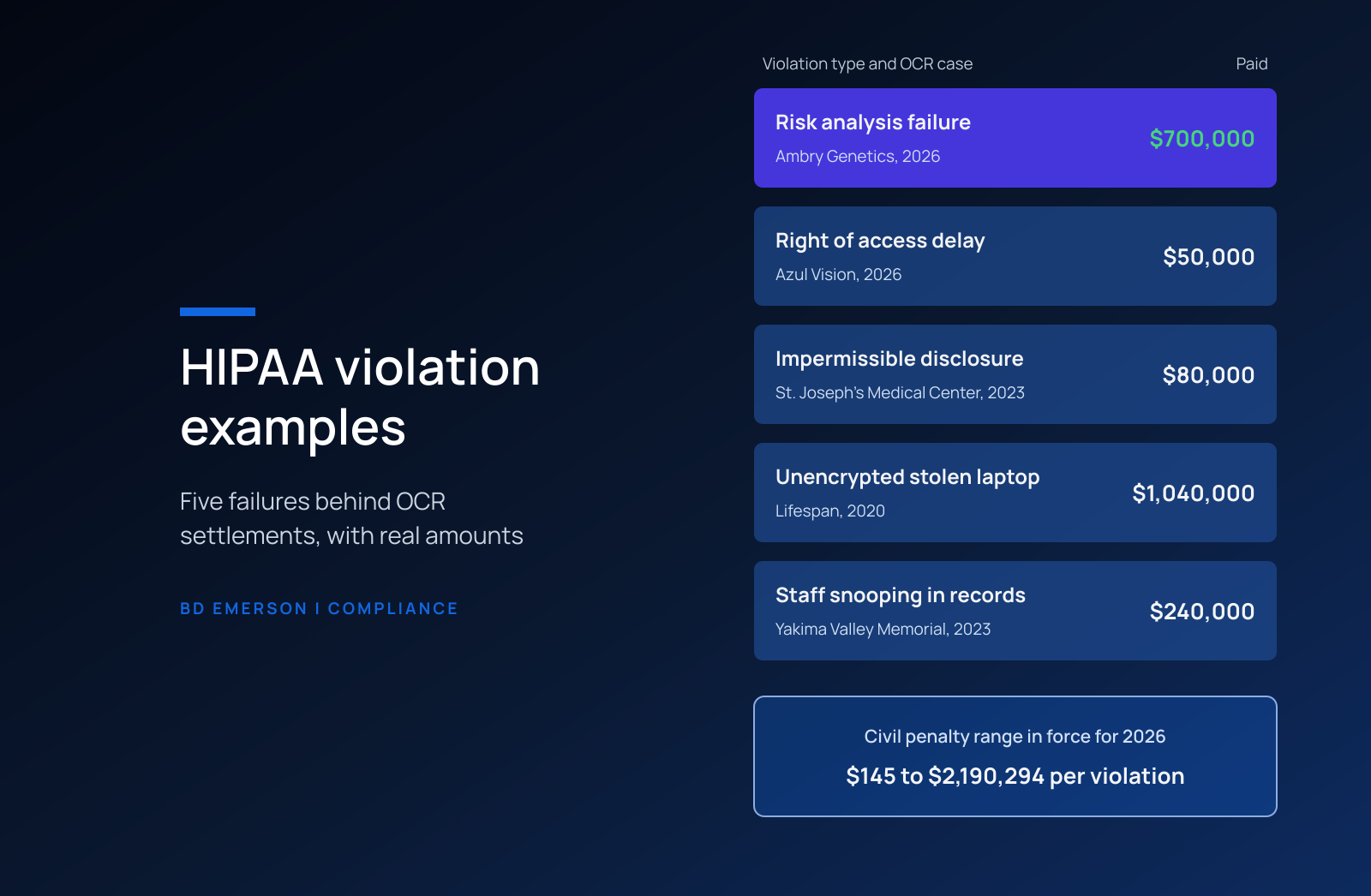
A HIPAA violation is any failure by a covered entity or business associate to meet a requirement of the HIPAA Privacy, Security or Breach Notification Rules, whether or not anyone's data is exposed. Five failures recur across the cases the HHS Office for Civil Rights (OCR) publishes: no accurate risk analysis, slow answers to patients' records requests, disclosures without permission, unencrypted devices that go missing, and staff who view records with no job reason. Ambry Genetics paid $700,000 in September 2026 after a phishing attack exposed 225,370 people, and Azul Vision paid $50,000 in August 2026 for taking 728 days to fulfill one patient's request. Civil penalties in force for 2026 run from $145 to $2,190,294 per violation.
What is considered a HIPAA violation?
HIPAA applies to covered entities, meaning health plans, health care clearinghouses and providers that conduct standard transactions electronically, and to the business associates that handle protected health information (PHI) for them. A violation is a failure to meet any requirement in the three rules. The Privacy Rule controls who may use and disclose PHI and gives patients the right to see their records. The Security Rule requires administrative, physical and technical safeguards for electronic PHI. The Breach Notification Rule sets who must be told about a breach and how fast.
A violation and a breach are different things. A breach is an impermissible use or disclosure that compromises PHI. Violations also exist with no breach at all: a practice that never documented a risk analysis is out of compliance before any complaint arrives. Business associates are directly liable too. BST & Co. CPAs, an accounting firm that receives PHI from a covered entity client, paid OCR $175,000 in August 2025 after a ransomware attack, because it had not conducted an accurate and thorough risk analysis.
HIPAA violation examples from OCR enforcement
OCR posts its settlements and civil money penalties on its resolution agreements page. The cases below come from that record, grouped by the failure OCR cited.
| Violation type | Example | Rule OCR cited |
|---|---|---|
| Risk analysis failure | Ambry Genetics, $700,000, September 2026 | 45 CFR 164.308(a)(1)(ii)(A) |
| Right of access delay | Azul Vision, $50,000, August 2026 | 45 CFR 164.524(b) |
| Impermissible disclosure | St. Joseph's Medical Center, $80,000, 2023 | 45 CFR 164.502(a) |
| Lost or stolen device | Lifespan, $1,040,000, July 2020 | Security Rule encryption and device and media controls |
| Snooping by staff | Yakima Valley Memorial Hospital, $240,000, 2023 | 45 CFR 164.316 policies and procedures |
Risk analysis failures
The risk analysis requirement at 45 CFR 164.308(a)(1)(ii)(A) appears in every hacking and ransomware case in this article. In January 2020, Ambry Genetics found that a phishing attack had compromised an employee's email account. OCR announced the $700,000 settlement on September 17, 2026 and cited three potential failures: no accurate and thorough risk analysis, no procedures for ending a workforce member's access to electronic PHI, and no unique user IDs to trace activity to a person. In October 2026, Lehigh Valley Health Network paid $800,000 after ransomware attackers took PHI of 248,359 people in February 2023 and posted data on the dark web. OCR cited failures to conduct an accurate and thorough risk analysis, to regularly review system activity, and to notify patients and HHS on time, and it called the case its 22nd ransomware enforcement action.
The fix is a risk analysis that covers every system that creates, receives, maintains or transmits electronic PHI, including email, cloud applications and backups, followed by a risk management plan that gives each risk an owner and a date. Ambry's corrective action plan requires a new risk analysis and risk management plan, unique user IDs in every system holding electronic PHI, and workforce training. Our guide to the HIPAA security risk assessment covers scope and method.
Right of access delays
Patients have a right to their records within 30 days of a request, with one 30-day extension, under 45 CFR 164.524. OCR's $200,000 penalty against Oregon Health & Science University in March 2025 was its 53rd right of access enforcement action. OHSU provided part of one patient's requested records in April 2019 and did not provide the rest until August 2021, nearly a year after OCR warned it in September 2020. Azul Vision took from January 9, 2023 to January 6, 2025 to fulfill one patient's request. Prevention is a tracked queue: log each request with the date received, send the records or a written extension notice within 30 days, and charge only a reasonable, cost-based fee.
Impermissible disclosures
Under 45 CFR 164.502(a), a covered entity may use or disclose PHI only as the Privacy Rule permits or as the patient authorizes in writing. On April 20, 2020, St. Joseph's Medical Center let an Associated Press reporter observe three patients being treated for COVID-19, with access to their clinical information and no signed authorizations, and it paid $80,000 in 2023. Manasa Health Center, a New Jersey psychiatric practice, paid $30,000 in 2023 after it disclosed four patients' PHI in replies to their negative Google reviews. Prevention is a written policy and the training to match it: no media access to patients without a signed authorization, and review replies that never confirm the reviewer is a patient.
Lost and stolen devices
Encryption is an addressable specification under 45 CFR 164.312(a)(2)(iv), which means an organization must implement it where reasonable and appropriate, or document why not and adopt an equivalent measure. Lifespan, a Rhode Island health system, had decided encryption was reasonable and appropriate and still had not encrypted its laptops when one belonging to a hospital employee was stolen. The theft exposed PHI of 20,431 people, and Lifespan paid $1,040,000 in July 2020. OCR also found a lack of device and media controls and no business associate agreement with Lifespan Corporation. The controls that prevent this are full-disk encryption on every laptop, encrypted removable media and an inventory that records where each device is. Breach notification applies only to unsecured PHI, and HHS guidance treats data encrypted to its standard as secured.
Snooping and insider misuse
Snooping is a workforce member viewing records without a job-related reason. Yakima Valley Memorial Hospital paid $240,000 in 2023 after 23 security guards in its emergency department used their own logins to view the records of 419 people. Montefiore Medical Center paid $4,750,000 in a settlement announced in February 2024 after one employee accessed 12,517 patients' records over six months in 2013 and sold some of the data to an identity theft ring. OCR cited Montefiore for failing to conduct an accurate risk analysis, regularly review system activity under 45 CFR 164.308(a)(1)(ii)(D) and implement audit controls that record and examine system activity under 164.312(b). Role-based access limits what each job can open, and audit logs reviewed on a fixed schedule catch the access those limits miss.
HIPAA violation fines and penalty tiers
Civil money penalties are set by culpability under 45 CFR 160.404 and adjusted for inflation in 45 CFR 102.3. The amounts below are the 2025 levels from HHS's January 28, 2026 inflation adjustment, which HHS kept in place when it skipped the 2026 adjustment in October 2026. Since April 2019, OCR has also applied lower annual limits to the first three tiers under a Notification of Enforcement Discretion, adjusted for inflation and in effect until further notice.
| Culpability tier | Per violation, 2025 levels in force for 2026 | Annual limit per requirement, 2019 notice before inflation |
|---|---|---|
| Did not know | $145 to $73,011 | $25,000 |
| Reasonable cause | $1,461 to $73,011 | $100,000 |
| Willful neglect, corrected within 30 days | $14,602 to $73,011 | $250,000 |
| Willful neglect, not corrected | $73,011 to $2,190,294 | $1,500,000 |
The annual limit applies to all violations of an identical requirement in a calendar year, which is how penalties grow. OCR's December 2024 penalty against Gulf Coast Pain Consultants placed four Security Rule violations in the reasonable cause tier and capped each at $100,000 a year. The risk analysis violation ran across five calendar years and alone accounted for $500,000, and the total of $1,400,000 fell to $1,190,000 after a reduction for recognized security practices.
Criminal penalties sit in 42 U.S.C. 1320d-6, and apply to people who knowingly obtain or disclose individually identifiable health information in violation of HIPAA. The maximum is a $50,000 fine and one year in prison. It rises to $100,000 and five years for offenses under false pretenses, and to $250,000 and ten years when the person intends to sell or use the information for commercial advantage, personal gain or malicious harm. OCR may refer complaints that involve possible criminal conduct to the Department of Justice.
HIPAA violation consequences beyond the penalty
OCR resolves most investigations through voluntary compliance, corrective action or a resolution agreement, and it may impose civil money penalties when an entity does not resolve the matter to its satisfaction. Each resolution agreement in this article carries a corrective action plan that OCR monitors for two or three years. Across those plans, OCR required new risk analyses and risk management plans, revised policies, workforce training, annual reports and six years of record retention. A breach adds notice letters to every affected person, plus media notice when more than 500 residents of a state are affected. State attorneys general can also sue under section 13410(e) of the HITECH Act to obtain damages for state residents and to stop further violations.
How do you report a HIPAA violation?
Anyone who believes a covered entity or business associate violated the HIPAA Rules can file a complaint with OCR. File within 180 days of when you knew of the act or omission; OCR may extend that deadline for good cause. You can use the OCR Complaint Portal, mail it to OCR's Centralized Case Management Operations in Washington, D.C., or email OCRComplaint@hhs.gov, though OCR warns that unencrypted email can be intercepted. OCR's complaint process page asks for:
- your name, full address, phone number and email address
- the name, address and phone number of the organization or person the complaint is about
- a short description of what happened and why you believe it broke the rules
- your signature and the date, plus the affected person's name if you file for someone else
The entity cannot retaliate against you for filing, and OCR asks to be told right away if it does. For covered entities, reporting means breach notification under 45 CFR 164.400 to 164.414. Notify affected individuals without unreasonable delay and no later than 60 days after discovery. Breaches affecting 500 or more people go to HHS on the same timeline, and smaller ones can be reported within 60 days after the end of the calendar year. A business associate must tell the covered entity within 60 days of discovery. Late notice is its own violation, as Lehigh Valley's settlement shows. Our HIPAA compliance checklist puts the breach response steps next to the other required safeguards.
When do you need a HIPAA violation attorney?
Bring in health care counsel when OCR sends a data request or notice of investigation, when a state attorney general contacts you, or when an incident may involve a workforce member's criminal conduct. BD Emerson is not a law firm and does not give legal advice. Our work sits beside counsel: we assemble the technical evidence OCR asks for, including the risk analysis, risk management plan, audit log reviews, device encryption status and training records. The Security Rule amendments HHS proposed in January 2025 are not final, so OCR measures you against the current rule, as our summary of the proposed HIPAA Security Rule changes explains.
If the examples above describe gaps in your own environment, start with the risk analysis, because OCR cited it in every hacking and ransomware case in this article. BD Emerson's HIPAA compliance services start by finding your security and privacy weaknesses and planning how to manage them, then cover written policies, administrative, physical and technical safeguards, business associate and vendor oversight, workforce training, breach response planning and continuous monitoring on Vanta. We build the documentation an OCR investigator or your counsel will ask for.

About the author
















