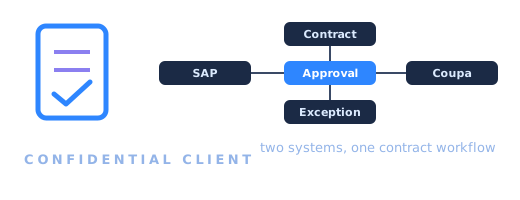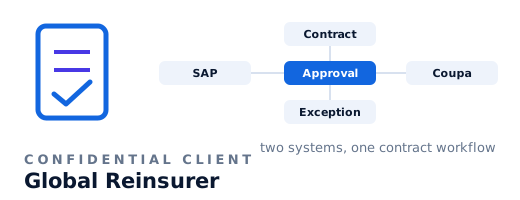

A global reinsurer managed thousands of active contracts across finance and procurement. SAP held the core financials and Coupa held spend and supplier management, and the contract process ran between the two through manual reconciliations, offline coordination, and approvals chased by email. Approval bottlenecks delayed the financial actions that depended on them, nobody could see a contract's status from start to finish, and earlier point solutions each covered one stage of the contract lifecycle, which left duplicated effort and inconsistent controls around them.
The team used Palantir Foundry as the layer between the two systems of record. SAP financial data and Coupa contract and procurement data flow into one governed model that standardizes contract attributes, approval states, and financial metadata, so finance and procurement read the same status for the same contract. Neither SAP nor Coupa was replaced or re-platformed.
Rules on top of that model watch contract lifecycle events and approval conditions. The system identifies stalled contracts, flags approval exceptions, and puts the required action in front of the person who owns it. When a contract exceeds a set financial threshold or departs from standard terms, the workflow routes it for additional review and records the rationale and the approvals for compliance. The logic is rule-based and explainable, which matters to a finance function that has to defend every approval to an auditor.
Users work in a Workshop application that manages the full contract lifecycle. Contract status, approval history, and required actions sit in one interface for both teams, and answers that used to take days of follow-up come back in seconds.
The build went from design to deployment readiness in about four weeks. Engineers worked with the client's finance and procurement stakeholders in focused working sessions to resolve defects and configure the approval workflows. The team set up Foundry DevOps processes, moved modules from the development environment to test, and validated the production connections to SAP and Coupa before a controlled rollout.
Contract approvals move faster because handoffs and ownership are defined in the workflow instead of in inboxes. Standardized approval logic and automated exception handling strengthened control and audit readiness. Finance and procurement stopped tracking and reconciling the same contracts twice, and leaders can see contract status, bottlenecks, and financial exposure across the portfolio as it stands today. The reinsurer plans to extend the platform to more contract types and to adjacent finance processes.
Client details in this case study are generalized to protect confidentiality. BD Emerson is part of Andersen Consulting, and this engagement was delivered by Andersen Consulting's AI and Advanced Analytics practice, the team we work with on Palantir Foundry and AIP programs. Our Palantir Foundry implementation page describes how these builds are scoped, and our guide to running Palantir Foundry on top of SAP explains the integration pattern used here. We are glad to walk through comparable work under NDA.