Talent Assessment: Methods, Validity, and the EEOC Uniform Guidelines
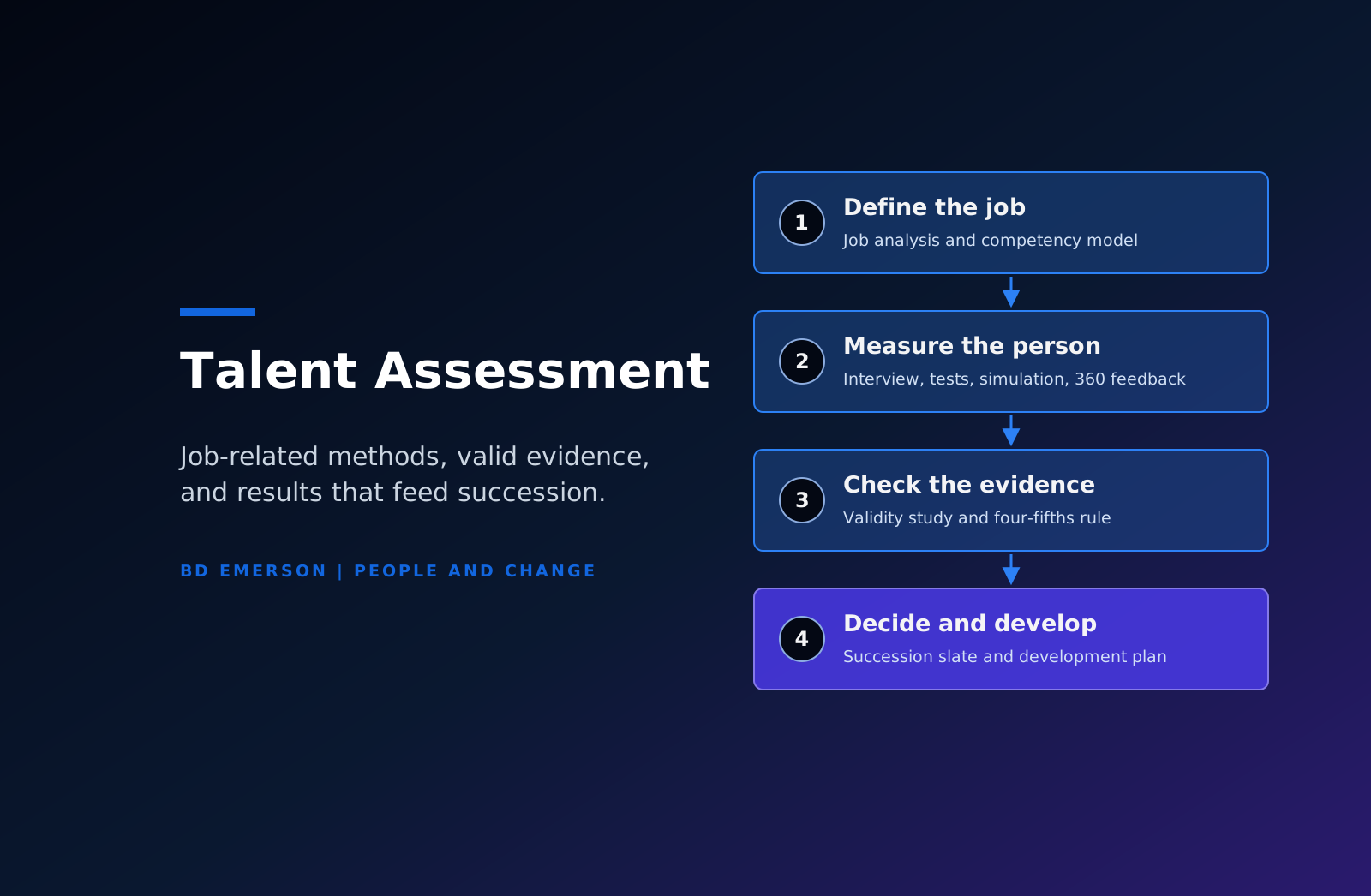
A talent assessment is a structured method for measuring a person's capabilities, potential, and fit for a role. The main methods are structured interviews, validated psychometric and cognitive tests, work simulations, and multi-rater feedback. Organizations use the results for three decisions: who to hire, who to promote, and how to develop the people they already employ. An assessment is only as useful as its validity, which is the evidence that its results relate to performance in the job. In the United States, validity also carries legal weight, because the EEOC's Uniform Guidelines on Employee Selection Procedures treat any measure used as a basis for an employment decision as a selection procedure.
What is a talent assessment?
A talent assessment answers a defined question about a person against a defined standard. The question might be whether a candidate can do the job or whether a director is ready for a vice president role. The standard is a description of what the role requires: the work behaviors, knowledge, and skills that separate strong performance from weak performance.
That standard is the difference between an assessment and an opinion. An assessment states the criteria before it evaluates anyone, measures every person the same way, and records the result so that someone else can review it.
Assessments serve two purposes, and the two should stay distinct. A selection assessment informs a decision about a person, such as a hire, a promotion, or a place on a succession slate. A development assessment informs the person, because it shows strengths and gaps that the individual and the manager can act on. The purpose changes how you administer the tool, who sees the results, and which legal rules apply.
What are the main talent assessment methods?
Four families of methods cover most of what organizations use. Each one measures something different, so a sound design combines two or three of them.
| Method | What it measures | Typical use | Main caution |
|---|---|---|---|
| Structured interview | Past behavior and judgment against defined competencies | Hiring and promotion | Needs trained interviewers and a written scoring guide |
| Psychometric and cognitive tests | Personality traits, work styles, and reasoning ability | Hiring, leadership selection, and development | Needs validity evidence for the job and monitoring for adverse impact |
| Simulations and work samples | Performance on tasks that mirror the job | Role-specific hiring and assessment centers for leaders | Costs more to build, and the tasks must reflect the real job |
| Multi-rater (360) feedback | How a manager, peers, and direct reports experience a person's behavior | Leadership development | Ratings change when raters know they affect pay or promotion |
Structured interviews
In a structured interview, every candidate answers the same job-related questions, and trained interviewers score each answer against a written guide. The structure is the source of the method's value. A 2022 meta-analysis in the Journal of Applied Psychology, Revisiting meta-analytic estimates of validity in personnel selection by Sackett, Zhang, Berry, and Lievens, re-examined the research record and reported that structured interviews emerged as the top-ranked selection procedure. The same study concluded that earlier summaries had overestimated the validity of many selection procedures, so ask any assessment vendor for the study behind its validity claim.
Validated psychometric and cognitive tools
Psychometric tools measure personality traits and work styles through standardized questionnaires, and cognitive tools measure reasoning. "Validated" has a specific meaning here: the publisher or the employer holds documented evidence that scores relate to performance in jobs like the one in question. A technical manual should report who the publisher studied, which job outcomes it measured, and how strongly scores related to those outcomes. A tool that has no technical manual has no place in an employment decision.
Simulations and work samples
A simulation asks the person to do a piece of the job. A sales candidate runs a discovery call with a trained role player, or a finance manager reviews a flawed forecast and presents the corrections. Assessment centers combine several simulations, and trained assessors rate each one against the same competencies. Simulations earn their cost in roles where a poor decision is expensive.
Multi-rater feedback
Multi-rater feedback, often called 360-degree feedback, collects ratings of a person's behavior from the manager, peers, direct reports, and the person. We recommend using it for development and keeping it out of pay and promotion decisions, because raters answer more candidly when their ratings do not decide a colleague's career.
What do validity and job-relatedness mean?
Validity is the evidence that supports using an assessment result for a specific purpose. It belongs to the use, so a test that is valid for selecting software engineers has no automatic validity for selecting sales managers. The Uniform Guidelines recognize three kinds of validity study:
- Criterion-related validity. Empirical data shows that the procedure predicts, or correlates significantly with, important elements of job performance.
- Content validity. Data shows that the content of the procedure is representative of important aspects of performance on the job. A work sample is the clearest case.
- Construct validity. Data shows that the procedure measures the degree to which candidates have identifiable characteristics that are important for successful job performance.
Job-relatedness is the link between what the assessment measures and what the job requires. The link starts with a job analysis, which the Guidelines define as a detailed statement of work behaviors and other information relevant to the job. Without one, nobody can show that the competencies in an interview guide or the traits in a personality report matter for the role.
The professional standard for this work is the Principles for the Validation and Use of Personnel Selection Procedures, published by the Society for Industrial and Organizational Psychology. The American Psychological Association's Council of Representatives approved the fifth edition in August 2018 as an official statement of the APA on employee selection testing.
Why does validity matter legally in the United States?
The Equal Employment Opportunity Commission, the Civil Service Commission, the Department of Labor, and the Department of Justice adopted the Uniform Guidelines on Employee Selection Procedures in 1978. The EEOC's version appears at 29 CFR Part 1607. Four points matter to anyone who buys or runs talent assessments.
First, the scope is broad. The Guidelines define a selection procedure as any measure, combination of measures, or procedure used as a basis for any employment decision, and the definition covers informal interviews and unscored application forms alongside formal tests. Employment decisions include hiring, promotion, demotion, referral, and retention. Selection for training or transfer can also count when it leads to one of those decisions. A succession assessment that decides who gets promoted is therefore a selection procedure. A development assessment whose results stay with the individual and a coach, and feed no employment decision, falls outside the definition.
Second, the Guidelines focus on adverse impact, which they define as a substantially different rate of selection that works to the disadvantage of members of a race, sex, or ethnic group. Their rule of thumb is the four-fifths rule. Federal enforcement agencies will generally regard a selection rate for any race, sex, or ethnic group that is less than four-fifths, or 80 percent, of the rate for the group with the highest rate as evidence of adverse impact. For example, if 50 percent of one group passes an assessment and 30 percent of another group passes, the ratio is 60 percent, which falls below the four-fifths threshold. Smaller differences can still constitute adverse impact where they are significant in both statistical and practical terms.
Third, adverse impact triggers the validation requirement. Under the Guidelines, the use of a selection procedure that has an adverse impact is considered discriminatory unless the procedure has been validated. The Guidelines do not require a validity study where no adverse impact results, and they encourage employers to use valid procedures in every case. Where two procedures are substantially equally valid, the employer should use the one with the lesser adverse impact.
Fourth, the Guidelines direct employers to maintain, and have available for inspection, records that disclose the impact of their selection procedures by sex and by race and ethnic group.
Other federal rules apply to assessments as well. The EEOC's fact sheet on employment tests and selection procedures explains that Title VII permits a test with a disproportionate effect only when it is job-related and consistent with business necessity, and that the Americans with Disabilities Act requires reasonable accommodation in how tests are administered. This section is general information, and employment counsel should review any assessment program before it informs employment decisions.
How do you choose and run a talent assessment?
Start with the decision. Write down what the assessment will decide, who will see the results, and whether the purpose is selection or development. That statement determines how the Guidelines apply.
Next, define the job. A job analysis for a single role can be a set of structured conversations with strong performers and their managers, followed by a short list of the work behaviors and capabilities that matter most. For a leadership level that spans many roles, the output is a competency model.
Then match methods to requirements. Use a structured interview for judgment and past behavior, a simulation for skills you can observe, and a validated psychometric tool for traits and reasoning. Ask every vendor for the technical manual, the validity evidence for comparable jobs, and the data on group differences in scores.
Finally, operate the process with discipline. Train interviewers and assessors before they rate anyone. Track pass rates by group so that you can run the four-fifths calculation on the total selection process. Review the assessment whenever the job changes, because the EEOC advises employers to keep abreast of changes in job requirements.
How do assessment results feed succession and development?
In succession planning, results give the talent review evidence about readiness against the requirements of the target role. Leaders combine that evidence with the person's performance record and experience, and they place each candidate on a slate with a readiness rating: ready now, ready after one more assignment, or a longer-term prospect. The assessment also names the specific gaps between the candidate and the role. The same discipline applies when a reorganization or merger requires selecting leaders for new roles, which is a common part of organizational transformation.
In development, each gap becomes an action. A director who scores low on strategic thinking in a case simulation might lead a cross-functional planning project with a coach. A feedback conversation with a trained professional comes first, because a report handed over without interpretation is easy to misread.
Aggregate results matter as much as individual ones. When 40 leaders complete the same assessment against the same competency model, the pattern across the group shows where the organization is strong and where the bench is thin. That pattern should set the priorities for a leadership development program.
Where do talent assessments go wrong?
Most failures trace to four causes. The organization picks a tool before it defines the job, so the assessment measures traits that nobody has connected to performance. Leaders treat a personality report as a verdict and skip the interview and the track record. A manager reuses development data for a promotion decision without telling participants, which damages trust and brings the results inside the Guidelines' definition of a selection procedure. Nobody monitors pass rates, so adverse impact goes unnoticed until a complaint arrives.
Each of these failures has the same remedy: decide the purpose first, tie the content to the job, keep the evidence, and connect the results to a decision.
BD Emerson delivers talent management work with our Andersen Consulting colleagues at Daniels Consulting Group, a firm of organizational psychologists and experienced business professionals founded in 2002 by Amy Daniels, Ph.D., an industrial and organizational psychologist. If you are designing an assessment process or connecting assessment results to succession and development plans, see our talent management consulting service or book a consultation.

About the author