

Saudi PDPL: What the Personal Data Protection Law Requires
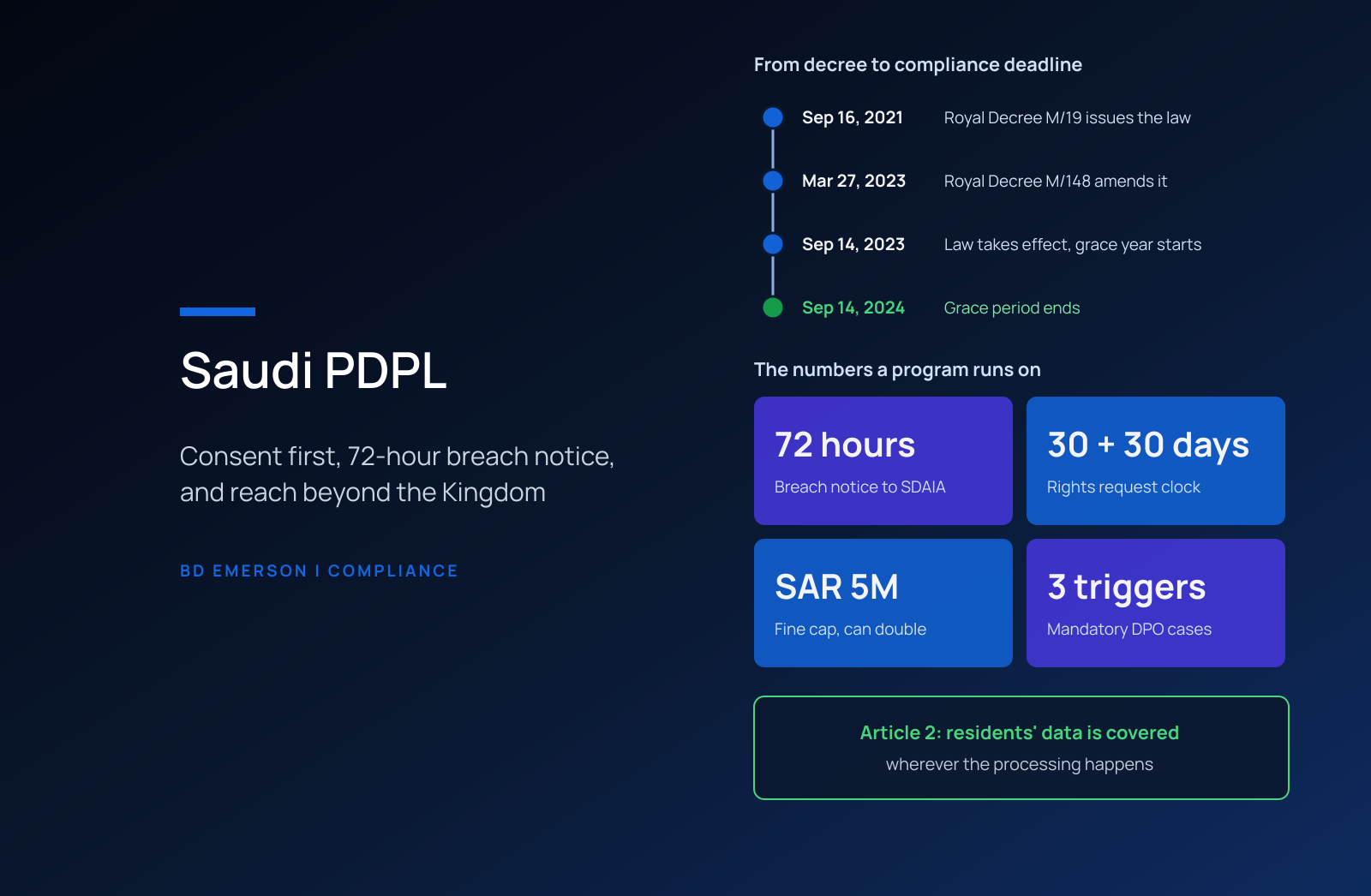
The PDPL is Saudi Arabia's Personal Data Protection Law, issued by Royal Decree M/19 of 9/2/1443H (September 16, 2021) and amended by Royal Decree M/148 of 5/9/1444H (March 27, 2023). It took effect on September 14, 2023, and organizations had a one-year grace period, to September 14, 2024, to comply. The Saudi Data and Artificial Intelligence Authority (SDAIA) supervises it. The law covers processing of personal data inside the Kingdom and processing of Saudi residents' data by organizations outside it. Consent is the default legal basis, controllers notify SDAIA within 72 hours of becoming aware of a breach that could cause harm, transfers abroad must meet Article 29 and SDAIA's Transfer Regulation, and administrative fines reach SAR 5 million, which can be doubled for a repeat violation.
What is the PDPL in Saudi Arabia?
The PDPL is the Kingdom's general data protection statute. It sets principles and leaves operational detail to the regulations and rules SDAIA issues under Article 42, so a compliance program has to read the whole set. The Ministry of Investment publishes an English text of the law. These are the instruments in force on November 22, 2026:
| Instrument | What it governs | Version or basis |
|---|---|---|
| Personal Data Protection Law | Scope, legal bases, rights, transfers, penalties | Royal Decree M/19, amended by M/148 |
| Implementing Regulation | Request handling, legitimate interest, breach notice, impact assessments, records | Issued by SDAIA under Article 42 |
| Regulation on Personal Data Transfer outside the Kingdom | Adequacy, safeguards, transfer risk assessments | Version 2.0, August 2024 |
| Rules Governing the National Register of Controllers Within the Kingdom | Who registers and how | Effective on publication on SDAIA's website |
| Rules for Appointing Personal Data Protection Officer | When a DPO is mandatory and what the role does | Version 1.0, August 2024 |
SDAIA acts as the Competent Authority, a role Article 1(3) leaves to a Council of Ministers resolution, and runs the National Data Governance Platform, where controllers register, report breaches and file impact assessments.
Who does the personal data protection law in Saudi Arabia apply to?
Article 2(1) applies the law to any processing of personal data that takes place in the Kingdom and to processing by a party outside the Kingdom of personal data relating to individuals residing in the Kingdom. It also reaches data of deceased persons that would identify them or a family member. Article 2(2) carves out personal or family use, provided the data has not been published or disclosed to others.
SDAIA's guide for controllers and processors places a German consulting firm serving clients in Jeddah in scope, and it keeps a Saudi online store's customer data under the law when a US cloud provider hosts it. Article 33(4) directs SDAIA to set tools for monitoring foreign controllers and processors that handle residents' data, along with procedures for enforcing the law abroad.
Personal data under Article 1(4) is any data, regardless of source or form, that may lead to identifying an individual. Sensitive data under Article 1(11) covers racial or ethnic origin, religious, intellectual or political belief, criminal convictions and offenses, identifying biometric or genetic data, health data, and data showing that one or both parents are unknown. A controller decides the purpose and manner of processing, and a processor acts on the controller's behalf. Article 8 requires the controller to use only processors that provide the necessary guarantees and to monitor them, and the controller stays responsible to the individual.
Legal bases: consent first, with four exceptions
Article 5(1) makes consent the default. A controller needs consent before processing personal data or changing the purpose, unless the law provides otherwise. Article 7 bars a controller from making consent a condition of a service unless the service relates directly to the processing.
Article 6 lists the four cases where consent is not required. The first is processing that serves the individual's actual interests when contacting them is impossible or difficult. The second is processing under another law or to carry out a prior agreement to which the individual is a party. The third is a public entity processing for security or judicial purposes. The fourth is the controller's legitimate interest, which applies only when no sensitive data is involved and the individual's rights are not prejudiced. SDAIA's handbook requires a controller relying on that basis to carry out a legitimate interest assessment under the Implementing Regulation.
Article 25 sets a marketing rule: controllers need prior consent to send advertising or awareness material through personal channels such as post and email, and each message must offer a clear opt-out.
What rights does the PDPL give individuals?
Article 4 gives individuals five rights: to be told the legal basis and purpose of collection, to access their personal data, to obtain it in a readable and clear format, to have it corrected, completed or updated, and to request its destruction once it is no longer needed. Article 5(2) lets the individual withdraw consent at any time.
Article 3 of the Implementing Regulation sets the clock. A controller acts on a request within 30 days and may extend by up to 30 more days when the request requires disproportionate effort or the same person files several requests, provided it tells the individual in advance and gives the reason. The controller verifies the requester's identity and keeps a record of every request, including oral ones. Our DSAR guide covers intake and identity checks.
Breach notification, DPOs, records and the National Register
Article 20(1) requires the controller to notify the Competent Authority of any breach, damage or illegal access to personal data. The National Register rules state the deadline in Article 12.1: within 72 hours of becoming aware of the incident. SDAIA's handbook applies the duty to a breach that potentially causes or leads to harm to the data or the individual, and reports go through the National Data Governance Platform. Article 20(2) requires notice to individuals when the incident would damage their data or prejudice their rights and interests.
A DPO is mandatory in three cases under Article 5 of SDAIA's DPO appointment rules: a public entity providing services that involve large-scale processing, a controller whose core activities involve regular and systematic monitoring of individuals, and a controller whose core activities rest on processing sensitive data. Article 4(2) allows the DPO to be an executive, an employee or an external contractor, which makes a DPO as a service arrangement a legitimate option.
Article 31 requires every controller to keep a record of processing activities and produce it on request. The minimum contents are contact details, purpose, categories of individuals, recipients, transfers outside the Kingdom and the expected retention period. Article 12 adds a privacy policy published before collection, and Article 19 requires the technical and organizational measures needed to protect the data.
Registration is narrower. Article 2 of the National Register rules requires registration when the controller is a public entity, when its main activity involves processing personal data, when it processes sensitive data, or when an individual processes personal data beyond personal or family use. Registration produces a certificate valid for up to five years, and SDAIA sends a renewal notice at least 30 days before expiry. The published rules cover controllers inside the Kingdom, and their preamble leaves registration of controllers outside it to separate rules. Our guide on how to build a data privacy program sets out the order we build these pieces in.
Cross-border transfers under the Transfer Regulation
Article 29(1) of the law allows transfers outside the Kingdom only for listed purposes, such as an obligation under an agreement the Kingdom is party to or one to which the individual is a party. Article 29(2) adds three conditions: the transfer must not prejudice national security or the Kingdom's vital interests, the destination must offer protection at least equivalent to the PDPL, and the transfer must be limited to the minimum data needed. Article 29(3) lifts those conditions in cases of extreme necessity, such as preserving life or treating disease.
The Regulation on Personal Data Transfer outside the Kingdom fills in the mechanics. Article 3 requires SDAIA to publish a list of countries and international organizations with adequate protection and to review it every four years or as necessary. Article 4(2) exempts the controller from the equivalence condition, the minimization condition or both in five cases, including intra-group central operations and non-recurring transfers involving few individuals. Each case carries its own safeguard, typically standard contractual clauses, binding common rules or a certificate from a body SDAIA licenses. The exemption never reaches the national security condition.
Article 7 requires a risk assessment before any transfer that relies on an Article 4 exemption and before any continuous or widespread transfer of sensitive data. The assessment covers six elements, from purpose and legal basis through the likelihood of harm and the controls that reduce it. Under Article 6, an exemption lapses when the safeguards are missing or SDAIA finds them inadequate, and the controller must halt the transfer and notify the recipients.
PDPL penalties
Article 35(1) is the criminal track: disclosing or publishing sensitive data in violation of the law with intent to harm the individual or for personal benefit carries imprisonment of up to two years, a fine of up to SAR 3 million, or both, and Article 35(4) lets the court double the fine for repeat offenses. Article 36(1) is the administrative track: any other violation draws a warning or a fine of up to SAR 5 million, and the fine may be doubled for a repeat violation. A committee formed by SDAIA's president decides violations under Article 36(2), and Article 36(3) allows appeal to the competent court.
How the PDPL differs from GDPR
The PDPL shares much of its vocabulary with the EU's General Data Protection Regulation. The differences sit where day-to-day work happens:
| Topic | Saudi PDPL | EU GDPR |
|---|---|---|
| Legal bases | Consent by default, four exceptions in Article 6 | Six lawful bases in Article 6(1), any one of which suffices |
| Legitimate interest | Unavailable for sensitive data | Special category data needs a separate Article 9 condition |
| Breach notice to regulator | 72 hours where the breach could cause harm | 72 hours unless the breach is unlikely to create risk |
| Rights request deadline | 30 days, plus up to 30 more | One month, extendable by two months for complex or numerous requests |
| Rights listed | No named right to object or to data portability | Rights to object and to portability |
| Registration | National Register for four controller categories | No general registration with the regulator |
| Sanctions | Fixed caps in riyals, plus a criminal track for sensitive data | Up to EUR 20 million or 4% of worldwide annual turnover, whichever is higher |
For a team that already runs a GDPR program, the PDPL work comes down to six additions:
- Re-map legal bases, moving sensitive data off legitimate interest and recording consent where Article 5 requires it.
- Extend the record of processing to Saudi residents with the Article 31 fields, including every transfer outside the Kingdom.
- For controllers in the Kingdom, test the four National Register triggers and register on the National Data Governance Platform where one applies.
- Check the three DPO triggers in SDAIA's rules, where the sensitive data trigger carries no large-scale threshold.
- Put the safeguard the Transfer Regulation requires behind each Article 4 transfer, with an Article 7 risk assessment before it starts.
- Update the breach runbook so the 72-hour clock and the reporting route point to SDAIA.
BD Emerson's data privacy consulting team helps organizations that process Saudi residents' data build these pieces. We map personal data and transfers, build the Article 31 records, run legitimate interest and transfer risk assessments, draft privacy policies and breach procedures, and can serve as your DPO. We are not a law firm, so we work alongside your Saudi counsel on legal interpretation, and compliance decisions rest with SDAIA and the Saudi courts.

About the author
















