

ADHICS Compliance: What Abu Dhabi's Healthcare Standard Requires
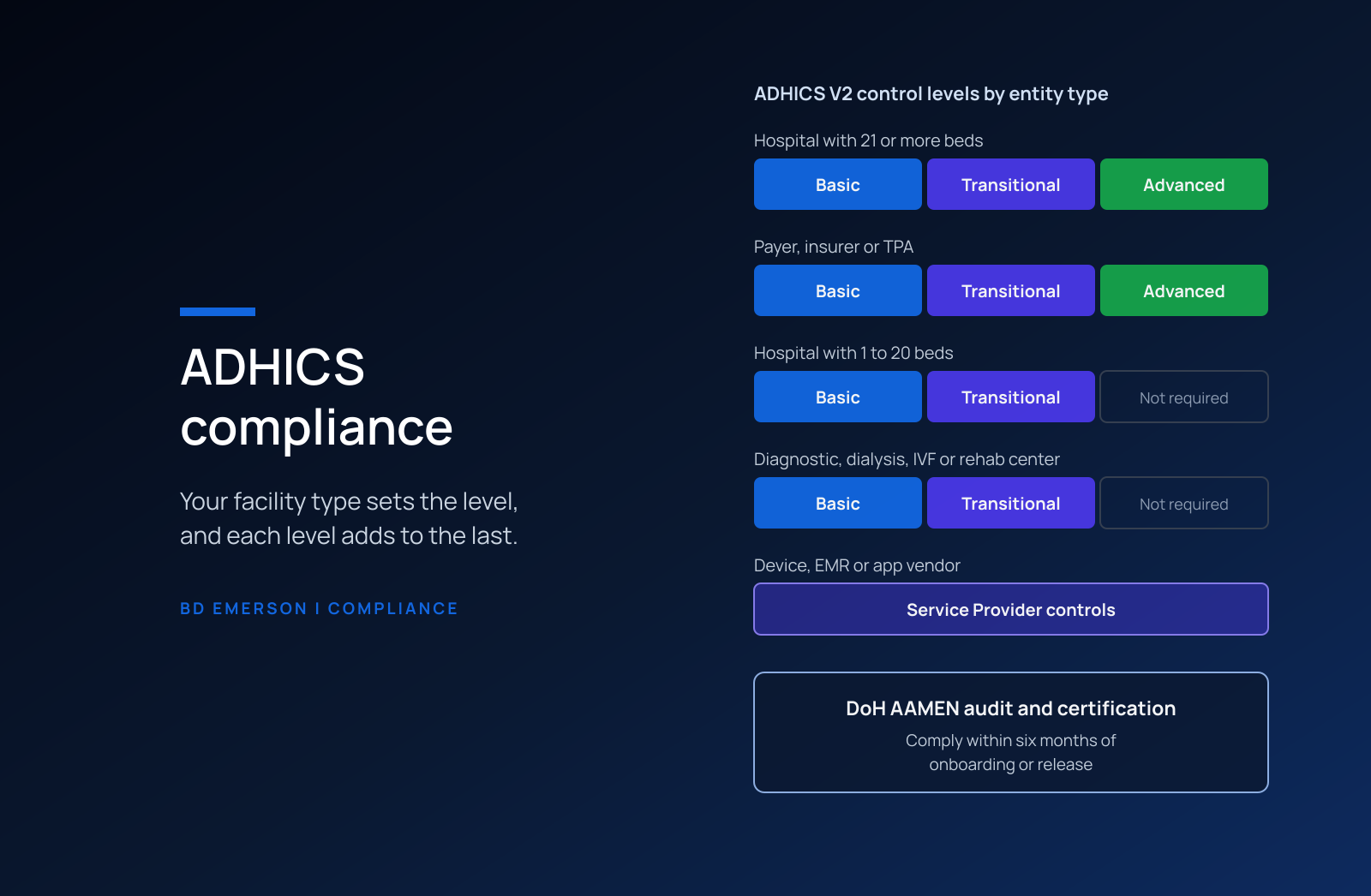
ADHICS is the Abu Dhabi Healthcare Information and Cyber Security Standard, the mandatory information security standard that the Department of Health Abu Dhabi (DoH) sets for every entity that generates, accesses, stores, uses, processes or transmits health information in the emirate. The version in force is ADHICS V2, published in May 2024 and effective August 2024. It replaced ADHICS V0.9 from 2019 and absorbed two separate DoH standards on medical device security and patient data privacy. Every control carries a Basic, Transitional or Advanced tag, and many also carry a Service Provider tag. Your facility type decides which tags apply to you, and DoH checks compliance through AAMEN, its healthcare information security audit and certification program.
What does ADHICS stand for, and what changed in V2?
ADHICS stands for Abu Dhabi Healthcare Information and Cyber Security Standard. DoH published the first version, V0.9, in February 2019, announced its launch on 2 March 2019 and gave all public and private healthcare facilities until 29 February 2020 to comply. The current document carries reference DOH/SD/ICSO/ADHICS/V2/2024, the DoH Information & Cyber Security Office owns it, and the full text is on the DoH website as a downloadable PDF.
V2 makes three changes that matter. First, it consolidates three earlier documents into one: ADHICS V0.9 of 2019, the Internet of Medical Things (IoMT) Security Standard V0.9 of 2020 and the Standard on Patient Healthcare Data Privacy V0.9 of 2020. The AAMEN program page now marks the IoMT and privacy standards as retired and addressed in ADHICS V2. Second, it adds a Service Provider category, which brings medical device and technology providers, electronic medical record (EMR) vendors and app developers directly into scope. Third, V0.9 split Operations Management and Communications into separate domains, and V2 combines them into a single Communications and Operation Management (CO) domain.
Who must comply with ADHICS?
ADHICS applies to any entity in the Emirate of Abu Dhabi that generates, accesses, stores, uses, processes or transmits health information, including healthcare facilities, payers, and healthcare technology and service providers. Its scope covers staff with access to patient data, information in physical and digital form, medical devices, applications, and the shared systems of the Abu Dhabi health sector such as Shafafiya, Malaffi and EMR platforms.
For licensed facilities, DoH publishes the AAMEN Applicability Matrix, and its version 3 from February 2023 lists the license types the program covers. Hospitals, nursing homes, clinics, medical and dental centers, one-day surgery, imaging and laboratory centers, dialysis and IVF centers, pharmacies, home care, mobile health units and telemedicine providers are all in. The matrix lists first aid posts, school clinics, drug stores, optical shops, dental laboratories and traditional and complementary medicine practitioners as not applicable.
Compliance is tied to the right to operate. When DoH launched the standard in 2019, it made ADHICS mandatory for new and renewing facility licenses. The DoH ADHICS FAQ adds that compliance with a minimum group of ADHICS controls set by the Malaffi team is a prerequisite for onboarding to Malaffi, the platform that connects public and private healthcare providers in the emirate. V2 also sets a hard data residency rule. Control CO 9.2 requires that health information, including personally identifiable information and protected health information, is not stored, shared, processed or transferred outside the UAE unless DoH has issued a specific exemption. The same control requires staff and third parties to provide support from inside the UAE unless DoH grants an exemption. A vendor that hosts an Abu Dhabi clinic's records in a European or US cloud region without that exemption fails the control. Our healthcare cybersecurity guide covers the threats behind these rules.
Basic, Transitional, Advanced and Service Provider controls
Each control in Section B, the standard's control catalog, carries a category tag, and the levels are cumulative: an entity at the Transitional level meets every Basic and Transitional control, and an Advanced entity meets all three levels.
| Category | Applies to | What it adds |
|---|---|---|
| Basic | Every in-scope entity | Controls that apply by default; the entity must give DoH a valid business justification for any it does not apply |
| Transitional | Hospitals with 1 to 20 beds, and centers such as diagnostic, dialysis, IVF and rehabilitation centers | Further controls on top of Basic |
| Advanced | Hospitals with 21 or more beds, Malaffi, payers and insurers, and third-party administrators | Further controls on top of Basic and Transitional |
| Service Provider | Medical device and technology providers, EMR providers, and web and mobile application providers | Controls for any external party that provides a medical device, system, application, infrastructure or database |
The V2 timeline is the same for all four categories: compliance within six months of official program induction or onboarding, or of the official release of the standard, whichever comes first. V0.9 gave Transitional and Advanced entities a full year. For any entity that was operating when V2 was released in May 2024, that six-month window closed more than a year ago.
What ADHICS requires before the first technical control
Section A sets up the governance that Section B depends on. An Information Security Governance Committee (ISGC) heads the entity's program. The committee needs a 60 percent quorum to meet, and it must review and approve quarterly progress and compliance reports and make sure they reach DoH. Below the committee sit a Health Information Infrastructure Protection (HIIP) Workgroup and a Chief Information Security Officer or an equivalent resource, whom the entity must appoint to lead the workgroup. The equivalent-resource option means a small clinic does not need a dedicated CISO hire, and the DoH FAQ says the roles must go to competent personnel.
Section A also requires an information security policy with document control, a risk management process with ongoing review, and a Statement of Applicability (SoA). The SoA lists the controls the entity considers necessary, the reason for each, its current implementation status and the justification for excluding any control that would otherwise apply. The entity rates information assets for confidentiality, integrity and availability on a scale of 1 to 5 and classifies information as Public, Restricted, Confidential or Secret.
The control domains in Section B
Section B begins with four domains. Human Resources Security (HR) runs from the HR 1 policy through HR 2 prior to employment, HR 3 during employment, which includes security and privacy awareness campaigns, and HR 4 termination or change of role. Asset Management (AM) covers policy, management of assets, classification and labeling, handling, and disposal across AM 1 to AM 5. Physical and Environmental Security (PE) covers secure areas under PE 2 and equipment security under PE 3. Access Control (AC) covers user access management, equipment and device access, periodic access reviews under AC 4, network access and operating system access.
The Communications and Operation Management (CO) domain holds most of the day-to-day technical evidence. It requires hardening baselines, operating procedures, change management and separation of environments (CO 2), capacity planning and acceptance criteria (CO 3), malware and gateway protection (CO 4), backup and archival (CO 5), monitoring, centralized logging, clock synchronization and data leakage prevention (CO 6), security assessments and vulnerability management (CO 7), patch management and tracking (CO 8), and secure information exchange, including the residency rule for health data (CO 9). CO 7.1 also requires the entity to cooperate with DoH during its own vulnerability assessment activity. This guide covers these five domains. Scope a gap assessment from the full V2 text, because the DoH FAQ and other V0.9-era summaries describe the older structure and timeline.
How does an ADHICS audit work?
ADHICS audits run at two levels, and an entity needs both. Inside the entity, section 6.2 of the standard requires an annual audit program that validates compliance with ADHICS, plus independent audits at least once a year or after any significant change. Internal or external resources can run the audits, and internal auditors must be functionally independent so they can report findings without bias. Results go to the relevant stakeholders for containment and remediation, and the ISGC receives regular briefings on audit outcomes and follow-up actions.
Outside the entity, DoH runs AAMEN, which the DoH ADHICS FAQ describes as the umbrella for its information security standards, audits, compliance monitoring and certifications, together with the DoH activity that enforces them. DoH launched the AAMEN audit program in November 2020 with a first stage of 60 healthcare facilities and a stated plan to extend auditing to every facility in the emirate. AAMEN certification now appears as a requirement inside other DoH standards. The Medical Tourism Standard, effective March 2025, states that the healthcare facility "shall be AAMEN certified," and the DoH Policy for the Governance of Mental Health Services, published in July 2026, sets the same requirement in section 3.1.5.
An ADHICS audit asks for proof that the governance exists and that the controls run. Prepare the SoA, the risk register and treatment decisions, ISGC minutes and the quarterly reports sent to DoH, the classified asset inventory, access review records under AC 4, patch tracking under CO 8, backup records under CO 5, centralized log samples under CO 6, and vulnerability assessment reports with remediation status under CO 7.
How does ADHICS relate to UAE IA and ISO 27001?
ADHICS maps its controls to the UAE Information Assurance Regulation (UAE IAR). Control groups in V2 carry a "UAE IAR Reference" tag that names the matching UAE IAR controls, for example M2.3.4 for the Statement of Applicability and T-series references for the technical controls in AM, PE, AC and CO. V0.9 carried equivalent tags under the label "UAE IA Reference." The Telecommunications and Digital Government Regulatory Authority (TDRA) developed the UAE IAR to raise the minimum protection of information assets across UAE entities, and it sets out both management and technical information security controls. If you already map to the UAE IAR, the ADHICS tags give you a ready crosswalk.
ADHICS follows the same architecture as an ISO/IEC 27001 management system: a governance body, a risk assessment that drives control selection, an SoA and an internal audit program. Neither the ADHICS FAQ nor the AAMEN program page lists an ISO 27001 certificate as a substitute for ADHICS compliance or AAMEN certification. An ISO 27001 program covers much of the ADHICS work, but it misses the DoH-specific layer: the ISGC structure and quarterly reporting to DoH, the in-country residency requirement in CO 9.2, Malaffi exchange controls, the Service Provider tags and cooperation with DoH vulnerability assessments. Our ISO 27001 implementation guide covers the management system side, and organizations that also hold US patient records can compare the overlap with our HIPAA compliance checklist.
A readiness sequence that holds up in an AAMEN audit
The order matters because operating controls need dated records, and records take time to build up. We work through ADHICS readiness in this sequence:
- Confirm your category from your DoH license type and the AAMEN Applicability Matrix, and record whether Service Provider tags apply to any system you build or host.
- Stand up the ISGC, appoint the CISO or equivalent, and set the quarterly reporting cycle to DoH.
- Run the risk assessment, rate assets on the 1 to 5 scale, and draft the SoA with a justification for every exclusion.
- Start the operating controls first: access reviews under AC 4, patching under CO 8, logging under CO 6 and vulnerability management under CO 7.
- Confirm that every system holding health information, including vendor-hosted EMR platforms and backup copies, sits inside the UAE.
- Run an independent internal audit against the full V2 text before DoH audits you, and close what it finds.
BD Emerson, part of Andersen Consulting since October 2026, provides ADHICS readiness support for DoH-licensed facilities, payers and healthcare technology vendors through our cybersecurity compliance practice. We confirm your category, perform the gap assessment against the full V2 control text, build the SoA and policy set, and support the independent annual audit that section 6.2 requires. DoH runs the AAMEN audit and certification, which keeps the firm preparing you separate from the regulator assessing you.

About the author
















