Change Management Communication Plan: What It Contains and How to Build One
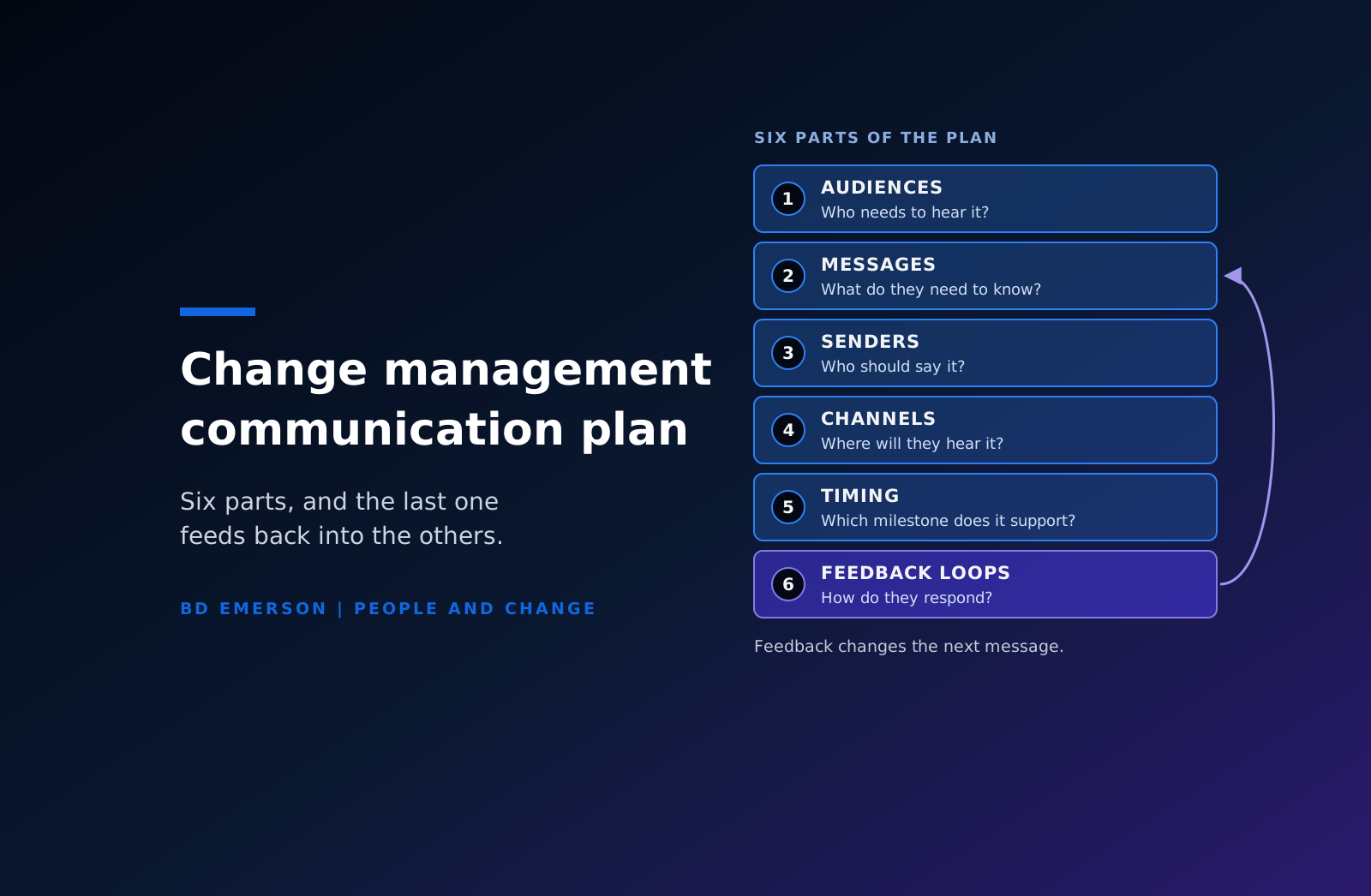
A change management communication plan is the document that states who needs to hear what about a change, from whom, through which channel, at what point, and how they can respond. It has six parts: audiences, messages, senders, channels, timing, and feedback loops. You build it from the stakeholder analysis and the change impact assessment, you schedule it against the project milestones, and you update it as questions and resistance come in. A good plan gives every affected group the right message from a sender they trust before they need to act on it.
What does a change management communication plan contain?
The U.S. Government Accountability Office examined what makes mergers and organizational transformations succeed, and its 2003 report on implementation steps lists nine key practices. One of them is to "establish a communication strategy to create shared expectations and report related progress." GAO attaches four implementation steps to that practice: communicate early and often to build trust, ensure consistency of message, encourage two-way communication, and provide information that meets the specific needs of employees. The six parts of a communication plan put those four steps on paper.
Audiences
The audience list comes from the stakeholder analysis. It groups people by how the change affects their work, because impact determines what each group needs to know. A typical plan separates executives, people managers, directly affected employees, indirectly affected employees, and outside parties such as customers or suppliers. Each group gets its own row in the plan.
Messages
Research on readiness for change gives a tested structure for message content. In a 2002 paper in the Journal of Organizational Change Management, Achilles Armenakis and Stanley Harris of Auburn University describe five components of a change message: discrepancy, appropriateness, efficacy, principal support, and personal valence. In plain terms, the message has to answer five questions. Why do we need to change? Why is this the right change? Can we do it? Do our leaders stand behind it? What does it mean for me? A plan that answers only the first two leaves employees to guess the answers that matter most to them.
Senders
Every message needs a named sender, and the sender should match the message. Senior leaders carry the business reasons for the change, because they made the decision and can speak for it. Direct managers carry the personal impact, because they know each person's job and will be present the next day to answer questions. The project team supplies facts, dates, and instructions.
Channels
Channels fall into two kinds. Broadcast channels such as email, the intranet, and recorded video reach many people with a consistent message. Conversation channels such as team meetings, town halls with open questions, and one-on-one discussions let people react and ask. Messages about personal impact belong in conversation channels. Reference details belong in a place people can find again.
Timing
Each communication is tied to a project milestone, so that the plan moves when the project moves. Managers hear before their teams, so that they can answer questions when the news arrives. Employees hear about an impact before they have to act on it.
Feedback loops
A feedback loop is a defined way for the audience to respond and a defined owner who reads the response and acts on it. GAO's report says communication should allow a two-way exchange with employees, customers, and stakeholders. Question boxes, manager reports, pulse surveys, and a network of change champions all serve this purpose when someone is accountable for the answers.
How do you build a change communication plan step by step?
The plan is one section of the wider change plan, and our change management plan template shows where it sits. Eight steps produce a working version.
- Start from the impact assessment. List the groups the change affects and what changes for each one: tasks, tools, reporting lines, measures, or location.
- Segment the audiences. Combine groups that share the same impact, and separate groups that will hear the same news differently.
- Write the core message. Draft one short statement of the case for change that every leader will use, so that the message stays consistent in tone and content.
- Adapt the message for each audience. Keep the core statement and add the audience's own answers to the five questions, with the most space given to what the change means for them.
- Assign senders. Name the person who delivers each message, and confirm that the person agrees and has the material to do it.
- Choose channels. Match each message to a broadcast channel, a conversation channel, or both.
- Sequence against milestones. Place each communication before the project event it supports, with managers briefed ahead of their teams.
- Define feedback and measures. State how each audience can respond, who reviews the responses, and how you will test whether the message was understood.
The fifth step deserves the most attention. A plan can name the chief operating officer as the sender of a message that the chief operating officer has never seen. Senders need a briefing, talking points, likely questions, and time on their calendar. Armenakis and Harris report that their own work on a major reorganization included coaching the company president and supporting the first company-wide announcement. That kind of preparation is a common part of leadership development during a change.
What does a sample change management communication plan look like?
The sample below covers a company that is replacing its order management system. Every row follows the same six parts, and the timing column refers to project milestones.
| Audience | Message | Sender | Channel | Timing | Feedback loop |
|---|---|---|---|---|---|
| Executive team | The business case, their role as visible sponsors, and the decisions we need from them | Chief executive and executive sponsor | Leadership meeting | At project approval, then at each steering committee | Open discussion, with decisions logged |
| People managers | What changes for their teams, what we need them to say, and the questions to expect | Executive sponsor and change lead | Manager briefing with a talking-points pack | Before each all-employee announcement | Managers report team questions to the change lead every week |
| Customer service representatives | Why the old system is being retired, how daily order entry changes, and when training takes place | Customer service director, then team supervisors | Team meetings and a system demonstration | After design sign-off and again before training opens | Questions in team meetings and a short pulse survey |
| Sales team | What changes in order status and customer updates, and what stays the same | Head of sales | Sales meeting and a one-page guide | Before user acceptance testing ends | Shared question log with published answers |
| All employees | Progress against the plan, early results, and answers to the most common questions | Executive sponsor | Town hall and intranet page | At each major milestone and after go-live | Live questions, with unanswered ones published afterward |
A real plan has more rows, because each message gets its own line with a date and an owner. The structure stays the same.
What are the common mistakes in a change communication plan?
Starting when the solution is ready
Teams often hold communication until the design is final, because they want to avoid questions they cannot yet answer. Employees hear rumors in the meantime and fill the gaps themselves. GAO's first implementation step is to communicate early and often, and the report explains that doing so helps build an understanding of the purpose of the planned changes. An early message can state what is decided, what is still open, and when the open items will be settled.
Sending one message to everyone
A single all-employee announcement treats a team whose jobs are being redesigned the same as a team that will notice a new login screen. The heavily affected group needs detail and conversation, and the lightly affected group needs two sentences. GAO's fourth step addresses this point: employees need to understand how the transformation will affect them.
Letting the project team send everything
Messages from a project mailbox read as project news. People want to hear the reasons from the leader who made the decision and the personal impact from their own manager. When the plan names the right senders and prepares them, the same content carries more authority.
Communicating in one direction
A plan made only of emails and announcements tells people about the change and learns nothing from them. A Project Management Institute paper on managing change in organizations states that "success of the change is reinforced by two-way communication and consultation with stakeholders," and it notes that involving stakeholders early increases buy-in and produces a better change. The questions people ask are also direct evidence of where resistance will appear.
Measuring what was sent
The number of emails sent and town halls held shows activity. The plan works when people can explain the change in their own words, and a short pulse survey or a set of manager check-ins can test that. Useful questions ask whether people know why the change is happening, what changes for them, and where to go with questions.
Stopping at go-live
Communication needs peak when people start working in the new way and meet the first problems. A plan that ends at launch leaves them without answers at that moment. Post-launch communication reports progress, shares fixes, and recognizes teams that have adopted the change, which matches the second half of GAO's practice: report related progress.
How does the communication plan fit with the rest of the change effort?
Communication creates awareness and understanding. It cannot build skill, which is the job of training, and it cannot substitute for leaders who act in line with the message. The plan therefore shares its audiences and timing with the training plan and the sponsor plan, and all three sit on the project schedule. The same discipline applies at larger scale in an organizational transformation, where several projects send messages to the same employees and one calendar has to coordinate them.
The effort a communication plan takes depends on the number of audiences, the depth of the impact on each, the number of sites and languages, and how prepared the senders are. BD Emerson builds and runs these plans with our Andersen Consulting colleagues at Daniels Consulting Group, whose consultants hold advanced degrees in organizational psychology, business, and communication. To plan the communication for a change you are leading, see our change management consulting service or book a consultation.

About the author