

Enterprise Risk Management Framework: COSO vs ISO 31000
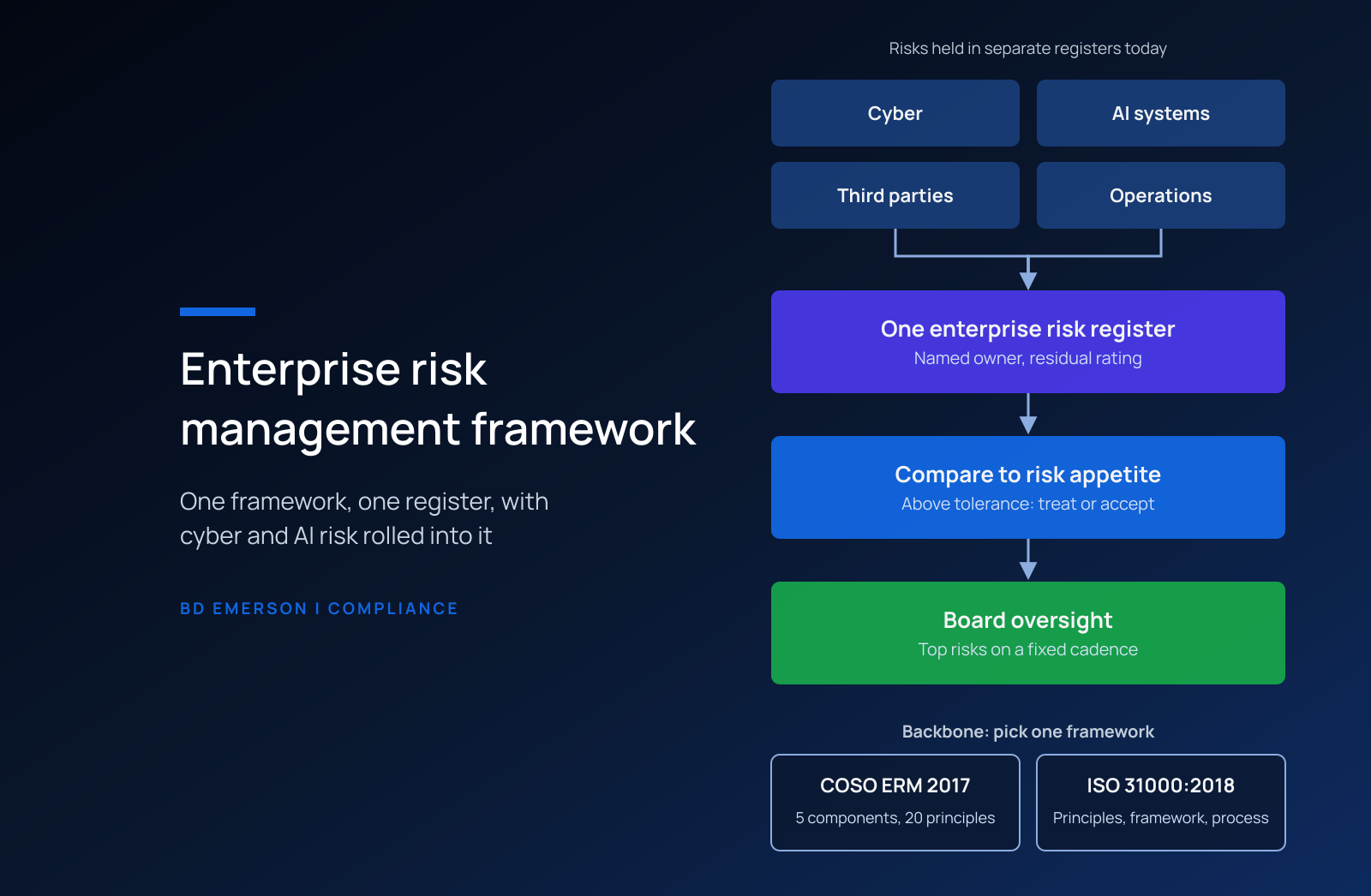
An enterprise risk management framework is the shared method an organization uses to identify, rate, respond to, and report risk across every business unit, measured against the strategy the board has approved. Two published frameworks supply the structure for that method. COSO's Enterprise Risk Management: Integrating with Strategy and Performance, published in June 2017, organizes the work into five components and 20 principles. ISO 31000:2018, Risk management: Guidelines, sets out principles, a framework, and a process, and ISO states that it cannot be used for certification. A sound program picks one as its backbone, writes an appetite statement, keeps one enterprise risk register with named owners, assigns roles using the IIA Three Lines Model, and feeds cyber and AI risk into that same register.
What is enterprise risk management?
Enterprise risk management, or ERM, is risk management run at the level of the whole organization instead of inside each department. Treasury hedges interest rate exposure, security tracks vulnerabilities, and operations plans for supplier failure, and each of them is managing risk. ERM puts those risks on one scale, compares them against the same appetite, and gives leadership a single view of what could stop the plan.
COSO describes ERM as the culture, capabilities, and practices that organizations integrate with strategy-setting and apply when they carry out that strategy, with a purpose of managing risk in creating, preserving, and realizing value. ISO 31000 defines risk as the effect of uncertainty on objectives. If the risk program cannot tell the executive team which handful of risks matter most to this year's plan, the organization has departmental lists and no enterprise view. COSO calls the combined picture a portfolio view, and developing it is Principle 14.
COSO ERM: five components and 20 principles
COSO, the Committee of Sponsoring Organizations of the Treadway Commission, released the current framework in June 2017 as an update to its 2004 Enterprise Risk Management: Integrated Framework. The 2017 edition places a stronger emphasis on how ERM informs strategy and its performance, which is why defining risk appetite sits inside the strategy component as Principle 7. The COSO executive summary lists the components and principles as follows.
| Component | Principles | What it covers |
|---|---|---|
| Governance and Culture | 1 to 5 | Board risk oversight, operating structures, desired culture, commitment to core values, and capable people |
| Strategy and Objective-Setting | 6 to 9 | Business context, risk appetite, alternative strategies, and business objectives |
| Performance | 10 to 14 | Identifying, assessing, and prioritizing risk, choosing responses, and building a portfolio view |
| Review and Revision | 15 to 17 | Substantial change, review of risk and performance, and improvement of ERM itself |
| Information, Communication, and Reporting | 18 to 20 | Information systems, risk communication, and reporting on risk, culture, and performance |
The components also work as an assessment checklist. A company with a well-kept risk register and no board oversight has covered Performance and skipped Governance and Culture. A company that never re-rates its risks after an acquisition has missed Principle 15, which asks the organization to assess substantial change.
ISO 31000: principles, framework, and process
ISO 31000:2018 is the second edition of the standard, published in February 2018 and confirmed by ISO in 2023. It gives guidelines instead of requirements, and ISO states that it cannot be used for certification purposes, although it can guide internal or external audit programs.
The standard has three parts. The principles describe what effective risk management looks like, and the 2018 edition makes creating and protecting value the key driver of risk management, with continual improvement, stakeholder inclusion, customization to the organization, and human and cultural factors among the principles. The framework covers how leadership embeds risk management, and ISO says top management should make sure risk management is integrated into all organizational activities, starting with the governance of the organization. The process is the working cycle, which ISO describes as identifying, analyzing, evaluating, treating, monitoring, and communicating risk across the organization.
A revision is in progress. ISO registered the draft of the third edition, ISO/DIS 31000, at stage 40.00 on November 3, 2026. The 2018 text remains the edition in force today.
COSO or ISO 31000: which framework fits?
The two frameworks agree on substance and differ in emphasis and vocabulary.
| Question | COSO ERM 2017 | ISO 31000:2018 |
|---|---|---|
| Structure | Five components and 20 principles | Principles, framework, and process |
| Starting point | Strategy and performance | Objectives and the risk process |
| Organizational certification | None | None; ISO says it cannot be certified |
| Strongest fit | US public companies whose audit committees already work in COSO internal control language | Multinationals and organizations already running ISO management systems such as ISO/IEC 27001 or ISO/IEC 42001 |
Many programs use the ISO 31000 process as the working method and the COSO components for board reporting and maturity assessment. Pick one as the vocabulary of record so the register, the appetite statement, and the board pack use the same terms. Security teams that already run risk assessments under ISO/IEC 27005 or NIST SP 800-30 can roll those results into either framework without rebuilding them.
Risk appetite, tolerance, and the risk register
Risk appetite is the amount and type of risk the organization is willing to accept in pursuit of its strategy. Tolerance applies that appetite to a specific objective or metric, and the NIST AI Risk Management Framework defines risk tolerance as the organization's readiness to bear the risk in order to achieve its objectives. An appetite statement might say the company has low appetite for regulatory breaches and moderate appetite for product launch risk. A tolerance turns that into a number someone can monitor, for example no more than two high-rated audit findings open past 90 days. The NIST Cybersecurity Framework 2.0 makes this explicit for security programs in subcategory GV.RM-02, which calls for risk appetite and risk tolerance statements that are established, communicated, and maintained.
The risk register is where appetite meets practice. Each entry needs a risk statement written as cause, event, and consequence; a named owner; an inherent rating; the controls in place; a residual rating; the chosen response, such as accepting, reducing, sharing, or avoiding the risk; one or two key risk indicators; and the date of the next review. The residual rating is compared against appetite, and anything above it needs more treatment or a documented acceptance by someone with the authority to accept it. Impact ratings for operational risks should come from a business impact analysis, and vendor risks belong in the same register on the same scale as the third-party risk program that tiers them.
Heat maps plot likelihood against impact, usually on a five-by-five grid, and show a board where risks sit relative to each other. They are weak at comparing risks that differ in kind, because multiplying two ordinal scores produces a number that looks precise and is not. For the few risks that drive the strategy, add a loss range in dollars so the board can weigh a ransomware scenario against a supply chain failure on one scale.
Who owns enterprise risk management?
The board owns oversight, management owns the risks, and internal audit tests whether the system works. The IIA Three Lines Model, published in July 2020 as an update of the Three Lines of Defense and updated again in September 2024, sets out those roles under six principles. The governing body accepts accountability to stakeholders, delegates responsibility and resources to management, and determines risk appetite. First-line roles sit with the managers who deliver products and services and manage the risk in them. Second-line roles, including a chief risk officer and the risk and compliance functions, provide expertise, monitoring, and challenge. The third line, internal audit, provides independent and objective assurance and advice on the adequacy and effectiveness of governance and risk management.
The IIA states that the lines are not intended to denote structural elements and that the numbering does not imply sequence. A mid-sized company with no chief risk officer can give the second-line role to the CFO and the third to an outsourced internal audit provider, as long as the person who owns a risk never reports independently on whether it is controlled.
For US public companies, the SEC has turned part of this into a disclosure requirement. Item 106 of Regulation S-K, adopted on July 26, 2023, requires a description of the board's oversight of cybersecurity risk, management's role in assessing and managing it, and whether and how cybersecurity processes have been integrated into the registrant's overall risk management system or processes. A company without an ERM program has little to write in that last answer.
Bringing cyber and AI risk into the enterprise register
Cyber and AI risks often sit in separate registers owned by the CISO or a data science lead, scored on scales the rest of the business does not use. CSF 2.0 subcategory GV.RM-03 states that cybersecurity risk management activities and outcomes are included in enterprise risk management processes. The NIST IR 8286 series, revised and finalized as Revision 1 on December 18, 2025, explains the mechanics: IR 8286A covers identifying and estimating cybersecurity risk in cybersecurity risk registers, and IR 8286C covers aggregating that data into the enterprise risk portfolio so senior leaders can monitor it. The technical register stays detailed, and the enterprise entry rolls system-level risks up into one business statement, such as loss of the customer platform for a full day.
AI risk follows the same logic. The NIST AI Risk Management Framework states that AI risk management should be integrated and incorporated into broader enterprise risk management strategies and processes, and COSO's guidance with Deloitte, Realize the Full Potential of Artificial Intelligence, applies the 2017 framework to AI. Each AI system with a material use gets an owner, an entry in the enterprise register scored on the enterprise scale, and controls drawn from the organization's AI governance program. For the governance side of that work, see our guide on how to build an AI governance framework.
How do you stand up an enterprise risk management process?
This sequence builds a first ERM cycle on either framework, and each step produces an artifact the next one depends on.
- Get a sponsor and a charter. The board or audit committee approves an ERM policy that names the framework, the owner roles, and the reporting cadence.
- Agree on the rating scales. Define five levels each for likelihood and impact, with impact tied to dollars, customers, regulatory exposure, and safety.
- Write the appetite statement. Set appetite by risk category, then give the top categories tolerances with a metric and a threshold.
- Run the first identification round. Interview each executive and pull the existing registers from security, compliance, finance, and operations.
- Build one register. Merge duplicates, assign one owner per risk, and rate inherent and residual risk.
- Set responses and indicators for every risk above appetite.
- Report the top risks to the board on a fixed cadence, re-rate the register after any substantial change, and have internal audit test the process.
Enterprise risk management software comes after the method. A spreadsheet can hold the first register, and a GRC platform earns its cost once several functions update it and the board wants trend data. Our evaluation of GRC software covers 11 platforms, including AuditBoard, ServiceNow GRC, and LogicGate, and the criteria for choosing among them, such as automation, framework support, audit readiness, and the integration ecosystem.
BD Emerson, now part of Andersen Consulting, builds the cyber, compliance, and third-party risk parts of an ERM program through our GRC consulting services. That work covers a risk assessment methodology aligned to ISO/IEC 27005 and NIST SP 800-30, a single risk register with a named owner for every risk, an operating cadence with committees and exception approvals, implementation of ServiceNow GRC, AuditBoard, Drata, or Vanta, and board packs that report risk in business terms.

About the author
















