

Third Party Risk Management Framework: Life Cycle, Tiers, and Tools
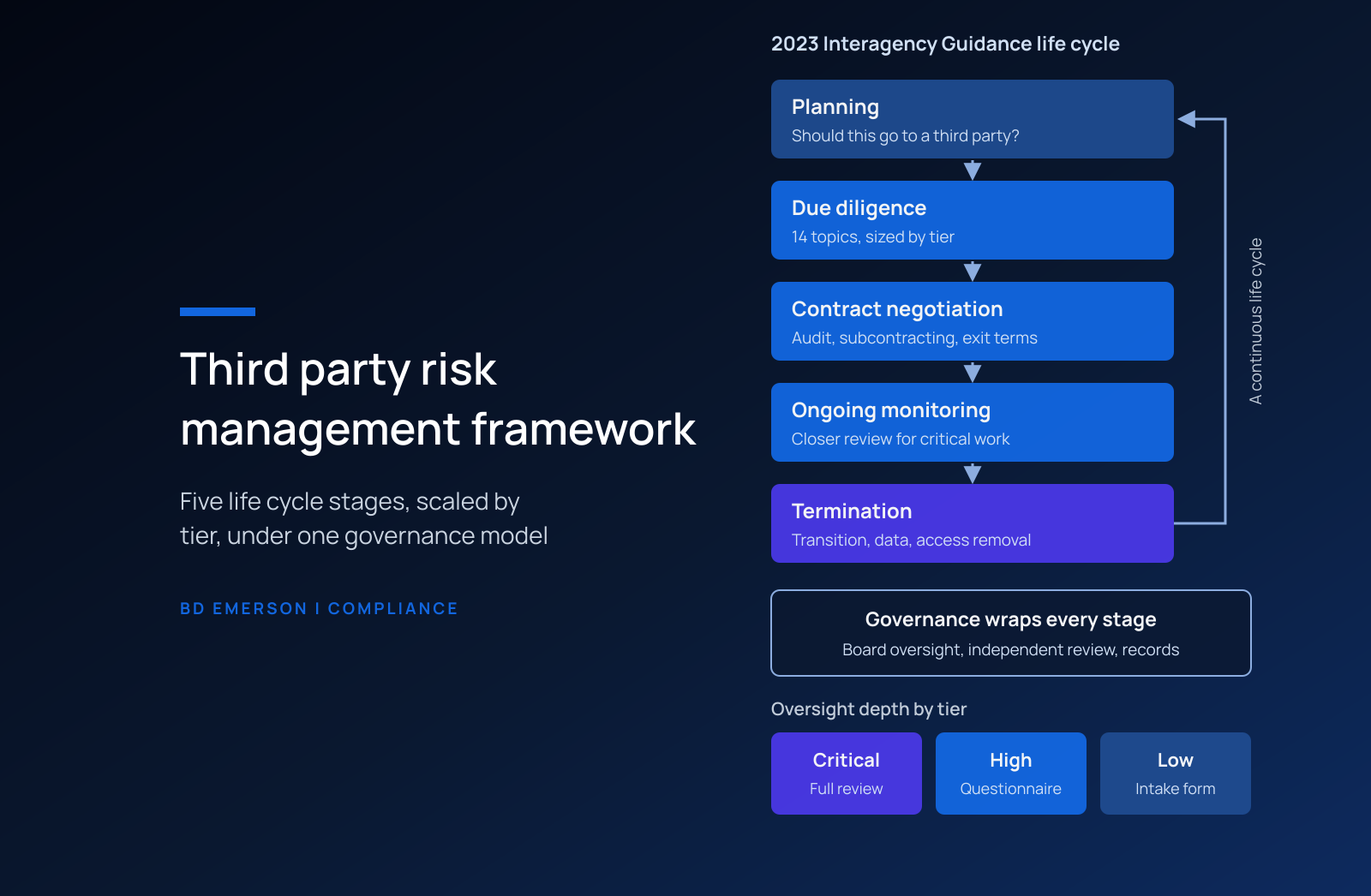
A third-party risk management framework is the documented set of roles, risk tiers, and life cycle steps an organization uses to choose outside providers, match scrutiny to the risk each one carries, and exit cleanly when a relationship ends. A full public model is the Interagency Guidance on Third-Party Relationships, which the Federal Reserve, FDIC, and OCC finalized on June 6, 2023. It sets five life cycle stages (planning, due diligence and third-party selection, contract negotiation, ongoing monitoring, and termination) inside three governance elements: oversight and accountability, independent reviews, and documentation and reporting. A working program pairs that life cycle with a control reference such as the NIST CSF 2.0 GV.SC category, the ISO/IEC 27036 series, or the Shared Assessments SIG questionnaire.
What is third party risk management?
Third-party risk management (TPRM) is the work of identifying, assessing, and controlling the risk that comes from depending on another organization. The 2023 guidance sets the scope wide. It addresses "any business arrangement between a banking organization and another entity, by contract or otherwise," and says a relationship "may exist despite a lack of a contract or remuneration." Its examples include outsourced services, independent consultants, referral arrangements, merchant payment processing, affiliates and subsidiaries, and joint ventures. By that test, an unpaid data-sharing partnership belongs in the inventory alongside a paid cloud contract.
A vendor risk management framework is the narrower version, limited to the suppliers you pay, and our guide to vendor risk management covers it. Both use the same life cycle, so one program can cover both. Accountability holds across both: the guidance states that "The use of third parties does not abrogate these responsibilities," so a bank that outsources a process still owns its compliance with the laws that govern it.
The five life cycle stages of a third-party risk management framework
The 2023 guidance describes "a continuous life cycle for third-party relationships," and exit planning starts early: the planning stage includes contingency plans to move the activity to another third party or bring it in-house. NIST CSF 2.0, published February 26, 2024, sets ten outcomes under Cybersecurity Supply Chain Risk Management (GV.SC). The table below maps each stage to the GV.SC subcategories that cover it. BD Emerson built this mapping, and NIST does not publish one.
| Stage | What the framework decides | NIST CSF 2.0 outcome |
|---|---|---|
| Planning | Whether the activity should go to a third party at all, and how critical it is | GV.SC-04, GV.SC-06 |
| Due diligence and selection | Whether this provider can meet your requirements, across 14 topics, including financial condition and reliance on subcontractors | GV.SC-06 |
| Contract negotiation | Audit rights, remediation, information handling, subcontracting, termination rights, and regulator access | GV.SC-05 |
| Ongoing monitoring | Whether controls, finances, and performance still hold, with closer review of higher-risk relationships | GV.SC-07, GV.SC-09 |
| Termination | How to transition the work, retrieve or destroy data, remove access, and settle costs | GV.SC-10 |
Due diligence covers the most ground. The guidance lists 14 topics, including financial condition, information security, operational resilience, incident reporting and management, insurance coverage, and reliance on subcontractors. For a low-risk provider, a short questionnaire addresses that list. For a provider running a critical activity, it means reading the scope and exceptions in its SOC 2 report or the scope of its ISO 27001 certificate, reviewing its business continuity test results, and confirming its insurance. Our vendor risk assessment method shows how to size that review by tier.
The contract makes due diligence enforceable. The guidance names 17 contract topics, among them the right to audit and require remediation, confidentiality and integrity, business continuity, subcontracting, default and termination, and regulatory supervision. CSF 2.0 GV.SC-05 asks that requirements addressing supply chain cybersecurity risk be "integrated into contracts and other types of agreements" with suppliers.
Ongoing monitoring confirms that what you approved is still true. The guidance lists factors such as changes in financial condition, lapses in insurance, audit and testing results, the location of subcontractors "and any related data," and how the provider responds to "changing threats, new vulnerabilities, and incidents." It calls for "more comprehensive or frequent monitoring" when a relationship supports higher-risk activities, including critical activities. When commenters urged continuous, real-time monitoring, the agencies replied that they "are not encouraging any specific approach to ongoing monitoring."
Termination planning belongs in the contract, because exit terms are hard to win once a relationship is ending. The guidance lists the factors to plan for: transition to an alternate third party or back in-house, termination costs and fees, data retention and destruction, information system connections and access control after the relationship ends, and handling of joint intellectual property. GV.SC-10 extends planning to activities "after the conclusion of a partnership or service agreement," which in practice means confirming the provider deleted your data and revoking every credential it held.
How to tier third parties by criticality
Tiering keeps a framework affordable. The 2023 guidance states that "Not all relationships present the same level of risk" and asks for oversight that matches each relationship's risk. It describes critical activities as those that could cause significant risk if the third party fails to meet expectations, have significant customer impacts, or have a significant impact on the bank's financial condition or operations. CSF 2.0 GV.SC-04 asks that suppliers be "known and prioritized by criticality."
We recommend three tiers. Critical providers support an activity that meets one of those tests or hold regulated data at volume, and they get full due diligence, negotiated contract terms, and at least an annual reassessment. High-risk providers touch sensitive data or production systems but could be replaced without disrupting customers, and they get a standard questionnaire and an evidence review. Low-risk providers have no data access and no operational dependence, so an intake form with a named owner and a renewal date is enough. Score each provider at intake on data sensitivity, system access, operational dependence, ease of substitution, and regulatory exposure, and rescore it when the relationship's scope changes.
On September 15, 2026, the OCC, Federal Reserve, FDIC, and NCUA published proposed third-party risk management guidance that moves away from the 2023 focus on "critical activities" and asks banks to oversee each relationship "in a manner proportionate to the risks they present." It organizes the program into four parts: risk identification and assessment, risk oversight, residual risk acceptance, and governance. It also states that the agencies "do not expect banking organizations to eliminate third-party risk." Comments were due November 16, 2026, and the notice states that "Any finalized guidance would replace the 2023 Guidance." Our guide to scalable third-party risk management shows how tiers change as a vendor count grows from 20 to 200.
Which third party risk management framework should you follow?
Pick one life cycle model and one control reference, then map every regulation and customer requirement to them. Separate programs for each regulation produce duplicate questionnaires and conflicting tiers.
| Reference | What it gives you | Best fit |
|---|---|---|
| 2023 Interagency Guidance (Federal Reserve, FDIC, OCC) | Life cycle stages, governance roles, 14 due diligence topics, and 17 contract topics | US banks, and any organization that wants a complete program template |
| NIST CSF 2.0, GV.SC-01 to GV.SC-10 | Ten supply chain outcomes, from strategy and roles through activities after a contract ends | Organizations that already measure security against CSF |
| ISO/IEC 27036 series | Requirements for acquirers and suppliers in Part 2 (2022) and supply chain guidance for hardware, software, and services in Part 3 (2023) | ISO 27001 programs that need depth behind the Annex A supplier controls |
| Shared Assessments SIG | The Standardized Information Gathering questionnaire, a shared question set for provider due diligence | Teams that need a recognized question set to send providers |
The guidance and CSF 2.0 are free. ISO/IEC 27036-2:2022 specifies information security requirements for "defining, implementing, operating" and improving supplier and acquirer relationships, and ISO sells it. ISO/IEC 27036-3:2023 covers hardware, software, and services supply chain security and supports the controls in ISO/IEC 27002, so an ISO/IEC 27001:2022 program can draw on the series for depth behind the Annex A supplier controls that an accredited certification body audits.
Who owns the framework, and how do you measure it?
The 2023 guidance gives the board ultimate responsibility for third-party risk oversight: it sets risk appetite, approves policies, and holds management accountable. Management runs the program: it integrates third-party risk management with the bank's overall risk management processes, sets staffing levels and expertise, escalates significant issues to the board, and terminates arrangements that do not meet expectations. Periodic independent reviews assess whether the bank's processes and controls "are designed and operating adequately," and management responds to what those reviews find.
Outside banking, the same split works with different titles. The business owner who requests a provider owns the relationship and its renewal. Security, privacy, and procurement review the provider against its tier requirements. A risk or compliance lead owns the policy, the tiering model, and residual risk acceptance above a set threshold. CSF 2.0 GV.SC-02 asks that cybersecurity roles for suppliers, customers, and partners be "established, communicated, and coordinated internally and externally," which includes telling each critical provider who its incident contact is on your side.
The guidance expects a current inventory that flags higher-risk and critical activities, plus risk assessments, due diligence results, executed contracts, monitoring reports, records of disruptions and breaches, and board reporting that shows dependency on a single provider for multiple activities. The measures that tell a board whether the framework works come out of those records:
- Share of active third parties with a current tier and a named owner
- Critical and high-risk providers past their reassessment date
- Open due diligence findings, by age and severity
- Critical contracts missing audit rights, breach notification, or termination assistance terms
- Third-party incidents and service disruptions in the period, with time to notification
- Providers that support more than one critical activity
How to manage fourth-party and subcontractor risk
Fourth-party risk is the exposure you inherit from your providers' own providers. The 2023 guidance manages it through the third party. Due diligence evaluates how much work the provider subcontracts, how it selects and oversees subcontractors, and where they operate. Subcontracting is one of the 17 contract topics, and the inventory includes related subcontractors as appropriate to the risk presented. The September 2026 proposal keeps that model, stating that "The use of subcontractors alone does not typically create an independent third-party relationship," while the bank remains responsible for complying with applicable laws.
We recommend three fourth-party controls. Require each critical and high-risk provider to share its subprocessor list and give notice before it adds one. Ask how the provider assesses its own critical suppliers, and read the subservice organization section of its SOC 2 report to see which controls it carves out. Then map concentration: when several critical providers run on the same cloud region or payment processor, one failure at that fourth party reaches all of them at once.
What should third party risk management software do?
Third-party risk management software holds the framework's records and runs its workflow. Products sold as TPRM tools, platforms, and solutions overlap heavily, so judge them on whether they hold the records described above. Write down the tiering model, questionnaire sets, and approval thresholds before you compare products, because a platform configured without them automates an undefined process.
A platform should hold the inventory with owners, tiers, and renewal dates; run intake and tier scoring; send questionnaires, including the SIG if you use it; collect evidence such as SOC 2 reports and penetration test summaries and flag it when it expires; track findings to closure; and produce the board metrics without a spreadsheet export. Residual risk acceptance stays with a named person.
BD Emerson, part of Andersen Consulting since October 2026, puts this life cycle into practice through its third-party risk management service. We assess your third parties' controls remotely or on site, work in Vanta or the tools you already use, and run the continuous monitoring and reporting that keeps your inventory and board metrics current.

About the author
















