

SAMA Cybersecurity Framework: Domains, Maturity Levels and Scope
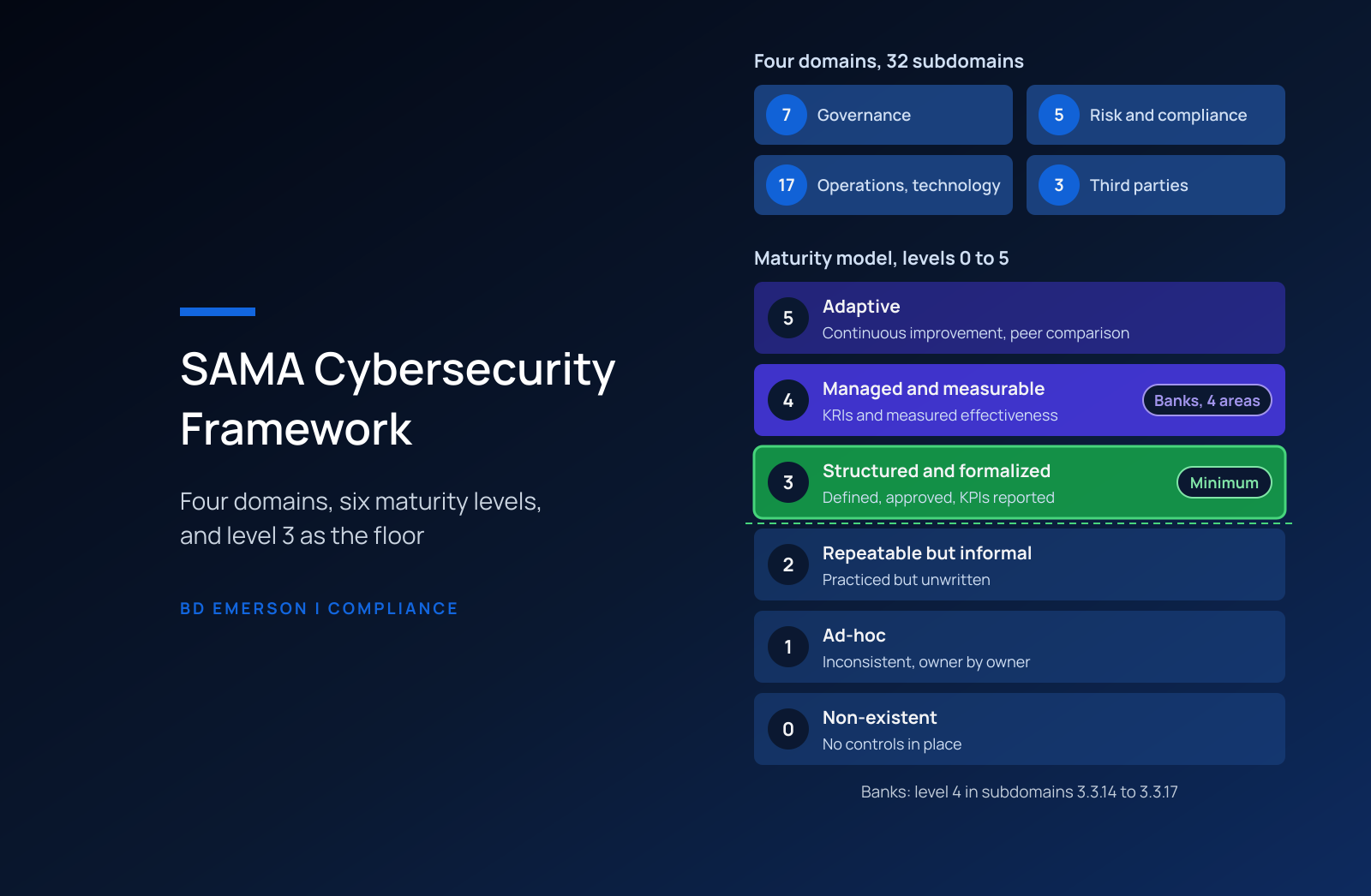
The SAMA Cybersecurity Framework, formally the Cyber Security Framework, is the mandatory control set that SAMA, now the Saudi Central Bank, issued on May 24, 2017 for the institutions it regulates: banks, insurance and reinsurance companies, financing companies, credit bureaus and financial market infrastructure. It sorts controls into four domains (leadership and governance, risk management and compliance, operations and technology, and third-party cyber security) and scores each organization on a six-level maturity model from 0 to 5. Every member organization must operate at maturity level 3 or higher, and banks must meet the level 4 requirements in event, incident, threat and vulnerability management. Each organization assesses itself against the framework, and SAMA reviews and audits those self-assessments.
What is the SAMA CSF?
SAMA CSF is the short name for the Cyber Security Framework, document number 381000091275. The Saudi Arabian Monetary Authority issued it, and in November 2020 King Salman approved the law that renamed the authority the Saudi Central Bank while keeping the SAMA acronym, so the framework still carries that name. The framework is listed as in force in the SAMA rulebook, and SAMA notes there that the Arabic text governs over the English translation.
Section 1.1 says SAMA built the framework from its own requirements and from NIST, Information Security Forum (ISF), ISO, Basel and PCI material. Under section 2.1, each subdomain states a principle (a summary of the required controls), an objective (what those controls must achieve) and control considerations (the mandated controls the organization works through). Where an organization cannot apply a control consideration, section 2.2 directs it to consider compensating controls, accept the risk internally and request a formal waiver from SAMA. Under Appendix D, the CISO and business owner sign the request, the CEO or managing director submits it, and the framework applies until SAMA grants the waiver.
Who does the SAMA cyber security framework apply to?
Section 1.4 applies the framework to every member organization SAMA regulates: banks, insurance and reinsurance companies, financing companies, credit bureaus and financial market infrastructure. Section 1.3 covers the organization's electronic and hardcopy information assets, and the framework gives direction for its subsidiaries, staff, third parties and customers.
All four domains apply to banks. Other member organizations get three exclusions and one conditional requirement. They are excluded from subdomain 3.2.3 on industry standards, unless they store, process or transmit cardholder data or use SWIFT services, in which case PCI DSS or the SWIFT Customer Security Controls Framework applies. They are excluded from 3.3.12 on payment systems. They are excluded from 3.3.13 on electronic banking, although any of them offering online services to customers still has to provide multi-factor authentication. Subdomain 3.1.2 makes alignment with the banking sector's cyber security strategy mandatory for them where it applies.
New entrants start on a lighter rulebook. SAMA's Cyber Resilience Fundamental Requirements, issued January 1, 2022, set baseline controls for firms seeking a SAMA license or Regulatory Sandbox entry, and the document states that it does not replace the CSF. For the threats these institutions face, see our guide to cybersecurity for the financial services sector.
The four domains and 32 subdomains
Section 3 holds the controls, divided as the table shows.
| Domain | Subdomains | What it covers |
|---|---|---|
| 3.1 Cyber Security Leadership and Governance | 7 (3.1.1 to 3.1.7) | Governance, strategy, policy, roles and responsibilities, security in project management, awareness, training |
| 3.2 Cyber Security Risk Management and Compliance | 5 (3.2.1 to 3.2.5) | Risk identification, analysis, response and monitoring; regulatory compliance; industry standards; reviews; audits |
| 3.3 Cyber Security Operations and Technology | 17 (3.3.1 to 3.3.17) | Human resources, physical and asset security, architecture, identity and access, applications, change, infrastructure, cryptography, bring your own device, secure disposal, payment systems, electronic banking, event, incident, threat and vulnerability management |
| 3.4 Third Party Cyber Security | 3 (3.4.1 to 3.4.3) | Contract and vendor management, outsourcing, cloud computing |
Subdomain 3.1.1 requires a board-mandated cyber security committee headed by an independent senior manager from a control function, with the CISO and senior managers from relevant departments as members, and internal audit may attend as an observer. The committee charter requires meetings at least quarterly. The cyber security function must sit apart from IT, with its own reporting line and budget, and it reports to the CEO or managing director or to the general manager of a control function.
Subdomain 3.2.4 calls for an annual cyber security review and penetration test of customer-facing and internet-facing services. Subdomain 3.3.5 requires multi-factor authentication for all remote access, for sensitive and critical systems and profiles, and, based on a risk assessment, for privileged access to critical systems. Under 3.3.15, the organization reports a medium or high classified incident to SAMA IT Risk Supervision immediately once it is identified, files a formal incident report after operations resume, and obtains SAMA's no-objection before any statement to the media.
The third-party domain requires SAMA approval before material outsourcing and before any use of hybrid or public cloud. Under 3.4.3, cloud services must in principle sit inside Saudi Arabia, a service outside the Kingdom needs explicit SAMA approval, and the contract must give the organization the right to audit the provider and to have its data returned and irreversibly deleted on exit. Our guide to scalable third-party risk management covers the vendor assessment program those contract terms depend on.
The maturity model and the level 3 requirement
Section 2.4 scores control areas on six levels. An organization reaches level 3, 4 or 5 only by meeting every criterion of the levels below it.
| Level | Name | What it means |
|---|---|---|
| 0 | Non-existent | No documentation, no awareness, and controls are not in place |
| 1 | Ad-hoc | Controls are partly defined and run inconsistently, varying by department or owner |
| 2 | Repeatable but informal | A standard practice exists but is unwritten, and control design is not formally approved |
| 3 | Structured and formalized | Controls are defined, approved and implemented, backed by policies, standards and procedures, with compliance monitored and KPIs reported |
| 4 | Managed and measurable | Control effectiveness is assessed periodically and improved, using KRIs and trend reporting |
| 5 | Adaptive | A continuous improvement plan drives the program, controls integrate with enterprise risk management, and performance is compared with peers |
Section 2.4 states that member organizations should operate at maturity level 3 or higher. Level 3 requires documentation and proof together: a board-endorsed policy, standards that set out which controls are required, procedures that tell staff how to perform them, and monitoring of compliance with key performance indicators (KPIs). A control that a team runs the same way every time from unwritten practice scores level 2, because no approved document defines it.
Banks face a higher bar in four subdomains. SAMA circular No. 29814/67 required each bank to send SAMA a board-approved roadmap, due by the end of the first quarter of 2019, for fulfilling every level 4 requirement in 3.3.14 event management, 3.3.15 incident management, 3.3.16 threat management and 3.3.17 vulnerability management by the end of the third quarter of 2022. Level 4 adds key risk indicators (KRIs) and periodic measurement of whether those controls work.
Self-assessment, SAMA review and audit
Section 2.3 requires each member organization to assess itself periodically against a questionnaire. SAMA reviews and audits those self-assessments to determine the organization's compliance level and maturity level. The framework sets no fixed interval.
SAMA's original instructions to banks required a board-approved roadmap to level 3 by the end of August 2017 and full compliance by the end of October 2018. The level 4 circular added an in-depth annual report from the bank's internal audit department on compliance against the required maturity level, and it states that SAMA conducts periodic inspection visits to verify the accuracy of the assessment. Financing companies had until the end of 2019 to comply fully.
Subdomain 3.2.5 sets the organization's own audit duty. Cyber security audits must be thorough, independent and regular, follow generally accepted auditing standards and the framework, and run under the organization's audit manual and audit plan. Subdomain 3.1.4 assigns that work to internal audit.
What is the SAMA IT Governance Framework?
The SAMA IT Governance Framework, document number 43028139, was issued on November 4, 2021 and applies to SAMA-regulated member organizations. Its four domains are IT governance and leadership (nine subdomains), IT risk management (four), IT operations management (eleven, including data centers, backup and virtualization) and system change management (eleven, including development, testing and patch management). It uses a six-level maturity model like the CSF's, with the same self-assessment and SAMA review. Its text names no minimum maturity level, and it states that it should be implemented together with the cyber security and business continuity frameworks.
The Business Continuity Management Framework, document number 381000058504, was issued on February 27, 2017 for member organizations, all banks operating in Saudi Arabia, banking subsidiaries of Saudi banks and subsidiaries of foreign banks in the Kingdom. Its 13 requirement areas run from governance and business impact analysis through disaster recovery, cyber resilience, crisis management and testing to assurance, and section 2.7 points back to the CSF for threat and vulnerability management. A May 18, 2022 circular applied a BCM framework to insurers and reinsurers, with full compliance due within one year.
SAMA CSF compared with NCA ECC and ISO 27001
A Saudi financial institution can answer to two cyber regulators. The National Cybersecurity Authority's Essential Cybersecurity Controls, version ECC-2:2024, apply to government organizations and their affiliated entities and to every private sector entity that owns, operates or hosts critical national infrastructure. ECC-2:2024 has 4 main domains, 28 subdomains, 108 main controls and 92 subcontrols, grouped as cybersecurity governance, cybersecurity defense, cybersecurity resilience, and third-party and cloud computing cybersecurity. An institution inside both scopes answers to SAMA for the CSF and to NCA, which assesses through self-assessments, compliance tool reports or field audits.
The two frameworks line up well at the domain level. Both open with governance, both end with a third-party and cloud domain, and both have dedicated subdomains for identity and access, vulnerability management, event monitoring, and incident and threat management. ECC subdomain 2-11 on penetration testing matches the annual test in CSF 3.2.4. ECC places business continuity inside its resilience domain, while SAMA handles it in the separate BCM Framework, and SAMA adds the maturity score. One control library, with each control tagged to its CSF subdomain and its ECC control number, lets a single team run both programs.
ISO/IEC 27001 is a certifiable management system standard. An organization with a working ISO 27001 management system already holds much of what level 3 asks for: a documented risk assessment, approved policies, defined roles, internal audit and management review. The gaps are the SAMA-specific requirements: the committee structure, the CISO's reporting line outside IT, immediate incident notification to SAMA, SAMA approval for cloud and material outsourcing, Saudi data location, and the maturity score itself. An accredited certification body certifies an ISO 27001 management system, while SAMA determines CSF compliance through its review and audit of the self-assessment. Our ISO 27001 implementation guide covers the management system side.
Getting to maturity level 3
A CSF program that holds up under SAMA review follows this sequence.
- Confirm which subdomains apply, using the section 1.4 exclusions if you are not a bank.
- Score each subdomain from 0 to 5 against its control considerations, with evidence for every score above 2.
- Close the level 3 documentation gaps first: policy, standards, procedures and the committee charter.
- Stand up KPI reporting for the quarterly committee meeting.
- Test the fixed requirements: MFA coverage, the annual penetration test, incident notification to SAMA, and cloud and outsourcing approvals.
- Have internal audit test the result before the next self-assessment goes to SAMA.
BD Emerson's cybersecurity compliance practice runs SAMA CSF gap assessments, scores current maturity by subdomain, builds the roadmap to level 3, drafts the policies, standards and procedures the framework requires, and supports internal audit in testing controls before the self-assessment goes in. We prepare the program and the evidence, and SAMA reviews it and sets your compliance and maturity level.

About the author
















