

Business Transformation: Types, Strategy, and the Transformation Office
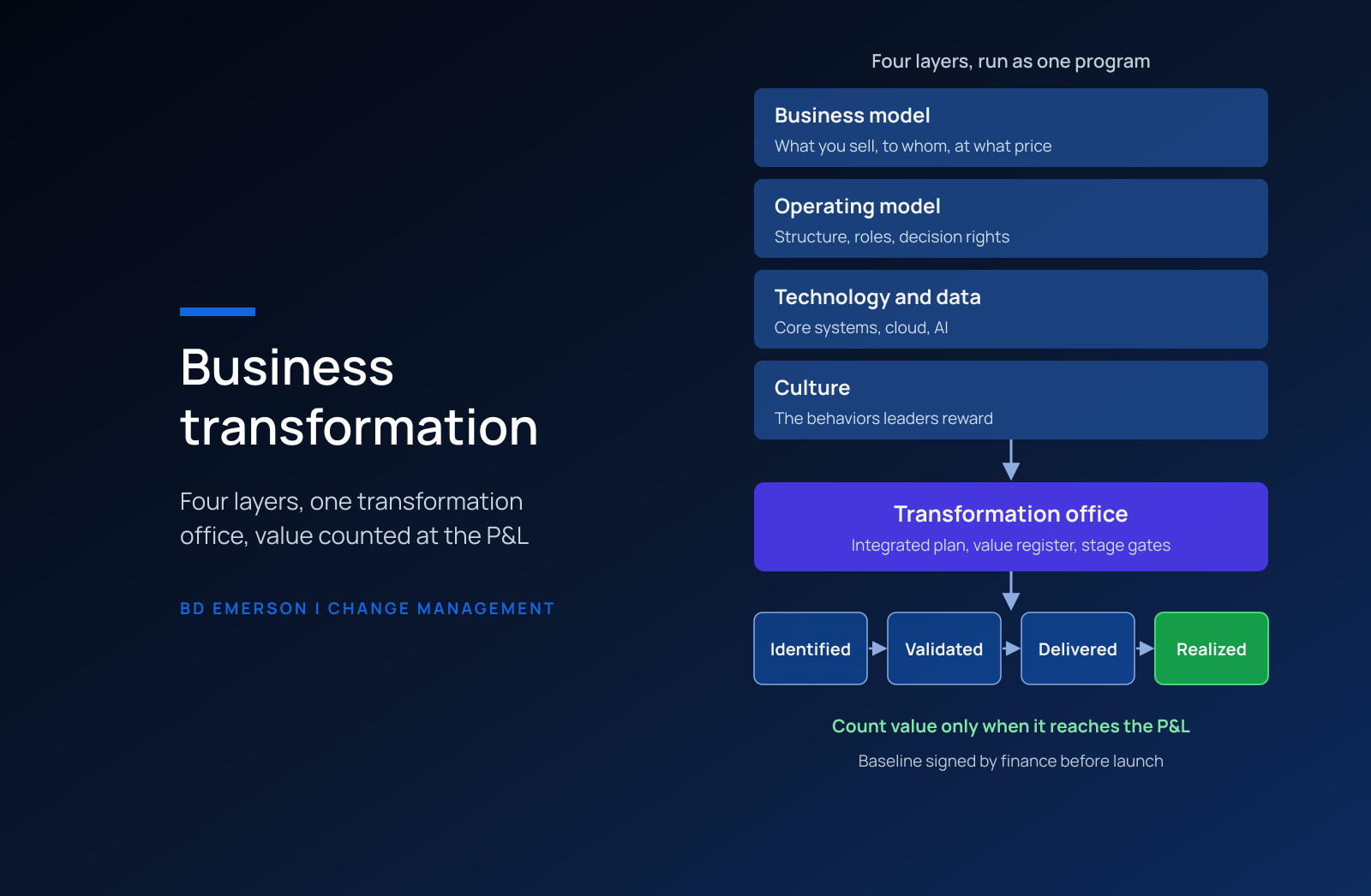
Business transformation is a coordinated change to how a company makes money, how it is organized to deliver, and how its people work, run as one program with a single executive owner and a financial target. It usually reaches four layers at once: the business model (what you sell, to whom, and at what price), the operating model (structure, roles, processes, and decision rights), the technology and data underneath both, and the culture that decides whether people use the new design. Continuous improvement makes the current model run better, while a transformation replaces parts of the model. Digital transformation is one layer of it. The programs that deliver results run through a transformation office, release value in waves, and count value only when it shows up in the financials.
The four types of business transformation
Most programs combine several types, and each type needs its own measure of success.
| Type | What changes | How you know it worked |
|---|---|---|
| Business model | The offer, the customer, the price, or the channel, such as a move from one-time license sales to subscriptions | Share of revenue from the new model and the margin it earns |
| Operating model | Structure, roles, decision rights, and core processes, such as consolidating regional finance teams into one shared service | Cost to serve, cycle time, and spans and layers |
| Technology and data | Core systems, data, and automation, such as an ERP replacement or a move from owned data centers to a cloud provider | Adoption of the new system, retired legacy cost, and process time |
| Culture | The behaviors leaders reward and the norms people follow, such as pushing decisions closer to the customer | Behavior measures from surveys and observation, and retention in affected teams |
The layers depend on each other. A subscription model stalls if the operating model still pays the sales team on one-time bookings, and a new ERP returns little if people keep running the business from spreadsheets. Our article on transformational change covers the related split between transformational, transitional, and incremental change.
How is business transformation different from digital transformation?
Digital transformation changes the technology and data a company runs on, and business transformation changes the company. A digital program can go live on schedule while the business case behind it goes unmet because roles, incentives, and processes stayed the same. The owner is a useful test. When the CIO owns the program and the measures are system milestones, it is a digital transformation. When the CEO or a business unit president owns it and the measures are revenue, margin, or cost to serve, it is a business transformation with a digital component. Digital business transformation usually describes the second case.
Cloud business transformation follows the same rule. Moving workloads from a data center to a cloud provider is a migration. It becomes part of a business transformation when the company also changes how it releases products, how it funds technology (shifting from capital projects to budgets owned by product teams), or which services it builds and which it buys. Our primer on digital transformation basics covers how to choose a technology partner for that layer.
Continuous improvement sits at the other end: Lean and Six Sigma programs make the current model faster and cheaper without changing its structure. John Kotter watched more than 100 companies "try to remake themselves into significantly better competitors" and grouped total quality management, reengineering, restructuring, cultural change, and turnaround together as versions of the same effort. In his 1995 Harvard Business Review article, he reported that most "fall somewhere in between, with a distinct tilt toward the lower end of the scale." A transformation changes the model, so it needs sponsorship from the top and a dedicated team.
What does a business transformation strategy include?
A business transformation strategy is the short document the executive team signs before any workstream starts, and it answers five questions. It puts the case for change in numbers, such as the margin gap, the share lost, or the cost a competitor no longer carries. It describes the target business model and operating model. It splits the value target by initiative and by year. It sets the order of initiatives. It names the governance: who decides, who funds, and who can stop a workstream. If the executive team cannot agree on the value target, the program is not ready to launch.
The U.S. Government Accountability Office reached a similar list in GAO-03-669, its July 2003 report on implementation steps for mergers and organizational transformations. Its first key practice is that top leadership drives the transformation, and the first step under it is to articulate "a succinct and compelling reason for change." Seven of its other practices call for integrated strategic goals, a key set of principles and priorities, implementation goals and a timeline made public, a dedicated implementation team, a performance management system that assigns accountability, a communication strategy, and employee involvement. Our guide to change management strategy covers the people-side decisions that sit next to the business strategy.
The transformation office
A transformation office is the small team that runs the program day to day for the executive sponsor. GAO calls it the implementation team, describes it as "responsible for the transformation's day-to-day management," says top leadership must give it the authority and resources to set priorities and make timely decisions, and notes that its size should match the scale of the change. It does not do the work inside each business unit. It holds the workstreams together and owns six things:
- The integrated plan, with the dependencies between workstreams and the date each initiative releases value.
- The value register, which records every initiative's target, baseline, owner, and status and is reconciled with finance.
- Stage gates, where an initiative moves forward only with evidence from the stage before.
- Risks, issues, and decisions, escalated to the steering committee on a fixed weekly cadence.
- Capacity, so the same managers are not carrying three initiatives on top of their regular jobs.
- The change plan and communication calendar, so employees hear one consistent message.
The office works best when its lead reports to the CEO or the business unit president, holds the authority to stop a workstream that misses its gate, and has a finance partner who signs off on value. GAO advised selecting high-performing team members and noted that the team's composition matters "because of the visual sign it communicates" about which parts of a combined organization dominate. A team drawn from every affected business unit tells employees the program belongs to the whole company. This is also where business transformation consulting services add the most: standing up the office, the value register, and the gates, then handing them to an internal lead.
Sequencing the work in waves
A program that tries to change everything at once overloads the managers who have to carry the change and leaves the business case unfunded for its first year. Sequencing in waves avoids both problems. The first wave funds initiatives that release value early and depend little on new systems, such as procurement savings, pricing discipline, or spans and layers. That value helps fund the later waves, which carry the longer work: system replacements, business model changes, and the culture shifts that depend on both.
GAO recommended thinking in terms of "multiple 'Day Ones'" and publishing implementation goals and a timeline so employees can see progress. Kotter's sixth error was failing to plan for and create short-term wins, and his seventh was declaring victory too soon. He wrote that until changes "sink deeply into a company's culture, a process that can take five to ten years, new approaches are fragile and subject to regression." GAO said successful major change management initiatives in large public and private organizations "can often take at least 5 to 7 years." Those durations argue for a sequence the company can sustain through several budget cycles and at least one change in leadership.
Tracking value so the results hold
Value tracking is where programs often lose credibility with the board, because savings that workstreams report do not appear in the P&L. Three habits prevent that. First, take the baseline before launch and have finance sign it, so no one can redefine the starting point later. Second, move each initiative through stages, from identified to validated to delivered to realized in the financials, and report only realized value as a result. Third, keep a named owner for each benefit after the program closes, because benefits tied to headcount or process changes erode once the program office disbands.
The failure rate quoted for transformations deserves the same scrutiny. Michael Beer and Nitin Nohria wrote in the May-June 2000 Harvard Business Review that "about 70% of all change initiatives fail." Mark Hughes reviewed five published instances of the claim in the Journal of Change Management in 2011 and found "no valid and reliable empirical evidence" to support it. A value register reconciled with finance is the measure that tells a board how its own program is doing.
Where does AI fit in a business transformation?
AI sits in the technology layer of a transformation, and Census Bureau data shows that most firms using it apply it in three or fewer business functions. A U.S. Census Bureau working paper published in April 2026 found that 18% of firms used AI in a business function between November 2025 and January 2026, or 32% weighted by employment. Among users, 57% used AI in three or fewer business functions, most often sales and marketing (52%), strategy and business development (45%), and IT (41%). Among users that reported any effect on worker tasks, 66% used AI only to augment those tasks, and 2% of users reported an AI-related employment decrease over the prior six months.
Those figures describe adoption inside the current operating model. AI business transformation starts when a company redesigns a process end to end around what the model can do, changes the roles and approvals in that process, and measures the result in cost to serve or cycle time. That work needs the same transformation office, baseline, and value register as any other initiative, plus governance over data, model risk, and security. Our analysis of why AI pilots stall covers the gaps that keep pilots from reaching production.
The people side decides whether the design gets used
Every type of transformation ends with people doing their work differently, and executives often fund that part last. A new operating model changes nothing until managers make decisions under the new rights, and a new system changes nothing until people stop using the workaround. GAO's practices address this directly, calling for communicating "early and often to build trust," encouraging two-way communication, and incorporating employee feedback into new policies and procedures.
The people plan should run on the same schedule as the program plan. It starts with an impact assessment by role, a readiness baseline, and a sponsor plan for each business unit leader. It continues with communication, training, and coaching for the managers who carry the change, and it reports adoption next to value. Daniels Consulting Group, which became part of Andersen Consulting alongside BD Emerson in October 2026, delivers this work with us. Amy Daniels, Ph.D., an organizational psychologist with a doctorate in industrial and organizational psychology, founded the firm, and its consultants draw on backgrounds in organizational psychology and business. DCG describes managing change as "both an art and a science."
BD Emerson puts the people plan and the program plan for a business transformation on one schedule, with one sponsor and one set of measures. Through our organizational transformation consulting practice, we and Daniels Consulting Group assess culture and readiness, align the leadership team on the case for change, design the organization and roles, coach executives and managers, and measure adoption and business results against a baseline set before launch. When the change runs through digital transformation, enterprise AI, core systems, or a post-merger integration, our technology teams deliver that work inside the same program.

About the author
















