

Strategic Workforce Planning: Process, AI Scenarios and Tools
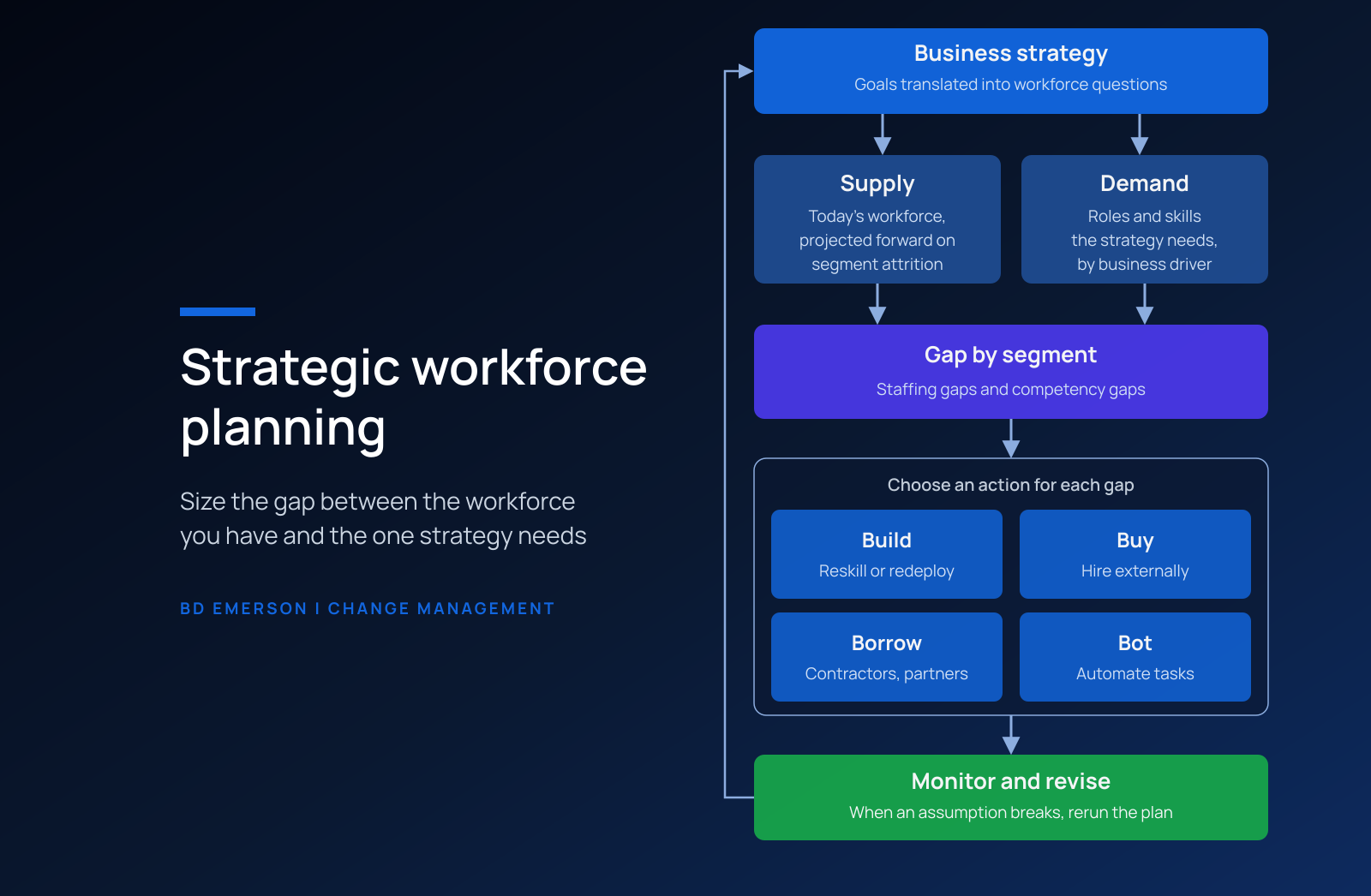
Strategic workforce planning is the process of deciding what workforce a business strategy needs, measuring the workforce the company has today, and choosing how to close the difference before it slows the strategy down. It runs in six steps: confirm the strategy, analyze workforce supply, forecast demand, size the gaps, choose actions (build, buy, borrow or bot), and monitor the results. It differs from operational headcount planning, which sets next year's hiring budget, because it works at the level of skills and critical roles across the full horizon of the strategy. The U.S. Government Accountability Office stated the purpose in its December 2003 report GAO-04-39: align an organization's human capital program with its current and emerging mission and programmatic goals, and develop long-term strategies for acquiring, developing and retaining staff.
What is workforce planning?
Workforce planning is the broader discipline, and strategic workforce planning is its long-range form. The U.S. Office of Personnel Management defines workforce planning in its November 2022 Workforce Planning Guide as a "systematic and continuous process for identifying the size and composition of a workforce" needed to meet an organization's goals. The international reference is ISO 30409:2016, Human resource management: Workforce planning, which ISO last reviewed and confirmed in 2022 and describes as scalable to any organization regardless of size, industry or sector.
Most companies already do one kind of workforce planning: the annual headcount budget. That plan answers how many people each department can hire next year and what they will cost. Strategic workforce planning answers a different question, which is whether the company will have the skills its strategy depends on, in the right places, when the strategy needs them.
| Question | Strategic workforce planning | Operational headcount planning |
|---|---|---|
| Horizon | The life of the business strategy | The budget year |
| Unit of planning | Skills, capabilities and critical roles | Requisitions and cost centers |
| Owner | Executive team, with HR and finance | Department heads and finance |
| Main output | A gap closure plan for each workforce segment | Approved headcount and salary budget |
| Review trigger | A strategy change or a broken assumption | Monthly variance against budget |
The two plans should connect. The strategic plan sets direction, and the operational plan funds the first year of it. A company that runs only the headcount budget ends up treating every resignation as a request to refill the same seat with the same job description.
The strategic workforce planning process in six steps
OPM's workforce planning model has five elements: Set Strategic Direction, Conduct Workforce Analysis, Develop Workforce Action Plan, Implement and Monitor Workforce Action Plan, and Evaluate and Revise Workforce Action Plan. The six steps below follow the same logic and split workforce analysis into supply, demand and gaps, because those three pieces use different data and different owners.
- Confirm the business strategy. Translate each strategic goal into workforce questions. A plan to open two distribution centers raises questions about warehouse supervisors, maintenance technicians and inventory analysts.
- Analyze supply. Measure current headcount, skills, tenure, retirement eligibility, attrition and internal movement for each segment, then project that workforce forward with no new action taken.
- Forecast demand. Estimate the roles and skills the strategy requires, using business drivers such as volume, customer count, revenue per employee and new capabilities the strategy introduces.
- Size the gaps. Compare projected supply with demand. OPM separates staffing gaps, where there are too few people, from competency gaps, where people lack the skills the work requires.
- Choose actions. Decide for each gap whether to build, buy, borrow or bot, and assign an owner, a budget and a date.
- Monitor and revise. Track progress against the plan and change it when the assumptions behind it change.
Supply analysis goes wrong when a company models attrition as one number. Turnover differs sharply by segment. The Bureau of Labor Statistics Job Openings and Labor Turnover Survey released on November 3, 2026 reported a September 2026 quits rate of 2.1 percent for total nonfarm employment, 0.9 percent in finance and insurance and 5.0 percent in accommodation and food services. Those are monthly, seasonally adjusted, preliminary rates. A plan that applies one company-wide rate to every role will overstate supply in high-turnover segments and understate it in stable ones.
Headcount tells you how many people you have. A skills inventory tells you what they can do, and it is the part most HR systems capture poorly. A structured talent assessment against future role requirements gives the supply side real data on readiness instead of job titles.
Workforce segmentation and critical roles
No company can model every role in detail, and it should not try. Segmentation decides where planning effort goes. OPM's guide sorts occupations into three tiers: strategic occupations, which set direction or directly affect mission delivery; core occupations, which execute mission functions; and supporting occupations, which maintain internal processes. It defines a mission critical occupation as one an agency considers core to carrying out its mission, where a vacant or understaffed position impairs mission delivery.
Private companies apply the same idea with two tests. The first is impact: if this role sat empty for a quarter, what part of the strategy would stop? The second is scarcity: how long does it take to hire or train someone to full productivity in this role? Roles that score high on both are critical roles. They get full supply and demand modeling, named successors and retention plans. Supporting roles can be planned with simple ratios, such as one payroll specialist per set number of employees, and revisited when those ratios drift.
A critical segment can be as small as the four people who understand a legacy billing system. Succession coverage for those positions is part of the workforce plan, and our talent management consulting team builds it alongside the planning work.
How does AI change workforce planning?
AI changes the demand side of the plan at the level of tasks, and the job titles stay the same until someone redesigns the role. The practical method is to break each role into its tasks, judge which tasks AI tools already perform or assist inside the company, and recalculate capacity from there. The O*NET 31.0 database, sponsored by the Department of Labor's Employment and Training Administration, lists 1,016 occupation codes and 18,838 task statements, which gives planners a standard starting task list before they adjust it to their own workflows.
Scenario planning works better than a single forecast here. For each affected role family, build three cases. In the first, tasks stay as they are. In the second, AI assists with a share of tasks, headcount holds and capacity moves to higher-value work. In the third, AI absorbs a share of tasks, fewer roles are needed and new roles appear to supervise, test and maintain the tools. Tie each scenario to evidence the company can measure, such as cycle time, volume handled per person and error rates in a controlled pilot. The plan moves to a scenario when the pilot data supports it, which keeps decisions reversible for as long as possible.
Reduction scenarios carry legal lead times that belong in the plan's timeline. The federal WARN Act generally covers employers with 100 or more employees and requires 60 calendar days' notice of plant closings and mass layoffs. A mass layoff at a single site covers 50 to 499 employees in a 30-day period who make up at least 33 percent of the site's workforce, or 500 or more employees regardless of that percentage. WARN does not preempt state or local law, so the timeline must also meet any state notice law that applies. The people side of the shift, how employees learn to work with the tools and how managers explain the changes, is the subject of our guide to AI change management.
Build, buy, borrow or bot: choosing the action
Every gap needs a response, and each response has a different cost, lead time and risk. The four-way framing below is common in workforce planning practice. OPM's guide covers the same ground with action categories for training and retraining, recruitment and retention, contracting out, technological enhancements and succession planning.
| Action | What it means | Fits when |
|---|---|---|
| Build | Reskill, upskill or redeploy current employees | Adjacent skills exist inside the company and the timeline allows training |
| Buy | Hire from the external market | The skill is permanent to the strategy and absent internally |
| Borrow | Use contractors, consultants or outsourced providers | The need is temporary, uncertain or specialized |
| Bot | Automate tasks with software or AI | Tasks are high volume, rule-based and measurable |
Most gaps take a mix. A company short on data engineers might hire two senior engineers, retrain analysts with strong SQL skills and use a contractor while training runs. The action plan should also name the people whose departure would reopen a gap the company already closed, and give each of them a retention plan.
What workforce planning tools and software do you need?
Data comes before software. A plan needs five inputs: the core HR system of record for headcount, positions, tenure and pay; the applicant tracking system for time to fill and offer acceptance; the finance budget for workforce cost; skills or learning data for capability; and external benchmarks such as BLS turnover data and O*NET task content. Before any tool goes in, HR and finance have to agree on definitions. Decide whether headcount means people or full-time equivalents, whether contractors count, and whether the plan tracks positions or people. Two teams using two definitions will produce two different gaps from the same data.
Many companies start strategic workforce planning in spreadsheets, which works for a first cycle with a few critical segments. Dedicated software earns its cost when the company needs repeatable scenario models and a shared source of numbers. The market has three broad types. Finance-led planning tools model workforce cost alongside the financial plan; Workday says Adaptive from Workday "brings workforce and financial planning onto one platform." Organizational design platforms model structure and skills; Orgvue describes creating and comparing scenarios to close gaps "using measures such as build, buy, borrow, bot." People analytics platforms add workforce planning to an analytics base; Visier says its Workforce Planning product enables "continuous, collaborative, data-driven planning."
Workforce planning analytics should answer a short list of questions for leadership. How many critical roles are vacant or at risk? What share of critical roles were filled internally? Is attrition in critical segments running above the plan's assumption? Is workforce cost tracking to budget? A dashboard that cannot answer those four questions gives leaders nothing to act on.
Monitoring the plan and keeping it current
GAO's fifth principle is to monitor and evaluate progress toward human capital goals and the contribution human capital results make toward programmatic results. In practice, that means a quarterly review of the plan's assumptions, an annual refresh tied to the strategy cycle and an unscheduled review when something material changes, such as an acquisition, a major system go-live or AI pilot results that move a role family into a different scenario.
The review needs the right people in the room. GAO's first principle is to involve top management, employees and other stakeholders in developing, communicating and implementing the plan. A plan written by HR alone usually stalls at the budget conversation, because the business leaders who own the demand forecast never agreed to it. The measures worth tracking are critical role vacancy rate, internal fill rate for critical roles, skill attainment against the build plan, regretted attrition in critical segments and workforce cost against budget.
BD Emerson's workforce transformation consulting turns a strategic workforce plan into role-level change. We mark each role as unchanged, changed, new or ending, write profiles for the changed and new roles, assess employees against those profiles and build the reskilling and transition plans that move people into the new work. Our Andersen Consulting colleagues at Daniels Consulting Group, who draw on a background in organizational psychology and business, lead that work with us.

About the author
















