Leadership Alignment: What It Is, How to Test It, and How to Build It
What is leadership alignment?
Leadership alignment is the condition in which the members of a leadership team hold the same priorities, make the same trade-offs when those priorities conflict, and act on both when the rest of the team is not in the room. It is a stricter standard than agreement in a meeting, which only records that nobody objected aloud. An aligned team gives the organization one answer to three questions: what matters most, what gives way when two goals collide, and how leaders are expected to behave. A misaligned team gives several answers, and the strategy slows down as each function follows the answer it heard from its own executive.
The definition has three parts, and each one can be observed. Shared priorities means every leader would write the same short list in the same order. Shared trade-offs means leaders would make the same call on a real conflict, such as which of two initiatives gets a scarce engineer. Shared behaviors means leaders do what the team decided, including the leaders who argued against the decision. A team can pass the first test and fail the other two, which explains how a strategy offsite can end with nodding heads and change nothing.
How is alignment different from agreement?
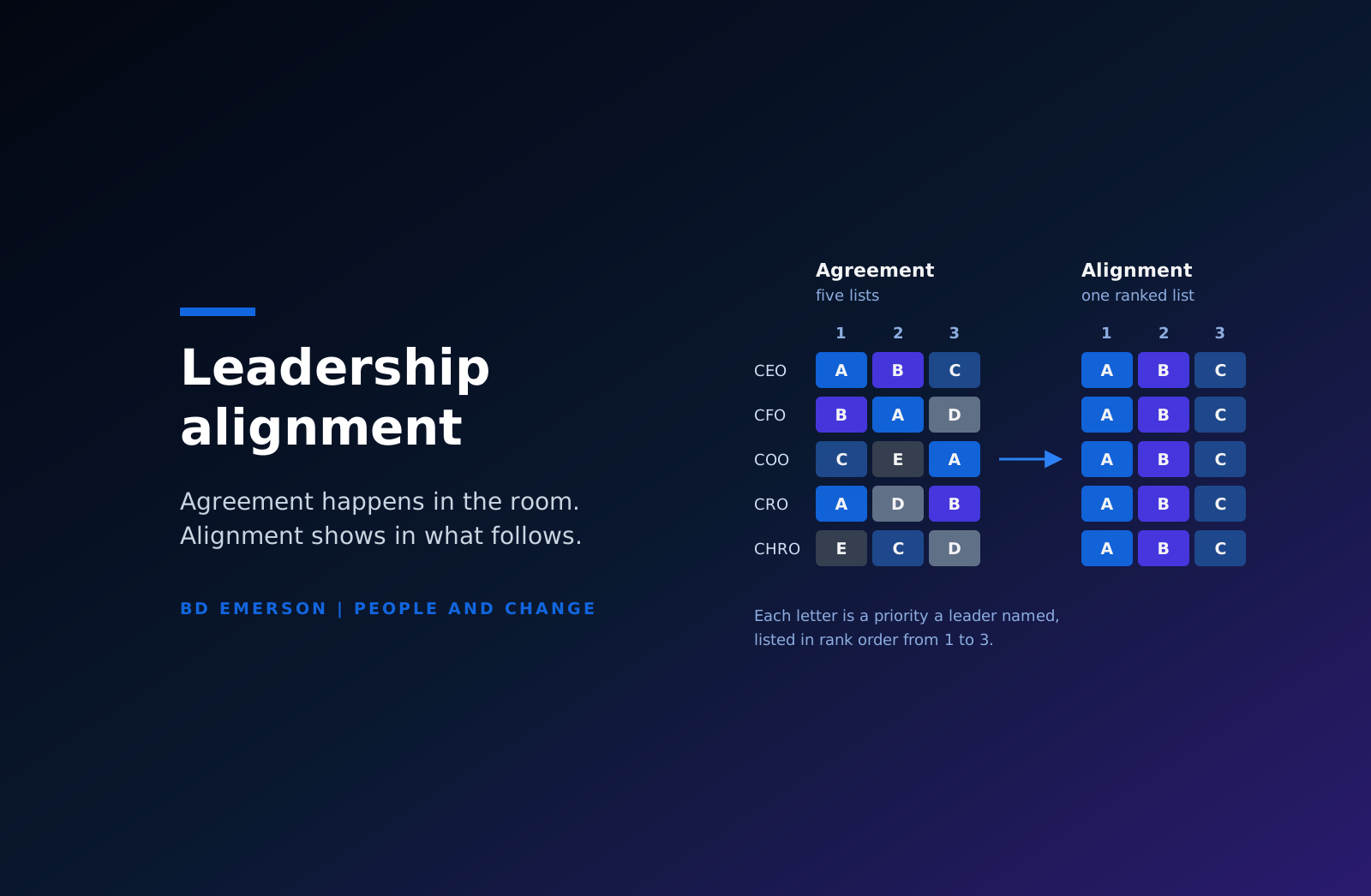
Agreement is an event, and it happens in the room. Alignment is a pattern, and it shows in what leaders do over the following months. Three differences matter in practice.
Agreement can be silent. A leader who has doubts and says nothing counts as agreeing, and the doubt comes back later as a delay, a reopened decision, or a quiet instruction to their own team. Alignment requires that the doubt was voiced and answered before the decision closed.
Agreement is usually about goals. Most executive teams will agree that growth, margin, customer experience, and talent all matter. Alignment is about rank order and trade-offs, because a strategy only becomes real at the point where one good thing has to give way to another.
Agreement belongs to the people in the meeting. Alignment has to survive translation. Each executive restates the strategy for a function, and each restatement can shift the emphasis. Alignment holds when a plant manager, a regional sales director, and a product lead would describe the same priorities after hearing them from three different executives.
Alignment also differs from unanimity. A team that debates hard, decides, and then backs the decision is aligned. A team that avoids debate to keep the peace has agreement and little else.
Why does misalignment stall strategy?
Two large surveys show how far apart leaders usually are on priorities. A survey of 11,000 senior executives, leaders, and managers from more than 400 companies, designed by Donald Sull of MIT Sloan with Rebecca Homkes of London Business School, asked people to list their company's top three to five priorities. Only a third could list their firm's top three. The figure was only slightly more than half for people who had been involved in developing the strategy. A later analysis by Sull and his coauthors, summarized by MIT Sloan, covered 124 organizations and found that only 28 percent of the executives and middle managers responsible for executing strategy could list three of their company's strategic priorities.
Those numbers describe a mechanism. When executives carry different versions of the priorities, four things follow.
Resources spread thin
Every executive funds the initiatives that match their own reading of the strategy. The company ends up with more programs than it can staff, and the most important ones compete for people with the least important ones.
Decisions get reopened
A decision that some leaders never accepted returns to the agenda in a new form. The team spends its meetings on questions it has already answered, and the organization learns that a decision is only a starting position.
Middle managers receive conflicting direction
Cross-functional work depends on managers who report to different executives. When those executives rank the priorities differently, the managers cannot resolve the conflict themselves, so they escalate it or wait.
People stop believing the strategy
Employees compare what leaders say with what leaders fund, measure, and reward. When the two diverge from one executive to the next, employees conclude that the strategy is optional and return to the work they already know.
How do you test leadership alignment?
Alignment can be measured with simple instruments, provided leaders answer separately and before they hear one another. Asking the group in a meeting measures agreement again. The table shows a test for each of the three components and the result that signals a gap.
| Component | How to test it | What a gap looks like |
|---|---|---|
| Shared priorities | Ask each leader to write the company's top three priorities for the year, in order, without conferring. Repeat the exercise with their direct reports. | The lists overlap on one item or none, or direct reports name priorities their own executive did not. |
| Shared trade-offs | Give each leader the same four or five real scenarios in which two priorities conflict, and ask what they would decide and why. | Leaders reach different decisions, or the same decision for reasons that would produce different answers next time. |
| Shared behaviors | Review the decisions of the last two quarters and trace what happened afterward in budgets, staffing, and communications. | Decisions were reopened, funding did not move, or functions received different messages about the same decision. |
Two further checks are useful. The first compares the stated priorities with where money and senior time went, since allocation shows the priorities the team is really working to. The second is a set of confidential interviews with each leader, conducted by someone outside the team. People say things in a one-to-one interview that they will not say in front of the chief executive, and those unsaid things are the misalignment.
Research on strategic consensus adds a caution about what to measure. A 2005 article in the Journal of Management by Franz Kellermanns, Jorge Walter, Christoph Lechner, and Steven Floyd examined why studies of strategic consensus had reached inconsistent findings about its value. The authors called for definitions that specify the locus of agreement, meaning who agrees, and the content of agreement, meaning what they agree on. The practical point for a leadership team is to be precise. The executive team needs to align on priorities and trade-offs. Middle managers need to align on what those priorities mean for their units. Testing whether everyone agrees with everything measures the wrong thing.
How does a leadership team build alignment?
Alignment is built through a sequence of working sessions and follow-through. The seven steps below take a team from diagnosis to a retest.
- Diagnose before the team meets. Interview each leader and run the priority and trade-off tests individually. Present the results to the team without attribution so that the gaps are on the table as data.
- Cut the list. Reduce the priorities to a short ranked list. Ranking forces the conversation that a list of equal priorities avoids, because someone's initiative has to come second.
- Decide the trade-offs with real cases. Take the conflicts that are live in the business now and decide them as a team. Record the reasoning, since the reasoning is what leaders will apply to the next case.
- Name the behaviors. State what each leader will do and stop doing as a result. Typical commitments cover which decisions leaders will delegate, how they will speak about the decision to their teams, and where they will move people and budget.
- Write one message. Agree on the words that every leader will use to explain the priorities and the trade-offs. Managers two levels down should hear the same explanation from any executive.
- Tie it to the operating rhythm. Change budgets, scorecards, incentives, and meeting agendas to match the decisions. Alignment that lives only in an offsite summary fades when the next quarter's pressure arrives.
- Retest. Repeat the individual tests after the cascade has reached middle management, and compare the results with the baseline.
The quality of the debate in steps two and three determines whether the alignment holds. Amy Edmondson's study of 51 work teams in a manufacturing company defined team psychological safety as a shared belief held by members of a team that the team is safe for interpersonal risk taking, and found that it was associated with team learning behavior. For an executive team the risk in question is telling a peer or the chief executive that a favored initiative should lose. If leaders judge that risk to be too high, they stay silent in the session and act on their disagreement afterward. A facilitator trained in group dynamics can make the disagreement discussable, and leadership development and coaching can build the habit so that the team does not need a facilitator each time.
Who has to be aligned, and in what order?
Alignment starts with the chief executive and direct reports, because every other level takes its direction from them. It then extends to the next level of leaders, who run the functions and business units and who translate priorities into plans. Middle managers come third, and they need more than a presentation. They need the reasoning behind the trade-offs so that they can make consistent calls on cases the executive team never discussed.
The order matters. A company that cascades a strategy before the top team has settled its own trade-offs sends the disagreement down the hierarchy, where it is harder to see and harder to fix. A transformation program raises the stakes further, since the organization is being asked to change how it works on the strength of what leaders say.
How long does alignment take, and how do you keep it?
The time required depends on how far apart the leaders are at the start, how many trade-offs are unresolved, how much trust the team has, and how many levels of leadership have to carry the message. A team with a clear strategy and a few open trade-offs needs less work than a team that has merged two companies or changed its chief executive.
Alignment also decays. New leaders join, markets move, and a decision that fit last year's conditions stops fitting. Teams that stay aligned treat it as a recurring task. They revisit the ranked priorities on a set schedule, they bring live trade-offs to the full team, and they repeat the individual tests often enough to catch drift early.
BD Emerson delivers this work with our Andersen Consulting colleagues at Daniels Consulting Group, a firm founded in 2002 by Amy Daniels, Ph.D., an industrial and organizational psychologist. If your strategy is clear on paper and slow in practice, see our strategy execution consulting service and book a consultation.

About the author