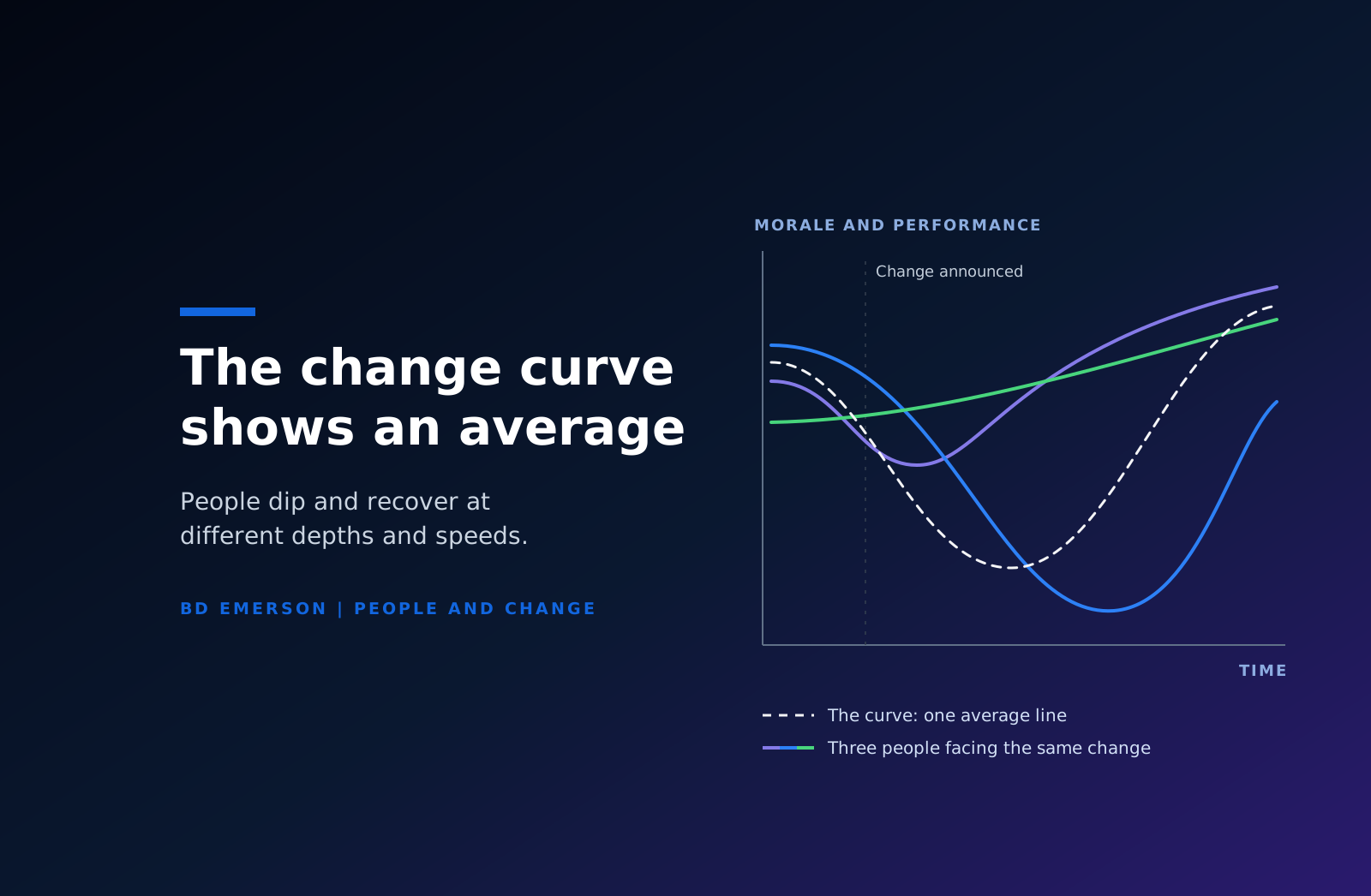
Resistance to Change: Why Employees Resist and How Leaders Respond
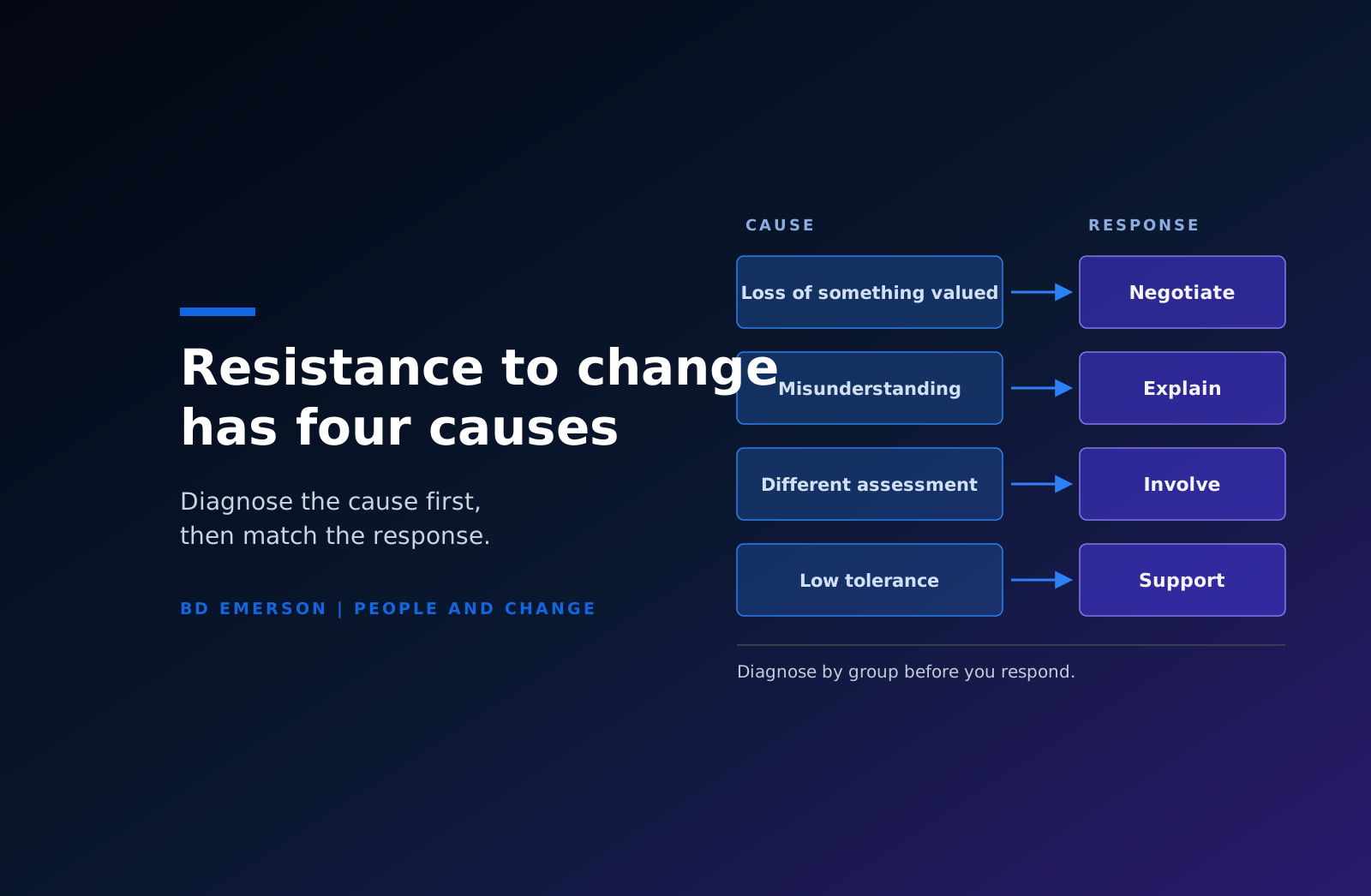
Resistance to change is the set of thoughts, feelings, and behaviors through which people oppose, slow, or withhold support for a change at work. Organizational psychology treats it as a response to the way a change is designed, explained, and led, so the first place to look for the cause is the context of the change. Employees resist for four common reasons: they expect to lose something they value, they misunderstand the change or distrust its sponsor, they judge the change differently than leaders do, or they doubt they can adapt. Leaders respond well when they diagnose which cause is present and match the response to it.
What is resistance to change?
Resistance to change describes any response that works against a change the organization has decided to make. The visible forms include open objection, slow adoption, workarounds that keep the old process alive, missed training, and silence in meetings followed by complaint afterward. The less visible forms matter as much. A team can comply with every instruction and still withhold the effort that makes a new process work.
Sandy Piderit's review in the Academy of Management Review gives the most useful definition for practitioners. She describes responses to change as attitudes with three dimensions: the cognitive (what a person believes about the change), the emotional (what the person feels about it), and the intentional (what the person plans to do). The three can disagree. An accountant can believe a shared services model is right for the company, feel anxious about a new manager, and intend to wait and see. Piderit calls that mixed state ambivalence, and she argues that most employees' first responses to a change that redefines what the organization values will be ambivalent.
This matters for managing resistance to change because a single label hides three different problems. A belief problem calls for evidence and dialogue, a feeling problem calls for support, and an intention problem calls for a clear ask and a reason to commit. Piderit also warns that the label itself can dismiss valid concerns and cast employees as obstacles, which leads managers to stop listening at the moment the information is most useful.
Where does the concept come from?
The term entered management research through a 1948 paper by Lester Coch and John French, "Overcoming Resistance to Change," published in the first volume of the journal Human Relations. In 1947 the two ran an experiment at the Harwood Manufacturing pajama factory in Marion, Virginia, where managers were changing jobs and cutting piece rates. One group of 18 pressers was told about the change in a meeting, in the plant's normal manner. Other groups helped design their new jobs and set the new rates, either through representatives or directly. A 2018 reexamination of the Harwood studies in the same journal recounts that the group that was only told restricted its production, and that three of its 18 members left within 40 days.
Bernard Burnes, reviewing the study in the Journal of Change Management, summarizes its central claim: resistance arises from the context in which a change takes place. That claim still organizes the field. The study also has limits that a careful reader should know. The 2018 reexamination points out that the experiment was run without the union the workers had recently elected, and that the piece-rate cut was framed in management's favor. We still take one practical lesson from Harwood, which is that the way a change is introduced shapes the response to it.
Why do employees resist change?
John Kotter and Leonard Schlesinger's Harvard Business Review article "Choosing Strategies for Change" names the four most common reasons people resist, and the four remain the best starting list for diagnosis.
Parochial self-interest. People expect to lose something they value, such as status, autonomy, a team, overtime pay, or expertise that took years to build. This form of employee resistance to change is rational from the employee's seat, and reassurance without substance makes it worse.
Misunderstanding and lack of trust. People do not understand what the change involves, or they do not trust the person leading it. Rumor fills every gap that communication leaves, and a history of unkept promises turns a neutral announcement into a threat.
Different assessments. Employees weigh the costs and benefits and reach a different answer than leaders did, often because they hold different information. Frontline staff know things about customers, systems, and workarounds that a business case can miss, which means this group is sometimes right.
Low tolerance for change. People doubt that they can develop the skills and behavior the change requires. The doubt grows when several changes land on the same team at once and when earlier changes arrived without training.
Individual differences add a fifth factor. Shaul Oreg's Resistance to Change Scale, published in the Journal of Applied Psychology, measures a person's dispositional inclination to resist change across four factors: routine seeking, emotional reaction to imposed change, cognitive rigidity, and short-term focus. Disposition explains why two people in the same role respond differently to the same announcement. When a whole department pushes back, the cause almost always sits in the design or the communication of the change, and leaders can fix both.
How do you diagnose the cause of resistance?
Diagnosis starts by separating the group from the individual and the cause from the symptom. A late timesheet, a skipped training session, and a hostile question in a town hall are symptoms. The cause is one of the reasons above, and each cause produces recognizable signals. The response names in the last column of the table are Kotter and Schlesinger's, and the pairing with each cause is how we apply them.
| Cause | What you hear and see | What to check | Response that fits |
|---|---|---|---|
| Loss of something valued | Questions about roles, pay, reporting lines, and location | The impact assessment by role: who loses status, autonomy, income, or expertise | Negotiation and agreement, with losses stated plainly |
| Misunderstanding and low trust | Rumors, repeated basic questions, references to past initiatives that failed | Whether employees can state what changes for them and who told them | Education and communication, delivered by direct managers |
| Different assessment | Specific objections to the design and workarounds that keep the old process alive | Whether the objection is correct, tested with data and with the people closest to the work | Participation and involvement, with design changes where the objection holds |
| Low tolerance for change | Anxiety about skills, slow adoption after go-live, requests to keep the old tool | Training completion, proficiency, and the number of concurrent changes on the same team | Facilitation and support through training, practice time, and coaching |
| Individual disposition | One person resists while peers in the same role adapt | The person's pattern across earlier changes | Individual coaching from the direct manager |
Three sources of evidence support the diagnosis. A change readiness assessment surveys the affected groups before launch and shows where belief, feeling, and intention diverge. Structured interviews with managers and frontline employees explain the survey numbers. Operational data such as training completion, system usage, error rates, and turnover in affected teams shows what people do, which often differs from what they say. Diagnose by group, because a finance team and a sales team facing the same program rarely resist for the same reason.
How do leaders manage resistance to change?
Leaders manage resistance to change by matching the response to the diagnosed cause. Kotter and Schlesinger describe six methods and the situations each one fits. Education and communication fit where information is missing or inaccurate. Participation and involvement fit where the people designing the change lack information that others hold. Facilitation and support fit where people struggle to adjust. Negotiation and agreement fit where a group will clearly lose out and has the power to resist. The last two methods, manipulation and coercion, appear in their list for situations where other tactics fail or speed is essential. We advise against both, because the trust they spend is the same trust the next change will need.
Four practices carry most of the weight once the cause is known.
- Involve the affected people in the design early. Ask the people who do the work to help shape the new process, and use their input where it improves the design. Involvement produces a better design and gives employees a stake in the result.
- State losses plainly. Tell people what they will lose, what stays the same, and what the organization will do about it. Employees forgive bad news faster than they forgive a surprise.
- Equip direct managers. Give managers the reasons for the change, answers to the hard questions, and the authority to resolve local problems. A manager who cannot explain the change will transmit doubt to the whole team.
- Treat objections as data. Log each objection, answer it, change the design when the objection is right, and report back to the people who raised it.
Timing matters as well. Resistance that surfaces before launch is cheap to address because the design can still move. Resistance that surfaces after go-live shows up as low adoption, and by then the available responses narrow to support and reinforcement. A change management plan should therefore schedule the diagnosis before the communications, and it should name who owns the response for each stakeholder group.
What mistakes make resistance worse?
The first mistake is treating resistance as one thing. A sponsor who answers every objection with more communication will fail with a group whose real problem is a loss of status or pay. More town halls do not help people who understand the change perfectly and dislike what it costs them.
The second mistake is labeling people as resisters. The label ends the conversation and assigns the cause to the employee before anyone has checked the design, the workload, or the sponsor's own behavior. Leaders who cancel steering meetings, skip their own training, or keep using the old report teach the organization that the change is optional.
The third mistake is stacking changes. A team that is absorbing a new system, a new structure, and a new manager in the same quarter has a capacity problem, and its slow adoption reflects arithmetic. Sequencing the changes, or removing other work, addresses the cause directly.
The fourth mistake is ignoring culture. When a change asks for behavior that the organization has never rewarded, such as raising problems early or sharing customers across teams, the resistance signals a conflict with the culture. That conflict needs work on norms, incentives, and leadership behavior, which is the subject of culture transformation.
When does resistance call for outside help?
Three situations justify outside support. The first is a program with a large workforce impact, such as an ERP implementation, a move to shared services, a merger, or an AI rollout that changes how roles are defined. The second is a pattern in which the same objections recur across unrelated programs, which points to trust or culture and away from any single project. The third is disagreement inside the leadership team, because employees read a divided sponsor group as permission to wait.
BD Emerson delivers this work with our Andersen Consulting colleagues at Daniels Consulting Group, a firm of organizational psychologists and experienced business professionals founded in 2002 by Amy Daniels, Ph.D. Our change management consulting service covers the readiness assessment, the stakeholder diagnosis, the change plan, and the manager preparation described above. Book a consultation to speak with BD Emerson and Daniels Consulting Group about the resistance you are seeing.

About the author