

Corporate Restructuring: Types, Process and the 13-Week Cash Forecast
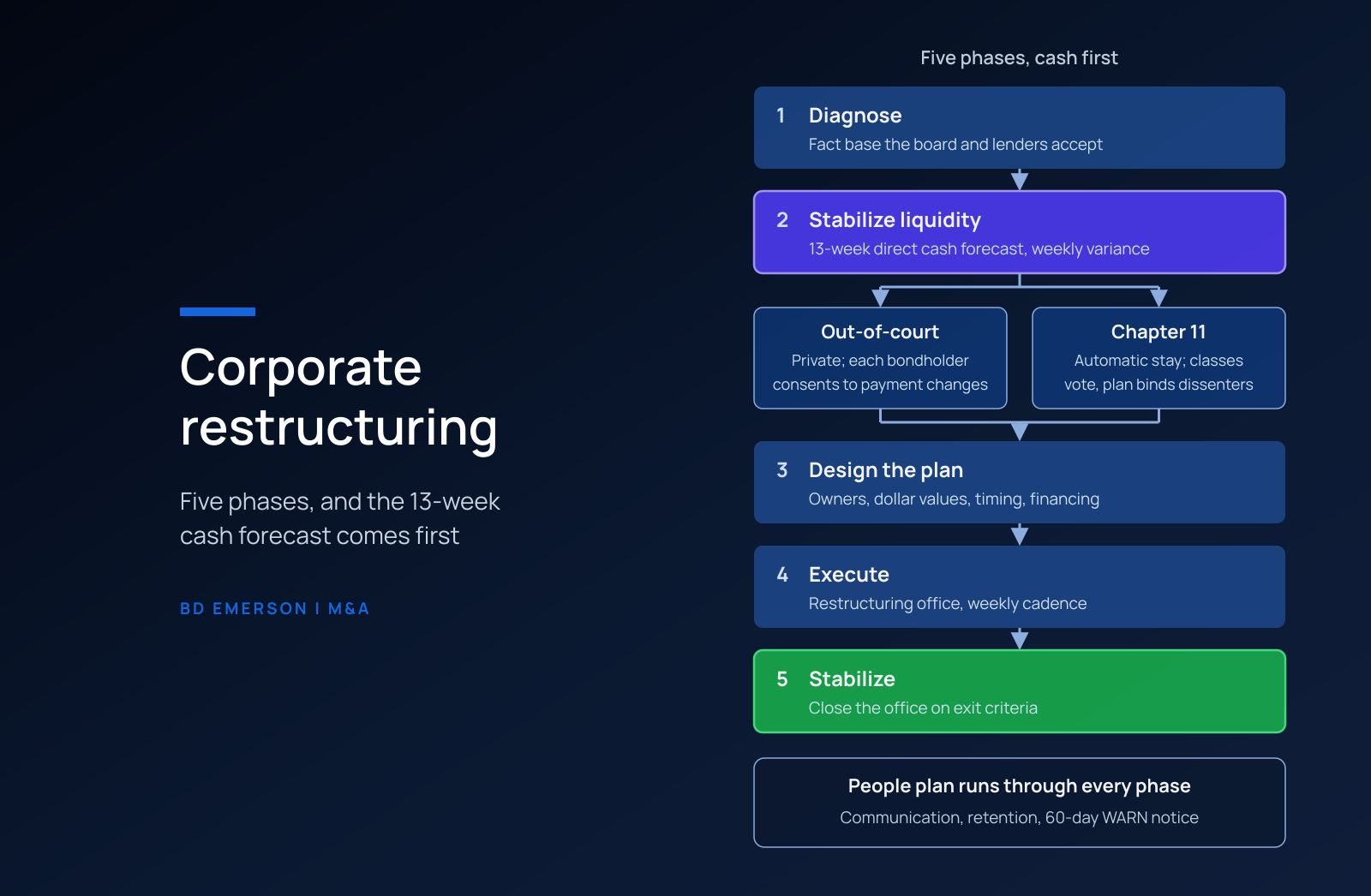
Corporate restructuring is a deliberate change to how a company operates, how it is organized, how it is financed or which businesses it owns, made to restore cash flow, profitability or strategic focus. There are four types: operational restructuring (cost base, sites and processes), organizational restructuring (structure, roles and headcount), financial restructuring (debt and equity) and portfolio restructuring (divestitures, carve-outs and spin-offs). The work runs in five phases: diagnose the problem, secure liquidity with a 13-week cash flow forecast, build the plan, execute it and stabilize the business. A company that cannot reach terms with its creditors out of court can reorganize under Chapter 11 of the U.S. Bankruptcy Code, which adds court oversight and its own rules on creditor votes, insider retention pay and disclosure.
What is corporate restructuring?
A restructuring starts when a company faces a gap that ordinary management cannot close inside the normal budget cycle. The trigger is usually one of four: a covenant test the company will fail next quarter, a debt maturity it cannot refinance, a segment that has lost money for several years, or an acquisition that never produced the savings in the deal model. Our piece on why mergers and acquisitions fail covers that last trigger.
Turnaround and restructuring overlap. A turnaround restores the operations and earnings of an underperforming business, while restructuring also covers the balance sheet, the legal entities and the portfolio. Most distressed companies need both, because cutting debt without fixing operations sends the company back to its lenders, and a turnaround stalls if cash runs out.
| Type | What changes | Common triggers |
|---|---|---|
| Operational | Cost base, sites, suppliers, processes, product lines | Margin decline, excess capacity, costs out of line with revenue |
| Organizational | Reporting lines, spans and layers, roles, headcount | Slow decisions, duplicated functions after a merger, a new strategy |
| Financial | Debt maturities, interest, covenants, equity | Covenant breach, refinancing risk, a cash shortfall |
| Portfolio | Which businesses the company owns | Non-core units, capital needed elsewhere, shareholder pressure |
For a sale or spin-off, our guide to the corporate divestiture process covers system separation and transition services.
The restructuring process from diagnosis to stabilization
Run a restructuring in five phases, in order. Skipping the diagnosis to rush into cost cuts is an expensive error, because cuts made without a fact base hit the wrong places.
- Diagnose. Build profitability by product, customer and site, measure how much of reported earnings converts to cash, and map the debt documents, maturities and covenants. The board and lenders must both accept the resulting fact base.
- Stabilize liquidity. Stand up the 13-week cash flow forecast, centralize cash approvals and take the quick actions that buy time.
- Design the plan. Set the initiatives, owners, dollar values, timing and one-time costs, and settle how the plan will be financed.
- Execute. Run the initiatives through a restructuring office on a weekly cadence and report progress to the board and lenders.
- Stabilize. Return the business to normal management routines once results hold, and close the restructuring office against defined exit criteria.
The restructuring office is a small team that reports to the CEO and keeps one integrated plan, one initiative register and one weekly meeting where owners report against their commitments.
Liquidity first: the 13-week cash flow forecast
The 13-week cash flow forecast is the working document of any restructuring. It covers one quarter in weekly columns and uses the direct method, forecasting cash receipts and disbursements rather than accrual earnings. It answers the question that sets the timeline for everything else: in which week does cash fall below the operating minimum?
Build it from the bank balances, the receivables aging, the payables aging, the payroll and benefits calendar, debt service dates, tax payments and committed capital spending. Each week, compare actuals to the forecast, explain every material variance and roll forward one week so the forecast always looks 13 weeks out. The variance report matters as much as the forecast, because lenders judge management's credibility on whether last week's numbers held.
The forecast also shows which cash actions are worth taking: collecting overdue receivables, releasing excess inventory, deferring capital projects that have not started, cutting discretionary spending and selling idle assets. Stretching supplier payments works only with honest supplier conversations, because a supplier surprised by a late payment often demands cash in advance. In Chapter 11, Section 363(c)(2) of the Bankruptcy Code bars the company from using cash collateral unless each party with an interest in it consents or the court authorizes it.
Out-of-court workout or Chapter 11: which path fits?
The choice of path is a legal and financial decision for counsel, the board and the company's financial advisors.
An out-of-court workout renegotiates debt privately through covenant waivers, forbearance agreements, amend-and-extend deals, debt-for-equity exchanges or exchange offers to bondholders. It is faster, cheaper and private, and it keeps management in control. Its weakness is consent. Section 316(b) of the Trust Indenture Act, codified at 15 U.S.C. 77ppp, says the right of a holder of a qualified indenture security to receive principal and interest when due cannot be impaired without that holder's consent. The statute lets an indenture authorize holders of at least 75 percent of principal to postpone an interest payment for up to three years. Outside that exception, a bondholder who does not consent keeps its right to principal and interest on the original due dates.
Chapter 11 changes the rules. The federal judiciary's Chapter 11 guide explains that filing triggers an automatic stay on collection actions, that the company usually continues as a debtor in possession, and that the debtor has a 120-day exclusive period to file a plan, extendable to no more than 18 months. A class of claims accepts a plan when creditors holding at least two-thirds in amount and more than one-half in number of the allowed claims voting in that class approve it, under 11 U.S.C. 1126(c). In a prepackaged case the company negotiates and solicits votes before it files. Subchapter V offers a simpler process for small businesses, and for cases filed on or after November 10, 2026, 11 U.S.C. 1182(1), as amended by Pub. L. 119-142, sets its debt limit at $7,500,000.
Large cases also use claims and noticing agents, which maintain the claims register and send the notices the court assigns to them. The Southern District of New York bankruptcy court lists Kroll Restructuring Administration LLC (formerly Prime Clerk LLC) and Epiq Corporate Restructuring, LLC among its approved agents.
| Factor | Out-of-court workout | Chapter 11 |
|---|---|---|
| Who must agree | Each affected creditor, subject to the amendment thresholds in the documents | Impaired classes vote, and a confirmed plan binds dissenters |
| Collection actions | Continue unless a forbearance agreement pauses them | Stopped by the automatic stay on filing |
| Control | Management and board, under lender covenants | Debtor in possession, under court oversight |
| Visibility | Private unless securities rules require disclosure | Public court docket |
| Insider retention pay | Set by the board, within any limits in the credit documents | Limited by Bankruptcy Code Section 503(c) |
What goes into a restructuring plan?
The restructuring plan is the business plan the board approves and the lenders underwrite, and in Chapter 11 it becomes the basis of the plan of reorganization. A plan that lenders will fund contains seven parts: a baseline signed off by finance, an initiative register with an owner, dollar value, one-time cost and cash timing for each initiative, a cash bridge from the current forecast to the target, the financing structure, the new organization design, the people and communication plan, and the governance and reporting the restructuring office will run.
For a public company, approving the plan can be a disclosure event. Under Item 2.05 of Form 8-K, when the board, a board committee or an authorized officer commits the company to an exit or disposal plan that will produce material charges, the company files within four business days. The filing gives the commitment date, a description of the action, the expected completion date and an estimate of costs by major type. If the company cannot estimate in good faith, it files an amendment within four business days after it can. The communication plan therefore has to be ready before the filing goes out, because employees and customers will read it.
The people side: communication, retention and WARN notice
Sequence the announcement, because employees, customers and suppliers hear it in the same week. Brief the board and lenders, then the leadership team, then the managers who will deliver the news, with scripts and answers to likely questions. Tell affected employees in person on the same day, then tell the people who remain what changes and why. Our guide to a change management communication plan covers sequencing and channels.
Layoffs bring legal notice duties. The Department of Labor's WARN Act guide says the federal law generally covers employers with 100 or more employees, not counting part-time employees (under 20 hours a week or under six months of the last 12), or with 100 or more employees, part-time included, who together work at least 4,000 hours a week. It requires 60 calendar days' notice before a plant closing or mass layoff. A mass layoff means 50 to 499 employees at a single site in any 30-day period who make up at least 33 percent of that site's workforce, or 500 or more employees regardless of percentage. Notice goes to affected employees or their representatives, the state dislocated worker unit and the chief elected official of the local government. An employer that violates the law owes back pay and benefits for up to 60 days. State laws can be stricter: New York's WARN law applies to private employers with 50 or more full-time employees in the state and requires 90 days' notice, with triggers starting at 25 employees. Confirm the thresholds in every state with affected staff, and have counsel check the count against 29 U.S.C. 2101 and 20 CFR Part 639 before setting dates.
Retention comes next. Identify the people the plan cannot lose, such as those who hold key customer relationships, run critical systems or produce the lender reporting, and tie their retention agreements to plan milestones. Chapter 11 tightly limits insider retention. Section 503(c)(1) of the Bankruptcy Code bars retention payments to insiders unless the court finds that the person has a bona fide job offer from another business at the same or greater pay, that the person's services are essential to the survival of the business, and that the payment stays within 10 times the mean of similar payments to nonmanagement employees that year, or 25 percent of a similar payment to that insider in the prior year if nonmanagement staff received none. Design these arrangements with counsel before any filing decision.
Stabilizing the business after the restructuring
The restructuring ends when results hold without the restructuring office pushing them. Set exit criteria in advance: cash above the operating minimum for a period the board sets, initiatives at full run rate in the P&L, the new organization working with written decision rights, and lender reporting run as a routine finance task.
Watch three things during stabilization. First, confirm that savings in the initiative register appear in monthly results, because costs creep back when managers rehire into eliminated roles. Second, remove the costs a sale or carve-out leaves behind, which our article on stranded costs after a divestiture covers. Third, track regretted attrition among the staff you chose to keep, open critical roles and employee survey results.
BD Emerson, part of Andersen Consulting since October 2026, works on restructurings as an advisor. Andersen Consulting offers operational and financial restructuring and turnaround advisory, and our organizational transformation consulting practice, delivered with Daniels Consulting Group, founded by organizational psychologist Amy Daniels, Ph.D., handles the people side: we diagnose how your organization responds to change, align the leadership team, equip managers to lead their teams and measure whether the new structure holds. We do not give legal advice or serve in court-appointed fiduciary roles, so we work alongside your restructuring counsel and your lenders' advisors.

About the author
















