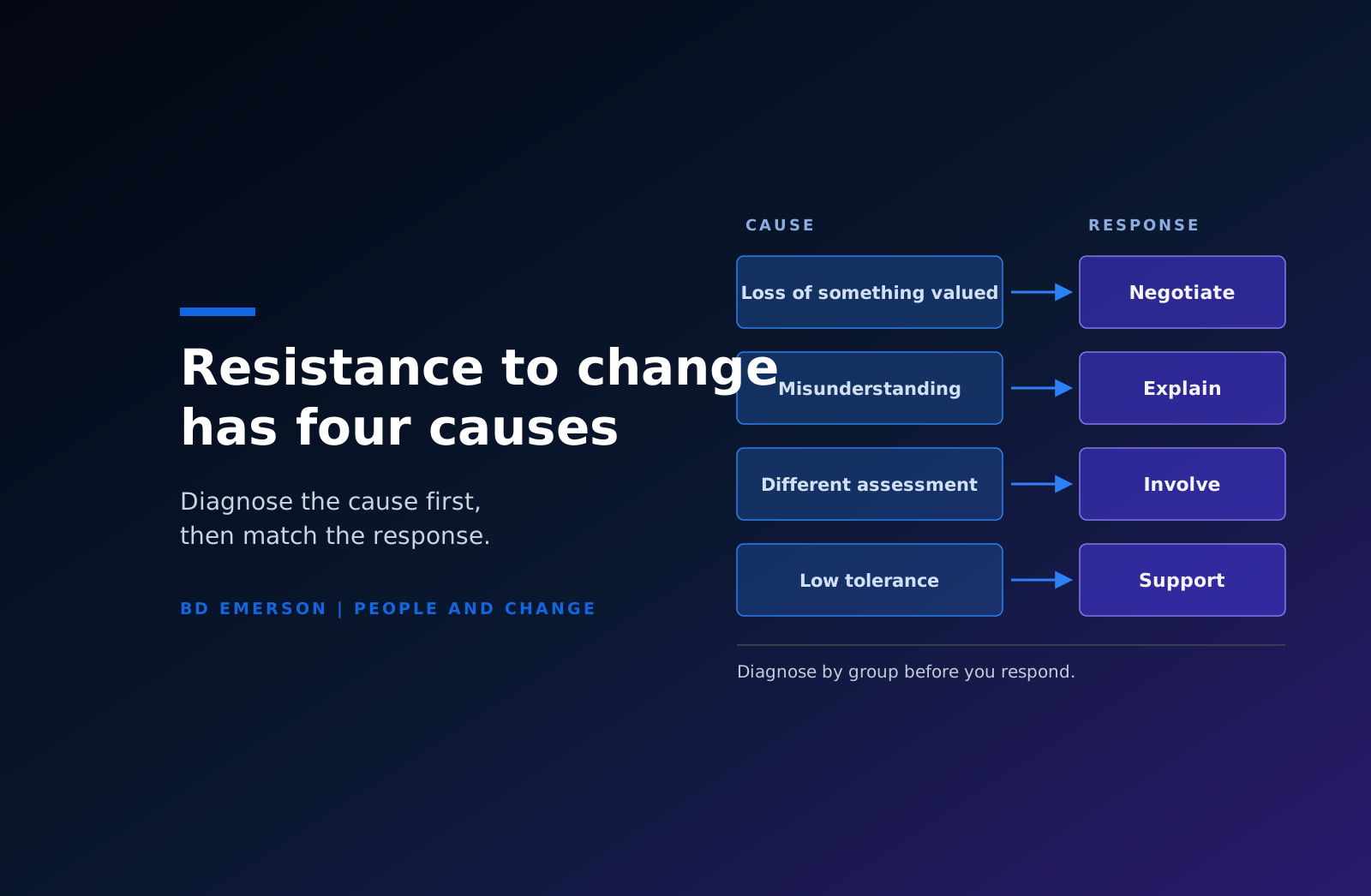
Transformational Change: What It Is and What Leaders Must Do Differently
What is transformational change?
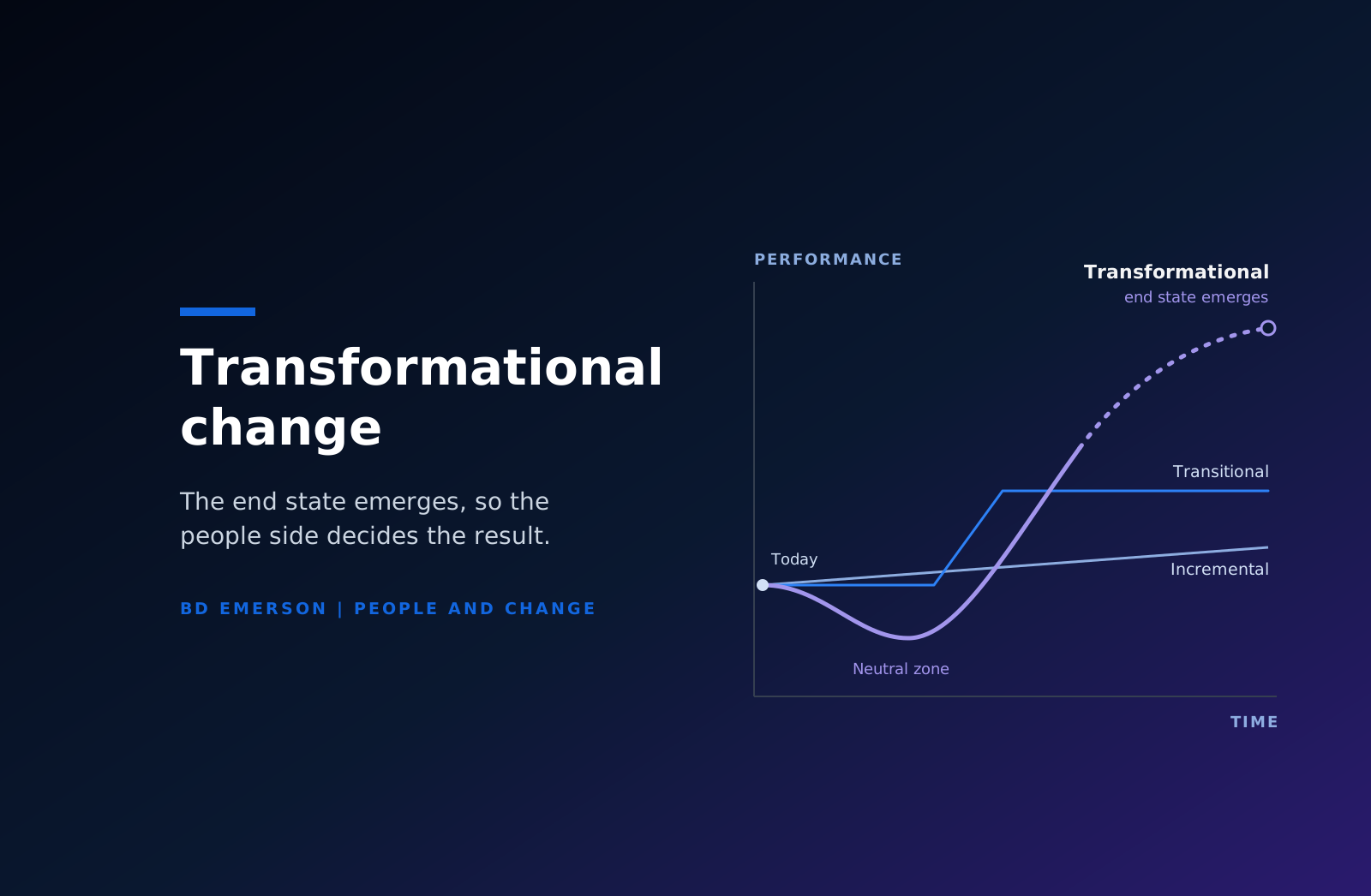
Transformational change is a shift in an organization's strategy, operating model, and culture that is large enough to require people to think and behave differently, and whose end state cannot be fully specified at the start. It differs from incremental change, which improves what already exists, and from transitional change, which replaces an old state with a known new one. A new strategy, a merger, a move to a different business model, and enterprise-wide adoption of AI are common triggers. The result depends on thousands of individual decisions to work in a new way, so the people side of the program determines whether the investment pays back.
The term comes from organization development research. W. Warner Burke and George Litwin's causal model of organizational performance and change, published in the Journal of Management in 1992, states that transformational change occurs as a response to the external environment and directly affects mission and strategy, leadership, and culture. Those three factors then shape what the authors call the transactional factors: structure, systems, management practices, and climate. The distinction tells a leadership team where the work sits. A reorganization or a system replacement touches the transactional layer. A transformation changes the purpose, the leadership behavior, and the shared assumptions that sit above that layer, and the transactional changes follow from them.
How does transformational change differ from incremental and transitional change?
The organization development literature separates developmental, transitional, and transformational change, a typology that began with an article in the OD Practitioner in 1985 and that treats each type as a different leadership task. Developmental change, which most executives call incremental change, improves skills, practices, and performance inside the current model. Transitional change fixes a problem by replacing structures, practices, or technology with a designed alternative, and it leaves the culture alone. Transformational change overhauls structure, practices, and culture together. The table below compares the three on the questions that matter when you plan the work.
| Question | Incremental change | Transitional change | Transformational change |
|---|---|---|---|
| What changes? | Skills, practices, and performance within the current model | Structures, practices, or technology | Strategy, structure, practices, and culture together |
| Is the end state known? | Yes. It is the current state, improved. | Yes. It is designed before the work starts. | In part. The direction is set and the details emerge as the organization learns. |
| What does it ask of people? | Do the current job better | Learn a new process, structure, or tool | Adopt new assumptions, behaviors, and ways of deciding |
| How is it managed? | Training and process improvement | A project plan with a defined cutover | A program that adjusts as it learns, led by the executive team |
| Example | Shortening the monthly close by two days | Replacing a payroll system | Moving a product company to a subscription business |
Two questions sort most programs into the right column. The first is whether you can draw the future state in detail today. If you can, the change is transitional, however large the budget. The second is whether the result depends on people holding different beliefs about customers, risk, authority, or what good work looks like. If it does, the change is transformational, and a project plan alone will deliver the new structure without the new behavior.
Large programs usually contain all three types. A transformation to shared services includes a transitional system migration and incremental improvements to individual processes. The label still matters because it sets the governance. Leaders who label a transformation as a transition tend to fix the scope early, delegate sponsorship to a project office, and declare success at go-live. The organization then runs the old habits on the new structure.
Why does the human side decide the outcome?
A company can buy technology and redraw an organization chart on a schedule it controls. It cannot buy the judgment calls that employees make each day, and those calls are where a transformation succeeds or stalls. A sales team that has been told to sell outcomes still chooses, on each call, whether to lead with the product. A plant manager who has been told that safety outranks output still chooses what to do when the line is behind. Transformational change is complete when those choices change without supervision.
William Bridges drew the line that explains why this takes more than a launch. His transition model defines change as the external event or situation and transition as the inner psychological process people go through as they come to terms with it. Transition has three phases. People first face endings and identify what they are losing. They then pass through a neutral zone, in which the old way is gone and the new way is not fully operational. New beginnings come last, when people take on new understandings and roles. In a transformation the endings are large. People give up expertise that took years to build, reporting lines that carried status, and an identity tied to how the company used to win.
The research on employee reactions points the same way. A review of 79 quantitative studies published between 1948 and 2007, written by Shaul Oreg, Maria Vakola, and Achilles Armenakis, grouped the antecedents of people's reactions to organizational change into five categories: the characteristics of the people affected, the internal context, the change process, the perceived benefit or harm, and the content of the change. Leaders control the process and the content, and they shape the context and the perceived benefit through what they say and do. Most of what drives employee reaction is therefore a leadership decision, and leaders make many of those decisions before the first announcement.
Do 70 percent of transformations fail?
The claim appears in many articles on this subject, and the evidence does not support it. Mark Hughes reviewed five published instances of the figure in the Journal of Change Management in 2011 and concluded that there is no valid and reliable empirical evidence for a 70 percent failure rate. We do not quote a failure rate for that reason. A leadership team gets more from asking which specific outcomes of its own program are at risk and what would have to be true for each one to hold. That question produces a list of named behaviors, groups, and decisions, and a list can be managed.
What is transformational change management?
Transformational change management is the planned work of helping people through a change in strategy, operating model, and culture. It uses the standard tools of change management, including stakeholder analysis, impact assessment, communications, training, and reinforcement. It adds five elements that a transitional project can run without.
- A shared case and direction. Every member of the executive team can state why the company is changing, what it is moving toward, and what has yet to be decided, in the same words.
- Defined behaviors. The program names the specific behaviors the new strategy requires and the current behaviors that have to stop, so that culture work has a target people can observe.
- Leadership alignment and development. Senior leaders agree on the trade-offs the strategy forces, and managers build the skills to lead teams through uncertainty.
- Planning in cycles. The plan sets a fixed direction and revisits the design at set points, because the organization learns what works only by trying it.
- Capacity management. Someone tracks the total load of change landing on each group and sequences the work so that critical teams are not asked to absorb everything at once.
The culture element deserves particular attention because it is the part most often left to slogans. Culture changes when the organization changes what it measures, rewards, promotes, and tolerates. Our culture transformation work with Daniels Consulting Group follows three steps for that reason: assess the current culture, define the culture the strategy needs, and activate it through leadership behavior and management systems.
What do leaders have to do differently?
Leaders run incremental and transitional change through delegation. They approve a business case, appoint a project manager, and review status. Transformational change removes that option, and it asks six things of the senior team.
Lead the change in person
The chief executive and the executive team sponsor the transformation directly. Employees read priority from where leaders spend their time, so the sponsor's calendar is part of the communication plan. A leader who announces the transformation and then returns to the previous agenda has told the organization that the change is optional.
Set direction and say what is still open
People can tolerate uncertainty when it is named. Leaders state what has been decided, what has yet to be decided, and when each open decision will be made. This is more credible than a detailed future-state design that the program will revise three times.
Change their own behavior first
The executive team is the first group that has to work in the new way. If the strategy calls for decisions closer to the customer, executives stop reviewing decisions they have delegated. If it calls for collaboration across business units, executives share budget and talent across them. Employees take leadership behavior as the real statement of the strategy.
Resolve the trade-offs at the top
Every transformation forces choices between growth and margin, speed and control, or one business unit's priorities and another's. When the executive team leaves those choices unresolved, each function resolves them in its own favor and the program fragments. Leadership development for a transformation starts with the top team working those trade-offs through until each member will defend the same answer.
Equip middle managers
Middle managers translate the strategy into the daily work of their teams, and they are also asked to change their own roles. They need the reasoning behind decisions, the authority to adapt the change to local conditions, and practice in holding hard conversations. A manager who learns about a change at the same time as the team cannot lead the team through it.
End the old way on purpose
New behaviors compete with old ones until the old ones are retired. Leaders close the forums, reports, metrics, and incentives that belonged to the previous model, and they acknowledge what people are losing when those things go. An explicit ending lets people stop defending the past.
How do you know a transformation is taking hold?
Milestones show that the program is busy. Four other measures show that the organization is changing. Alignment measures test whether leaders give consistent answers about priorities and trade-offs. Understanding measures test whether employees can explain what is changing and what it means for their work. Adoption measures count how many people in each affected group are using the new processes and showing the defined behaviors. Outcome measures track the business results the transformation was meant to produce. Reviewing all four on a regular schedule lets the executive team adjust the plan while the adjustment is still cheap.
How long the work takes depends on how far the new strategy sits from the current culture, how many groups are affected, how aligned the executive team is at the start, and how much other change the organization is carrying.
BD Emerson delivers this work with our Andersen Consulting colleagues at Daniels Consulting Group, a firm of organizational psychologists and experienced business professionals founded in 2002 by Amy Daniels, Ph.D. If your organization is planning a transformation or is partway through one that has stalled, see our organizational transformation consulting service and book a consultation.

About the author